<?xml version="1.0" encoding="utf-8"?>
<feed xmlns="http://www.w3.org/2005/Atom">
    <id>https://mlflow.org/articles/</id>
    <title>MLflow Blog</title>
    <updated>2026-07-31T00:00:00.000Z</updated>
    <generator>https://github.com/jpmonette/feed</generator>
    <link rel="alternate" href="https://mlflow.org/articles/"/>
    <subtitle>MLflow Blog</subtitle>
    <icon>https://mlflow.org/img/mlflow-favicon.ico</icon>
    <entry>
        <title type="html"><![CDATA[Why Standardize AI Workflows for Enterprise MLops]]></title>
        <id>https://mlflow.org/articles/why-standardize-ai-workflows/</id>
        <link href="https://mlflow.org/articles/why-standardize-ai-workflows/"/>
        <updated>2026-07-31T00:00:00.000Z</updated>
        <summary type="html"><![CDATA[Discover why standardizing AI workflows is crucial for effective enterprise MLOps. Learn how it enhances reliability and reduces costs.]]></summary>
        <content type="html"><![CDATA[<p><img decoding="async" loading="lazy" src="https://csuxjmfbwmkxiegfpljm.supabase.co/storage/v1/object/public/blog-images/organization-30814/1785471865748_Data-engineer-organizing-AI-workflow-diagrams.jpeg" alt="Data engineer organizing AI workflow diagrams" class="img_ev3q"></p>
<p>Standardizing AI workflows converts experimental GenAI into reliable, auditable production systems. Without a shared foundation, every team reinvents context delivery, evaluation criteria, and tracing schemas, and the result is exception sprawl that compounds with every new pilot. The minimal set of standards that deliver immediate value: identity and access posture, a context and metadata layer, model and prompt registries, evaluation and acceptance criteria, and a unified observability schema.</p>
<p><strong>Pro Tip:</strong> <em>Freeze a small set of platform-level building blocks before you scale pilots. Adding standards retroactively costs three to five times more in engineering effort than defining them upfront.</em></p>
<h2 class="anchor anchorTargetStickyNavbar_Vzrq" id="table-of-contents">Table of Contents<a href="https://mlflow.org/articles/why-standardize-ai-workflows/#table-of-contents" class="hash-link" aria-label="Direct link to Table of Contents" title="Direct link to Table of Contents" translate="no">​</a></h2>
<ul>
<li class=""><a href="https://mlflow.org/articles/why-standardize-ai-workflows/#why-standardize-ai-workflows-before-scaling-pilots" class="">Why standardize AI workflows before scaling pilots</a></li>
<li class=""><a href="https://mlflow.org/articles/why-standardize-ai-workflows/#what-does-standardizing-ai-workflows-actually-deliver" class="">What does standardizing AI workflows actually deliver?</a></li>
<li class=""><a href="https://mlflow.org/articles/why-standardize-ai-workflows/#how-do-you-implement-ai-workflow-standards-without-slowing-teams-down" class="">How do you implement AI workflow standards without slowing teams down?</a></li>
<li class=""><a href="https://mlflow.org/articles/why-standardize-ai-workflows/#what-technical-architecture-enforces-ai-workflow-standards" class="">What technical architecture enforces AI workflow standards?</a></li>
<li class=""><a href="https://mlflow.org/articles/why-standardize-ai-workflows/#how-does-governance-align-with-isoiec-42001-and-audit-requirements" class="">How does governance align with ISO/IEC 42001 and audit requirements?</a></li>
<li class=""><a href="https://mlflow.org/articles/why-standardize-ai-workflows/#what-pitfalls-should-you-watch-for-when-introducing-ai-standards" class="">What pitfalls should you watch for when introducing AI standards?</a></li>
<li class=""><a href="https://mlflow.org/articles/why-standardize-ai-workflows/#how-does-mlflow-map-to-these-standards-in-practice" class="">How does Mlflow map to these standards in practice?</a></li>
<li class=""><a href="https://mlflow.org/articles/why-standardize-ai-workflows/#key-takeaways" class="">Key Takeaways</a></li>
<li class=""><a href="https://mlflow.org/articles/why-standardize-ai-workflows/#the-political-reality-of-platform-standards" class="">The political reality of platform standards</a></li>
<li class=""><a href="https://mlflow.org/articles/why-standardize-ai-workflows/#mlflow-gives-your-team-a-production-ready-standards-foundation" class="">Mlflow gives your team a production-ready standards foundation</a></li>
<li class=""><a href="https://mlflow.org/articles/why-standardize-ai-workflows/#useful-sources-and-further-reading" class="">Useful sources and further reading</a></li>
</ul>
<h2 class="anchor anchorTargetStickyNavbar_Vzrq" id="why-standardize-ai-workflows-before-scaling-pilots">Why standardize AI workflows before scaling pilots<a href="https://mlflow.org/articles/why-standardize-ai-workflows/#why-standardize-ai-workflows-before-scaling-pilots" class="hash-link" aria-label="Direct link to Why standardize AI workflows before scaling pilots" title="Direct link to Why standardize AI workflows before scaling pilots" translate="no">​</a></h2>
<p>CAISI field notes frame the core principle clearly: treat AI as a platform capability before you scale it as a business capability. That posture means centralizing what must be common and allowing controlled variation everywhere else.</p>
<p>The items that must be standardized fall into eight categories:</p>
<ul>
<li class=""><strong>Identity and access posture</strong> — which principals can invoke which models, tools, and data sources; prevents unauthorized model calls and credential leakage</li>
<li class=""><strong>Context and semantic layer</strong> — a shared business glossary and canonical data sources that agents query; prevents twelve business units from maintaining twelve inconsistent context stores</li>
<li class=""><strong>Model registry</strong> — versioned model artifacts with provenance metadata; enables reproducible runs and rollback</li>
<li class=""><strong>Prompt registry</strong> — versioned prompt templates with owner, purpose, and linked evaluation results; separates content from acceptance criteria</li>
<li class=""><strong>Evaluation and acceptance criteria</strong> — explicit pass/fail thresholds for output quality, latency, and safety; a prompt is not a standard until acceptance gates are defined</li>
<li class=""><strong>Observability and tracing schema</strong> — unified span attributes across all agents and pipelines; without this, debugging becomes what practitioners call "AI archaeology"</li>
<li class=""><strong>Deployment and CI/CD environment rules</strong> — environment-aware configuration, secrets management, and promotion gates</li>
<li class=""><strong>Evidence and audit records</strong> — immutable logs of who acted, on what input, with which model version, and what policy verdict was returned</li>
</ul>
<table><thead><tr><th>Item</th><th>Purpose</th><th>Minimum fields</th></tr></thead><tbody><tr><td>Identity and access</td><td>Prevent unauthorized invocations</td><td>Principal, scope, credential TTL</td></tr><tr><td>Context endpoint</td><td>Consistent semantic grounding</td><td>Source ID, version, freshness timestamp</td></tr><tr><td>Model registry</td><td>Reproducibility and rollback</td><td>Model ID, version, artifact hash, lineage</td></tr><tr><td>Prompt registry</td><td>Prompt governance and versioning</td><td>Prompt ID, version, owner, eval link</td></tr><tr><td>Evaluation criteria</td><td>Trusted output gates</td><td>Metric name, threshold, pass/fail, evaluator</td></tr><tr><td>Tracing schema</td><td>Unified observability</td><td>Trace ID, span type, latency, token count</td></tr><tr><td>Audit record</td><td>Regulatory evidence</td><td>Actor, input hash, model version, output, verdict</td></tr></tbody></table>
<p>Standardizing tracing, evaluation, and guardrails delivers the highest near-term value as the number of AI systems grows.</p>
<p><img decoding="async" loading="lazy" src="https://csuxjmfbwmkxiegfpljm.supabase.co/storage/v1/object/public/blog-images/organization-30814/1785471869867_Hands-marking-AI-governance-checklist.jpeg" alt="Hands marking AI governance checklist" class="img_ev3q"></p>
<h2 class="anchor anchorTargetStickyNavbar_Vzrq" id="what-does-standardizing-ai-workflows-actually-deliver">What does standardizing AI workflows actually deliver?<a href="https://mlflow.org/articles/why-standardize-ai-workflows/#what-does-standardizing-ai-workflows-actually-deliver" class="hash-link" aria-label="Direct link to What does standardizing AI workflows actually deliver?" title="Direct link to What does standardizing AI workflows actually deliver?" translate="no">​</a></h2>
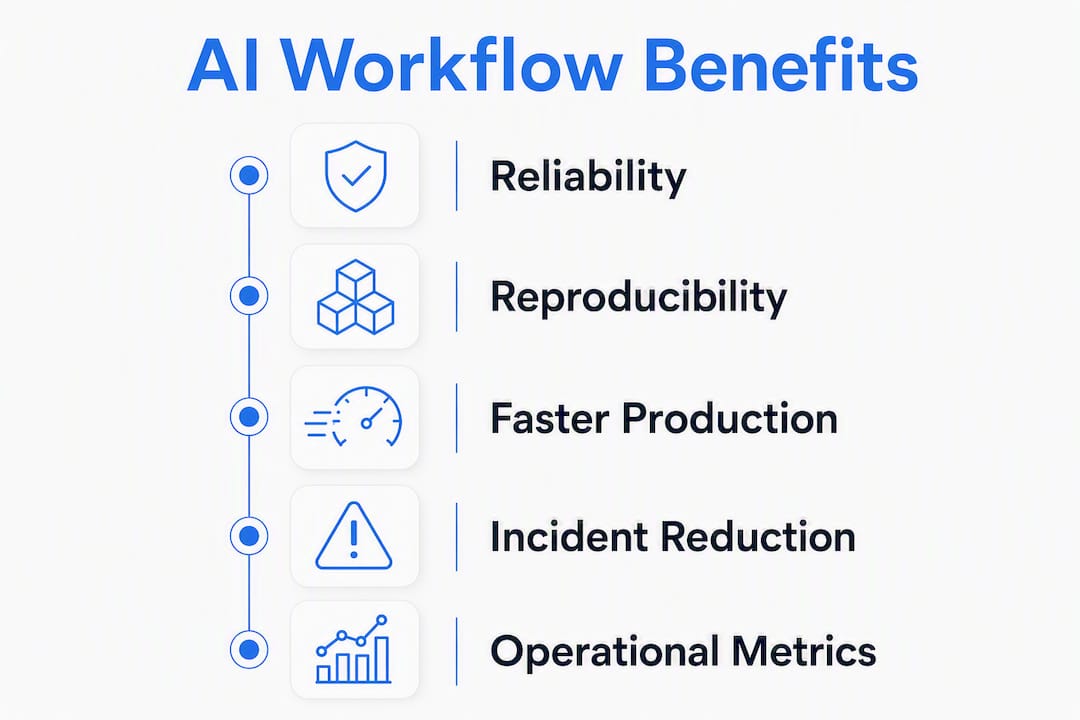
<p>The business case maps directly to operational metrics your platform sponsors already track.</p>
<p><img decoding="async" loading="lazy" src="https://csuxjmfbwmkxiegfpljm.supabase.co/storage/v1/object/public/blog-images/organization-30814/1785472329170_Infographic-showing-key-benefits-of-AI-workflow-standardization.jpeg" alt="Infographic showing key benefits of AI workflow standardization" class="img_ev3q"></p>
<p><strong>Reliability and incident reduction.</strong> Unified tracing means every agent run produces a queryable span tree. When a production incident occurs, you locate the failing component in minutes, not days. Non-deterministic AI systems have hidden state: prompts, model versions, sampled outputs. Standardized tracing reduces the cost of surfacing that state dramatically.</p>
<p><strong>Reproducibility.</strong> Declaring model and prompt versions in configuration, as engineering discipline requires, means any run can be replayed with identical inputs. That is the difference between a demo and a production system.</p>
<p><strong>Faster time-to-production.</strong> Teams that share a context endpoint, a model registry, and a CI/CD promotion gate stop rebuilding the same scaffolding for every new use case. Onboarding a new agent drops from weeks to days.</p>
<p><strong>Regulatory readiness.</strong> Audit records that capture actor, input, model version, output, and policy verdict satisfy the evidence requirements that regulators and internal risk teams request. <a href="https://blog.ansi.org/ansi/why-should-organizations-adhere-to-ai-standards/" target="_blank" rel="noopener noreferrer" class="">ISO/IEC 42001</a> provides a recognized governance framework that auditors accept.</p>
<p><strong>Lower exception volume.</strong> Rising exception counts are a leading indicator that standards are missing or ambiguous. Measuring exception volume as a KPI gives platform teams an early warning signal before incidents escalate.</p>
<blockquote>
<p>"Standards provide a common basis that helps balance rapid innovation with governance and makes decision processes more transparent, building accountability and public trust." — ANSI commentary on ISO/IEC AI standards</p>
</blockquote>
<p>Track these metrics per phase: mean time to resolution (MTTR) for AI incidents, regression-fail rate across model updates, time-to-deploy for new agents, and exception count per sprint.</p>
<h2 class="anchor anchorTargetStickyNavbar_Vzrq" id="how-do-you-implement-ai-workflow-standards-without-slowing-teams-down">How do you implement AI workflow standards without slowing teams down?<a href="https://mlflow.org/articles/why-standardize-ai-workflows/#how-do-you-implement-ai-workflow-standards-without-slowing-teams-down" class="hash-link" aria-label="Direct link to How do you implement AI workflow standards without slowing teams down?" title="Direct link to How do you implement AI workflow standards without slowing teams down?" translate="no">​</a></h2>
<p>A four-phase roadmap keeps standards minimal and iterative.</p>
<ol>
<li class=""><strong>Assess (Days 1–30):</strong> Inventory all active AI pilots. Count exception volume per use case. Identify which teams share no context, tracing, or evaluation infrastructure. Assign a platform owner and a security reviewer to each pilot.</li>
<li class=""><strong>Define (Days 30–60):</strong> Draft minimal data contracts for the eight items above. Define two to three acceptance criteria per use case. Document the context endpoint schema and the tracing span attributes. Keep standards to one page per domain.</li>
<li class=""><strong>Pilot (Days 60–90):</strong> Apply standards to one or two high-value use cases. Measure exception volume before and after. Validate that the model registry, prompt registry, and tracing pipeline produce the expected artifacts. Collect feedback from the BU pilot lead.</li>
<li class=""><strong>Scale (Days 90–180):</strong> Adopt a federated governance model. Central platform teams own the shared context endpoint, model registry, and tracing schema. Business units own delivery and can vary their tooling within those guardrails.</li>
</ol>
<table><thead><tr><th>Phase</th><th>Owner</th><th>Deliverable</th><th>Checkpoint</th></tr></thead><tbody><tr><td>Assess</td><td>Platform owner</td><td>Exception inventory, pilot map</td><td>Day 30</td></tr><tr><td>Define</td><td>Security reviewer + platform owner</td><td>Data contracts, tracing schema</td><td>Day 60</td></tr><tr><td>Pilot</td><td>BU pilot lead</td><td>Instrumented use case, eval results</td><td>Day 90</td></tr><tr><td>Scale</td><td>Platform owner + BU leads</td><td>Federated governance model</td><td>Day 180</td></tr></tbody></table>
<p><strong>Pro Tip:</strong> <em>Measure exception volume weekly during the pilot phase. A flat or declining count confirms your standards are specific enough. A rising count means a standard is still too vague or missing entirely.</em></p>
<h2 class="anchor anchorTargetStickyNavbar_Vzrq" id="what-technical-architecture-enforces-ai-workflow-standards">What technical architecture enforces AI workflow standards?<a href="https://mlflow.org/articles/why-standardize-ai-workflows/#what-technical-architecture-enforces-ai-workflow-standards" class="hash-link" aria-label="Direct link to What technical architecture enforces AI workflow standards?" title="Direct link to What technical architecture enforces AI workflow standards?" translate="no">​</a></h2>
<p>Five components form the reference architecture. Each maps to a specific failure mode the standards above are designed to prevent.</p>
<ul>
<li class=""><strong>Context endpoint (MCP-style server):</strong> A single service that agents query for business glossary terms, canonical data sources, and metadata. Shared infrastructure for context lets business units adopt different agent frameworks while preserving consistency and auditability.</li>
<li class=""><strong>Model and prompt registry:</strong> Versioned stores for model artifacts and prompt templates. During a CI/CD promotion, the pipeline reads the registered model ID and prompt version, runs acceptance criteria, and blocks promotion on failure.</li>
<li class=""><strong>AI gateway:</strong> A cross-provider control plane that enforces prompt policies, rate limits, credential rotation, and cost attribution before requests reach any model provider. This is where <a href="https://mlflow.org/articles/tags/centralized-ai-model-access-control" target="_blank" rel="noopener noreferrer" class="">centralized AI model access control</a> is applied at runtime.</li>
<li class=""><strong>Observability and tracing pipeline:</strong> Every agent span, tool call, and LLM invocation emits a structured trace with a canonical schema. Telemetry flows to a queryable store so platform teams can correlate latency, token usage, and output quality across runs.</li>
<li class=""><strong>Model inventory and lifecycle manager:</strong> Tracks model risk classification, approval status, re-validation dates, and deprecation schedules. Connects to the CI/CD pipeline to gate deployments on approval state.</li>
</ul>
<p>Integration notes: connect your secrets store to the AI gateway for credential injection; wire the tracing pipeline to your existing observability platform via OpenTelemetry; trigger evaluation runs from CI/CD on every model or prompt version bump.</p>
<h2 class="anchor anchorTargetStickyNavbar_Vzrq" id="how-does-governance-align-with-isoiec-42001-and-audit-requirements">How does governance align with ISO/IEC 42001 and audit requirements?<a href="https://mlflow.org/articles/why-standardize-ai-workflows/#how-does-governance-align-with-isoiec-42001-and-audit-requirements" class="hash-link" aria-label="Direct link to How does governance align with ISO/IEC 42001 and audit requirements?" title="Direct link to How does governance align with ISO/IEC 42001 and audit requirements?" translate="no">​</a></h2>
<p><a href="https://www.iso.org/sectors/it-technologies/ai" target="_blank" rel="noopener noreferrer" class="">ISO/IEC 42001</a> establishes an AI management system standard that auditors and regulators increasingly reference. Aligning your platform standards to it reduces regulatory friction because the evidence artifacts you already produce map directly to its requirements.</p>
<p>Governance artifacts to require on every production AI system:</p>
<ul>
<li class="">Evidence record per inference run: actor identity, input hash, model version, output, policy verdict, timestamp</li>
<li class="">Model risk classification: low/medium/high based on data sensitivity and decision impact</li>
<li class="">Approval workflow: sign-off from security reviewer and risk owner before production promotion</li>
<li class="">Periodic re-validation gate: scheduled re-evaluation against acceptance criteria after model updates or data drift events</li>
<li class="">Audit log retention: immutable, tamper-evident storage for the period your compliance team specifies</li>
</ul>
<p>AI standards bridge regulatory gaps and create transparent decision-making paths that build accountability. A platform that produces these artifacts automatically, rather than requiring engineers to assemble them manually, is the practical payoff of standardization.</p>
<p><strong>Pro Tip:</strong> <em>Map each governance artifact to a specific ISO/IEC 42001 clause during your define phase. That mapping becomes your audit response package and saves days of evidence collection when a review arrives.</em></p>
<p>For <a href="https://blog.papersynapse.com/blog/systematic-review-quality-checklist" target="_blank" rel="noopener noreferrer" class="">systematic evidence capture</a>, treat audit records as first-class pipeline outputs, not afterthoughts.</p>
<h2 class="anchor anchorTargetStickyNavbar_Vzrq" id="what-pitfalls-should-you-watch-for-when-introducing-ai-standards">What pitfalls should you watch for when introducing AI standards?<a href="https://mlflow.org/articles/why-standardize-ai-workflows/#what-pitfalls-should-you-watch-for-when-introducing-ai-standards" class="hash-link" aria-label="Direct link to What pitfalls should you watch for when introducing AI standards?" title="Direct link to What pitfalls should you watch for when introducing AI standards?" translate="no">​</a></h2>
<p><strong>Standardizing tools instead of context.</strong> Mandating a single LLM provider or agent framework kills adoption. Standardize the interfaces and data contracts; let teams pick their implementation.</p>
<p><strong>Starting too late.</strong> Standards applied after ten pilots are in production require retroactive instrumentation. The political cost is high and the coverage is always incomplete. Start during the first pilot.</p>
<p><strong>Over-broad standards that block innovation.</strong> A standard that specifies more than the minimum necessary fields becomes a bottleneck. Keep each standard to the smallest contract that prevents the failure mode it targets, then extend iteratively.</p>
<p><strong>Missing observability and acceptance criteria.</strong> Shipping an agent without a tracing schema and explicit pass/fail thresholds means you cannot tell whether it is working. This is the most common gap in early-stage enterprise GenAI programs.</p>
<p><strong>Negotiating with product teams:</strong> Frame standards as shared infrastructure that reduces their toil, not as compliance overhead. Show the before/after exception count from your pilot. Offer to own the platform components so product teams only consume them.</p>
<ol>
<li class="">Identify the failure mode each standard prevents.</li>
<li class="">Write the minimal data contract that addresses it.</li>
<li class="">Pilot with one team, measure exception volume, and publish results.</li>
<li class="">Use those results as the business case for broader adoption.</li>
</ol>
<h2 class="anchor anchorTargetStickyNavbar_Vzrq" id="how-does-mlflow-map-to-these-standards-in-practice">How does Mlflow map to these standards in practice?<a href="https://mlflow.org/articles/why-standardize-ai-workflows/#how-does-mlflow-map-to-these-standards-in-practice" class="hash-link" aria-label="Direct link to How does Mlflow map to these standards in practice?" title="Direct link to How does Mlflow map to these standards in practice?" translate="no">​</a></h2>
<p>Mlflow's capabilities correspond directly to the eight standardization items above.</p>
<ul>
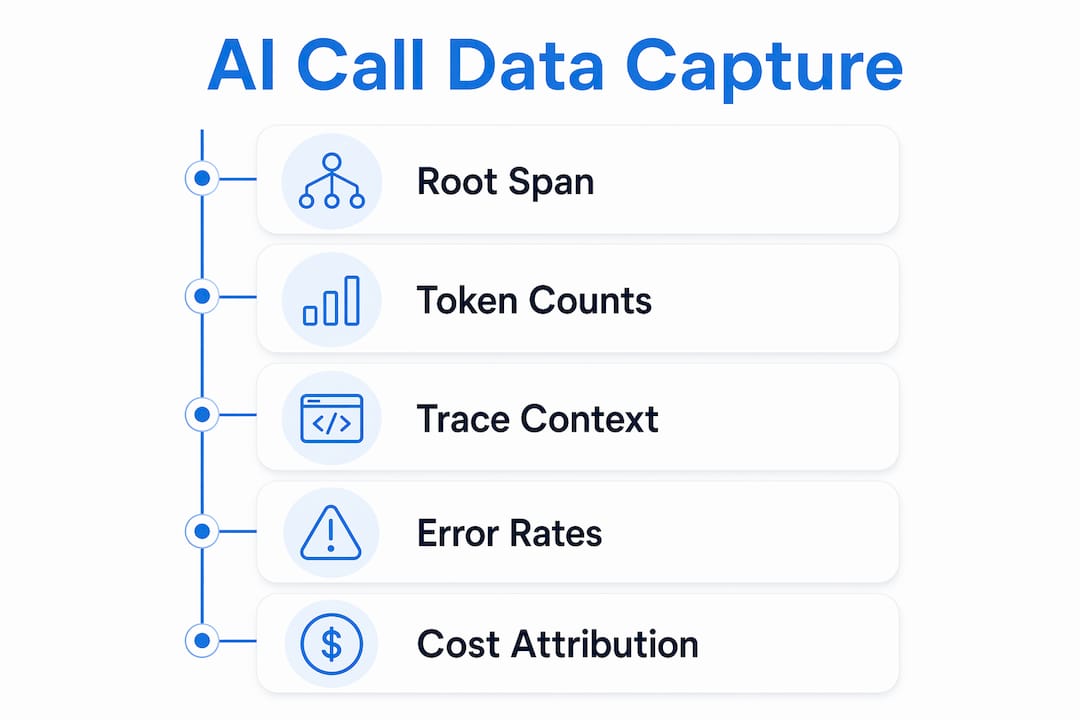
<li class=""><strong>Observability and tracing:</strong> Mlflow's <a href="https://mlflow.org/ai-observability" target="_blank" rel="noopener noreferrer" class="">AI observability</a> provides deep agentic reasoning traces, capturing every span, tool call, and token count with a structured schema that feeds directly into the unified tracing pipeline described above.</li>
<li class=""><strong>Prompt registry:</strong> The <a href="https://mlflow.org/prompt-registry" target="_blank" rel="noopener noreferrer" class="">prompt registry</a> versions prompt templates with owner metadata and links each version to its evaluation results, separating content from acceptance criteria.</li>
<li class=""><strong>Model registry:</strong> Mlflow's model registry stores versioned artifacts with lineage, approval state, and deployment history, giving the lifecycle manager its source of truth.</li>
<li class=""><strong>AI gateway:</strong> The centralized AI Gateway enforces cross-provider controls, credential rotation, and prompt policies at runtime, covering the access posture and policy enforcement requirements.</li>
<li class=""><strong>Evaluation:</strong> LLM-as-a-Judge evaluation runs automatically on model and prompt version bumps, producing the acceptance-criteria verdicts that gate CI/CD promotions.</li>
</ul>
<p>For platform engineers: wire Mlflow's tracing SDK into your existing OpenTelemetry pipeline, register your context endpoint as a custom dependency, and configure the AI Gateway as the single egress point for all model provider calls.</p>
<p><strong>Pro Tip:</strong> <em>Start with Mlflow tracing on your highest-traffic agent. The span data you collect in the first two weeks will reveal which model versions, prompt versions, and tool calls account for the majority of latency and errors, giving you a prioritized list of what to standardize next.</em></p>
<h2 class="anchor anchorTargetStickyNavbar_Vzrq" id="key-takeaways">Key Takeaways<a href="https://mlflow.org/articles/why-standardize-ai-workflows/#key-takeaways" class="hash-link" aria-label="Direct link to Key Takeaways" title="Direct link to Key Takeaways" translate="no">​</a></h2>
<p>Standardizing AI workflows is the fastest path from experimental GenAI to reliable, auditable production systems that satisfy governance requirements and scale without exception sprawl.</p>
<table><thead><tr><th>Point</th><th>Details</th></tr></thead><tbody><tr><td>Freeze standards early</td><td>Define minimal data contracts before scaling pilots to avoid costly retroactive instrumentation.</td></tr><tr><td>Measure exception volume</td><td>Rising exception counts signal missing or vague standards; track this weekly as a leading KPI.</td></tr><tr><td>Federated governance scales</td><td>Central teams own shared interfaces; business units own delivery within those guardrails.</td></tr><tr><td>ISO/IEC 42001 alignment</td><td>Producing evidence records, risk classifications, and audit logs maps directly to recognized governance frameworks.</td></tr><tr><td>Mlflow covers the stack</td><td>Mlflow's tracing, prompt registry, model registry, AI Gateway, and LLM-as-a-Judge evaluation address all eight standardization domains.</td></tr></tbody></table>
<h2 class="anchor anchorTargetStickyNavbar_Vzrq" id="the-political-reality-of-platform-standards">The political reality of platform standards<a href="https://mlflow.org/articles/why-standardize-ai-workflows/#the-political-reality-of-platform-standards" class="hash-link" aria-label="Direct link to The political reality of platform standards" title="Direct link to The political reality of platform standards" translate="no">​</a></h2>
<p>The hardest part of introducing AI workflow standards is not the architecture. It is convincing twelve product teams that a shared context endpoint is worth the coordination cost. My rule: never propose a standard without showing the failure mode it prevents and the exception count it reduces. Data from a two-week pilot is more persuasive than any governance framework document.</p>
<p>The platform-first posture works because it separates what must be common from what can vary. Centralize the context layer, the tracing schema, and the evaluation gates. Let teams choose their agent frameworks, their LLM providers, and their prompt styles within those guardrails. That controlled variation is not a weakness in the standard; it is what makes adoption politically viable. The teams that resist standards the hardest are usually the ones rebuilding the same context store for the third time. Show them the shared endpoint and they tend to come around quickly.</p>
<h2 class="anchor anchorTargetStickyNavbar_Vzrq" id="mlflow-gives-your-team-a-production-ready-standards-foundation">Mlflow gives your team a production-ready standards foundation<a href="https://mlflow.org/articles/why-standardize-ai-workflows/#mlflow-gives-your-team-a-production-ready-standards-foundation" class="hash-link" aria-label="Direct link to Mlflow gives your team a production-ready standards foundation" title="Direct link to Mlflow gives your team a production-ready standards foundation" translate="no">​</a></h2>
<p>The gap between a working GenAI demo and a production system that satisfies your security team, your compliance team, and your on-call engineers is exactly the gap that Mlflow is built to close. Mlflow's open-source platform covers observability with deep agentic tracing, a versioned prompt registry with evaluation links, a centralized AI Gateway for cross-provider governance, and a model registry with full lifecycle management. Teams that adopt Mlflow as their platform foundation skip months of custom instrumentation and get audit-ready artifacts from day one.</p>
<p><img decoding="async" loading="lazy" src="https://csuxjmfbwmkxiegfpljm.supabase.co/storage/v1/object/public/blog-images/organization-30814/1778726621079_mlflow.jpg" alt="Mlflow" class="img_ev3q"></p>
<p>Evaluate Mlflow's <a href="https://mlflow.org/genai" target="_blank" rel="noopener noreferrer" class="">GenAI and agent engineering platform</a> to see how its capabilities map to the standards your team needs to enforce before the next pilot goes to production.</p>
<h2 class="anchor anchorTargetStickyNavbar_Vzrq" id="useful-sources-and-further-reading">Useful sources and further reading<a href="https://mlflow.org/articles/why-standardize-ai-workflows/#useful-sources-and-further-reading" class="hash-link" aria-label="Direct link to Useful sources and further reading" title="Direct link to Useful sources and further reading" translate="no">​</a></h2>
<p><strong>Governance and standards</strong></p>
<ul>
<li class="">ISO/IEC AI standards overview — ISO's AI management system standards, including ISO/IEC 42001</li>
<li class="">ANSI: Why organizations should adhere to AI standards — Connects standards adoption to governance, accountability, and public trust</li>
<li class=""><a href="https://nvlpubs.nist.gov/nistpubs/gcr/2026/NIST.GCR.26-069.pdf" target="_blank" rel="noopener noreferrer" class="">NIST: A Possible Approach for Evaluating AI Standards Development</a> — Framework for measuring the impact of AI standards on innovation and trust</li>
<li class=""><a href="https://journals.library.columbia.edu/index.php/stlr/article/view/14862" target="_blank" rel="noopener noreferrer" class="">The Role of Standards in Enabling the AI Stack</a> — Columbia Science and Technology Law Review analysis of standards as enabling infrastructure</li>
</ul>
<p><strong>Architecture and implementation playbooks</strong></p>
<ul>
<li class="">CAISI: What Platform Teams Must Standardize Before AI Can Scale — Field notes on identity, evidence, validation, and exception volume as platform KPIs</li>
<li class="">Atlan: How to Standardize AI Tooling Across Business Units — MCP server pattern and federated governance for context standardization</li>
<li class="">The Underestimated Challenge of Production AI: Standardized Components — Practitioner analysis prioritizing tracing, evaluation, and guardrails</li>
<li class="">Generative AI workflows need engineering discipline to scale beyond the demo — Case write-ups on reproducible pipeline execution and CI/CD integration</li>
<li class="">Your AI Workflow Is Not Slow. It Is Missing a Standard. — Explains why acceptance criteria, not prompts, define a standard</li>
<li class=""><a href="https://papers.ssrn.com/sol3/papers.cfm?abstract_id=4481608" target="_blank" rel="noopener noreferrer" class="">Crafting an AI Compass: The Influence of Global AI Standards on Firms</a> — SSRN research on how AI standardization drives investment and firm value</li>
</ul>
<h2 class="anchor anchorTargetStickyNavbar_Vzrq" id="recommended">Recommended<a href="https://mlflow.org/articles/why-standardize-ai-workflows/#recommended" class="hash-link" aria-label="Direct link to Recommended" title="Direct link to Recommended" translate="no">​</a></h2>
<ul>
<li class=""><a href="https://mlflow.org/articles/tags/enterprise-ai-solutions" target="_blank" rel="noopener noreferrer" class="">One post tagged with "enterprise AI solutions" | MLflow</a></li>
<li class=""><a href="https://mlflow.org/articles/tags/ai-workflow-integration" target="_blank" rel="noopener noreferrer" class="">One post tagged with "AI workflow integration" | MLflow</a></li>
<li class=""><a href="https://mlflow.org/articles/tags/enhancing-workflows-with-ai" target="_blank" rel="noopener noreferrer" class="">One post tagged with "enhancing workflows with AI" | MLflow</a></li>
<li class=""><a href="https://mlflow.org/articles/tags/automating-enterprise-tasks" target="_blank" rel="noopener noreferrer" class="">One post tagged with "automating enterprise tasks" | MLflow</a></li>
</ul>]]></content>
        <category label="best practices for AI standardization" term="best practices for AI standardization"/>
        <category label="benefits of standardizing AI" term="benefits of standardizing AI"/>
        <category label="AI workflow optimization strategies" term="AI workflow optimization strategies"/>
        <category label="how to standardize AI processes" term="how to standardize AI processes"/>
        <category label="importance of consistent AI workflows" term="importance of consistent AI workflows"/>
        <category label="challenges in AI standardization" term="challenges in AI standardization"/>
        <category label="streamlining AI project workflows" term="streamlining AI project workflows"/>
        <category label="why standardize ai workflows" term="why standardize ai workflows"/>
        <category label="why unify AI operations" term="why unify AI operations"/>
    </entry>
    <entry>
        <title type="html"><![CDATA[AI Model Registry Management Checklist for MLOps Engineers]]></title>
        <id>https://mlflow.org/articles/ai-model-registry-management-checklist/</id>
        <link href="https://mlflow.org/articles/ai-model-registry-management-checklist/"/>
        <updated>2026-07-30T00:00:00.000Z</updated>
        <summary type="html"><![CDATA[Ensure safe AI in production with our essential AI model registry management checklist. Achieve auditability and compliance for your models.]]></summary>
        <content type="html"><![CDATA[<p><img decoding="async" loading="lazy" src="https://csuxjmfbwmkxiegfpljm.supabase.co/storage/v1/object/public/blog-images/organization-30814/1785386163758_MLOps-engineer-reviewing-AI-model-registry-checklist.jpeg" alt="MLOps engineer reviewing AI model registry checklist" class="img_ev3q"></p>
<p>This checklist is the minimum viable, governance-ready model registry specification your team needs to run safe, auditable AI in production. Get this right and you get auditability, reproducibility, safe promotion, and clean retirement. Skip it and you get shadow models, untracked artifacts, and compliance gaps that surface at the worst possible moment.</p>
<p><strong>Essential registry checkpoints:</strong></p>
<ul>
<li class="">Required metadata fields: <code>model_id</code>, <code>version</code>, <code>owner</code>, <code>use_case</code>, <code>dataset_fingerprint</code>, <code>training_commit</code>, <code>hyperparameters</code>, <code>evaluation_metrics</code>, <code>risk_tier</code>, <code>compliance_tags</code>, <code>last_review_date</code>, <code>deprecation_target</code></li>
<li class="">Immutability and versioning: every artifact is write-once; changes produce a new version</li>
<li class="">Validation gates: automated acceptance tests, fairness/safety checks, and manual governance review before any promotion</li>
<li class="">RBAC and provenance: scoped permissions per environment, signed artifacts, dataset IDs, and commit hashes</li>
<li class="">CI/CD hooks: registry state drives promotion triggers; no out-of-band deployments</li>
<li class="">Monitoring hooks: performance metrics, drift signals, and error rates write back into the registry</li>
<li class="">Deprecation and retirement policy: <code>deprecation_target</code> set at registration; formal decommissioning steps before archive</li>
<li class="">Backup and DR: metadata and artifact snapshots on a defined retention schedule</li>
</ul>
<hr>
<h2 class="anchor anchorTargetStickyNavbar_Vzrq" id="table-of-contents">Table of Contents<a href="https://mlflow.org/articles/ai-model-registry-management-checklist/#table-of-contents" class="hash-link" aria-label="Direct link to Table of Contents" title="Direct link to Table of Contents" translate="no">​</a></h2>
<ul>
<li class=""><a href="https://mlflow.org/articles/ai-model-registry-management-checklist/#what-is-a-model-registry-and-where-does-it-fit-in-mlops" class="">What is a model registry and where does it fit in MLOps?</a></li>
<li class=""><a href="https://mlflow.org/articles/ai-model-registry-management-checklist/#what-are-the-model-lifecycle-stages-your-registry-must-track" class="">What are the model lifecycle stages your registry must track?</a></li>
<li class=""><a href="https://mlflow.org/articles/ai-model-registry-management-checklist/#what-metadata-and-artifacts-must-every-registry-entry-store" class="">What metadata and artifacts must every registry entry store?</a></li>
<li class=""><a href="https://mlflow.org/articles/ai-model-registry-management-checklist/#how-should-you-version-models-and-enforce-artifact-immutability" class="">How should you version models and enforce artifact immutability?</a></li>
<li class=""><a href="https://mlflow.org/articles/ai-model-registry-management-checklist/#what-validation-gates-must-pass-before-a-model-is-promoted" class="">What validation gates must pass before a model is promoted?</a></li>
<li class=""><a href="https://mlflow.org/articles/ai-model-registry-management-checklist/#how-should-governance-approvals-and-promotion-workflows-work" class="">How should governance approvals and promotion workflows work?</a></li>
<li class=""><a href="https://mlflow.org/articles/ai-model-registry-management-checklist/#how-do-you-secure-a-model-registry-with-rbac-and-provenance" class="">How do you secure a model registry with RBAC and provenance?</a></li>
<li class=""><a href="https://mlflow.org/articles/ai-model-registry-management-checklist/#how-do-you-integrate-a-model-registry-with-cicd-pipelines" class="">How do you integrate a model registry with CI/CD pipelines?</a></li>
<li class=""><a href="https://mlflow.org/articles/ai-model-registry-management-checklist/#what-observability-signals-and-audit-logs-does-a-registry-need" class="">What observability signals and audit logs does a registry need?</a></li>
<li class=""><a href="https://mlflow.org/articles/ai-model-registry-management-checklist/#how-do-you-handle-rollbacks-deprecation-and-model-retirement" class="">How do you handle rollbacks, deprecation, and model retirement?</a></li>
<li class=""><a href="https://mlflow.org/articles/ai-model-registry-management-checklist/#what-goes-wrong-without-good-registry-practices" class="">What goes wrong without good registry practices?</a></li>
<li class=""><a href="https://mlflow.org/articles/ai-model-registry-management-checklist/#which-registry-implementation-should-you-choose" class="">Which registry implementation should you choose?</a></li>
<li class=""><a href="https://mlflow.org/articles/ai-model-registry-management-checklist/#how-does-mlflow-map-to-this-checklist-in-practice" class="">How does Mlflow map to this checklist in practice?</a></li>
<li class=""><a href="https://mlflow.org/articles/ai-model-registry-management-checklist/#copy-paste-checklist-template-for-your-registry-intake-form" class="">Copy-paste checklist template for your registry intake form</a></li>
<li class=""><a href="https://mlflow.org/articles/ai-model-registry-management-checklist/#key-takeaways" class="">Key Takeaways</a></li>
<li class=""><a href="https://mlflow.org/articles/ai-model-registry-management-checklist/#why-incremental-adoption-beats-a-big-bang-registry-rollout" class="">Why incremental adoption beats a big-bang registry rollout</a></li>
<li class=""><a href="https://mlflow.org/articles/ai-model-registry-management-checklist/#mlflow-gives-you-the-building-blocks-to-implement-this-checklist-today" class="">Mlflow gives you the building blocks to implement this checklist today</a></li>
<li class=""><a href="https://mlflow.org/articles/ai-model-registry-management-checklist/#useful-sources-to-consult-next" class="">Useful sources to consult next</a></li>
</ul>
<h2 class="anchor anchorTargetStickyNavbar_Vzrq" id="what-is-a-model-registry-and-where-does-it-fit-in-mlops">What is a model registry and where does it fit in MLOps?<a href="https://mlflow.org/articles/ai-model-registry-management-checklist/#what-is-a-model-registry-and-where-does-it-fit-in-mlops" class="hash-link" aria-label="Direct link to What is a model registry and where does it fit in MLOps?" title="Direct link to What is a model registry and where does it fit in MLOps?" translate="no">​</a></h2>
<p>A model registry is the single source of truth for model artifacts and governance metadata. It stores the trained artifact, its version history, the metadata that describes how it was built, and the approval records that authorize its use in production. That is a narrower, more operational role than an experiment tracker, which records every training run and its parameters, and a broader role than a plain artifact store, which holds files without lifecycle semantics.</p>
<p>The distinction matters in practice. An experiment tracker like MLflow's tracking server captures hundreds of runs, most of which never reach production. The registry holds only the candidates that have passed a quality gate, and it carries the governance record that proves they did. A <a href="https://mlflow.org/classical-ml/model-registry" target="_blank" rel="noopener noreferrer" class="">model registry</a> is therefore the integration point between training, deployment, monitoring, and compliance workflows, not just a file cabinet.</p>
<p>Operationally, the flow looks like this: a training pipeline writes artifacts and metrics to an experiment tracker, a promotion step registers the best candidate in the registry, and the registry then drives deployment, monitoring, and incident response. Governance experts recommend integrating the registry directly with deployment approvals, monitoring alerts, and incident escalation so governance decisions are enforced, not merely recorded.</p>
<p>If answering a cross-cutting question like "which models use dataset X?" takes more than a few minutes, the system is functioning as a spreadsheet, not a registry. A queryable registry should return answers in under a minute.</p>
<hr>
<h2 class="anchor anchorTargetStickyNavbar_Vzrq" id="what-are-the-model-lifecycle-stages-your-registry-must-track">What are the model lifecycle stages your registry must track?<a href="https://mlflow.org/articles/ai-model-registry-management-checklist/#what-are-the-model-lifecycle-stages-your-registry-must-track" class="hash-link" aria-label="Direct link to What are the model lifecycle stages your registry must track?" title="Direct link to What are the model lifecycle stages your registry must track?" translate="no">​</a></h2>
<p>Model lifecycle management is a continuous loop with distinct stages. The registry is the single source of truth as models transition from evaluation to production and eventually to retirement. Each stage has required metadata and a defined gate before the next transition is allowed.</p>
<ol>
<li class=""><strong>Train.</strong> The training pipeline logs hyperparameters, dataset fingerprint, environment hash, and random seed to the experiment tracker. No registry entry exists yet.</li>
<li class=""><strong>Evaluate.</strong> Automated evaluation runs against a held-out test set. Metrics, evaluation dataset ID, and test run ID are attached to the candidate run.</li>
<li class=""><strong>Register.</strong> A passing candidate is registered in the registry with all required metadata fields. The <code>deprecation_target</code> field is set at this point, not later.</li>
<li class=""><strong>Promote to staging.</strong> Automated acceptance tests and a fairness/safety check pass. An ML lead approves. The registry records the approval event with approver ID, role, timestamp, and justification.</li>
<li class=""><strong>Promote to production.</strong> For high-risk models, a privacy or compliance reviewer co-signs. The CI/CD pipeline pulls the artifact from the registry, builds the serving image, runs smoke tests, and executes a canary rollout.</li>
<li class=""><strong>Monitor.</strong> Performance metrics, drift signals, and error rates are written back into the registry on a defined cadence. Retraining is triggered when drift exceeds a threshold or a scheduled review flags degradation.</li>
<li class=""><strong>Retrain or retire.</strong> If retraining produces a better candidate, it enters the lifecycle at stage 1 with a parent-run link to the predecessor. If the use case is discontinued, the model follows the formal retirement workflow.</li>
</ol>
<p><strong>Review cadences by risk tier:</strong> low-risk models warrant a quarterly review; medium-risk models, monthly; high-risk or regulated models, continuous monitoring with a formal human review at least every 90 days.</p>
<hr>
<h2 class="anchor anchorTargetStickyNavbar_Vzrq" id="what-metadata-and-artifacts-must-every-registry-entry-store">What metadata and artifacts must every registry entry store?<a href="https://mlflow.org/articles/ai-model-registry-management-checklist/#what-metadata-and-artifacts-must-every-registry-entry-store" class="hash-link" aria-label="Direct link to What metadata and artifacts must every registry entry store?" title="Direct link to What metadata and artifacts must every registry entry store?" translate="no">​</a></h2>
<p>The minimum required fields are: <code>model_id</code>, <code>version</code>, <code>owner</code>, <code>use_case</code>, <code>dataset_fingerprint</code>, <code>training_commit</code>, <code>hyperparameters</code>, <code>evaluation_metrics</code>, <code>risk_tier</code>, <code>compliance_tags</code>, <code>last_review_date</code>, and <code>deprecation_target</code>. A <a href="https://atlan.com/know/what-is-ai-registry/" target="_blank" rel="noopener noreferrer" class="">12-field schema</a> covering system owner, data inputs, risk tier, last audit date, model version, and training data provenance maps directly to EU AI Act Annex IV and NIST AI RMF obligations.</p>
<table><thead><tr><th>Field</th><th>Purpose</th><th>Required</th></tr></thead><tbody><tr><td><code>model_id</code></td><td>Unique, stable identifier across all versions</td><td>Required</td></tr><tr><td><code>version</code></td><td>Monotonic or semantic version string</td><td>Required</td></tr><tr><td><code>owner</code></td><td>Accountable team or individual</td><td>Required</td></tr><tr><td><code>use_case</code></td><td>Business context and intended deployment scope</td><td>Required</td></tr><tr><td><code>dataset_fingerprint</code></td><td>Hash or ID of the training dataset snapshot</td><td>Required</td></tr><tr><td><code>training_commit</code></td><td>Git commit SHA of the training code</td><td>Required</td></tr><tr><td><code>hyperparameters</code></td><td>Key training parameters as a structured map</td><td>Required</td></tr><tr><td><code>evaluation_metrics</code></td><td>Accuracy, latency, fairness scores at registration</td><td>Required</td></tr><tr><td><code>risk_tier</code></td><td>Low / Medium / High / Regulated</td><td>Required</td></tr><tr><td><code>compliance_tags</code></td><td>Applicable regulations (e.g., HIPAA, CCPA, EU AI Act)</td><td>Required</td></tr><tr><td><code>last_review_date</code></td><td>Date of most recent governance review</td><td>Required</td></tr><tr><td><code>deprecation_target</code></td><td>Planned retirement date, set at registration</td><td>Required</td></tr><tr><td><code>model_card_url</code></td><td>Link to human-readable model card document</td><td>Optional</td></tr><tr><td><code>serving_endpoint</code></td><td>Current deployment endpoint(s)</td><td>Optional</td></tr><tr><td><code>parent_run_id</code></td><td>Registry ID of the predecessor model</td><td>Optional</td></tr></tbody></table>
<p><strong>Sample model card fields</strong> (machine-readable JSON block + human-readable summary): intended use, out-of-scope uses, training data description, evaluation results by subgroup, known limitations, and contact owner. The machine-readable block feeds automated compliance checks; the human-readable summary serves governance reviewers and downstream consumers.</p>
<p><strong>Schema rollout checklist:</strong></p>
<ul>
<li class="">Define required vs. optional fields before onboarding the first model</li>
<li class="">Version the schema itself so backward-incompatible changes are tracked</li>
<li class="">Provide a migration script when adding a new required field to an existing registry</li>
<li class="">Validate field completeness at registration time; reject entries missing required fields</li>
</ul>
<p>Teams that try to capture 50+ columns at launch frequently see immediate registry abandonment. Start with the 12-field core above and add fields only when a governance or operational need is demonstrated.</p>
<hr>
<h2 class="anchor anchorTargetStickyNavbar_Vzrq" id="how-should-you-version-models-and-enforce-artifact-immutability">How should you version models and enforce artifact immutability?<a href="https://mlflow.org/articles/ai-model-registry-management-checklist/#how-should-you-version-models-and-enforce-artifact-immutability" class="hash-link" aria-label="Direct link to How should you version models and enforce artifact immutability?" title="Direct link to How should you version models and enforce artifact immutability?" translate="no">​</a></h2>
<p>Every change to code, prompts, or hyperparameters must produce a new version rather than an in-place overwrite. Immutability is foundational for reproducibility, auditability, and reliable rollback paths in production environments.</p>
<p><strong>Versioning rules:</strong></p>
<ul>
<li class="">Use a monotonic build ID (e.g., <code>v1</code>, <code>v2</code>, <code>v3</code>) for registry versions; reserve semantic versioning (<code>1.2.3</code>) for model families where major/minor/patch distinctions carry product meaning</li>
<li class="">Every version carries a <code>parent_run_id</code> linking it to its predecessor in the registry</li>
<li class="">Dataset snapshot references are immutable: store the dataset ID or hash, not a mutable path</li>
<li class="">Each version entry includes a changelog field describing what changed from the previous version</li>
<li class="">Artifact storage is write-once; the registry enforces this at the API level, not just by convention</li>
</ul>
<p><strong>Identifier scheme:</strong> combine a stable <code>model_id</code> (e.g., <code>fraud-detector</code>) with a monotonic version integer and a content-addressed artifact hash. The artifact hash is the ground truth for reproducibility; the version integer is the human-readable handle.</p>
<p><strong>Artifact naming convention:</strong> <code>{model_id}/{version}/{artifact_type}.{ext}</code> — for example, <code>fraud-detector/v12/model.pkl</code> or <code>churn-predictor/v3/model.onnx</code>. Consistent naming makes automated retrieval and CI/CD integration straightforward.</p>
<p><img decoding="async" loading="lazy" src="https://csuxjmfbwmkxiegfpljm.supabase.co/storage/v1/object/public/blog-images/organization-30814/1785386163125_Data-scientist-coding-model-versioning-scripts.jpeg" alt="Data scientist coding model versioning scripts" class="img_ev3q"></p>
<p><strong>Pro Tip:</strong> <em>Lock the random seed in your training code and capture the full environment hash (Python version, library versions, CUDA version) as a registry field. Repeating a training run on the same dataset snapshot with the same seed and environment should reproduce a bit-identical artifact. If it does not, your pipeline has a non-determinism source that will undermine rollback reliability.</em></p>
<hr>
<h2 class="anchor anchorTargetStickyNavbar_Vzrq" id="what-validation-gates-must-pass-before-a-model-is-promoted">What validation gates must pass before a model is promoted?<a href="https://mlflow.org/articles/ai-model-registry-management-checklist/#what-validation-gates-must-pass-before-a-model-is-promoted" class="hash-link" aria-label="Direct link to What validation gates must pass before a model is promoted?" title="Direct link to What validation gates must pass before a model is promoted?" translate="no">​</a></h2>
<p>Three gate categories must clear before any promotion: automated acceptance tests, fairness and safety checks, and a manual governance review. All test artifacts — raw scores, evaluation dataset ID, and test run ID — must be attached to the registry entry before the promotion request is submitted.</p>
<p><img decoding="async" loading="lazy" src="https://csuxjmfbwmkxiegfpljm.supabase.co/storage/v1/object/public/blog-images/organization-30814/1785386169776_ML-team-discussing-model-validation-gates.jpeg" alt="ML team discussing model validation gates" class="img_ev3q"></p>
<table><thead><tr><th>Metric</th><th>Suggested threshold / trigger</th></tr></thead><tbody><tr><td>Accuracy (classification)</td><td>Must meet or exceed baseline model by ≥ 1%</td></tr><tr><td>P50 latency</td><td>≤ defined SLA for the use case</td></tr><tr><td>—</td><td>≤ 2× P50; alert if exceeded</td></tr><tr><td>Drift delta (feature distribution)</td><td>Review if &gt; 5% shift from training distribution</td></tr><tr><td>Fairness metric (e.g., equalized odds)</td><td>Disparity ≤ 5% across protected groups</td></tr><tr><td>Regression vs. baseline</td><td>No metric may regress more than 2% from the current production model</td></tr><tr><td>Hallucination / refusal rate (LLMs)</td><td>Must fall below a defined threshold set per use case</td></tr></tbody></table>
<p><strong>Gating checklist:</strong></p>
<ul>
<li class="">Unit tests on model loading, input schema validation, and output shape</li>
<li class="">Data and feature sanity checks: no null columns, no out-of-range values, schema matches serving contract</li>
<li class="">Performance threshold tests against the metrics table above</li>
<li class="">Regression test comparing candidate against the current production model on a held-out reference set</li>
<li class="">For LLMs and agents: adversarial prompt sanity tests and hallucination rate checks</li>
<li class="">Fairness evaluation across defined demographic subgroups</li>
<li class="">Human governance review for any model classified as medium-risk or higher</li>
</ul>
<p>Every test run produces a structured result artifact. That artifact is attached to the registry entry with its <code>test_run_id</code> and <code>evaluation_dataset_id</code> before the promotion workflow begins. No attachment, no promotion.</p>
<hr>
<h2 class="anchor anchorTargetStickyNavbar_Vzrq" id="how-should-governance-approvals-and-promotion-workflows-work">How should governance approvals and promotion workflows work?<a href="https://mlflow.org/articles/ai-model-registry-management-checklist/#how-should-governance-approvals-and-promotion-workflows-work" class="hash-link" aria-label="Direct link to How should governance approvals and promotion workflows work?" title="Direct link to How should governance approvals and promotion workflows work?" translate="no">​</a></h2>
<p>Governance must be enforced via the registry, not just recorded there. A registry that stores approval records after the fact provides an audit trail but does not prevent unauthorized promotions. The registry must block the promotion API call until all required approvals are present.</p>
<ol>
<li class=""><strong>ML lead approval</strong> — required for all promotions to staging and production. Verifies that evaluation artifacts are attached and thresholds are met.</li>
<li class=""><strong>Data owner approval</strong> — required when the training dataset changes between versions. Confirms data lineage and licensing.</li>
<li class=""><strong>Privacy or compliance review</strong> — required for any model tagged <code>risk_tier: high</code> or carrying a regulated compliance tag (HIPAA, CCPA, EU AI Act). Must be completed before production promotion.</li>
<li class=""><strong>Automated approval</strong> — low-risk models with all automated gates passing may be auto-approved to staging; human approval is still required for production.</li>
</ol>
<p><strong>Approval record schema</strong> (stored per approval event in the registry):</p>
<table><thead><tr><th>Field</th><th>Description</th></tr></thead><tbody><tr><td><code>approver_id</code></td><td>Authenticated user or service account ID</td></tr><tr><td><code>role</code></td><td>ML Lead / Data Owner / Compliance Reviewer / Automated</td></tr><tr><td><code>decision</code></td><td>Approved / Rejected / Conditional</td></tr><tr><td><code>justification</code></td><td>Free-text rationale or linked ticket ID</td></tr><tr><td><code>linked_evidence</code></td><td>Test run ID, evaluation artifact URL, or policy document reference</td></tr></tbody></table>
<p>Automated notifications should fire when a model enters the approval queue. If no decision is recorded within the SLA window (typically 48 hours for staging, 72 hours for production), the registry escalates to the team lead. Hard gates mean the deployment pipeline cannot proceed without the approval record; soft gates log a warning but allow promotion, which is appropriate only for low-risk internal tooling.</p>
<hr>
<h2 class="anchor anchorTargetStickyNavbar_Vzrq" id="how-do-you-secure-a-model-registry-with-rbac-and-provenance">How do you secure a model registry with RBAC and provenance?<a href="https://mlflow.org/articles/ai-model-registry-management-checklist/#how-do-you-secure-a-model-registry-with-rbac-and-provenance" class="hash-link" aria-label="Direct link to How do you secure a model registry with RBAC and provenance?" title="Direct link to How do you secure a model registry with RBAC and provenance?" translate="no">​</a></h2>
<p>The three primary security responsibilities for a registry are: role-based access control scoped to environment, artifact integrity verification, and secret handling that never stores credentials in registry metadata.</p>
<p><strong>Permission scopes:</strong></p>
<ul>
<li class=""><strong>Developers:</strong> read access to all stages; write access to <code>registered</code> and <code>staging</code> only</li>
<li class=""><strong>ML leads:</strong> write access to <code>staging</code> and <code>production</code>; approval authority</li>
<li class=""><strong>Governance team:</strong> read-only access to all stages and audit logs; no write access</li>
<li class=""><strong>CI/CD service accounts:</strong> scoped write access to specific lifecycle transitions; no human-interactive permissions</li>
<li class=""><strong>Data scientists:</strong> read access to <code>staging</code> and <code>production</code>; write access to <code>registered</code> only</li>
</ul>
<p><strong>Provenance checklist:</strong></p>
<ul>
<li class="">Dataset ID or content hash stored as an immutable registry field</li>
<li class="">Git commit SHA of the training code at the time of artifact creation</li>
<li class="">Container image digest for the serving environment</li>
<li class="">Signed artifact: the artifact file is signed with a key managed by your secrets manager (e.g., AWS KMS, HashiCorp Vault); the signature is stored in the registry</li>
<li class="">Lineage graph linking dataset → training run → model version → serving endpoint</li>
</ul>
<p>Each provenance item serves a specific audit purpose. The dataset ID answers "what data trained this model?" The commit SHA answers "what code produced this artifact?" The container image digest answers "what environment served this model?" Together they form a chain of evidence that satisfies both internal incident response and external compliance audits.</p>
<p><strong>Backup and disaster recovery:</strong> registry metadata should be snapshotted daily to a separate storage account. Artifacts in cold storage should be retained for at least 5–7 years for regulated use cases. Retired model artifacts move to cold storage immediately after the retirement workflow completes; metadata remains queryable.</p>
<p><strong>Pro Tip:</strong> <em>Never store API keys, database credentials, or signing keys as registry metadata fields. Reference them by secret name (e.g., <code>vault://prod/model-signing-key</code>) so the registry record is safe to export for audits without exposing live credentials.</em></p>
<hr>
<h2 class="anchor anchorTargetStickyNavbar_Vzrq" id="how-do-you-integrate-a-model-registry-with-cicd-pipelines">How do you integrate a model registry with CI/CD pipelines?<a href="https://mlflow.org/articles/ai-model-registry-management-checklist/#how-do-you-integrate-a-model-registry-with-cicd-pipelines" class="hash-link" aria-label="Direct link to How do you integrate a model registry with CI/CD pipelines?" title="Direct link to How do you integrate a model registry with CI/CD pipelines?" translate="no">​</a></h2>
<p>The registry must be the single event source for CI/CD promotion triggers. No deployment should originate outside the registry; every serving environment change traces back to a registry state transition.</p>
<p><strong>Automation checklist:</strong></p>
<ul>
<li class="">On <code>register</code> event: trigger automated validation pipeline (unit tests, schema checks, metric evaluation)</li>
<li class="">On <code>approval</code> event: trigger serving image build and staging deployment</li>
<li class="">On <code>metric_regression</code> event: trigger rollback to the previous production version and notify the ML lead</li>
<li class="">On <code>deprecation_target</code> reached: trigger traffic rerouting and credential revocation workflow</li>
</ul>
<p><strong>Production promotion pipeline sequence:</strong></p>
<ol>
<li class="">Pull artifact from registry using the version's content-addressed hash</li>
<li class="">Run validation suite: schema check, performance threshold test, regression test vs. current production</li>
<li class="">Build serving container image; record image digest in the registry</li>
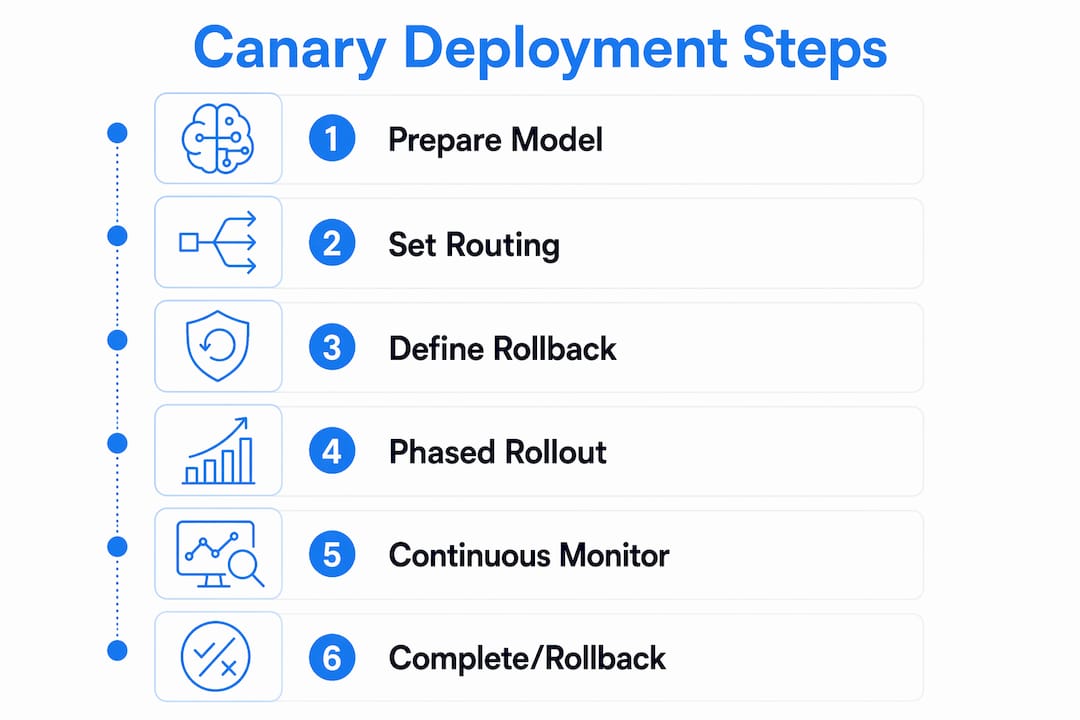
<li class="">Execute canary deployment: route 5–10% of traffic to the new version</li>
<li class="">Monitor canary for a defined window (typically 30–60 minutes); write metric snapshots back to the registry</li>
<li class="">On pass: execute full rollout; update <code>serving_endpoint</code> field in the registry</li>
<li class="">On fail: automatic rollback to the previous production version; attach incident record to the registry entry</li>
</ol>
<p>All pipeline steps must be idempotent. If a registration or promotion step fails and retries, the outcome should be identical to a first-run success. Idempotency prevents duplicate registry entries and ensures that a retried canary deployment does not double-count traffic. For <a href="https://mlflow.org/articles/tags/continuous-model-integration" target="_blank" rel="noopener noreferrer" class="">continuous model integration</a> patterns, Mlflow publishes practical how-tos that teams can adapt directly.</p>
<hr>
<h2 class="anchor anchorTargetStickyNavbar_Vzrq" id="what-observability-signals-and-audit-logs-does-a-registry-need">What observability signals and audit logs does a registry need?<a href="https://mlflow.org/articles/ai-model-registry-management-checklist/#what-observability-signals-and-audit-logs-does-a-registry-need" class="hash-link" aria-label="Direct link to What observability signals and audit logs does a registry need?" title="Direct link to What observability signals and audit logs does a registry need?" translate="no">​</a></h2>
<p>The registry must capture and surface key monitoring signals and store append-only audit logs. Monitoring data written at deployment time goes stale fast; the registry needs a feedback loop that keeps it current.</p>
<p><strong>Monitoring signals to attach to registry entries:</strong></p>
<ul>
<li class="">Prediction performance metrics (accuracy, F1, AUC) on a rolling evaluation window</li>
<li class="">Feature drift metrics: population stability index or Jensen-Shannon divergence vs. training distribution</li>
<li class="">Input data schema changes: alerts when upstream data contracts change</li>
<li class="">Error rates and exception counts from the serving endpoint</li>
<li class="">User complaint or escalation counts linked to the model version</li>
<li class="">For LLMs and agents: hallucination rate, refusal rate, and latency percentiles from <a href="https://mlflow.org/ai-observability" target="_blank" rel="noopener noreferrer" class="">AI observability</a> tracing</li>
</ul>
<p><strong>Audit log requirements:</strong></p>
<ul>
<li class="">Append-only writes: no record may be deleted or modified after creation</li>
<li class="">Retention: minimum 3 years for standard models; 7 years for regulated use cases</li>
<li class="">Searchable fields: <code>model_id</code>, <code>version</code>, <code>event_type</code>, <code>actor_id</code>, <code>timestamp</code>, <code>outcome</code></li>
<li class="">Every audit event links back to the registry entry by <code>model_id</code> and <code>version</code></li>
</ul>
<p>Automated feedback loops close the gap between deployment-time state and runtime reality. A monitoring system that detects drift should write a metric snapshot to the registry with a timestamp and a severity flag. The registry then surfaces that snapshot in governance dashboards and can trigger a retraining or review workflow automatically. The registry as a compliance artifact integrated with incident response means that when something goes wrong, the audit trail is already in the registry, not scattered across separate logging systems.</p>
<hr>
<h2 class="anchor anchorTargetStickyNavbar_Vzrq" id="how-do-you-handle-rollbacks-deprecation-and-model-retirement">How do you handle rollbacks, deprecation, and model retirement?<a href="https://mlflow.org/articles/ai-model-registry-management-checklist/#how-do-you-handle-rollbacks-deprecation-and-model-retirement" class="hash-link" aria-label="Direct link to How do you handle rollbacks, deprecation, and model retirement?" title="Direct link to How do you handle rollbacks, deprecation, and model retirement?" translate="no">​</a></h2>
<p>Retiring a model is as important as deploying it. Set <code>deprecation_target</code> at registration, not when the model is already past its useful life. Industry guidance in 2026 emphasizes deprecation targets and formal decommissioning to prevent retired models from retaining access rights.</p>
<p><strong>Retirement checklist:</strong></p>
<ol>
<li class="">Announce deprecation: update registry status to <code>deprecated</code>; notify all downstream consumers via the registry's notification hooks</li>
<li class="">Route traffic to the replacement model; verify the replacement is stable under production load</li>
<li class="">Revoke serving credentials and API keys associated with the deprecated version</li>
<li class="">Archive the artifact to cold storage; record the archive location in the registry</li>
<li class="">Update registry status to <code>retired</code>; set <code>archived_by</code> and <code>retirement_reason</code> fields</li>
<li class="">Confirm no active serving endpoints reference the retired version</li>
</ol>
<p><strong>Deprecation fields to capture:</strong></p>
<table><thead><tr><th>Field</th><th>Description</th></tr></thead><tbody><tr><td><code>deprecation_target</code></td><td>Planned retirement date, set at registration</td></tr><tr><td><code>retirement_reason</code></td><td>Business or technical rationale</td></tr><tr><td><code>archived_by</code></td><td>Authenticated user who executed the archive step</td></tr><tr><td><code>retention_period</code></td><td>How long the artifact must be retained (e.g., 7 years)</td></tr><tr><td><code>compliance_archive_reference</code></td><td>Reference ID in the compliance archive system</td></tr></tbody></table>
<p>Regulated records typically require a multi-year retention window. Cold storage for artifacts is appropriate immediately after retirement; metadata must remain queryable for the full retention period. A model that is <code>retired</code> in the registry but still has active credentials is a security incident waiting to happen.</p>
<hr>
<h2 class="anchor anchorTargetStickyNavbar_Vzrq" id="what-goes-wrong-without-good-registry-practices">What goes wrong without good registry practices?<a href="https://mlflow.org/articles/ai-model-registry-management-checklist/#what-goes-wrong-without-good-registry-practices" class="hash-link" aria-label="Direct link to What goes wrong without good registry practices?" title="Direct link to What goes wrong without good registry practices?" translate="no">​</a></h2>
<p>The most common failures are: spreadsheet-based tracking, missing provenance, no gated promotion, field bloat at launch, and no formal retirement process. Each is avoidable with a small, deliberate policy decision.</p>
<ul>
<li class=""><strong>Registry abandonment due to field bloat:</strong> teams that launch with 50+ required fields see engineers route around the registry within weeks. <em>Mitigation: start with a 10-field core and add fields only when a governance need is demonstrated.</em></li>
<li class=""><strong>In-place artifact overwrites:</strong> a model file overwritten in place breaks every rollback path and makes the audit trail meaningless. <em>Mitigation: enforce write-once artifact storage at the infrastructure level, not just by convention.</em></li>
<li class=""><strong>Disconnected monitoring:</strong> metrics live in a separate observability tool with no link back to the registry entry. <em>Mitigation: automate metric snapshot writes back into the registry on a defined cadence.</em></li>
<li class=""><strong>Shadow AI:</strong> teams deploy models outside the registry to move faster. <em>Mitigation: make the registry the only path to a serving environment by gating deployment infrastructure on registry state.</em></li>
<li class=""><strong>Unclear ownership:</strong> no <code>owner</code> field means no one is accountable when a model drifts or causes an incident. <em>Mitigation: require <code>owner</code> at registration; block promotion if the field is empty.</em></li>
<li class=""><strong>No retirement process:</strong> models accumulate in <code>production</code> status long after replacement. <em>Mitigation: set <code>deprecation_target</code> at registration and automate a review trigger when the date approaches.</em></li>
</ul>
<p><strong>Measuring registry health:</strong> track the percentage of production models with all required fields populated, the percentage with a <code>deprecation_target</code> set, and the query latency for cross-cutting questions (target: under 60 seconds). These three metrics tell you whether the registry is being used as designed or drifting back toward spreadsheet behavior.</p>
<hr>
<h2 class="anchor anchorTargetStickyNavbar_Vzrq" id="which-registry-implementation-should-you-choose">Which registry implementation should you choose?<a href="https://mlflow.org/articles/ai-model-registry-management-checklist/#which-registry-implementation-should-you-choose" class="hash-link" aria-label="Direct link to Which registry implementation should you choose?" title="Direct link to Which registry implementation should you choose?" translate="no">​</a></h2>
<p>The three implementation categories are: open-source self-hosted registries, managed cloud registries, and enterprise AI governance platforms. The most important selection axis is your governance needs, specifically whether you need hard promotion gates, audit-log retention, and RBAC at the infrastructure level.</p>
<p><strong>Selection criteria:</strong></p>
<p><strong>Integration surface.</strong> If your training pipelines already use Python-native tooling and your serving layer is containerized, an open-source registry with a Python SDK and REST API fits naturally. Managed cloud registries integrate tightly with their own serving and monitoring stacks, which is an advantage if you are already on that cloud.</p>
<p><strong>Audit and retention.</strong> Regulated industries (healthcare, finance) need append-only audit logs with a 7-year retention guarantee. Verify that the registry backend, not just the application layer, enforces this.</p>
<p><strong>RBAC granularity.</strong> Some registries offer only coarse-grained permissions (read/write per registry). Production use cases need environment-scoped permissions (read-only in production for most roles, write only via CI/CD service accounts).</p>
<p><strong>Automation hooks.</strong> A registry without event-driven webhooks or a pub/sub integration forces you to poll for state changes. Polling introduces latency and complexity; prefer event-driven architectures.</p>
<p><strong>Scale and observability.</strong> At hundreds of models and thousands of versions, registry query performance and storage costs become real constraints. Managed cloud registries handle scaling transparently; self-hosted options require you to manage the backing store.</p>
<p><strong>Pro Tip:</strong> <em>Before committing to a managed cloud registry, audit the export API. If you cannot extract all metadata and artifacts in a portable format without vendor tooling, you have a lock-in risk. A practical implementation sequence — define schema, set artifact storage, implement lifecycle stage rules, configure access controls, wire CI/CD, link lineage and monitoring — works for any registry category and is a useful evaluation checklist.</em></p>
<p>Mlflow is a strong fit when you need an open-source, Python-native registry with built-in lifecycle stages, a REST API, and extensible integration points for CI/CD and observability. It handles the full checklist: artifact versioning, metadata APIs, stage transitions, and hooks for monitoring feedback loops. For teams that need managed infrastructure or a fully hosted compliance tier, managed cloud options are worth evaluating, but watch for the lock-in risk above.</p>
<hr>
<h2 class="anchor anchorTargetStickyNavbar_Vzrq" id="how-does-mlflow-map-to-this-checklist-in-practice">How does Mlflow map to this checklist in practice?<a href="https://mlflow.org/articles/ai-model-registry-management-checklist/#how-does-mlflow-map-to-this-checklist-in-practice" class="hash-link" aria-label="Direct link to How does Mlflow map to this checklist in practice?" title="Direct link to How does Mlflow map to this checklist in practice?" translate="no">​</a></h2>
<p>Mlflow provides the core registry capabilities the checklist requires: artifact versioning, structured metadata, lifecycle stage transitions, and APIs that CI/CD pipelines can call directly. Here is how the checklist items map to Mlflow features.</p>
<p><strong>Checklist-to-Mlflow mapping:</strong></p>
<ul>
<li class=""><strong>Required metadata fields:</strong> Mlflow's <code>MlflowClient.log_param()</code>, <code>log_metric()</code>, and <code>set_tag()</code> APIs store all required fields. Custom tags cover <code>risk_tier</code>, <code>compliance_tags</code>, <code>dataset_fingerprint</code>, and <code>deprecation_target</code>.</li>
<li class=""><strong>Immutability and versioning:</strong> Mlflow creates a new <code>ModelVersion</code> for every registration call; it does not overwrite existing versions. The artifact URI is content-addressed.</li>
<li class=""><strong>Stage transitions:</strong> <code>MlflowClient.transition_model_version_stage()</code> moves a version through <code>None → Staging → Production → Archived</code>. Combine this with a webhook or event listener to trigger CI/CD steps.</li>
<li class=""><strong>Evaluation artifacts:</strong> attach evaluation results using <code>mlflow.log_artifact()</code> before calling the registration API. The artifact is linked to the run and, through the run, to the model version.</li>
<li class=""><strong>Approval records:</strong> store approval metadata as tags on the <code>ModelVersion</code> object (<code>approver_id</code>, <code>approval_timestamp</code>, <code>justification</code>). A CI/CD gate checks for these tags before executing the production promotion step.</li>
<li class=""><strong>Monitoring feedback loops:</strong> write metric snapshots back to the registry using <code>MlflowClient.set_model_version_tag()</code> on a scheduled basis. For LLMs and agents, Mlflow's <a href="https://mlflow.org/llm-as-a-judge" target="_blank" rel="noopener noreferrer" class="">LLM-as-a-Judge evaluation</a> framework automates quality scoring and can write results directly to the registry.</li>
</ul>
<p><strong>Code patterns to implement:</strong></p>
<p>Register a model: call <code>mlflow.register_model(model_uri, name)</code> at the end of a training run. Set required tags immediately after registration using <code>MlflowClient.set_model_version_tag()</code>. Transition to staging: call <code>transition_model_version_stage(name, version, "Staging")</code> from your CI/CD pipeline after validation passes. Promote to production: same API call with <code>"Production"</code> as the target stage, gated on approval tag presence.</p>
<p><strong>Pro Tip:</strong> <em>For enterprise scale, configure Mlflow's backing store as a managed PostgreSQL instance and artifact store as S3 or GCS with versioning enabled. This gives you the append-only audit semantics and retention controls the checklist requires without building custom infrastructure. Pair the registry with Mlflow's <a href="https://mlflow.org/articles/tags/ai-model-management-automation" target="_blank" rel="noopener noreferrer" class="">AI model management automation</a> patterns to automate registration, promotion, and monitoring feedback in a single pipeline.</em></p>
<hr>
<h2 class="anchor anchorTargetStickyNavbar_Vzrq" id="copy-paste-checklist-template-for-your-registry-intake-form">Copy-paste checklist template for your registry intake form<a href="https://mlflow.org/articles/ai-model-registry-management-checklist/#copy-paste-checklist-template-for-your-registry-intake-form" class="hash-link" aria-label="Direct link to Copy-paste checklist template for your registry intake form" title="Direct link to Copy-paste checklist template for your registry intake form" translate="no">​</a></h2>
<p>Paste this block into your team's ticket template, intake form, or internal policy doc. Every new model registration must satisfy all required items before the registry entry is created.</p>
<p><strong>Required registry fields (all must be populated at registration):</strong></p>
<ul class="contains-task-list containsTaskList_mC6p">
<li class="task-list-item"><input type="checkbox" disabled=""> <code>model_id</code> — unique, stable identifier</li>
<li class="task-list-item"><input type="checkbox" disabled=""> <code>version</code> — monotonic version integer</li>
<li class="task-list-item"><input type="checkbox" disabled=""> <code>owner</code> — accountable team or individual</li>
<li class="task-list-item"><input type="checkbox" disabled=""> <code>use_case</code> — intended deployment scope</li>
<li class="task-list-item"><input type="checkbox" disabled=""> <code>dataset_fingerprint</code> — hash or ID of training dataset snapshot</li>
<li class="task-list-item"><input type="checkbox" disabled=""> <code>training_commit</code> — Git commit SHA</li>
<li class="task-list-item"><input type="checkbox" disabled=""> <code>hyperparameters</code> — key training parameters as structured map</li>
<li class="task-list-item"><input type="checkbox" disabled=""> <code>evaluation_metrics</code> — accuracy, latency, fairness scores</li>
<li class="task-list-item"><input type="checkbox" disabled=""> <code>risk_tier</code> — Low / Medium / High / Regulated</li>
<li class="task-list-item"><input type="checkbox" disabled=""> <code>compliance_tags</code> — applicable regulations</li>
<li class="task-list-item"><input type="checkbox" disabled=""> <code>last_review_date</code> — date of most recent governance review</li>
<li class="task-list-item"><input type="checkbox" disabled=""> <code>deprecation_target</code> — planned retirement date</li>
</ul>
<p><strong>Required approval steps:</strong></p>
<ul class="contains-task-list containsTaskList_mC6p">
<li class="task-list-item"><input type="checkbox" disabled=""> <!-- -->ML lead approval recorded with <code>approver_id</code>, <code>role</code>, <code>timestamp</code>, <code>justification</code></li>
<li class="task-list-item"><input type="checkbox" disabled=""> <!-- -->Data owner approval (required if dataset changed)</li>
<li class="task-list-item"><input type="checkbox" disabled=""> <!-- -->Compliance review (required for High / Regulated risk tier)</li>
</ul>
<p><strong>Mandatory tests (artifacts must be attached before promotion):</strong></p>
<ul class="contains-task-list containsTaskList_mC6p">
<li class="task-list-item"><input type="checkbox" disabled=""> <!-- -->Unit tests: model load, input schema, output shape</li>
<li class="task-list-item"><input type="checkbox" disabled=""> <!-- -->Performance threshold tests vs. baseline</li>
<li class="task-list-item"><input type="checkbox" disabled=""> <!-- -->Regression test vs. current production model</li>
<li class="task-list-item"><input type="checkbox" disabled=""> <!-- -->Fairness evaluation across defined subgroups</li>
<li class="task-list-item"><input type="checkbox" disabled=""> <!-- -->LLM/agent hallucination and refusal rate check (if applicable)</li>
</ul>
<p><strong>Retirement metadata (set at registration, updated at retirement):</strong></p>
<ul class="contains-task-list containsTaskList_mC6p">
<li class="task-list-item"><input type="checkbox" disabled=""> <code>deprecation_target</code> set</li>
<li class="task-list-item"><input type="checkbox" disabled=""> <code>retirement_reason</code> recorded at retirement</li>
<li class="task-list-item"><input type="checkbox" disabled=""> <code>archived_by</code> recorded</li>
<li class="task-list-item"><input type="checkbox" disabled=""> <code>retention_period</code> defined</li>
<li class="task-list-item"><input type="checkbox" disabled=""> <code>compliance_archive_reference</code> populated</li>
</ul>
<p><strong>Suggested policy values by risk tier:</strong></p>
<table><thead><tr><th>Risk tier</th><th>Review cadence</th><th>Approval required</th><th>Retention</th></tr></thead><tbody><tr><td>Low</td><td>Quarterly</td><td>ML lead</td><td>3 years</td></tr><tr><td>Medium</td><td>Monthly</td><td>ML lead + data owner</td><td>5 years</td></tr><tr><td>High</td><td>Every 90 days</td><td>ML lead + data owner + compliance</td><td>7 years</td></tr><tr><td>Regulated</td><td>Continuous + 90-day human review</td><td>All approvers</td><td>7 years</td></tr></tbody></table>
<p>For implementation guidance, the Mlflow model registry docs and the <a href="https://mlflow.org/articles/tags/ai-model-management-best-practices" target="_blank" rel="noopener noreferrer" class="">AI model management best practices</a> tag are the fastest starting points.</p>
<hr>
<h2 class="anchor anchorTargetStickyNavbar_Vzrq" id="key-takeaways">Key Takeaways<a href="https://mlflow.org/articles/ai-model-registry-management-checklist/#key-takeaways" class="hash-link" aria-label="Direct link to Key Takeaways" title="Direct link to Key Takeaways" translate="no">​</a></h2>
<p>A production-ready AI model registry requires immutable versioning, a 12-field metadata schema, hard promotion gates with approval records, automated monitoring feedback loops, and a formal retirement policy set at registration time.</p>
<table><thead><tr><th>Point</th><th>Details</th></tr></thead><tbody><tr><td>Start with a 12-field schema</td><td>Required fields include <code>model_id</code>, <code>version</code>, <code>owner</code>, <code>risk_tier</code>, <code>dataset_fingerprint</code>, and <code>deprecation_target</code>.</td></tr><tr><td>Immutability is non-negotiable</td><td>Every change produces a new version; write-once artifact storage must be enforced at the infrastructure level.</td></tr><tr><td>Hard gates block unauthorized promotions</td><td>The registry must block the promotion API call until all required approvals and test artifacts are present.</td></tr><tr><td>Monitoring writes back into the registry</td><td>Automated metric snapshots and drift signals keep the registry current, not just deployment-time accurate.</td></tr><tr><td>Mlflow covers the full checklist</td><td>Mlflow's artifact versioning, stage transitions, metadata APIs, and observability hooks implement every required checkpoint.</td></tr></tbody></table>
<hr>
<h2 class="anchor anchorTargetStickyNavbar_Vzrq" id="why-incremental-adoption-beats-a-big-bang-registry-rollout">Why incremental adoption beats a big-bang registry rollout<a href="https://mlflow.org/articles/ai-model-registry-management-checklist/#why-incremental-adoption-beats-a-big-bang-registry-rollout" class="hash-link" aria-label="Direct link to Why incremental adoption beats a big-bang registry rollout" title="Direct link to Why incremental adoption beats a big-bang registry rollout" translate="no">​</a></h2>
<p>Most teams I see struggle with registry adoption not because the tooling is wrong but because they try to govern everything at once. A 50-field schema launched on day one is a registry that engineers will route around by day thirty. The evidence is clear: a 10-field core prevents early abandonment, and you can always add fields when a real governance need emerges.</p>
<p>The rollout plan that actually works has three phases. Start with an inventory: catalog every model currently in production, even if the only metadata you can recover is <code>model_id</code>, <code>owner</code>, and <code>use_case</code>. That inventory tells you where your governance gaps are and gives you a baseline for measuring progress. Phase two is the minimal schema plus hard gates: implement the 12 required fields, wire the promotion API to block on missing fields, and attach automated test artifacts before any promotion. This phase is where the registry earns its keep. Phase three is CI/CD automation and observability: event-driven promotion triggers, monitoring feedback loops, and the retirement workflow. By this point the registry is a live operational system, not a documentation exercise.</p>
<p>Measure success with three numbers: the percentage of production models with all required fields populated, the percentage with a <code>deprecation_target</code> set, and the time it takes to answer a cross-cutting query like "which models use dataset X?" If that query takes more than a minute, the registry is not yet functioning as designed. These metrics are simple enough to track in a weekly team review and specific enough to drive real behavior change.</p>
<p>The governance piece that most teams underinvest in is the retirement workflow. Deploying a model gets attention; retiring one does not. But a model that is <code>production</code> in the registry, no longer actively monitored, and still holding live credentials is a liability. Set <code>deprecation_target</code> at registration, automate the review trigger, and treat retirement with the same operational rigor as deployment.</p>
<hr>
<h2 class="anchor anchorTargetStickyNavbar_Vzrq" id="mlflow-gives-you-the-building-blocks-to-implement-this-checklist-today">Mlflow gives you the building blocks to implement this checklist today<a href="https://mlflow.org/articles/ai-model-registry-management-checklist/#mlflow-gives-you-the-building-blocks-to-implement-this-checklist-today" class="hash-link" aria-label="Direct link to Mlflow gives you the building blocks to implement this checklist today" title="Direct link to Mlflow gives you the building blocks to implement this checklist today" translate="no">​</a></h2>
<p>The checklist above covers a lot of ground, but you do not need to build the underlying infrastructure from scratch. Mlflow provides the registry, APIs, staging transitions, and observability hooks to implement every checkpoint described here, as a free, open-source platform your team can run today.</p>
<p><img decoding="async" loading="lazy" src="https://csuxjmfbwmkxiegfpljm.supabase.co/storage/v1/object/public/blog-images/organization-30814/1778726621079_mlflow.jpg" alt="Mlflow" class="img_ev3q"></p>
<p>Specifically, Mlflow maps to the checklist like this: artifact versioning and write-once storage are built into the model registry; stage transitions (<code>Staging → Production → Archived</code>) are first-class API operations; metadata and approval records attach as structured tags; and the <a href="https://mlflow.org/genai" target="_blank" rel="noopener noreferrer" class="">GenAI and agent observability</a> layer handles LLM-specific signals like hallucination rates, latency percentiles, and LLM-as-a-Judge evaluation scores. For teams managing LLMs and agents, Mlflow's AI observability tooling closes the monitoring feedback loop that keeps the registry current after deployment.</p>
<p>Start with the Mlflow model registry documentation to wire up your first registration and stage transition. From there, the automation and observability layers are incremental additions, not a separate project.</p>
<hr>
<h2 class="anchor anchorTargetStickyNavbar_Vzrq" id="useful-sources-to-consult-next">Useful sources to consult next<a href="https://mlflow.org/articles/ai-model-registry-management-checklist/#useful-sources-to-consult-next" class="hash-link" aria-label="Direct link to Useful sources to consult next" title="Direct link to Useful sources to consult next" translate="no">​</a></h2>
<ul>
<li class=""><strong>AI Governance Lexicon: ML Model Governance and Registry</strong> — covers governance integration, hard gates, and the operational compliance artifact concept. Maps to sections on governance workflows, definition, and monitoring.</li>
<li class=""><strong>Atlan: What Is an AI Registry?</strong> — enterprise registry field schema mapping to EU AI Act Annex IV and NIST AI RMF. Maps to the metadata schema and compliance sections.</li>
<li class=""><strong>Atlan: Model Registry Implementation Guide</strong> — phased implementation sequence, immutability rules, and pitfalls. Maps to versioning, tools, and implementation sections.</li>
<li class=""><strong>ValueStreamAI: AI Model Lifecycle Guide</strong> — canonical lifecycle stages, deprecation target guidance, and retirement workflows. Maps to lifecycle overview and retirement sections.</li>
<li class=""><strong>CloseIt: AI Model Inventory Fields</strong> — field prioritization and the 10-field core recommendation. Maps to metadata schema and perspective sections.</li>
<li class=""><strong>Mlflow Model Registry Documentation</strong> — primary implementation reference for registration, stage transitions, and metadata APIs.</li>
<li class=""><strong><a href="https://www.informationweek.com/machine-learning-ai/why-ai-model-management-is-so-important" target="_blank" rel="noopener noreferrer" class="">InformationWeek: Why AI Model Management Is So Important</a></strong> — practitioner perspectives on centralized gateways, lifecycle governance, and semantic versioning at scale.</li>
</ul>
<h2 class="anchor anchorTargetStickyNavbar_Vzrq" id="recommended">Recommended<a href="https://mlflow.org/articles/ai-model-registry-management-checklist/#recommended" class="hash-link" aria-label="Direct link to Recommended" title="Direct link to Recommended" translate="no">​</a></h2>
<ul>
<li class=""><a href="https://mlflow.org/articles/tags/ai-model-management-automation" target="_blank" rel="noopener noreferrer" class="">One post tagged with "AI model management automation" | MLflow</a></li>
<li class=""><a href="https://mlflow.org/articles/tags/ai-version-control" target="_blank" rel="noopener noreferrer" class="">One post tagged with "AI version control" | MLflow</a></li>
<li class=""><a href="https://mlflow.org/articles/tags/continuous-model-integration" target="_blank" rel="noopener noreferrer" class="">One post tagged with "continuous model integration" | MLflow</a></li>
<li class=""><a href="https://mlflow.org/articles/tags/llmops-process-optimization" target="_blank" rel="noopener noreferrer" class="">One post tagged with "llmops process optimization" | MLflow</a></li>
</ul>]]></content>
        <category label="model management best practices" term="model management best practices"/>
        <category label="ai model governance framework" term="ai model governance framework"/>
        <category label="how to manage ai models" term="how to manage ai models"/>
        <category label="best practices for model registries" term="best practices for model registries"/>
        <category label="model version control checklist" term="model version control checklist"/>
        <category label="ai model tracking guide" term="ai model tracking guide"/>
        <category label="ai model lifecycle management" term="ai model lifecycle management"/>
        <category label="ai model registry management checklist" term="ai model registry management checklist"/>
        <category label="model registry checklist" term="model registry checklist"/>
        <category label="effective ai model management" term="effective ai model management"/>
        <category label="ai model deployment checklist" term="ai model deployment checklist"/>
    </entry>
    <entry>
        <title type="html"><![CDATA[Managing AI Vendor Risk for Enterprise AI Teams]]></title>
        <id>https://mlflow.org/articles/managing-ai-vendor-risk-enterprise/</id>
        <link href="https://mlflow.org/articles/managing-ai-vendor-risk-enterprise/"/>
        <updated>2026-07-29T00:00:00.000Z</updated>
        <summary type="html"><![CDATA[Master managing AI vendor risk in enterprise deployments. Discover effective strategies for assessments, contracts, and monitoring to safeguard your projects.]]></summary>
        <content type="html"><![CDATA[<p><img decoding="async" loading="lazy" src="https://csuxjmfbwmkxiegfpljm.supabase.co/storage/v1/object/public/blog-images/organization-30814/1785297541130_Team-discussing-AI-vendor-risk-governance.jpeg" alt="Team discussing AI vendor risk governance" class="img_ev3q"></p>
<p>The fastest way to control AI vendor risk in enterprise LLM and GenAI deployments is a proportionate TPRM overlay that combines AI-specific vendor assessments, contractual safeguards (AIBOM, material behavioral change clauses), and continuous behavioral monitoring. The <a href="https://nvlpubs.nist.gov/nistpubs/ai/nist.ai.100-1.pdf" target="_blank" rel="noopener noreferrer" class="">NIST AI Risk Management Framework</a> and the MAS proportionality principle are the two governing standards to anchor your program. Mlflow operationalizes the observability and automated evaluation layer that makes continuous monitoring practical at scale.</p>
<p><strong>Start here — your immediate next steps:</strong></p>
<ul>
<li class="">Tier every active AI vendor by impact, data sensitivity, and operational reliance (low / medium / high).</li>
<li class="">Add three contract clauses to every new LLM vendor agreement: AIBOM delivery, material behavioral change notification, and explicit training-data opt-out for production keys.</li>
<li class="">Run at least one synthetic behavioral test suite against each high-tier vendor API in your CI pipeline today.</li>
</ul>
<p><strong>Pro Tip:</strong> <em>Verify the opt-out setting on every production API key before your next deployment. Default terms on most commercial LLM APIs permit training on your inputs unless you explicitly disable it.</em></p>
<h2 class="anchor anchorTargetStickyNavbar_Vzrq" id="table-of-contents">Table of Contents<a href="https://mlflow.org/articles/managing-ai-vendor-risk-enterprise/#table-of-contents" class="hash-link" aria-label="Direct link to Table of Contents" title="Direct link to Table of Contents" translate="no">​</a></h2>
<ul>
<li class=""><a href="https://mlflow.org/articles/managing-ai-vendor-risk-enterprise/#how-to-classify-ai-vendor-engagements-by-risk-and-apply-proportional-governance" class="">How to classify AI vendor engagements by risk and apply proportional governance</a></li>
<li class=""><a href="https://mlflow.org/articles/managing-ai-vendor-risk-enterprise/#vendor-vetting-checklist-that-goes-beyond-standard-tprm-questionnaires" class="">Vendor vetting checklist that goes beyond standard TPRM questionnaires</a></li>
<li class=""><a href="https://mlflow.org/articles/managing-ai-vendor-risk-enterprise/#contractual-controls-slas-and-negotiation-priorities-that-reduce-ai-vendor-risk" class="">Contractual controls, SLAs, and negotiation priorities that reduce AI vendor risk</a></li>
<li class=""><a href="https://mlflow.org/articles/managing-ai-vendor-risk-enterprise/#run-time-controls-observability-continuous-evaluation-and-operational-gating" class="">Run-time controls: observability, continuous evaluation, and operational gating</a></li>
<li class=""><a href="https://mlflow.org/articles/managing-ai-vendor-risk-enterprise/#governance-for-subvendors-model-suppliers-and-open-source-components" class="">Governance for subvendors, model suppliers, and open-source components</a></li>
<li class=""><a href="https://mlflow.org/articles/managing-ai-vendor-risk-enterprise/#practical-test-suites-red-team-playbooks-and-audit-evidence" class="">Practical test suites, red-team playbooks, and audit evidence</a></li>
<li class=""><a href="https://mlflow.org/articles/managing-ai-vendor-risk-enterprise/#phased-rollout-plan-with-raci-timeline-and-cost-buckets" class="">Phased rollout plan with RACI, timeline, and cost buckets</a></li>
<li class=""><a href="https://mlflow.org/articles/managing-ai-vendor-risk-enterprise/#kpis-cadence-and-who-to-brief-on-ai-vendor-risk" class="">KPIs, cadence, and who to brief on AI vendor risk</a></li>
<li class=""><a href="https://mlflow.org/articles/managing-ai-vendor-risk-enterprise/#key-takeaways" class="">Key Takeaways</a></li>
<li class=""><a href="https://mlflow.org/articles/managing-ai-vendor-risk-enterprise/#why-the-governance-gap-matters-more-than-the-compliance-gap" class="">Why the governance gap matters more than the compliance gap</a></li>
<li class=""><a href="https://mlflow.org/articles/managing-ai-vendor-risk-enterprise/#mlflow-gives-your-team-a-production-grade-vendor-governance-layer" class="">Mlflow gives your team a production-grade vendor governance layer</a></li>
<li class=""><a href="https://mlflow.org/articles/managing-ai-vendor-risk-enterprise/#useful-sources-and-further-reading" class="">Useful sources and further reading</a></li>
</ul>
<h2 class="anchor anchorTargetStickyNavbar_Vzrq" id="how-to-classify-ai-vendor-engagements-by-risk-and-apply-proportional-governance">How to classify AI vendor engagements by risk and apply proportional governance<a href="https://mlflow.org/articles/managing-ai-vendor-risk-enterprise/#how-to-classify-ai-vendor-engagements-by-risk-and-apply-proportional-governance" class="hash-link" aria-label="Direct link to How to classify AI vendor engagements by risk and apply proportional governance" title="Direct link to How to classify AI vendor engagements by risk and apply proportional governance" translate="no">​</a></h2>
<p>MAS guidance frames AI governance as proportionate to model impact, complexity, and operational reliance. That framing maps directly to NIST AI RMF's MAP function, which asks teams to define context before applying controls. The practical output is a risk tier that determines onboarding depth, reassessment frequency, and minimum control requirements.</p>
<p>Four materiality criteria drive tier assignment: (1) impact on regulated data or customer outcomes, (2) model complexity and opacity, (3) degree of operational reliance, and (4) whether the model generates customer-facing or legally consequential outputs.</p>
<table><thead><tr><th>Tier</th><th>Example use case</th><th>Onboarding depth</th><th>Reassessment cadence</th><th>Minimum controls</th></tr></thead><tbody><tr><td>Low</td><td>Internal concierge chat plugin</td><td>Lightweight questionnaire</td><td>Annual</td><td>Logging, opt-out verification</td></tr><tr><td>Medium</td><td>Internal code generation assistant</td><td>Standard TPRM + AI addendum</td><td>Semi-annual</td><td>AIBOM, bias review, behavioral tests</td></tr><tr><td>High</td><td>LLM generating customer-facing legal text</td><td>Full AI due diligence</td><td>Quarterly</td><td>Full TEVV, audit rights, incident SLA, subprocessor map</td></tr></tbody></table>
<p>A concierge chat plugin that only accesses internal FAQs sits at low tier. An LLM that drafts loan disclosures or medical summaries is high tier by definition, regardless of vendor reputation.</p>
<p><img decoding="async" loading="lazy" src="https://csuxjmfbwmkxiegfpljm.supabase.co/storage/v1/object/public/blog-images/organization-30814/1785298171792_Infographic-showing-AI-vendor-risk-tiers-hierarchy.jpeg" alt="Infographic showing AI vendor risk tiers hierarchy" class="img_ev3q"></p>
<h2 class="anchor anchorTargetStickyNavbar_Vzrq" id="vendor-vetting-checklist-that-goes-beyond-standard-tprm-questionnaires">Vendor vetting checklist that goes beyond standard TPRM questionnaires<a href="https://mlflow.org/articles/managing-ai-vendor-risk-enterprise/#vendor-vetting-checklist-that-goes-beyond-standard-tprm-questionnaires" class="hash-link" aria-label="Direct link to Vendor vetting checklist that goes beyond standard TPRM questionnaires" title="Direct link to Vendor vetting checklist that goes beyond standard TPRM questionnaires" translate="no">​</a></h2>
<p><a href="https://www.pwc.com/us/en/tech-effect/ai-analytics/responsible-ai-tprm.html" target="_blank" rel="noopener noreferrer" class="">Standard TPRM questionnaires miss AI-specific risks</a> like data lineage, bias mitigation, and model-training transparency. Your AI vendor assessment must add these items explicitly.</p>
<p><strong>Core assessment items to request:</strong></p>
<ul>
<li class=""><strong>Model provenance and AIBOM:</strong> Which base model, version, and fine-tuning layers are in scope?</li>
<li class=""><strong>Training-data provenance:</strong> What datasets were used, and are they licensed for commercial use?</li>
<li class=""><strong>Bias-mitigation documentation:</strong> What evaluation datasets and fairness metrics were applied?</li>
<li class=""><strong>Data lineage and retention:</strong> Where does your input data go, and for how long?</li>
<li class=""><strong>Explainability artifacts:</strong> Are model cards, datasheets, or TEVV logs available?</li>
<li class=""><strong>Fine-tuning and continuous-training policy:</strong> Will the model be updated, and how will you be notified?</li>
<li class=""><strong>Subprocessor disclosure:</strong> Which fourth parties process your data?</li>
<li class=""><strong>Default data-use settings:</strong> Does the vendor opt out of training by default on production keys?</li>
</ul>
<table><thead><tr><th>Evidence request</th><th>Format to ask for</th></tr></thead><tbody><tr><td>AIBOM</td><td>Machine-readable SPDX or CycloneDX file</td></tr><tr><td>Bias evaluation</td><td>Model card with fairness metrics and test datasets</td></tr><tr><td>TEVV logs</td><td>Test run artifacts, pass/fail thresholds, regression history</td></tr><tr><td>Subprocessor list</td><td>Named list with data-access scope</td></tr></tbody></table>
<p><strong>Red flags:</strong> no AIBOM available, ambiguous data-reuse language, no process for notifying you of model updates, or inability to reproduce prior test cases.</p>
<h2 class="anchor anchorTargetStickyNavbar_Vzrq" id="contractual-controls-slas-and-negotiation-priorities-that-reduce-ai-vendor-risk">Contractual controls, SLAs, and negotiation priorities that reduce AI vendor risk<a href="https://mlflow.org/articles/managing-ai-vendor-risk-enterprise/#contractual-controls-slas-and-negotiation-priorities-that-reduce-ai-vendor-risk" class="hash-link" aria-label="Direct link to Contractual controls, SLAs, and negotiation priorities that reduce AI vendor risk" title="Direct link to Contractual controls, SLAs, and negotiation priorities that reduce AI vendor risk" translate="no">​</a></h2>
<p>The NIST Generative AI Profile recommends explicit disclosure clauses, recordkeeping obligations, and incident response planning as baseline contractual requirements for GenAI vendors. Practitioners add that you must define "material behavioral change" in objective terms, not just as a narrative concept.</p>
<p><strong>Essential clauses to include or strengthen:</strong></p>
<ul>
<li class="">AIBOM delivery at signing and on each model update</li>
<li class="">Notification of material behavioral change within a defined window (a short notification window is a reasonable starting position)</li>
<li class="">Explicit prohibition on using your data for model training or fine-tuning</li>
<li class="">Named subprocessor list with change-notification obligations</li>
<li class="">Audit rights: right to request TEVV logs, model cards, and incident records</li>
<li class="">Incident response SLA: detection-to-notification timeline and remediation commitments</li>
<li class="">Exit and data-destruction provisions: how model artifacts and your data are returned or destroyed</li>
<li class="">Change-control approval: your right to approve or reject model version upgrades in production</li>
</ul>
<p>On SLA metrics, target latency and availability thresholds appropriate to your use case, a model-behavior stability threshold tied to your synthetic test suite pass rate, and a maximum response time for model-change notification. Define "material" quantitatively: a regression of more than X% on your benchmark suite, or a shift in output distribution beyond a defined threshold.</p>
<p><strong>Pro Tip:</strong> <em>Require the vendor to retain historical model artifacts for a sufficient period to allow reproduction of prior outputs to investigate complaints or regulatory inquiries. Without them, you cannot reproduce a prior output to investigate a complaint or regulatory inquiry.</em></p>
<p><img decoding="async" loading="lazy" src="https://csuxjmfbwmkxiegfpljm.supabase.co/storage/v1/object/public/blog-images/organization-30814/1785297546691_Hands-exchanging-AI-vendor-contract-to-sign.jpeg" alt="Hands exchanging AI vendor contract to sign" class="img_ev3q"></p>
<h2 class="anchor anchorTargetStickyNavbar_Vzrq" id="run-time-controls-observability-continuous-evaluation-and-operational-gating">Run-time controls: observability, continuous evaluation, and operational gating<a href="https://mlflow.org/articles/managing-ai-vendor-risk-enterprise/#run-time-controls-observability-continuous-evaluation-and-operational-gating" class="hash-link" aria-label="Direct link to Run-time controls: observability, continuous evaluation, and operational gating" title="Direct link to Run-time controls: observability, continuous evaluation, and operational gating" translate="no">​</a></h2>
<p>Continuous behavioral monitoring catches silent model drift and vendor-pushed updates that point-in-time audits miss entirely. The operational control layer has three components: instrumentation, gating, and continuous evaluation.</p>
<p><strong>Observability checklist:</strong></p>
<ul>
<li class="">Log every input, output, prompt version, and model version identifier</li>
<li class="">Map prompt templates to artifact versions for full lineage</li>
<li class="">Alert on distributional shifts in output length, sentiment, or refusal rate</li>
<li class="">Gate deployments on pre-production TEVV pass rates</li>
<li class="">Enable rollback to a prior model version within a defined SLA</li>
</ul>
<p>For deployment gating, run pre-production TEVV (unit tests, integration tests, adversarial prompts) before any model version reaches production. After deployment, run synthetic behavioral tests continuously against the live vendor API. Mlflow's <a href="https://mlflow.org/ai-observability" target="_blank" rel="noopener noreferrer" class="">automated evaluation</a> and deep tracing capabilities make this pipeline practical: you can instrument agentic reasoning traces, version prompts alongside model artifacts, and trigger alerts when evaluation scores drop below threshold.</p>
<p><strong>Pro Tip:</strong> <em>Add at least two synthetic adversarial prompts to your CI pipeline for every high-tier vendor integration. They cost almost nothing to run and are the fastest signal you have that a silent model update has changed behavior.</em></p>
<h2 class="anchor anchorTargetStickyNavbar_Vzrq" id="governance-for-subvendors-model-suppliers-and-open-source-components">Governance for subvendors, model suppliers, and open-source components<a href="https://mlflow.org/articles/managing-ai-vendor-risk-enterprise/#governance-for-subvendors-model-suppliers-and-open-source-components" class="hash-link" aria-label="Direct link to Governance for subvendors, model suppliers, and open-source components" title="Direct link to Governance for subvendors, model suppliers, and open-source components" translate="no">​</a></h2>
<p>The NIST GAI Profile explicitly recommends supplier vetting, SBOM/AIBOM requirements, and dynamic monitoring for third-party GenAI risks, including fourth-party components your primary vendor relies on.</p>
<p><strong>Supply-chain controls to implement:</strong></p>
<ul>
<li class="">Map every vendor's subprocessors and the data each can access</li>
<li class="">Require AIBOM and SBOM for any model that uses open-source weights or third-party datasets</li>
<li class="">Document fallback options for every critical AI service (what happens if the vendor API goes down or is deprecated?)</li>
<li class="">For open-source models: vet licensing (Apache 2.0, MIT, or commercial-use-restricted?), pin versions explicitly, and prefer private cloud or on-premises hosting for high-tier workloads</li>
</ul>
<p><strong>Pro Tip:</strong> <em>For your highest-risk workloads, private hosting of open-source model weights eliminates the subprocessor risk entirely. The operational overhead is real, but so is the data-custody advantage.</em></p>
<h2 class="anchor anchorTargetStickyNavbar_Vzrq" id="practical-test-suites-red-team-playbooks-and-audit-evidence">Practical test suites, red-team playbooks, and audit evidence<a href="https://mlflow.org/articles/managing-ai-vendor-risk-enterprise/#practical-test-suites-red-team-playbooks-and-audit-evidence" class="hash-link" aria-label="Direct link to Practical test suites, red-team playbooks, and audit evidence" title="Direct link to Practical test suites, red-team playbooks, and audit evidence" translate="no">​</a></h2>
<p>Repeatable testing is the operational backbone of AI vendor governance. A test suite for a third-party LLM integration should cover four layers:</p>
<ol>
<li class=""><strong>Unit tests:</strong> deterministic input/output checks for known-good and known-bad cases</li>
<li class=""><strong>Integration tests:</strong> end-to-end workflow validation including upstream and downstream system behavior</li>
<li class=""><strong>Adversarial prompts:</strong> injection attempts, jailbreak patterns, and out-of-distribution inputs</li>
<li class=""><strong>LLM-as-a-Judge evaluation:</strong> automated scoring of output quality, safety, and policy compliance using a secondary model as evaluator</li>
</ol>
<p>For red-teaming, define scope (which endpoints, which data categories), establish safe-handling rules for sensitive test inputs, use a severity taxonomy (critical / high / medium / low), and track remediation to closure. Mlflow's <a href="https://mlflow.org/llm-as-a-judge" target="_blank" rel="noopener noreferrer" class="">LLM-as-a-Judge framework</a> supports automated evaluation artifact generation, which doubles as audit evidence.</p>
<blockquote>
<p><strong>Audit evidence to maintain:</strong> historical model outputs with version identifiers, TEVV run logs with pass/fail records, drift alerts with timestamps, model-change notifications from the vendor, and signed attestations of AIBOM delivery. Without this paper trail, you cannot demonstrate due diligence to a regulator or board.</p>
</blockquote>
<h2 class="anchor anchorTargetStickyNavbar_Vzrq" id="phased-rollout-plan-with-raci-timeline-and-cost-buckets">Phased rollout plan with RACI, timeline, and cost buckets<a href="https://mlflow.org/articles/managing-ai-vendor-risk-enterprise/#phased-rollout-plan-with-raci-timeline-and-cost-buckets" class="hash-link" aria-label="Direct link to Phased rollout plan with RACI, timeline, and cost buckets" title="Direct link to Phased rollout plan with RACI, timeline, and cost buckets" translate="no">​</a></h2>
<table><thead><tr><th>Phase</th><th>Timeline</th><th>Key activities</th><th>Trigger to advance</th></tr></thead><tbody><tr><td>Pilot</td><td>Weeks 1–—</td><td>Tier 2–3 vendors, draft AI contract addendum, deploy synthetic test suite</td><td>TEVV pass rate stable; contract signed</td></tr><tr><td>Hardened onboarding</td><td>Weeks 7–—</td><td>Full TPRM AI overlay, AIBOM collection, observability instrumentation</td><td>All high-tier vendors assessed</td></tr><tr><td>Scale and continuous monitoring</td><td>Ongoing</td><td>Automated evaluation in CI, quarterly reassessments, executive reporting</td><td>KPIs within threshold for several weeks</td></tr></tbody></table>
<p><strong>RACI summary:</strong></p>
<ul>
<li class=""><strong>Vendor assessment:</strong> Procurement owns, Security reviews, ML Engineering consults</li>
<li class=""><strong>Contract negotiation:</strong> Legal owns, Risk Management approves, ML Engineering provides technical requirements</li>
<li class=""><strong>Runtime observability:</strong> ML Engineering owns, Security monitors, Risk Management reviews</li>
<li class=""><strong>Incident response:</strong> Security owns, Legal notifies, ML Engineering remediates</li>
<li class=""><strong>Offboarding:</strong> Procurement owns, Legal verifies data destruction, ML Engineering confirms artifact removal</li>
</ul>
<p>Cost buckets to plan for: initial assessment labor (questionnaires, evidence review), tooling and monitoring infrastructure, legal negotiation time on AI-specific clauses, and ongoing audit and continuous evaluation compute.</p>
<p><strong>Pro Tip:</strong> <em>Pre-vetting a small set of approved providers dramatically reduces duplicate assessment work. Publish an internal approved-vendor list with pre-negotiated AI addenda and teams can onboard in days instead of weeks.</em></p>
<h2 class="anchor anchorTargetStickyNavbar_Vzrq" id="kpis-cadence-and-who-to-brief-on-ai-vendor-risk">KPIs, cadence, and who to brief on AI vendor risk<a href="https://mlflow.org/articles/managing-ai-vendor-risk-enterprise/#kpis-cadence-and-who-to-brief-on-ai-vendor-risk" class="hash-link" aria-label="Direct link to KPIs, cadence, and who to brief on AI vendor risk" title="Direct link to KPIs, cadence, and who to brief on AI vendor risk" translate="no">​</a></h2>
<p><strong>Core KPIs to track:</strong></p>
<ul>
<li class="">Model-behavior stability score (synthetic test suite pass rate, week over week)</li>
<li class="">TEVV pass rate at each deployment gate</li>
<li class="">Data provenance coverage (percentage of active vendor integrations with confirmed AIBOM)</li>
<li class="">Incident mean-time-to-detect (MTTD) and mean-time-to-recover (MTTR)</li>
<li class="">Third-party compliance score (percentage of vendors meeting minimum control requirements)</li>
</ul>
<p>Reporting cadence: daily operational alerts for anomaly detection, weekly engineering reviews of behavioral stability trends, monthly risk-owner dashboards covering compliance scores and open findings, and quarterly executive heat maps showing tier distribution and incident trends.</p>
<p>For executive audiences, translate technical signals into business risk language: a drop in TEVV pass rate becomes "vendor model behavior has shifted outside approved parameters, affecting X workflows." Engineers need the root-cause detail; boards need the exposure and remediation timeline. Mlflow's <a href="https://mlflow.org/articles/tags/enterprise-ai-monitoring" target="_blank" rel="noopener noreferrer" class="">enterprise AI monitoring</a> capabilities support both layers by surfacing trace-level detail for engineers and aggregated evaluation scores for dashboards.</p>
<h2 class="anchor anchorTargetStickyNavbar_Vzrq" id="key-takeaways">Key Takeaways<a href="https://mlflow.org/articles/managing-ai-vendor-risk-enterprise/#key-takeaways" class="hash-link" aria-label="Direct link to Key Takeaways" title="Direct link to Key Takeaways" translate="no">​</a></h2>
<p>A proportionate, vendor-specific governance program combining AI-specific assessments, contractual safeguards, and continuous behavioral monitoring is the most effective way to manage AI vendor risk in enterprise GenAI deployments.</p>
<table><thead><tr><th>Point</th><th>Details</th></tr></thead><tbody><tr><td>Tier vendors by materiality</td><td>Assign low, medium, or high tier based on data sensitivity, model complexity, and operational reliance before applying controls.</td></tr><tr><td>Contractual rights are non-negotiable</td><td>Require AIBOM delivery, material behavioral change notification, and explicit training-data opt-out in every high-tier vendor agreement.</td></tr><tr><td>Continuous monitoring beats audits</td><td>Synthetic test suites running in CI catch silent model drift that point-in-time questionnaires miss entirely.</td></tr><tr><td>Supply-chain visibility requires AIBOM</td><td>Map subprocessors and require SBOM/AIBOM for every vendor using open-source weights or third-party datasets.</td></tr><tr><td>Mlflow operationalizes the monitoring layer</td><td>Mlflow's automated evaluation, LLM-as-a-Judge scoring, and deep tracing give teams the observability infrastructure to run continuous vendor governance at scale.</td></tr></tbody></table>
<h2 class="anchor anchorTargetStickyNavbar_Vzrq" id="why-the-governance-gap-matters-more-than-the-compliance-gap">Why the governance gap matters more than the compliance gap<a href="https://mlflow.org/articles/managing-ai-vendor-risk-enterprise/#why-the-governance-gap-matters-more-than-the-compliance-gap" class="hash-link" aria-label="Direct link to Why the governance gap matters more than the compliance gap" title="Direct link to Why the governance gap matters more than the compliance gap" translate="no">​</a></h2>
<p>The conventional framing of AI vendor risk as a compliance problem misses the operational reality. Regulatory checklists tell you what to document. They do not tell you that a vendor pushed a silent model update at 2 AM that shifted your customer-facing output distribution by enough to trigger a complaint pattern you won't see for three weeks. That is the actual risk.</p>
<p>The teams that manage this well are not the ones with the most elaborate governance documents. They are the ones who instrumented their vendor integrations early, defined behavioral thresholds before they needed them, and negotiated notification rights when the vendor still wanted the contract. The NIST AI RMF and MAS proportionality guidance are useful precisely because they push you toward measurable controls, not just policy statements.</p>
<p>The alignment between those frameworks and a well-instrumented MLflow deployment is not coincidental. GOVERN → MAP → MEASURE → MANAGE maps almost directly onto tier assignment, assessment, TEVV, and continuous monitoring. The teams that close the governance gap fastest are the ones who treat observability as a first-class engineering requirement, not an audit afterthought.</p>
<h2 class="anchor anchorTargetStickyNavbar_Vzrq" id="mlflow-gives-your-team-a-production-grade-vendor-governance-layer">Mlflow gives your team a production-grade vendor governance layer<a href="https://mlflow.org/articles/managing-ai-vendor-risk-enterprise/#mlflow-gives-your-team-a-production-grade-vendor-governance-layer" class="hash-link" aria-label="Direct link to Mlflow gives your team a production-grade vendor governance layer" title="Direct link to Mlflow gives your team a production-grade vendor governance layer" translate="no">​</a></h2>
<p>The hardest part of AI vendor governance is not writing the policy. It is instrumenting your production environment to detect behavioral drift, version your prompts alongside model artifacts, and generate audit-ready evaluation records automatically. That is exactly what Mlflow is built for.</p>
<p><img decoding="async" loading="lazy" src="https://csuxjmfbwmkxiegfpljm.supabase.co/storage/v1/object/public/blog-images/organization-30814/1778726621079_mlflow.jpg" alt="Mlflow" class="img_ev3q"></p>
<p>Mlflow's <a href="https://mlflow.org/genai" target="_blank" rel="noopener noreferrer" class="">GenAI and agent engineering platform</a> gives enterprise AI teams automated LLM-as-a-Judge evaluation, deep tracing of agentic reasoning chains, prompt and artifact versioning, and a centralized AI Gateway for cross-provider governance. To pilot: configure an evaluation pipeline against your highest-tier vendor integration, add two synthetic behavioral tests to CI, and connect Mlflow tracing to your existing alerting stack. Your risk and security teams get the audit trail; your engineers get the root-cause signal. Start your evaluation at mlflow.org/genai.</p>
<h2 class="anchor anchorTargetStickyNavbar_Vzrq" id="useful-sources-and-further-reading">Useful sources and further reading<a href="https://mlflow.org/articles/managing-ai-vendor-risk-enterprise/#useful-sources-and-further-reading" class="hash-link" aria-label="Direct link to Useful sources and further reading" title="Direct link to Useful sources and further reading" translate="no">​</a></h2>
<p>The guidance in this article draws on the following authoritative documents and practitioner resources:</p>
<ul>
<li class=""><strong>NIST AI Risk Management Framework (AI RMF 1.0):</strong> Core governance structure (GOVERN, MAP, MEASURE, MANAGE), TEVV requirements, and monitoring recommendations. Directly supports sections on risk tiering, operational controls, and KPIs.</li>
<li class=""><strong>NIST Generative AI Profile (AI 600-1):</strong> GAI-specific vendor disclosure, SBOM/AIBOM requirements, and dynamic monitoring guidance. Supports vendor assessment checklist and supply-chain sections.</li>
<li class=""><strong>MAS AI Risk Management Executive Handbook:</strong> Proportionality principle, AI-specific KRIs, and procurement uplift guidance. Supports risk-tiering and contract sections.</li>
<li class=""><strong><a href="https://www.oecd.org/content/dam/oecd/en/publications/reports/2026/02/oecd-due-diligence-guidance-for-responsible-ai_7831bb49/41671712-en.pdf" target="_blank" rel="noopener noreferrer" class="">OECD Due Diligence Guidance for Responsible AI</a>:</strong> Due diligence framework for AI systems across business relationships; supports vendor assessment and supply-chain governance.</li>
<li class=""><strong>PwC: Responsible AI and Third-Party Risk Management:</strong> Practical guidance on integrating AI controls into TPRM and pre-vetting provider lists. Supports procurement and implementation sections.</li>
<li class=""><strong>BeyondScale: Third-Party AI Vendor Risk Assessment:</strong> Practitioner playbook on behavioral monitoring, AIBOM contract language, and continuous test harnesses. Supports operational controls, contract, and testing sections.</li>
<li class=""><strong>AI Governance Playbook: Managing Third-Party AI Risk:</strong> Guidance on training-data opt-out verification and production key management. Supports vendor assessment and contract sections.</li>
<li class=""><strong>Mlflow implementation resources:</strong> <a href="https://mlflow.org/articles/tags/ai-observability-in-enterprises" target="_blank" rel="noopener noreferrer" class="">AI observability</a>, <a href="https://mlflow.org/articles/tags/ai-model-governance" target="_blank" rel="noopener noreferrer" class="">AI model governance</a>, and <a href="https://mlflow.org/articles/tags/ai-risk-management" target="_blank" rel="noopener noreferrer" class="">AI risk management</a> tag pages provide implementation depth mapped to the operational controls and monitoring sections of this guide.</li>
</ul>
<h2 class="anchor anchorTargetStickyNavbar_Vzrq" id="recommended">Recommended<a href="https://mlflow.org/articles/managing-ai-vendor-risk-enterprise/#recommended" class="hash-link" aria-label="Direct link to Recommended" title="Direct link to Recommended" translate="no">​</a></h2>
<ul>
<li class=""><a href="https://mlflow.org/articles/tags/multi-vendor-ai-solutions" target="_blank" rel="noopener noreferrer" class="">One post tagged with "multi-vendor AI solutions" | MLflow</a></li>
<li class=""><a href="https://mlflow.org/articles/tags/why-audit-artificial-intelligence" target="_blank" rel="noopener noreferrer" class="">One post tagged with "why audit artificial intelligence" | MLflow</a></li>
<li class=""><a href="https://mlflow.org/articles/tags/challenges-in-auditing-ai" target="_blank" rel="noopener noreferrer" class="">One post tagged with "challenges in auditing AI" | MLflow</a></li>
<li class=""><a href="https://mlflow.org/articles/tags/managing-ai-access-rights" target="_blank" rel="noopener noreferrer" class="">One post tagged with "managing AI access rights" | MLflow</a></li>
</ul>]]></content>
        <category label="how to evaluate AI vendors" term="how to evaluate AI vendors"/>
        <category label="assessing AI vendor compliance" term="assessing AI vendor compliance"/>
        <category label="enterprise AI risk governance" term="enterprise AI risk governance"/>
        <category label="enterprise vendor risk assessment" term="enterprise vendor risk assessment"/>
        <category label="managing AI supply chain risk" term="managing AI supply chain risk"/>
        <category label="AI risk management strategies" term="AI risk management strategies"/>
        <category label="managing ai vendor risk enterprise" term="managing ai vendor risk enterprise"/>
        <category label="AI vendor relationship management" term="AI vendor relationship management"/>
    </entry>
    <entry>
        <title type="html"><![CDATA[Instrumenting AI Calls in Backend Services: A Guide]]></title>
        <id>https://mlflow.org/articles/instrumenting-ai-calls-in-backend-services/</id>
        <link href="https://mlflow.org/articles/instrumenting-ai-calls-in-backend-services/"/>
        <updated>2026-07-28T00:00:00.000Z</updated>
        <summary type="html"><![CDATA[Unlock end-to-end visibility in your agent pipeline by mastering instrumenting AI calls in backend services. Learn key patterns and tools.]]></summary>
        <content type="html"><![CDATA[<p><img decoding="async" loading="lazy" src="https://csuxjmfbwmkxiegfpljm.supabase.co/storage/v1/object/public/blog-images/organization-30814/1785217270351_Engineer-typing-code-at-backend-services-workstation.jpeg" alt="Engineer typing code at backend services workstation" class="img_ev3q"></p>
<p>Instrument every AI run as a single root trace with child spans for <code>llm.generate</code>/<code>chat</code>, retrieval, <code>tool.call</code>, retries, auth, and external API calls — and attach token counts plus cost attributes to every span. That one pattern gives you end-to-end visibility across your entire agent pipeline.</p>
<p><strong>Minimal viable checklist:</strong></p>
<ul>
<li class="">Wrap each AI invocation in a root span (<code>agent.run</code> or <code>invoke_agent</code>), then open child spans for every model call, tool execution, and retry.</li>
<li class="">Record <code>ai.input_tokens</code>, <code>ai.output_tokens</code>, <code>ai.cost_usd</code>, <code>ai.model</code>, and <code>ai.provider</code> on every LLM span.</li>
<li class="">Propagate W3C Trace Context (<code>traceparent</code>/<code>tracestate</code>) and a stable <code>run.id</code> across every process, queue, and network boundary.</li>
</ul>
<blockquote>
<p><strong>TL;DR:</strong> Required technologies: OpenTelemetry SDK (Python or JS), an OTLP Collector, and a backend such as Grafana Tempo, Honeycomb, or Datadog. Quick verification: after your first test run, confirm a trace exists with child spans, token counts are non-zero, and <code>run.id</code> is consistent across all spans. If any span shows <code>null</code> tokens or a missing parent, your wrapper has a gap.</p>
</blockquote>
<hr>
<h2 class="anchor anchorTargetStickyNavbar_Vzrq" id="table-of-contents">Table of Contents<a href="https://mlflow.org/articles/instrumenting-ai-calls-in-backend-services/#table-of-contents" class="hash-link" aria-label="Direct link to Table of Contents" title="Direct link to Table of Contents" translate="no">​</a></h2>
<ul>
<li class=""><a href="https://mlflow.org/articles/instrumenting-ai-calls-in-backend-services/#why-should-you-instrument-aillm-calls-in-backend-services" class="">Why should you instrument AI/LLM calls in backend services?</a></li>
<li class=""><a href="https://mlflow.org/articles/instrumenting-ai-calls-in-backend-services/#what-data-should-you-capture-for-every-ai-call" class="">What data should you capture for every AI call?</a></li>
<li class=""><a href="https://mlflow.org/articles/instrumenting-ai-calls-in-backend-services/#how-do-you-connect-requests-to-agent-runs-and-tool-calls-without-orphan-spans" class="">How do you connect requests to agent runs and tool calls without orphan spans?</a></li>
<li class=""><a href="https://mlflow.org/articles/instrumenting-ai-calls-in-backend-services/#what-do-practical-instrumentation-patterns-look-like-in-python-and-typescript" class="">What do practical instrumentation patterns look like in Python and TypeScript?</a></li>
<li class=""><a href="https://mlflow.org/articles/instrumenting-ai-calls-in-backend-services/#how-do-you-build-the-observability-pipeline-from-collector-to-dashboard" class="">How do you build the observability pipeline from collector to dashboard?</a></li>
<li class=""><a href="https://mlflow.org/articles/instrumenting-ai-calls-in-backend-services/#what-kpis-dashboards-and-alerts-should-you-build-for-ai-calls" class="">What KPIs, dashboards, and alerts should you build for AI calls?</a></li>
<li class=""><a href="https://mlflow.org/articles/instrumenting-ai-calls-in-backend-services/#what-operational-risks-should-you-address-before-going-live" class="">What operational risks should you address before going live?</a></li>
<li class=""><a href="https://mlflow.org/articles/instrumenting-ai-calls-in-backend-services/#how-does-mlflow-map-to-the-recommended-instrumentation-pattern" class="">How does Mlflow map to the recommended instrumentation pattern?</a></li>
<li class=""><a href="https://mlflow.org/articles/instrumenting-ai-calls-in-backend-services/#key-takeaways" class="">Key Takeaways</a></li>
<li class=""><a href="https://mlflow.org/articles/instrumenting-ai-calls-in-backend-services/#what-teams-actually-learn-when-they-ship-agent-observability" class="">What teams actually learn when they ship agent observability</a></li>
<li class=""><a href="https://mlflow.org/articles/instrumenting-ai-calls-in-backend-services/#mlflow-gives-you-production-grade-agent-observability-from-day-one" class="">Mlflow gives you production-grade agent observability from day one</a></li>
<li class=""><a href="https://mlflow.org/articles/instrumenting-ai-calls-in-backend-services/#authoritative-sources-and-further-reading" class="">Authoritative sources and further reading</a></li>
</ul>
<h2 class="anchor anchorTargetStickyNavbar_Vzrq" id="why-should-you-instrument-aillm-calls-in-backend-services">Why should you instrument AI/LLM calls in backend services?<a href="https://mlflow.org/articles/instrumenting-ai-calls-in-backend-services/#why-should-you-instrument-aillm-calls-in-backend-services" class="hash-link" aria-label="Direct link to Why should you instrument AI/LLM calls in backend services?" title="Direct link to Why should you instrument AI/LLM calls in backend services?" translate="no">​</a></h2>
<p>Without instrumentation, an AI call is a black box. You see a 200 OK and a latency number, but you have no idea whether the model burned 40,000 tokens on a retry loop, whether a tool call silently failed, or whether your P99 latency spike came from DNS resolution or token generation. OpenTelemetry traces can break a single 14-second AI API call into phases — DNS, TLS, time-to-first-token (TTFT), and token generation — and reveal exactly where time is spent.</p>
<p>The four concrete goals instrumentation delivers:</p>
<p><strong>Faster postmortems.</strong> When a user reports a wrong answer or a timeout, a trace with a <code>run.id</code> lets you replay the exact sequence of model calls, tool invocations, and retries that produced it. Without that, you're guessing.</p>
<p><strong>Accurate cost attribution.</strong> Token counts on spans let you compute cost per run, cost per feature, and cost per tenant. Without token attributes, you cannot retrospectively assign cost to a trace — you only know your monthly bill, not which workflow drove it.</p>
<p><strong>Spotting token waste and hallucinations.</strong> <a href="https://github.com/anjor-labs/anjor/tree/66df3329ce179c05d75959f501389fa33f922276" target="_blank" rel="noopener noreferrer" class="">Failure clustering and per-tool quality grades</a> surface patterns like a retrieval step that consistently returns low-quality context, pushing the model to hallucinate. Token explosion during retries is another common failure that only becomes visible when you track <code>retry_count</code> alongside token counts.</p>
<p><img decoding="async" loading="lazy" src="https://csuxjmfbwmkxiegfpljm.supabase.co/storage/v1/object/public/blog-images/organization-30814/1785217711341_Infographic-showing-key-AI-call-data-capture-steps.jpeg" alt="Infographic showing key AI call data capture steps" class="img_ev3q"></p>
<p><strong>Alerting on model regressions.</strong> When a new model version ships, token-per-run trends and error rates tell you within hours whether quality or cost regressed — before users notice.</p>
<p>Each of these goals maps directly to data you need to collect: traces and spans for postmortems, token attributes for cost, structured logs for correctness, and metrics for alerting. The sections below specify exactly what to capture and how.</p>
<hr>
<h2 class="anchor anchorTargetStickyNavbar_Vzrq" id="what-data-should-you-capture-for-every-ai-call">What data should you capture for every AI call?<a href="https://mlflow.org/articles/instrumenting-ai-calls-in-backend-services/#what-data-should-you-capture-for-every-ai-call" class="hash-link" aria-label="Direct link to What data should you capture for every AI call?" title="Direct link to What data should you capture for every AI call?" translate="no">​</a></h2>
<p>The answer is more than just the model response. You need a span taxonomy that covers every step an agent takes, plus the attributes that make each span queryable.</p>
<h3 class="anchor anchorTargetStickyNavbar_Vzrq" id="span-taxonomy">Span taxonomy<a href="https://mlflow.org/articles/instrumenting-ai-calls-in-backend-services/#span-taxonomy" class="hash-link" aria-label="Direct link to Span taxonomy" title="Direct link to Span taxonomy" translate="no">​</a></h3>
<table><thead><tr><th>Event type</th><th>Minimum attributes</th><th>Why it matters</th></tr></thead><tbody><tr><td><code>agent.run</code> / <code>invoke_agent</code></td><td><code>run.id</code>, <code>agent.name</code>, <code>tenant.id</code>, <code>user.id</code> (hashed)</td><td>Root span; anchors the whole trace</td></tr><tr><td><code>llm.generate</code> / <code>chat</code></td><td><code>ai.model</code>, <code>ai.provider</code>, <code>ai.input_tokens</code>, <code>ai.output_tokens</code>, <code>ai.cost_usd</code>, <code>ai.ttft_ms</code>, <code>request.id</code></td><td>Cost and latency attribution</td></tr><tr><td><code>retrieval</code></td><td><code>retrieval.query</code>, <code>retrieval.top_k</code>, <code>retrieval.latency_ms</code>, <code>cache.hit</code></td><td>Identifies low-quality context</td></tr><tr><td><code>tool.call</code> / <code>execute_tool</code></td><td><code>tool.name</code>, <code>tool.type</code>, <code>tool.result_status</code>, <code>http.status_code</code></td><td>Surfaces integration failures</td></tr><tr><td><code>retry</code></td><td><code>retry.count</code>, <code>retry.reason</code>, <code>ai.error.type</code></td><td>Detects token explosion loops</td></tr><tr><td><code>auth</code></td><td><code>auth.provider</code>, <code>http.status_code</code>, <code>auth.latency_ms</code></td><td>Catches silent auth failures</td></tr></tbody></table>
<p>OpenTelemetry GenAI semantic conventions define spans like <code>invoke_agent</code>, <code>chat</code>, and <code>execute_tool</code> and specify model and token attributes — but they stop at the integration/tool boundary. You must add auth, retry, and outbound HTTP spans yourself.</p>
<h3 class="anchor anchorTargetStickyNavbar_Vzrq" id="metrics-and-logs-to-emit">Metrics and logs to emit<a href="https://mlflow.org/articles/instrumenting-ai-calls-in-backend-services/#metrics-and-logs-to-emit" class="hash-link" aria-label="Direct link to Metrics and logs to emit" title="Direct link to Metrics and logs to emit" translate="no">​</a></h3>
<ul>
<li class=""><strong>Latency:</strong> P50/P95/P99 per step (model call, retrieval, tool execution)</li>
<li class=""><strong>Error rates:</strong> per tool, per model, per <code>ai.error.type</code> (rate limit, timeout, parse failure)</li>
<li class=""><strong>Token trends:</strong> input and output tokens per run, per feature, per tenant</li>
<li class=""><strong>Cost:</strong> <code>ai.cost_usd</code> per run and per successful task (compute from token counts × model price map)</li>
<li class=""><strong>Cache hit rate:</strong> for retrieval and prompt caching layers</li>
<li class=""><strong>Structured logs:</strong> prompt and response text, linked to the trace via <code>trace_id</code> and <code>run.id</code></li>
</ul>
<p><strong>Pro Tip:</strong> <em>Make prompt and response capture opt-in at the SDK level. Set a <code>CAPTURE_PROMPTS=false</code> default and require an explicit environment flag to enable it. Raw prompts belong in a high-trust, access-controlled log store — never in a low-trust metrics export or a shared dashboard. Use hashed user IDs instead of raw identifiers in span attributes, and strip PII from tool results before recording them. See <a href="https://mlflow.org/articles/tags/ai-logging-best-practices" target="_blank" rel="noopener noreferrer" class="">AI logging best practices</a> for a structured approach to safe prompt capture.</em></p>
<hr>
<h2 class="anchor anchorTargetStickyNavbar_Vzrq" id="how-do-you-connect-requests-to-agent-runs-and-tool-calls-without-orphan-spans">How do you connect requests to agent runs and tool calls without orphan spans?<a href="https://mlflow.org/articles/instrumenting-ai-calls-in-backend-services/#how-do-you-connect-requests-to-agent-runs-and-tool-calls-without-orphan-spans" class="hash-link" aria-label="Direct link to How do you connect requests to agent runs and tool calls without orphan spans?" title="Direct link to How do you connect requests to agent runs and tool calls without orphan spans?" translate="no">​</a></h2>
<p>Always propagate W3C Trace Context (<code>traceparent</code>/<code>tracestate</code>) and a stable <code>run.id</code> across every hop. That single rule is what keeps one trace telling the whole run story instead of fragmenting into disconnected orphan spans.</p>
<p><img decoding="async" loading="lazy" src="https://csuxjmfbwmkxiegfpljm.supabase.co/storage/v1/object/public/blog-images/organization-30814/1785217255282_Developer-typing-coding-trace-context-propagation.jpeg" alt="Developer typing coding trace context propagation" class="img_ev3q"></p>
<p>Tracing without context propagation leads to orphan spans — a well-documented failure mode where tool call spans appear in your backend with no parent, making them useless for debugging. The fix is mechanical but must be applied at every boundary: HTTP headers, queue message headers, gRPC metadata, and async worker invocations.</p>
<h3 class="anchor anchorTargetStickyNavbar_Vzrq" id="how-to-propagate-context-across-boundaries">How to propagate context across boundaries<a href="https://mlflow.org/articles/instrumenting-ai-calls-in-backend-services/#how-to-propagate-context-across-boundaries" class="hash-link" aria-label="Direct link to How to propagate context across boundaries" title="Direct link to How to propagate context across boundaries" translate="no">​</a></h3>
<p>Attach <code>run.id</code> and the W3C trace context to the root span when the request enters your backend. Pass both forward at every hop:</p>
<div class="language-text codeBlockContainer_Ckt0 theme-code-block" style="--prism-color:#9CDCFE;--prism-background-color:#1E1E1E"><div class="codeBlockContent_QJqH"><pre tabindex="0" class="prism-code language-text codeBlock_bY9V thin-scrollbar" style="color:#9CDCFE;background-color:#1E1E1E"><code class="codeBlockLines_e6Vv"><span class="token-line" style="color:#9CDCFE"><span class="token plain"># Pseudo-code: server → agent module → worker → external tool call</span><br></span><span class="token-line" style="color:#9CDCFE"><span class="token plain" style="display:inline-block"></span><br></span><span class="token-line" style="color:#9CDCFE"><span class="token plain"># 1. Incoming HTTP request — extract W3C context</span><br></span><span class="token-line" style="color:#9CDCFE"><span class="token plain">ctx = otel.propagate.extract(request.headers)</span><br></span><span class="token-line" style="color:#9CDCFE"><span class="token plain">with tracer.start_as_current_span("agent.run", context=ctx) as root:</span><br></span><span class="token-line" style="color:#9CDCFE"><span class="token plain">    root.set_attribute("run.id", run_id)</span><br></span><span class="token-line" style="color:#9CDCFE"><span class="token plain">    root.set_attribute("agent.name", "my-agent")</span><br></span><span class="token-line" style="color:#9CDCFE"><span class="token plain">    root.set_attribute("tenant.id", tenant_id)</span><br></span><span class="token-line" style="color:#9CDCFE"><span class="token plain" style="display:inline-block"></span><br></span><span class="token-line" style="color:#9CDCFE"><span class="token plain">    # 2. Enqueue async work — inject context into queue message headers</span><br></span><span class="token-line" style="color:#9CDCFE"><span class="token plain">    headers = {}</span><br></span><span class="token-line" style="color:#9CDCFE"><span class="token plain">    otel.propagate.inject(headers)</span><br></span><span class="token-line" style="color:#9CDCFE"><span class="token plain">    headers["x-run-id"] = run_id</span><br></span><span class="token-line" style="color:#9CDCFE"><span class="token plain">    queue.send(payload, headers=headers)</span><br></span><span class="token-line" style="color:#9CDCFE"><span class="token plain" style="display:inline-block"></span><br></span><span class="token-line" style="color:#9CDCFE"><span class="token plain"># 3. Worker — extract context from queue message headers</span><br></span><span class="token-line" style="color:#9CDCFE"><span class="token plain">ctx = otel.propagate.extract(message.headers)</span><br></span><span class="token-line" style="color:#9CDCFE"><span class="token plain">run_id = message.headers["x-run-id"]</span><br></span><span class="token-line" style="color:#9CDCFE"><span class="token plain">with tracer.start_as_current_span("tool.call", context=ctx) as span:</span><br></span><span class="token-line" style="color:#9CDCFE"><span class="token plain">    span.set_attribute("run.id", run_id)</span><br></span><span class="token-line" style="color:#9CDCFE"><span class="token plain">    span.set_attribute("tool.name", "web_search")</span><br></span><span class="token-line" style="color:#9CDCFE"><span class="token plain">    # ... execute tool, record result</span><br></span></code></pre></div></div>
<p>In multi-agent orchestrations, the calling agent emits the primary invocation span and called agents emit child spans with unique <code>agent.name</code> attributes. This prevents trace fragmentation and preserves coherent timelines across sub-agent boundaries.</p>
<p><strong>Pro Tip:</strong> <em>To detect orphan spans, query your tracing backend for spans where <code>parent_span_id</code> is null but <code>span.kind</code> is not <code>SERVER</code>. Any result is a propagation gap. Remediation checklist: (1) verify <code>traceparent</code> is injected into outbound HTTP headers, (2) confirm queue consumers extract headers before opening spans, (3) check that gRPC interceptors pass metadata, and (4) validate that worker span <code>parent_id</code> matches the enqueuing span's <code>span_id</code>.</em></p>
<hr>
<h2 class="anchor anchorTargetStickyNavbar_Vzrq" id="what-do-practical-instrumentation-patterns-look-like-in-python-and-typescript">What do practical instrumentation patterns look like in Python and TypeScript?<a href="https://mlflow.org/articles/instrumenting-ai-calls-in-backend-services/#what-do-practical-instrumentation-patterns-look-like-in-python-and-typescript" class="hash-link" aria-label="Direct link to What do practical instrumentation patterns look like in Python and TypeScript?" title="Direct link to What do practical instrumentation patterns look like in Python and TypeScript?" translate="no">​</a></h2>
<p>Use a small, testable wrapper that opens a root span and emits child spans for the request, streaming phases, retries, and tool calls. Keep domain attributes consistent across all wrappers so your dashboards can query them uniformly.</p>
<p>Passive instrumentation libraries that patch HTTP clients can emit token usage and protocol-level visibility without code changes — useful for fast adoption. For production, an explicit wrapper gives you more control over attribute naming and sampling.</p>
<p><img decoding="async" loading="lazy" src="https://csuxjmfbwmkxiegfpljm.supabase.co/storage/v1/object/public/blog-images/organization-30814/1785217256434_Two-engineers-discuss-instrumentation-patterns-at-whiteboard.jpeg" alt="Two engineers discuss instrumentation patterns at whiteboard" class="img_ev3q"></p>
<h3 class="anchor anchorTargetStickyNavbar_Vzrq" id="python-opentelemetry-sdk-skeleton">Python: OpenTelemetry SDK skeleton<a href="https://mlflow.org/articles/instrumenting-ai-calls-in-backend-services/#python-opentelemetry-sdk-skeleton" class="hash-link" aria-label="Direct link to Python: OpenTelemetry SDK skeleton" title="Direct link to Python: OpenTelemetry SDK skeleton" translate="no">​</a></h3>
<div class="language-python codeBlockContainer_Ckt0 theme-code-block" style="--prism-color:#9CDCFE;--prism-background-color:#1E1E1E"><div class="codeBlockContent_QJqH"><pre tabindex="0" class="prism-code language-python codeBlock_bY9V thin-scrollbar" style="color:#9CDCFE;background-color:#1E1E1E"><code class="codeBlockLines_e6Vv"><span class="token-line" style="color:#9CDCFE"><span class="token keyword" style="color:rgb(86, 156, 214)">from</span><span class="token plain"> opentelemetry </span><span class="token keyword" style="color:rgb(86, 156, 214)">import</span><span class="token plain"> trace</span><br></span><span class="token-line" style="color:#9CDCFE"><span class="token plain"></span><span class="token keyword" style="color:rgb(86, 156, 214)">from</span><span class="token plain"> opentelemetry</span><span class="token punctuation" style="color:rgb(212, 212, 212)">.</span><span class="token plain">sdk</span><span class="token punctuation" style="color:rgb(212, 212, 212)">.</span><span class="token plain">trace </span><span class="token keyword" style="color:rgb(86, 156, 214)">import</span><span class="token plain"> TracerProvider</span><br></span><span class="token-line" style="color:#9CDCFE"><span class="token plain"></span><span class="token keyword" style="color:rgb(86, 156, 214)">from</span><span class="token plain"> opentelemetry</span><span class="token punctuation" style="color:rgb(212, 212, 212)">.</span><span class="token plain">sdk</span><span class="token punctuation" style="color:rgb(212, 212, 212)">.</span><span class="token plain">trace</span><span class="token punctuation" style="color:rgb(212, 212, 212)">.</span><span class="token plain">export </span><span class="token keyword" style="color:rgb(86, 156, 214)">import</span><span class="token plain"> BatchSpanProcessor</span><br></span><span class="token-line" style="color:#9CDCFE"><span class="token plain"></span><span class="token keyword" style="color:rgb(86, 156, 214)">from</span><span class="token plain"> opentelemetry</span><span class="token punctuation" style="color:rgb(212, 212, 212)">.</span><span class="token plain">exporter</span><span class="token punctuation" style="color:rgb(212, 212, 212)">.</span><span class="token plain">otlp</span><span class="token punctuation" style="color:rgb(212, 212, 212)">.</span><span class="token plain">proto</span><span class="token punctuation" style="color:rgb(212, 212, 212)">.</span><span class="token plain">grpc</span><span class="token punctuation" style="color:rgb(212, 212, 212)">.</span><span class="token plain">trace_exporter </span><span class="token keyword" style="color:rgb(86, 156, 214)">import</span><span class="token plain"> OTLPSpanExporter</span><br></span><span class="token-line" style="color:#9CDCFE"><span class="token plain"></span><span class="token keyword" style="color:rgb(86, 156, 214)">import</span><span class="token plain"> time</span><br></span><span class="token-line" style="color:#9CDCFE"><span class="token plain" style="display:inline-block"></span><br></span><span class="token-line" style="color:#9CDCFE"><span class="token plain"></span><span class="token comment" style="color:rgb(106, 153, 85)"># Init</span><span class="token plain"></span><br></span><span class="token-line" style="color:#9CDCFE"><span class="token plain">provider </span><span class="token operator" style="color:rgb(212, 212, 212)">=</span><span class="token plain"> TracerProvider</span><span class="token punctuation" style="color:rgb(212, 212, 212)">(</span><span class="token punctuation" style="color:rgb(212, 212, 212)">)</span><span class="token plain"></span><br></span><span class="token-line" style="color:#9CDCFE"><span class="token plain">provider</span><span class="token punctuation" style="color:rgb(212, 212, 212)">.</span><span class="token plain">add_span_processor</span><span class="token punctuation" style="color:rgb(212, 212, 212)">(</span><span class="token plain">BatchSpanProcessor</span><span class="token punctuation" style="color:rgb(212, 212, 212)">(</span><span class="token plain">OTLPSpanExporter</span><span class="token punctuation" style="color:rgb(212, 212, 212)">(</span><span class="token punctuation" style="color:rgb(212, 212, 212)">)</span><span class="token punctuation" style="color:rgb(212, 212, 212)">)</span><span class="token punctuation" style="color:rgb(212, 212, 212)">)</span><span class="token plain"></span><br></span><span class="token-line" style="color:#9CDCFE"><span class="token plain">trace</span><span class="token punctuation" style="color:rgb(212, 212, 212)">.</span><span class="token plain">set_tracer_provider</span><span class="token punctuation" style="color:rgb(212, 212, 212)">(</span><span class="token plain">provider</span><span class="token punctuation" style="color:rgb(212, 212, 212)">)</span><span class="token plain"></span><br></span><span class="token-line" style="color:#9CDCFE"><span class="token plain">tracer </span><span class="token operator" style="color:rgb(212, 212, 212)">=</span><span class="token plain"> trace</span><span class="token punctuation" style="color:rgb(212, 212, 212)">.</span><span class="token plain">get_tracer</span><span class="token punctuation" style="color:rgb(212, 212, 212)">(</span><span class="token string" style="color:rgb(206, 145, 120)">"ai-backend"</span><span class="token punctuation" style="color:rgb(212, 212, 212)">)</span><span class="token plain"></span><br></span><span class="token-line" style="color:#9CDCFE"><span class="token plain" style="display:inline-block"></span><br></span><span class="token-line" style="color:#9CDCFE"><span class="token plain"></span><span class="token keyword" style="color:rgb(86, 156, 214)">def</span><span class="token plain"> </span><span class="token function" style="color:rgb(220, 220, 170)">traced_llm_call</span><span class="token punctuation" style="color:rgb(212, 212, 212)">(</span><span class="token plain">prompt</span><span class="token punctuation" style="color:rgb(212, 212, 212)">:</span><span class="token plain"> </span><span class="token builtin" style="color:rgb(86, 156, 214)">str</span><span class="token punctuation" style="color:rgb(212, 212, 212)">,</span><span class="token plain"> model</span><span class="token punctuation" style="color:rgb(212, 212, 212)">:</span><span class="token plain"> </span><span class="token builtin" style="color:rgb(86, 156, 214)">str</span><span class="token punctuation" style="color:rgb(212, 212, 212)">,</span><span class="token plain"> run_id</span><span class="token punctuation" style="color:rgb(212, 212, 212)">:</span><span class="token plain"> </span><span class="token builtin" style="color:rgb(86, 156, 214)">str</span><span class="token punctuation" style="color:rgb(212, 212, 212)">)</span><span class="token punctuation" style="color:rgb(212, 212, 212)">:</span><span class="token plain"></span><br></span><span class="token-line" style="color:#9CDCFE"><span class="token plain">    </span><span class="token keyword" style="color:rgb(86, 156, 214)">with</span><span class="token plain"> tracer</span><span class="token punctuation" style="color:rgb(212, 212, 212)">.</span><span class="token plain">start_as_current_span</span><span class="token punctuation" style="color:rgb(212, 212, 212)">(</span><span class="token string" style="color:rgb(206, 145, 120)">"llm.generate"</span><span class="token punctuation" style="color:rgb(212, 212, 212)">)</span><span class="token plain"> </span><span class="token keyword" style="color:rgb(86, 156, 214)">as</span><span class="token plain"> span</span><span class="token punctuation" style="color:rgb(212, 212, 212)">:</span><span class="token plain"></span><br></span><span class="token-line" style="color:#9CDCFE"><span class="token plain">        span</span><span class="token punctuation" style="color:rgb(212, 212, 212)">.</span><span class="token plain">set_attribute</span><span class="token punctuation" style="color:rgb(212, 212, 212)">(</span><span class="token string" style="color:rgb(206, 145, 120)">"ai.model"</span><span class="token punctuation" style="color:rgb(212, 212, 212)">,</span><span class="token plain"> model</span><span class="token punctuation" style="color:rgb(212, 212, 212)">)</span><span class="token plain"></span><br></span><span class="token-line" style="color:#9CDCFE"><span class="token plain">        span</span><span class="token punctuation" style="color:rgb(212, 212, 212)">.</span><span class="token plain">set_attribute</span><span class="token punctuation" style="color:rgb(212, 212, 212)">(</span><span class="token string" style="color:rgb(206, 145, 120)">"ai.provider"</span><span class="token punctuation" style="color:rgb(212, 212, 212)">,</span><span class="token plain"> </span><span class="token string" style="color:rgb(206, 145, 120)">"openai"</span><span class="token punctuation" style="color:rgb(212, 212, 212)">)</span><span class="token plain"></span><br></span><span class="token-line" style="color:#9CDCFE"><span class="token plain">        span</span><span class="token punctuation" style="color:rgb(212, 212, 212)">.</span><span class="token plain">set_attribute</span><span class="token punctuation" style="color:rgb(212, 212, 212)">(</span><span class="token string" style="color:rgb(206, 145, 120)">"run.id"</span><span class="token punctuation" style="color:rgb(212, 212, 212)">,</span><span class="token plain"> run_id</span><span class="token punctuation" style="color:rgb(212, 212, 212)">)</span><span class="token plain"></span><br></span><span class="token-line" style="color:#9CDCFE"><span class="token plain" style="display:inline-block"></span><br></span><span class="token-line" style="color:#9CDCFE"><span class="token plain">        </span><span class="token comment" style="color:rgb(106, 153, 85)"># Non-streaming call</span><span class="token plain"></span><br></span><span class="token-line" style="color:#9CDCFE"><span class="token plain">        t0 </span><span class="token operator" style="color:rgb(212, 212, 212)">=</span><span class="token plain"> time</span><span class="token punctuation" style="color:rgb(212, 212, 212)">.</span><span class="token plain">time</span><span class="token punctuation" style="color:rgb(212, 212, 212)">(</span><span class="token punctuation" style="color:rgb(212, 212, 212)">)</span><span class="token plain"></span><br></span><span class="token-line" style="color:#9CDCFE"><span class="token plain">        response </span><span class="token operator" style="color:rgb(212, 212, 212)">=</span><span class="token plain"> llm_client</span><span class="token punctuation" style="color:rgb(212, 212, 212)">.</span><span class="token plain">chat</span><span class="token punctuation" style="color:rgb(212, 212, 212)">(</span><span class="token plain">prompt</span><span class="token operator" style="color:rgb(212, 212, 212)">=</span><span class="token plain">prompt</span><span class="token punctuation" style="color:rgb(212, 212, 212)">,</span><span class="token plain"> model</span><span class="token operator" style="color:rgb(212, 212, 212)">=</span><span class="token plain">model</span><span class="token punctuation" style="color:rgb(212, 212, 212)">)</span><span class="token plain"></span><br></span><span class="token-line" style="color:#9CDCFE"><span class="token plain">        span</span><span class="token punctuation" style="color:rgb(212, 212, 212)">.</span><span class="token plain">set_attribute</span><span class="token punctuation" style="color:rgb(212, 212, 212)">(</span><span class="token string" style="color:rgb(206, 145, 120)">"ai.input_tokens"</span><span class="token punctuation" style="color:rgb(212, 212, 212)">,</span><span class="token plain"> response</span><span class="token punctuation" style="color:rgb(212, 212, 212)">.</span><span class="token plain">usage</span><span class="token punctuation" style="color:rgb(212, 212, 212)">.</span><span class="token plain">prompt_tokens</span><span class="token punctuation" style="color:rgb(212, 212, 212)">)</span><span class="token plain"></span><br></span><span class="token-line" style="color:#9CDCFE"><span class="token plain">        span</span><span class="token punctuation" style="color:rgb(212, 212, 212)">.</span><span class="token plain">set_attribute</span><span class="token punctuation" style="color:rgb(212, 212, 212)">(</span><span class="token string" style="color:rgb(206, 145, 120)">"ai.output_tokens"</span><span class="token punctuation" style="color:rgb(212, 212, 212)">,</span><span class="token plain"> response</span><span class="token punctuation" style="color:rgb(212, 212, 212)">.</span><span class="token plain">usage</span><span class="token punctuation" style="color:rgb(212, 212, 212)">.</span><span class="token plain">completion_tokens</span><span class="token punctuation" style="color:rgb(212, 212, 212)">)</span><span class="token plain"></span><br></span><span class="token-line" style="color:#9CDCFE"><span class="token plain">        span</span><span class="token punctuation" style="color:rgb(212, 212, 212)">.</span><span class="token plain">set_attribute</span><span class="token punctuation" style="color:rgb(212, 212, 212)">(</span><span class="token string" style="color:rgb(206, 145, 120)">"ai.cost_usd"</span><span class="token punctuation" style="color:rgb(212, 212, 212)">,</span><span class="token plain"> compute_cost</span><span class="token punctuation" style="color:rgb(212, 212, 212)">(</span><span class="token plain">model</span><span class="token punctuation" style="color:rgb(212, 212, 212)">,</span><span class="token plain"> response</span><span class="token punctuation" style="color:rgb(212, 212, 212)">.</span><span class="token plain">usage</span><span class="token punctuation" style="color:rgb(212, 212, 212)">)</span><span class="token punctuation" style="color:rgb(212, 212, 212)">)</span><span class="token plain"></span><br></span><span class="token-line" style="color:#9CDCFE"><span class="token plain">        span</span><span class="token punctuation" style="color:rgb(212, 212, 212)">.</span><span class="token plain">set_attribute</span><span class="token punctuation" style="color:rgb(212, 212, 212)">(</span><span class="token string" style="color:rgb(206, 145, 120)">"ai.latency_ms"</span><span class="token punctuation" style="color:rgb(212, 212, 212)">,</span><span class="token plain"> </span><span class="token punctuation" style="color:rgb(212, 212, 212)">(</span><span class="token plain">time</span><span class="token punctuation" style="color:rgb(212, 212, 212)">.</span><span class="token plain">time</span><span class="token punctuation" style="color:rgb(212, 212, 212)">(</span><span class="token punctuation" style="color:rgb(212, 212, 212)">)</span><span class="token plain"> </span><span class="token operator" style="color:rgb(212, 212, 212)">-</span><span class="token plain"> t0</span><span class="token punctuation" style="color:rgb(212, 212, 212)">)</span><span class="token plain"> </span><span class="token operator" style="color:rgb(212, 212, 212)">*</span><span class="token plain"> </span><span class="token number" style="color:rgb(181, 206, 168)">1000</span><span class="token punctuation" style="color:rgb(212, 212, 212)">)</span><span class="token plain"></span><br></span><span class="token-line" style="color:#9CDCFE"><span class="token plain">        </span><span class="token keyword" style="color:rgb(86, 156, 214)">return</span><span class="token plain"> response</span><br></span><span class="token-line" style="color:#9CDCFE"><span class="token plain" style="display:inline-block"></span><br></span><span class="token-line" style="color:#9CDCFE"><span class="token plain"></span><span class="token keyword" style="color:rgb(86, 156, 214)">def</span><span class="token plain"> </span><span class="token function" style="color:rgb(220, 220, 170)">traced_streaming_call</span><span class="token punctuation" style="color:rgb(212, 212, 212)">(</span><span class="token plain">prompt</span><span class="token punctuation" style="color:rgb(212, 212, 212)">:</span><span class="token plain"> </span><span class="token builtin" style="color:rgb(86, 156, 214)">str</span><span class="token punctuation" style="color:rgb(212, 212, 212)">,</span><span class="token plain"> model</span><span class="token punctuation" style="color:rgb(212, 212, 212)">:</span><span class="token plain"> </span><span class="token builtin" style="color:rgb(86, 156, 214)">str</span><span class="token punctuation" style="color:rgb(212, 212, 212)">,</span><span class="token plain"> run_id</span><span class="token punctuation" style="color:rgb(212, 212, 212)">:</span><span class="token plain"> </span><span class="token builtin" style="color:rgb(86, 156, 214)">str</span><span class="token punctuation" style="color:rgb(212, 212, 212)">)</span><span class="token punctuation" style="color:rgb(212, 212, 212)">:</span><span class="token plain"></span><br></span><span class="token-line" style="color:#9CDCFE"><span class="token plain">    </span><span class="token keyword" style="color:rgb(86, 156, 214)">with</span><span class="token plain"> tracer</span><span class="token punctuation" style="color:rgb(212, 212, 212)">.</span><span class="token plain">start_as_current_span</span><span class="token punctuation" style="color:rgb(212, 212, 212)">(</span><span class="token string" style="color:rgb(206, 145, 120)">"llm.generate"</span><span class="token punctuation" style="color:rgb(212, 212, 212)">)</span><span class="token plain"> </span><span class="token keyword" style="color:rgb(86, 156, 214)">as</span><span class="token plain"> span</span><span class="token punctuation" style="color:rgb(212, 212, 212)">:</span><span class="token plain"></span><br></span><span class="token-line" style="color:#9CDCFE"><span class="token plain">        span</span><span class="token punctuation" style="color:rgb(212, 212, 212)">.</span><span class="token plain">set_attribute</span><span class="token punctuation" style="color:rgb(212, 212, 212)">(</span><span class="token string" style="color:rgb(206, 145, 120)">"ai.model"</span><span class="token punctuation" style="color:rgb(212, 212, 212)">,</span><span class="token plain"> model</span><span class="token punctuation" style="color:rgb(212, 212, 212)">)</span><span class="token plain"></span><br></span><span class="token-line" style="color:#9CDCFE"><span class="token plain">        span</span><span class="token punctuation" style="color:rgb(212, 212, 212)">.</span><span class="token plain">set_attribute</span><span class="token punctuation" style="color:rgb(212, 212, 212)">(</span><span class="token string" style="color:rgb(206, 145, 120)">"run.id"</span><span class="token punctuation" style="color:rgb(212, 212, 212)">,</span><span class="token plain"> run_id</span><span class="token punctuation" style="color:rgb(212, 212, 212)">)</span><span class="token plain"></span><br></span><span class="token-line" style="color:#9CDCFE"><span class="token plain">        t0 </span><span class="token operator" style="color:rgb(212, 212, 212)">=</span><span class="token plain"> time</span><span class="token punctuation" style="color:rgb(212, 212, 212)">.</span><span class="token plain">time</span><span class="token punctuation" style="color:rgb(212, 212, 212)">(</span><span class="token punctuation" style="color:rgb(212, 212, 212)">)</span><span class="token plain"></span><br></span><span class="token-line" style="color:#9CDCFE"><span class="token plain">        ttft_recorded </span><span class="token operator" style="color:rgb(212, 212, 212)">=</span><span class="token plain"> </span><span class="token boolean">False</span><span class="token plain"></span><br></span><span class="token-line" style="color:#9CDCFE"><span class="token plain">        tokens </span><span class="token operator" style="color:rgb(212, 212, 212)">=</span><span class="token plain"> </span><span class="token number" style="color:rgb(181, 206, 168)">0</span><span class="token plain"></span><br></span><span class="token-line" style="color:#9CDCFE"><span class="token plain" style="display:inline-block"></span><br></span><span class="token-line" style="color:#9CDCFE"><span class="token plain">        </span><span class="token keyword" style="color:rgb(86, 156, 214)">for</span><span class="token plain"> chunk </span><span class="token keyword" style="color:rgb(86, 156, 214)">in</span><span class="token plain"> llm_client</span><span class="token punctuation" style="color:rgb(212, 212, 212)">.</span><span class="token plain">stream</span><span class="token punctuation" style="color:rgb(212, 212, 212)">(</span><span class="token plain">prompt</span><span class="token operator" style="color:rgb(212, 212, 212)">=</span><span class="token plain">prompt</span><span class="token punctuation" style="color:rgb(212, 212, 212)">,</span><span class="token plain"> model</span><span class="token operator" style="color:rgb(212, 212, 212)">=</span><span class="token plain">model</span><span class="token punctuation" style="color:rgb(212, 212, 212)">)</span><span class="token punctuation" style="color:rgb(212, 212, 212)">:</span><span class="token plain"></span><br></span><span class="token-line" style="color:#9CDCFE"><span class="token plain">            </span><span class="token keyword" style="color:rgb(86, 156, 214)">if</span><span class="token plain"> </span><span class="token keyword" style="color:rgb(86, 156, 214)">not</span><span class="token plain"> ttft_recorded</span><span class="token punctuation" style="color:rgb(212, 212, 212)">:</span><span class="token plain"></span><br></span><span class="token-line" style="color:#9CDCFE"><span class="token plain">                </span><span class="token comment" style="color:rgb(106, 153, 85)"># Streaming: treat TTFT and token generation as distinct phases</span><span class="token plain"></span><br></span><span class="token-line" style="color:#9CDCFE"><span class="token plain">                span</span><span class="token punctuation" style="color:rgb(212, 212, 212)">.</span><span class="token plain">set_attribute</span><span class="token punctuation" style="color:rgb(212, 212, 212)">(</span><span class="token string" style="color:rgb(206, 145, 120)">"ai.ttft_ms"</span><span class="token punctuation" style="color:rgb(212, 212, 212)">,</span><span class="token plain"> </span><span class="token punctuation" style="color:rgb(212, 212, 212)">(</span><span class="token plain">time</span><span class="token punctuation" style="color:rgb(212, 212, 212)">.</span><span class="token plain">time</span><span class="token punctuation" style="color:rgb(212, 212, 212)">(</span><span class="token punctuation" style="color:rgb(212, 212, 212)">)</span><span class="token plain"> </span><span class="token operator" style="color:rgb(212, 212, 212)">-</span><span class="token plain"> t0</span><span class="token punctuation" style="color:rgb(212, 212, 212)">)</span><span class="token plain"> </span><span class="token operator" style="color:rgb(212, 212, 212)">*</span><span class="token plain"> </span><span class="token number" style="color:rgb(181, 206, 168)">1000</span><span class="token punctuation" style="color:rgb(212, 212, 212)">)</span><span class="token plain"></span><br></span><span class="token-line" style="color:#9CDCFE"><span class="token plain">                ttft_recorded </span><span class="token operator" style="color:rgb(212, 212, 212)">=</span><span class="token plain"> </span><span class="token boolean">True</span><span class="token plain"></span><br></span><span class="token-line" style="color:#9CDCFE"><span class="token plain">            tokens </span><span class="token operator" style="color:rgb(212, 212, 212)">+=</span><span class="token plain"> chunk</span><span class="token punctuation" style="color:rgb(212, 212, 212)">.</span><span class="token plain">token_count</span><br></span><span class="token-line" style="color:#9CDCFE"><span class="token plain">            </span><span class="token keyword" style="color:rgb(86, 156, 214)">yield</span><span class="token plain"> chunk</span><br></span><span class="token-line" style="color:#9CDCFE"><span class="token plain" style="display:inline-block"></span><br></span><span class="token-line" style="color:#9CDCFE"><span class="token plain">        span</span><span class="token punctuation" style="color:rgb(212, 212, 212)">.</span><span class="token plain">set_attribute</span><span class="token punctuation" style="color:rgb(212, 212, 212)">(</span><span class="token string" style="color:rgb(206, 145, 120)">"ai.output_tokens"</span><span class="token punctuation" style="color:rgb(212, 212, 212)">,</span><span class="token plain"> tokens</span><span class="token punctuation" style="color:rgb(212, 212, 212)">)</span><span class="token plain"></span><br></span><span class="token-line" style="color:#9CDCFE"><span class="token plain">        span</span><span class="token punctuation" style="color:rgb(212, 212, 212)">.</span><span class="token plain">set_attribute</span><span class="token punctuation" style="color:rgb(212, 212, 212)">(</span><span class="token string" style="color:rgb(206, 145, 120)">"ai.cost_usd"</span><span class="token punctuation" style="color:rgb(212, 212, 212)">,</span><span class="token plain"> compute_cost</span><span class="token punctuation" style="color:rgb(212, 212, 212)">(</span><span class="token plain">model</span><span class="token punctuation" style="color:rgb(212, 212, 212)">,</span><span class="token plain"> tokens</span><span class="token punctuation" style="color:rgb(212, 212, 212)">)</span><span class="token punctuation" style="color:rgb(212, 212, 212)">)</span><br></span></code></pre></div></div>
<p>Treating streaming as two phases — TTFT and token generation — is critical. Insiders track TTFT and token generation as distinct spans to avoid masking slow generation behind an initially fast response.</p>
<h3 class="anchor anchorTargetStickyNavbar_Vzrq" id="typescriptnodejs-opentelemetry-js-sdk">TypeScript/Node.js: OpenTelemetry JS SDK<a href="https://mlflow.org/articles/instrumenting-ai-calls-in-backend-services/#typescriptnodejs-opentelemetry-js-sdk" class="hash-link" aria-label="Direct link to TypeScript/Node.js: OpenTelemetry JS SDK" title="Direct link to TypeScript/Node.js: OpenTelemetry JS SDK" translate="no">​</a></h3>
<div class="language-typescript codeBlockContainer_Ckt0 theme-code-block" style="--prism-color:#9CDCFE;--prism-background-color:#1E1E1E"><div class="codeBlockContent_QJqH"><pre tabindex="0" class="prism-code language-typescript codeBlock_bY9V thin-scrollbar" style="color:#9CDCFE;background-color:#1E1E1E"><code class="codeBlockLines_e6Vv"><span class="token-line" style="color:#9CDCFE"><span class="token keyword" style="color:rgb(86, 156, 214)">import</span><span class="token plain"> </span><span class="token punctuation" style="color:rgb(212, 212, 212)">{</span><span class="token plain"> trace</span><span class="token punctuation" style="color:rgb(212, 212, 212)">,</span><span class="token plain"> context</span><span class="token punctuation" style="color:rgb(212, 212, 212)">,</span><span class="token plain"> propagation </span><span class="token punctuation" style="color:rgb(212, 212, 212)">}</span><span class="token plain"> </span><span class="token keyword" style="color:rgb(86, 156, 214)">from</span><span class="token plain"> </span><span class="token string" style="color:rgb(206, 145, 120)">"@opentelemetry/api"</span><span class="token punctuation" style="color:rgb(212, 212, 212)">;</span><span class="token plain"></span><br></span><span class="token-line" style="color:#9CDCFE"><span class="token plain"></span><span class="token keyword" style="color:rgb(86, 156, 214)">import</span><span class="token plain"> </span><span class="token punctuation" style="color:rgb(212, 212, 212)">{</span><span class="token plain"> NodeTracerProvider </span><span class="token punctuation" style="color:rgb(212, 212, 212)">}</span><span class="token plain"> </span><span class="token keyword" style="color:rgb(86, 156, 214)">from</span><span class="token plain"> </span><span class="token string" style="color:rgb(206, 145, 120)">"@opentelemetry/sdk-trace-node"</span><span class="token punctuation" style="color:rgb(212, 212, 212)">;</span><span class="token plain"></span><br></span><span class="token-line" style="color:#9CDCFE"><span class="token plain"></span><span class="token keyword" style="color:rgb(86, 156, 214)">import</span><span class="token plain"> </span><span class="token punctuation" style="color:rgb(212, 212, 212)">{</span><span class="token plain"> OTLPTraceExporter </span><span class="token punctuation" style="color:rgb(212, 212, 212)">}</span><span class="token plain"> </span><span class="token keyword" style="color:rgb(86, 156, 214)">from</span><span class="token plain"> </span><span class="token string" style="color:rgb(206, 145, 120)">"@opentelemetry/exporter-trace-otlp-grpc"</span><span class="token punctuation" style="color:rgb(212, 212, 212)">;</span><span class="token plain"></span><br></span><span class="token-line" style="color:#9CDCFE"><span class="token plain"></span><span class="token keyword" style="color:rgb(86, 156, 214)">import</span><span class="token plain"> </span><span class="token punctuation" style="color:rgb(212, 212, 212)">{</span><span class="token plain"> BatchSpanProcessor </span><span class="token punctuation" style="color:rgb(212, 212, 212)">}</span><span class="token plain"> </span><span class="token keyword" style="color:rgb(86, 156, 214)">from</span><span class="token plain"> </span><span class="token string" style="color:rgb(206, 145, 120)">"@opentelemetry/sdk-trace-base"</span><span class="token punctuation" style="color:rgb(212, 212, 212)">;</span><span class="token plain"></span><br></span><span class="token-line" style="color:#9CDCFE"><span class="token plain" style="display:inline-block"></span><br></span><span class="token-line" style="color:#9CDCFE"><span class="token plain"></span><span class="token keyword" style="color:rgb(86, 156, 214)">const</span><span class="token plain"> provider </span><span class="token operator" style="color:rgb(212, 212, 212)">=</span><span class="token plain"> </span><span class="token keyword" style="color:rgb(86, 156, 214)">new</span><span class="token plain"> </span><span class="token class-name" style="color:rgb(78, 201, 176)">NodeTracerProvider</span><span class="token punctuation" style="color:rgb(212, 212, 212)">(</span><span class="token punctuation" style="color:rgb(212, 212, 212)">)</span><span class="token punctuation" style="color:rgb(212, 212, 212)">;</span><span class="token plain"></span><br></span><span class="token-line" style="color:#9CDCFE"><span class="token plain">provider</span><span class="token punctuation" style="color:rgb(212, 212, 212)">.</span><span class="token function" style="color:rgb(220, 220, 170)">addSpanProcessor</span><span class="token punctuation" style="color:rgb(212, 212, 212)">(</span><span class="token keyword" style="color:rgb(86, 156, 214)">new</span><span class="token plain"> </span><span class="token class-name" style="color:rgb(78, 201, 176)">BatchSpanProcessor</span><span class="token punctuation" style="color:rgb(212, 212, 212)">(</span><span class="token keyword" style="color:rgb(86, 156, 214)">new</span><span class="token plain"> </span><span class="token class-name" style="color:rgb(78, 201, 176)">OTLPTraceExporter</span><span class="token punctuation" style="color:rgb(212, 212, 212)">(</span><span class="token punctuation" style="color:rgb(212, 212, 212)">)</span><span class="token punctuation" style="color:rgb(212, 212, 212)">)</span><span class="token punctuation" style="color:rgb(212, 212, 212)">)</span><span class="token punctuation" style="color:rgb(212, 212, 212)">;</span><span class="token plain"></span><br></span><span class="token-line" style="color:#9CDCFE"><span class="token plain">provider</span><span class="token punctuation" style="color:rgb(212, 212, 212)">.</span><span class="token function" style="color:rgb(220, 220, 170)">register</span><span class="token punctuation" style="color:rgb(212, 212, 212)">(</span><span class="token punctuation" style="color:rgb(212, 212, 212)">)</span><span class="token punctuation" style="color:rgb(212, 212, 212)">;</span><span class="token plain"></span><br></span><span class="token-line" style="color:#9CDCFE"><span class="token plain"></span><span class="token keyword" style="color:rgb(86, 156, 214)">const</span><span class="token plain"> tracer </span><span class="token operator" style="color:rgb(212, 212, 212)">=</span><span class="token plain"> trace</span><span class="token punctuation" style="color:rgb(212, 212, 212)">.</span><span class="token function" style="color:rgb(220, 220, 170)">getTracer</span><span class="token punctuation" style="color:rgb(212, 212, 212)">(</span><span class="token string" style="color:rgb(206, 145, 120)">"ai-backend"</span><span class="token punctuation" style="color:rgb(212, 212, 212)">)</span><span class="token punctuation" style="color:rgb(212, 212, 212)">;</span><span class="token plain"></span><br></span><span class="token-line" style="color:#9CDCFE"><span class="token plain" style="display:inline-block"></span><br></span><span class="token-line" style="color:#9CDCFE"><span class="token plain"></span><span class="token keyword" style="color:rgb(86, 156, 214)">async</span><span class="token plain"> </span><span class="token keyword" style="color:rgb(86, 156, 214)">function</span><span class="token plain"> </span><span class="token function" style="color:rgb(220, 220, 170)">tracedLLMCall</span><span class="token punctuation" style="color:rgb(212, 212, 212)">(</span><span class="token plain">prompt</span><span class="token operator" style="color:rgb(212, 212, 212)">:</span><span class="token plain"> </span><span class="token builtin" style="color:rgb(86, 156, 214)">string</span><span class="token punctuation" style="color:rgb(212, 212, 212)">,</span><span class="token plain"> model</span><span class="token operator" style="color:rgb(212, 212, 212)">:</span><span class="token plain"> </span><span class="token builtin" style="color:rgb(86, 156, 214)">string</span><span class="token punctuation" style="color:rgb(212, 212, 212)">,</span><span class="token plain"> runId</span><span class="token operator" style="color:rgb(212, 212, 212)">:</span><span class="token plain"> </span><span class="token builtin" style="color:rgb(86, 156, 214)">string</span><span class="token punctuation" style="color:rgb(212, 212, 212)">)</span><span class="token plain"> </span><span class="token punctuation" style="color:rgb(212, 212, 212)">{</span><span class="token plain"></span><br></span><span class="token-line" style="color:#9CDCFE"><span class="token plain">  </span><span class="token keyword" style="color:rgb(86, 156, 214)">return</span><span class="token plain"> tracer</span><span class="token punctuation" style="color:rgb(212, 212, 212)">.</span><span class="token function" style="color:rgb(220, 220, 170)">startActiveSpan</span><span class="token punctuation" style="color:rgb(212, 212, 212)">(</span><span class="token string" style="color:rgb(206, 145, 120)">"llm.generate"</span><span class="token punctuation" style="color:rgb(212, 212, 212)">,</span><span class="token plain"> </span><span class="token keyword" style="color:rgb(86, 156, 214)">async</span><span class="token plain"> </span><span class="token punctuation" style="color:rgb(212, 212, 212)">(</span><span class="token plain">span</span><span class="token punctuation" style="color:rgb(212, 212, 212)">)</span><span class="token plain"> </span><span class="token operator" style="color:rgb(212, 212, 212)">=&gt;</span><span class="token plain"> </span><span class="token punctuation" style="color:rgb(212, 212, 212)">{</span><span class="token plain"></span><br></span><span class="token-line" style="color:#9CDCFE"><span class="token plain">    span</span><span class="token punctuation" style="color:rgb(212, 212, 212)">.</span><span class="token function" style="color:rgb(220, 220, 170)">setAttribute</span><span class="token punctuation" style="color:rgb(212, 212, 212)">(</span><span class="token string" style="color:rgb(206, 145, 120)">"ai.model"</span><span class="token punctuation" style="color:rgb(212, 212, 212)">,</span><span class="token plain"> model</span><span class="token punctuation" style="color:rgb(212, 212, 212)">)</span><span class="token punctuation" style="color:rgb(212, 212, 212)">;</span><span class="token plain"></span><br></span><span class="token-line" style="color:#9CDCFE"><span class="token plain">    span</span><span class="token punctuation" style="color:rgb(212, 212, 212)">.</span><span class="token function" style="color:rgb(220, 220, 170)">setAttribute</span><span class="token punctuation" style="color:rgb(212, 212, 212)">(</span><span class="token string" style="color:rgb(206, 145, 120)">"ai.provider"</span><span class="token punctuation" style="color:rgb(212, 212, 212)">,</span><span class="token plain"> </span><span class="token string" style="color:rgb(206, 145, 120)">"anthropic"</span><span class="token punctuation" style="color:rgb(212, 212, 212)">)</span><span class="token punctuation" style="color:rgb(212, 212, 212)">;</span><span class="token plain"></span><br></span><span class="token-line" style="color:#9CDCFE"><span class="token plain">    span</span><span class="token punctuation" style="color:rgb(212, 212, 212)">.</span><span class="token function" style="color:rgb(220, 220, 170)">setAttribute</span><span class="token punctuation" style="color:rgb(212, 212, 212)">(</span><span class="token string" style="color:rgb(206, 145, 120)">"run.id"</span><span class="token punctuation" style="color:rgb(212, 212, 212)">,</span><span class="token plain"> runId</span><span class="token punctuation" style="color:rgb(212, 212, 212)">)</span><span class="token punctuation" style="color:rgb(212, 212, 212)">;</span><span class="token plain"></span><br></span><span class="token-line" style="color:#9CDCFE"><span class="token plain" style="display:inline-block"></span><br></span><span class="token-line" style="color:#9CDCFE"><span class="token plain">    </span><span class="token keyword" style="color:rgb(86, 156, 214)">const</span><span class="token plain"> t0 </span><span class="token operator" style="color:rgb(212, 212, 212)">=</span><span class="token plain"> Date</span><span class="token punctuation" style="color:rgb(212, 212, 212)">.</span><span class="token function" style="color:rgb(220, 220, 170)">now</span><span class="token punctuation" style="color:rgb(212, 212, 212)">(</span><span class="token punctuation" style="color:rgb(212, 212, 212)">)</span><span class="token punctuation" style="color:rgb(212, 212, 212)">;</span><span class="token plain"></span><br></span><span class="token-line" style="color:#9CDCFE"><span class="token plain">    </span><span class="token keyword" style="color:rgb(86, 156, 214)">let</span><span class="token plain"> ttftRecorded </span><span class="token operator" style="color:rgb(212, 212, 212)">=</span><span class="token plain"> </span><span class="token boolean">false</span><span class="token punctuation" style="color:rgb(212, 212, 212)">;</span><span class="token plain"></span><br></span><span class="token-line" style="color:#9CDCFE"><span class="token plain">    </span><span class="token keyword" style="color:rgb(86, 156, 214)">let</span><span class="token plain"> outputTokens </span><span class="token operator" style="color:rgb(212, 212, 212)">=</span><span class="token plain"> </span><span class="token number" style="color:rgb(181, 206, 168)">0</span><span class="token punctuation" style="color:rgb(212, 212, 212)">;</span><span class="token plain"></span><br></span><span class="token-line" style="color:#9CDCFE"><span class="token plain" style="display:inline-block"></span><br></span><span class="token-line" style="color:#9CDCFE"><span class="token plain">    </span><span class="token keyword" style="color:rgb(86, 156, 214)">const</span><span class="token plain"> stream </span><span class="token operator" style="color:rgb(212, 212, 212)">=</span><span class="token plain"> </span><span class="token keyword" style="color:rgb(86, 156, 214)">await</span><span class="token plain"> llmClient</span><span class="token punctuation" style="color:rgb(212, 212, 212)">.</span><span class="token function" style="color:rgb(220, 220, 170)">stream</span><span class="token punctuation" style="color:rgb(212, 212, 212)">(</span><span class="token punctuation" style="color:rgb(212, 212, 212)">{</span><span class="token plain"> prompt</span><span class="token punctuation" style="color:rgb(212, 212, 212)">,</span><span class="token plain"> model </span><span class="token punctuation" style="color:rgb(212, 212, 212)">}</span><span class="token punctuation" style="color:rgb(212, 212, 212)">)</span><span class="token punctuation" style="color:rgb(212, 212, 212)">;</span><span class="token plain"></span><br></span><span class="token-line" style="color:#9CDCFE"><span class="token plain">    </span><span class="token keyword" style="color:rgb(86, 156, 214)">for</span><span class="token plain"> </span><span class="token keyword" style="color:rgb(86, 156, 214)">await</span><span class="token plain"> </span><span class="token punctuation" style="color:rgb(212, 212, 212)">(</span><span class="token keyword" style="color:rgb(86, 156, 214)">const</span><span class="token plain"> chunk </span><span class="token keyword" style="color:rgb(86, 156, 214)">of</span><span class="token plain"> stream</span><span class="token punctuation" style="color:rgb(212, 212, 212)">)</span><span class="token plain"> </span><span class="token punctuation" style="color:rgb(212, 212, 212)">{</span><span class="token plain"></span><br></span><span class="token-line" style="color:#9CDCFE"><span class="token plain">      </span><span class="token keyword" style="color:rgb(86, 156, 214)">if</span><span class="token plain"> </span><span class="token punctuation" style="color:rgb(212, 212, 212)">(</span><span class="token operator" style="color:rgb(212, 212, 212)">!</span><span class="token plain">ttftRecorded</span><span class="token punctuation" style="color:rgb(212, 212, 212)">)</span><span class="token plain"> </span><span class="token punctuation" style="color:rgb(212, 212, 212)">{</span><span class="token plain"></span><br></span><span class="token-line" style="color:#9CDCFE"><span class="token plain">        span</span><span class="token punctuation" style="color:rgb(212, 212, 212)">.</span><span class="token function" style="color:rgb(220, 220, 170)">setAttribute</span><span class="token punctuation" style="color:rgb(212, 212, 212)">(</span><span class="token string" style="color:rgb(206, 145, 120)">"ai.ttft_ms"</span><span class="token punctuation" style="color:rgb(212, 212, 212)">,</span><span class="token plain"> Date</span><span class="token punctuation" style="color:rgb(212, 212, 212)">.</span><span class="token function" style="color:rgb(220, 220, 170)">now</span><span class="token punctuation" style="color:rgb(212, 212, 212)">(</span><span class="token punctuation" style="color:rgb(212, 212, 212)">)</span><span class="token plain"> </span><span class="token operator" style="color:rgb(212, 212, 212)">-</span><span class="token plain"> t0</span><span class="token punctuation" style="color:rgb(212, 212, 212)">)</span><span class="token punctuation" style="color:rgb(212, 212, 212)">;</span><span class="token plain"></span><br></span><span class="token-line" style="color:#9CDCFE"><span class="token plain">        ttftRecorded </span><span class="token operator" style="color:rgb(212, 212, 212)">=</span><span class="token plain"> </span><span class="token boolean">true</span><span class="token punctuation" style="color:rgb(212, 212, 212)">;</span><span class="token plain"></span><br></span><span class="token-line" style="color:#9CDCFE"><span class="token plain">      </span><span class="token punctuation" style="color:rgb(212, 212, 212)">}</span><span class="token plain"></span><br></span><span class="token-line" style="color:#9CDCFE"><span class="token plain">      outputTokens </span><span class="token operator" style="color:rgb(212, 212, 212)">+=</span><span class="token plain"> chunk</span><span class="token punctuation" style="color:rgb(212, 212, 212)">.</span><span class="token plain">tokenCount </span><span class="token operator" style="color:rgb(212, 212, 212)">??</span><span class="token plain"> </span><span class="token number" style="color:rgb(181, 206, 168)">0</span><span class="token punctuation" style="color:rgb(212, 212, 212)">;</span><span class="token plain"></span><br></span><span class="token-line" style="color:#9CDCFE"><span class="token plain">    </span><span class="token punctuation" style="color:rgb(212, 212, 212)">}</span><span class="token plain"></span><br></span><span class="token-line" style="color:#9CDCFE"><span class="token plain" style="display:inline-block"></span><br></span><span class="token-line" style="color:#9CDCFE"><span class="token plain">    span</span><span class="token punctuation" style="color:rgb(212, 212, 212)">.</span><span class="token function" style="color:rgb(220, 220, 170)">setAttribute</span><span class="token punctuation" style="color:rgb(212, 212, 212)">(</span><span class="token string" style="color:rgb(206, 145, 120)">"ai.output_tokens"</span><span class="token punctuation" style="color:rgb(212, 212, 212)">,</span><span class="token plain"> outputTokens</span><span class="token punctuation" style="color:rgb(212, 212, 212)">)</span><span class="token punctuation" style="color:rgb(212, 212, 212)">;</span><span class="token plain"></span><br></span><span class="token-line" style="color:#9CDCFE"><span class="token plain">    span</span><span class="token punctuation" style="color:rgb(212, 212, 212)">.</span><span class="token function" style="color:rgb(220, 220, 170)">setAttribute</span><span class="token punctuation" style="color:rgb(212, 212, 212)">(</span><span class="token string" style="color:rgb(206, 145, 120)">"ai.latency_ms"</span><span class="token punctuation" style="color:rgb(212, 212, 212)">,</span><span class="token plain"> Date</span><span class="token punctuation" style="color:rgb(212, 212, 212)">.</span><span class="token function" style="color:rgb(220, 220, 170)">now</span><span class="token punctuation" style="color:rgb(212, 212, 212)">(</span><span class="token punctuation" style="color:rgb(212, 212, 212)">)</span><span class="token plain"> </span><span class="token operator" style="color:rgb(212, 212, 212)">-</span><span class="token plain"> t0</span><span class="token punctuation" style="color:rgb(212, 212, 212)">)</span><span class="token punctuation" style="color:rgb(212, 212, 212)">;</span><span class="token plain"></span><br></span><span class="token-line" style="color:#9CDCFE"><span class="token plain">    span</span><span class="token punctuation" style="color:rgb(212, 212, 212)">.</span><span class="token function" style="color:rgb(220, 220, 170)">end</span><span class="token punctuation" style="color:rgb(212, 212, 212)">(</span><span class="token punctuation" style="color:rgb(212, 212, 212)">)</span><span class="token punctuation" style="color:rgb(212, 212, 212)">;</span><span class="token plain"></span><br></span><span class="token-line" style="color:#9CDCFE"><span class="token plain">  </span><span class="token punctuation" style="color:rgb(212, 212, 212)">}</span><span class="token punctuation" style="color:rgb(212, 212, 212)">)</span><span class="token punctuation" style="color:rgb(212, 212, 212)">;</span><span class="token plain"></span><br></span><span class="token-line" style="color:#9CDCFE"><span class="token plain"></span><span class="token punctuation" style="color:rgb(212, 212, 212)">}</span><br></span></code></pre></div></div>
<h3 class="anchor anchorTargetStickyNavbar_Vzrq" id="recommended-span-attribute-names">Recommended span attribute names<a href="https://mlflow.org/articles/instrumenting-ai-calls-in-backend-services/#recommended-span-attribute-names" class="hash-link" aria-label="Direct link to Recommended span attribute names" title="Direct link to Recommended span attribute names" translate="no">​</a></h3>
<ul>
<li class=""><code>ai.model</code>, <code>ai.provider</code>, <code>ai.input_tokens</code>, <code>ai.output_tokens</code>, <code>ai.cost_usd</code>, <code>ai.ttft_ms</code></li>
<li class=""><code>tool.name</code>, <code>tool.type</code>, <code>tool.result_status</code></li>
<li class=""><code>retry.count</code>, <code>ai.error.type</code></li>
<li class=""><code>run.id</code>, <code>agent.name</code>, <code>tenant.id</code></li>
</ul>
<p>For existing HTTP clients or SDKs, wrap the client call, intercept response or stream events, and emit token counts after the response completes. Explore <a href="https://mlflow.org/articles/tags/how-developers-trace-ai" target="_blank" rel="noopener noreferrer" class="">how developers trace AI</a> for additional patterns and troubleshooting guidance.</p>
<hr>
<h2 class="anchor anchorTargetStickyNavbar_Vzrq" id="how-do-you-build-the-observability-pipeline-from-collector-to-dashboard">How do you build the observability pipeline from collector to dashboard?<a href="https://mlflow.org/articles/instrumenting-ai-calls-in-backend-services/#how-do-you-build-the-observability-pipeline-from-collector-to-dashboard" class="hash-link" aria-label="Direct link to How do you build the observability pipeline from collector to dashboard?" title="Direct link to How do you build the observability pipeline from collector to dashboard?" translate="no">​</a></h2>
<p>Use an OpenTelemetry Collector (OTel Collector) to receive OTLP, apply sampling and transformations, and route to one or more backends. That single collector gives you a clean separation between instrumentation and storage, so you can swap backends without touching service code.</p>
<p><a href="https://docs.honeycomb.io/send-data/use-cases/agents" target="_blank" rel="noopener noreferrer" class="">Transform processors can remap vendor-specific telemetry into GenAI semantic conventions</a>, making agent timelines usable even when your LLM SDK emits non-standard attribute names.</p>
<h3 class="anchor anchorTargetStickyNavbar_Vzrq" id="pipeline-checklist">Pipeline checklist<a href="https://mlflow.org/articles/instrumenting-ai-calls-in-backend-services/#pipeline-checklist" class="hash-link" aria-label="Direct link to Pipeline checklist" title="Direct link to Pipeline checklist" translate="no">​</a></h3>
<ul>
<li class=""><strong>OTLP receiver:</strong> accept traces and metrics from all instrumented services over gRPC or HTTP</li>
<li class=""><strong>Batch processor:</strong> buffer spans before export to reduce network overhead</li>
<li class=""><strong>Sampling processor:</strong> apply tail-based sampling to preserve tail failures while reducing volume</li>
<li class=""><strong>Transform processor:</strong> remap vendor attributes to GenAI semconv (<code>ai.model</code>, <code>ai.input_tokens</code>, etc.)</li>
<li class=""><strong>Exporters:</strong> route to your chosen backends via OTLP/gRPC</li>
</ul>
<h3 class="anchor anchorTargetStickyNavbar_Vzrq" id="backend-trade-offs">Backend trade-offs<a href="https://mlflow.org/articles/instrumenting-ai-calls-in-backend-services/#backend-trade-offs" class="hash-link" aria-label="Direct link to Backend trade-offs" title="Direct link to Backend trade-offs" translate="no">​</a></h3>
<p><strong>Grafana Tempo</strong> works well for trace storage when you already run a Grafana stack. Pair it with Prometheus for metrics and you get a cost-effective open-source pipeline. Queries are TraceQL-based and well-suited to latency analysis.</p>
<p><strong>Honeycomb</strong> excels at high-cardinality event analytics. Its agent timeline view and BubbleUp feature make it fast to find which combination of <code>ai.model</code> + <code>tool.name</code> + <code>tenant.id</code> is driving cost spikes. Honeycomb's remapping processors let you normalize existing telemetry to GenAI conventions without re-instrumenting services.</p>
<p><strong>Datadog</strong> gives you integrated APM, metrics, logs, and alerting in one platform. The trade-off is cost at scale, but the correlation between traces, logs, and infrastructure metrics is hard to match with a DIY stack.</p>
<p><strong>ClickHouse or Tinybird</strong> are the right choice when you need high-cardinality analytics at low cost — for example, computing cost-per-run aggregated by tenant, model, and feature over 90 days. Neither is a tracing backend, but as an analytics store fed by your collector, they handle token trend queries that would be expensive in a pure APM tool.</p>
<p>For cost-aware analytics, a common pattern is to export traces to both a tracing backend (Honeycomb or Tempo) and an analytics store (ClickHouse), using the collector's fan-out exporter. The tracing backend handles debugging; the analytics store handles billing and trend analysis. Platforms like <a href="https://aetherpulse.app/" target="_blank" rel="noopener noreferrer" class="">AETHER Pulse</a> address high-cardinality event analytics and alerting patterns specifically for AI call workloads, which can complement your collector pipeline.</p>
<hr>
<h2 class="anchor anchorTargetStickyNavbar_Vzrq" id="what-kpis-dashboards-and-alerts-should-you-build-for-ai-calls">What KPIs, dashboards, and alerts should you build for AI calls?<a href="https://mlflow.org/articles/instrumenting-ai-calls-in-backend-services/#what-kpis-dashboards-and-alerts-should-you-build-for-ai-calls" class="hash-link" aria-label="Direct link to What KPIs, dashboards, and alerts should you build for AI calls?" title="Direct link to What KPIs, dashboards, and alerts should you build for AI calls?" translate="no">​</a></h2>
<p>Prioritize P99 latency, TTFT, error rate by tool and model, tokens per run, cost per successful task, and retry/error tax. Those six metrics cover the failure modes that actually matter in production.</p>
<h3 class="anchor anchorTargetStickyNavbar_Vzrq" id="dashboard-panels-to-build">Dashboard panels to build<a href="https://mlflow.org/articles/instrumenting-ai-calls-in-backend-services/#dashboard-panels-to-build" class="hash-link" aria-label="Direct link to Dashboard panels to build" title="Direct link to Dashboard panels to build" translate="no">​</a></h3>
<ul>
<li class=""><strong>Overall health:</strong> request rate, error rate, P50/P95/P99 latency (by model and tool)</li>
<li class=""><strong>Cost trends:</strong> <code>ai.cost_usd</code> per run over time, broken down by tenant, feature, and model</li>
<li class=""><strong>Slowest steps:</strong> a ranked list of spans by P99 latency, filterable by <code>agent.name</code> and <code>run.id</code></li>
<li class=""><strong>Top-erroring tools:</strong> error rate per <code>tool.name</code>, with <code>ai.error.type</code> breakdown (rate limit, timeout, parse failure)</li>
<li class=""><strong>Token trends:</strong> input and output tokens per run, week-over-week delta to catch prompt bloat</li>
<li class=""><strong>Sample traces:</strong> a panel linking directly to traces associated with recent incidents, filterable by <code>run.id</code></li>
</ul>
<p>Use <a href="https://mlflow.org/articles/tags/ai-trace-analysis-techniques" target="_blank" rel="noopener noreferrer" class="">AI trace analysis techniques</a> to surface root-cause signals from trace data and build queries that connect cost spikes to specific agent runs.</p>
<h3 class="anchor anchorTargetStickyNavbar_Vzrq" id="alert-escalation-checklist">Alert escalation checklist<a href="https://mlflow.org/articles/instrumenting-ai-calls-in-backend-services/#alert-escalation-checklist" class="hash-link" aria-label="Direct link to Alert escalation checklist" title="Direct link to Alert escalation checklist" translate="no">​</a></h3>
<ol>
<li class=""><strong>Threshold breach:</strong> P99 <code>llm.generate</code> latency exceeds your SLO, or tokens-per-run increases more than 30% week-over-week, or <code>ai.error.type=rate_limit</code> spikes above baseline.</li>
<li class=""><strong>Context capture:</strong> attach <code>trace_id</code> and <code>run.id</code> to the alert payload so on-call engineers can jump directly to the offending trace.</li>
<li class=""><strong>Automated action:</strong> trigger throttling or model fallback (e.g., switch to a smaller model) when cost-per-run exceeds a budget threshold.</li>
<li class=""><strong>Escalation:</strong> page the on-call engineer if automated action fails to bring the metric back within bounds within five minutes.</li>
<li class=""><strong>Postmortem link:</strong> after resolution, attach the trace and alert timeline to the incident record for future reference.</li>
</ol>
<p>For <a href="https://mlflow.org/articles/tags/production-workflow-analysis" target="_blank" rel="noopener noreferrer" class="">production workflow analysis</a>, build queries that correlate cost spikes with specific <code>agent.name</code> and <code>tenant.id</code> combinations — that's usually where runaway spend hides.</p>
<hr>
<h2 class="anchor anchorTargetStickyNavbar_Vzrq" id="what-operational-risks-should-you-address-before-going-live">What operational risks should you address before going live?<a href="https://mlflow.org/articles/instrumenting-ai-calls-in-backend-services/#what-operational-risks-should-you-address-before-going-live" class="hash-link" aria-label="Direct link to What operational risks should you address before going live?" title="Direct link to What operational risks should you address before going live?" translate="no">​</a></h2>
<p>The two biggest risks are prompt leakage and uncontrolled cardinality. Both are fixable before launch, but both are easy to miss when you're focused on getting traces to appear.</p>
<h3 class="anchor anchorTargetStickyNavbar_Vzrq" id="privacy-checklist">Privacy checklist<a href="https://mlflow.org/articles/instrumenting-ai-calls-in-backend-services/#privacy-checklist" class="hash-link" aria-label="Direct link to Privacy checklist" title="Direct link to Privacy checklist" translate="no">​</a></h3>
<ul>
<li class="">Make prompt and response capture opt-in (default off in all environments)</li>
<li class="">Mask PII in tool results before recording them as span attributes</li>
<li class="">Keep raw prompts in a separate, access-controlled log store — never in your shared metrics pipeline</li>
<li class="">Use hashed user IDs (<code>user.id_hash</code>) instead of raw identifiers in span attributes</li>
<li class="">Apply redaction at the collector level as a backstop, not as the primary control</li>
</ul>
<h3 class="anchor anchorTargetStickyNavbar_Vzrq" id="sampling-and-cardinality">Sampling and cardinality<a href="https://mlflow.org/articles/instrumenting-ai-calls-in-backend-services/#sampling-and-cardinality" class="hash-link" aria-label="Direct link to Sampling and cardinality" title="Direct link to Sampling and cardinality" translate="no">​</a></h3>
<p>Tail-based sampling is the right strategy for AI workloads: sample 100% of error traces and slow traces (above P95 threshold), and sample a fraction of successful fast traces. This preserves visibility into tail failures without overwhelming your storage backend.</p>
<p>High-cardinality attributes like <code>prompt.text</code> or <code>response.text</code> should never be span attributes — they belong in structured logs linked to the trace via <code>trace_id</code>. Use <code>tool.name</code> and <code>ai.model</code> as span attributes (bounded cardinality), not free-text fields. For <a href="https://mlflow.org/articles/tags/ai-debugging-practices" target="_blank" rel="noopener noreferrer" class="">AI debugging practices</a>, structured logs linked to traces give you the full context without blowing up your metrics cardinality.</p>
<h3 class="anchor anchorTargetStickyNavbar_Vzrq" id="common-pre-launch-mistakes">Common pre-launch mistakes<a href="https://mlflow.org/articles/instrumenting-ai-calls-in-backend-services/#common-pre-launch-mistakes" class="hash-link" aria-label="Direct link to Common pre-launch mistakes" title="Direct link to Common pre-launch mistakes" translate="no">​</a></h3>
<ul>
<li class="">Missing <code>traceparent</code> injection in outbound HTTP headers from tool calls</li>
<li class="">Not recording <code>ai.input_tokens</code> and <code>ai.output_tokens</code> (makes cost attribution impossible)</li>
<li class="">Recording raw prompts by default in all environments (a data leak waiting to happen)</li>
<li class="">Using <code>user.email</code> or <code>user.name</code> as span attributes instead of hashed IDs</li>
<li class="">Setting <code>ai.model</code> to a free-text field that includes version suffixes, creating unbounded cardinality</li>
</ul>
<p><strong>Pro Tip:</strong> <em>Run this verification checklist during integration testing: (1) confirm a trace exists with a root <code>agent.run</code> span and at least one <code>llm.generate</code> child span, (2) check that <code>ai.input_tokens</code> and <code>ai.output_tokens</code> are non-zero on every LLM span, (3) verify <code>run.id</code> is identical across all spans in the trace, (4) confirm no raw prompt text appears in span attributes, and (5) validate that async worker spans have a non-null <code>parent_span_id</code>.</em></p>
<hr>
<h2 class="anchor anchorTargetStickyNavbar_Vzrq" id="how-does-mlflow-map-to-the-recommended-instrumentation-pattern">How does Mlflow map to the recommended instrumentation pattern?<a href="https://mlflow.org/articles/instrumenting-ai-calls-in-backend-services/#how-does-mlflow-map-to-the-recommended-instrumentation-pattern" class="hash-link" aria-label="Direct link to How does Mlflow map to the recommended instrumentation pattern?" title="Direct link to How does Mlflow map to the recommended instrumentation pattern?" translate="no">​</a></h2>
<p>Mlflow can serve as a centralized element of a production observability and evaluation stack by integrating run metadata, deep agent tracing, and evaluation pipelines for LLMs and agents. It maps directly to the patterns described above, covering trace root management, token accounting, cost attribution, and prompt governance in one platform.</p>
<h3 class="anchor anchorTargetStickyNavbar_Vzrq" id="mlflow-feature-mapping">Mlflow feature mapping<a href="https://mlflow.org/articles/instrumenting-ai-calls-in-backend-services/#mlflow-feature-mapping" class="hash-link" aria-label="Direct link to Mlflow feature mapping" title="Direct link to Mlflow feature mapping" translate="no">​</a></h3>
<table><thead><tr><th>Pattern area</th><th>How Mlflow addresses it</th><th>Implementation tip</th></tr></thead><tbody><tr><td>Trace root and agent spans</td><td>Native agent tracing with <code>invoke_agent</code>, <code>llm.generate</code>, and <code>tool.call</code> span support</td><td>Use Mlflow's tracing SDK to auto-instrument supported frameworks; add manual spans for custom tools</td></tr><tr><td>Token accounting</td><td>Automatic token count capture on LLM spans; exportable to downstream analytics</td><td>Enable token logging in the Mlflow tracing config; verify counts appear in the UI after first run</td></tr><tr><td>Cost attribution</td><td>Per-run cost computation from token counts and model price maps</td><td>Configure a model price map in Mlflow's AI Gateway; cost appears as a run attribute</td></tr><tr><td>Prompt governance</td><td>Centralized AI Gateway for prompt versioning, access control, and cross-provider routing</td><td>Route all LLM calls through the Mlflow AI Gateway to enforce prompt policies and capture versions</td></tr><tr><td>Evaluation</td><td>LLM-as-a-Judge evaluation hooks for automated correctness scoring</td><td>Attach evaluation runs to traced agent runs; use <a href="https://mlflow.org/llm-as-a-judge" target="_blank" rel="noopener noreferrer" class="">LLM-as-a-Judge evaluation</a> for regression detection</td></tr></tbody></table>
<p>Mlflow's AI Gateway handles cross-provider governance, so you can switch between OpenAI, Anthropic, and other providers without changing instrumentation code. The <a href="https://mlflow.org/ai-observability" target="_blank" rel="noopener noreferrer" class="">AI observability</a> feature page covers tracing and evaluation integrations with quickstart examples. For teams integrating inspection and evaluation tooling, the <a href="https://mlflow.org/blog/inspect-mlflow-integration" target="_blank" rel="noopener noreferrer" class="">Inspect AI and Mlflow integration</a> shows a concrete example of combining tracing with automated safety evaluations.</p>
<p>Enterprise teams can access support contracts and bespoke integration guidance through Mlflow's enterprise offering. The <a href="https://mlflow.org/genai" target="_blank" rel="noopener noreferrer" class="">GenAI and agent engineering</a> page is the primary starting point for agent tracing, AI Gateway setup, and evaluation pipeline docs.</p>
<hr>
<h2 class="anchor anchorTargetStickyNavbar_Vzrq" id="key-takeaways">Key Takeaways<a href="https://mlflow.org/articles/instrumenting-ai-calls-in-backend-services/#key-takeaways" class="hash-link" aria-label="Direct link to Key Takeaways" title="Direct link to Key Takeaways" translate="no">​</a></h2>
<p>Instrumenting AI calls correctly requires a root span per run, token counts on every LLM span, W3C Trace Context propagation across all boundaries, and a cost-aware analytics pipeline feeding actionable dashboards and alerts.</p>
<table><thead><tr><th>Point</th><th>Details</th></tr></thead><tbody><tr><td>Root span per run</td><td>Open one <code>agent.run</code> span per invocation; all model, tool, and retry spans must be children of it.</td></tr><tr><td>Token counts are non-negotiable</td><td>Record <code>ai.input_tokens</code> and <code>ai.output_tokens</code> on every LLM span — without them, cost attribution is impossible.</td></tr><tr><td>W3C Trace Context everywhere</td><td>Inject <code>traceparent</code> into HTTP headers, queue messages, and gRPC metadata to prevent orphan spans.</td></tr><tr><td>Prompt capture is opt-in</td><td>Default prompt logging to off; enable it only in controlled environments with access-controlled storage.</td></tr><tr><td>Mlflow accelerates rollout</td><td>Mlflow's agent tracing, AI Gateway, and LLM-as-a-Judge evaluation map directly to the recommended pattern and reduce setup time.</td></tr></tbody></table>
<hr>
<h2 class="anchor anchorTargetStickyNavbar_Vzrq" id="what-teams-actually-learn-when-they-ship-agent-observability">What teams actually learn when they ship agent observability<a href="https://mlflow.org/articles/instrumenting-ai-calls-in-backend-services/#what-teams-actually-learn-when-they-ship-agent-observability" class="hash-link" aria-label="Direct link to What teams actually learn when they ship agent observability" title="Direct link to What teams actually learn when they ship agent observability" translate="no">​</a></h2>
<p>The conventional wisdom in AI observability is "add tracing and you'll see everything." That's only half right. What most teams discover after their first production rollout is that the traces exist, but the useful signal is buried — because they stopped at the LLM call boundary.</p>
<p>The most common failure we see is a team that instruments <code>llm.generate</code> perfectly but leaves <code>tool.call</code> and the integration layer as black boxes. In practice, most production agent failures happen in the integration layer: an auth token expires silently, a third-party API returns a 429 that triggers a retry loop, or a retrieval step returns empty results that the model then hallucinates over. None of that is visible if your spans stop at the model boundary.</p>
<p>Three lessons that hold across every production rollout:</p>
<p><strong>Start small, but start complete.</strong> A single traced endpoint with full token counts and context propagation teaches you more than ten endpoints with partial instrumentation. Get one agent run fully traced before expanding coverage.</p>
<p><strong>Make token billing visible to the whole team, not just ops.</strong> When engineers can see cost-per-run in a dashboard during development, they self-correct prompt bloat before it reaches production. That behavioral shift is worth more than any alert rule.</p>
<p><strong>Protect prompts from day one.</strong> Retrofitting prompt redaction after a data incident is painful. Build the opt-in flag and the access-controlled log store before you enable prompt capture anywhere.</p>
<p><strong>Phased rollout checklist:</strong></p>
<ol>
<li class=""><strong>Dev:</strong> instrument one agent, verify trace exists with tokens and <code>run.id</code>, confirm no raw prompts in span attributes</li>
<li class=""><strong>Staging:</strong> enable tail-based sampling, validate context propagation across async boundaries, build cost dashboard</li>
<li class=""><strong>Canary:</strong> run 5–10% of production traffic, compare token trends and error rates against baseline</li>
<li class=""><strong>Production:</strong> enable full rollout, activate alerting rules, link alerts to trace IDs in incident tooling</li>
</ol>
<hr>
<h2 class="anchor anchorTargetStickyNavbar_Vzrq" id="mlflow-gives-you-production-grade-agent-observability-from-day-one">Mlflow gives you production-grade agent observability from day one<a href="https://mlflow.org/articles/instrumenting-ai-calls-in-backend-services/#mlflow-gives-you-production-grade-agent-observability-from-day-one" class="hash-link" aria-label="Direct link to Mlflow gives you production-grade agent observability from day one" title="Direct link to Mlflow gives you production-grade agent observability from day one" translate="no">​</a></h2>
<p>Shipping the instrumentation pattern described in this guide from scratch takes weeks. Mlflow compresses that to hours by providing native agent tracing, a centralized AI Gateway for prompt governance, and LLM-as-a-Judge evaluation pipelines — all integrated into one open-source platform.</p>
<p><img decoding="async" loading="lazy" src="https://csuxjmfbwmkxiegfpljm.supabase.co/storage/v1/object/public/blog-images/organization-30814/1778726621079_mlflow.jpg" alt="Mlflow" class="img_ev3q"></p>
<p>Where most teams spend their first sprint wiring together an OTel SDK, a collector, and a cost-attribution script, Mlflow handles that plumbing out of the box. You get deep tracing of agentic reasoning, automatic token count capture, and cross-provider governance through the AI Gateway — without building custom middleware. The AI observability platform page walks you through the quickstart, and the GenAI and agent engineering page covers agent tracing setup, evaluation hooks, and Gateway configuration. Start with the quickstart, get your first traced agent run in under an hour, and build from there.</p>
<hr>
<h2 class="anchor anchorTargetStickyNavbar_Vzrq" id="authoritative-sources-and-further-reading">Authoritative sources and further reading<a href="https://mlflow.org/articles/instrumenting-ai-calls-in-backend-services/#authoritative-sources-and-further-reading" class="hash-link" aria-label="Direct link to Authoritative sources and further reading" title="Direct link to Authoritative sources and further reading" translate="no">​</a></h2>
<p>The resources below cover the standards, SDK details, and practical examples referenced throughout this guide.</p>
<ul>
<li class=""><strong>OpenTelemetry GenAI Semantic Conventions</strong> — Covers <code>invoke_agent</code>, <code>chat</code>, <code>execute_tool</code> span definitions and model/token attributes; explains the integration-layer gap teams must fill manually.</li>
<li class=""><strong>Add OpenTelemetry Tracing to AI API Calls (EzAI Blog)</strong> — Practical walkthrough showing how tracing breaks a 14-second AI call into DNS, TLS, TTFT, and token generation phases; includes streaming instrumentation patterns.</li>
<li class=""><strong>Instrumenting AI Agents (Honeycomb Docs)</strong> — Covers agent timeline views, remapping processors for GenAI semconv, and multi-agent trace coherence.</li>
<li class=""><strong>OpenTelemetry for AI Agents: 8 Tracing Rules</strong> — Minimum attribute requirements for cost-aware tracing; explains why token counts are required for retrospective cost attribution.</li>
<li class=""><strong>anjor-labs/anjor (GitHub)</strong> — Passive instrumentation library that patches HTTP clients to emit token usage, schema drift detection, and per-tool quality grades without code changes.</li>
<li class=""><strong>NikhilBhutani/Go_AI_Backend (GitHub)</strong> — Domain-agnostic Go backend framework with LLM Gateway, audit logging, cost aggregation, and multi-agent orchestration; useful reference for backend AI integration architecture.</li>
<li class=""><strong>Watchtower (fahd09/watchtower, GitHub)</strong> — Proxy-based tool for monitoring all API traffic between AI coding agents and their APIs; captures token counts, SSE stream events, agent hierarchy, and rate limits in a real-time dashboard.</li>
<li class=""><strong><a href="https://learn.microsoft.com/en-us/training/paths/integrate-backend-services-ai-solutions/" target="_blank" rel="noopener noreferrer" class="">Microsoft Learn: Integrate Backend Services with AI Solutions</a></strong> — Learning path covering Azure Service Bus, Event Grid, and Azure Functions for building event-driven AI backends; relevant for async instrumentation patterns.</li>
<li class=""><strong>Mlflow AI Observability</strong> — Mlflow's feature page for tracing and evaluation integrations; includes quickstart examples for agent tracing and AI Gateway setup.</li>
<li class=""><strong>Mlflow GenAI and Agent Engineering</strong> — Primary docs for agent tracing, AI Gateway configuration, and LLM-as-a-Judge evaluation pipelines.</li>
</ul>
<h2 class="anchor anchorTargetStickyNavbar_Vzrq" id="recommended">Recommended<a href="https://mlflow.org/articles/instrumenting-ai-calls-in-backend-services/#recommended" class="hash-link" aria-label="Direct link to Recommended" title="Direct link to Recommended" translate="no">​</a></h2>
<ul>
<li class=""><a href="https://mlflow.org/articles/tags/how-to-configure-ai-services" target="_blank" rel="noopener noreferrer" class="">One post tagged with "how to configure AI services" | MLflow</a></li>
<li class=""><a href="https://mlflow.org/articles/tags/deploying-ai-model-services" target="_blank" rel="noopener noreferrer" class="">One post tagged with "deploying AI model services" | MLflow</a></li>
<li class=""><a href="https://mlflow.org/articles/tags/ai-service-endpoint-examples" target="_blank" rel="noopener noreferrer" class="">One post tagged with "AI service endpoint examples" | MLflow</a></li>
<li class=""><a href="https://mlflow.org/articles/tags/best-practices-for-ai-endpoints" target="_blank" rel="noopener noreferrer" class="">One post tagged with "best practices for AI endpoints" | MLflow</a></li>
</ul>]]></content>
        <category label="backend AI integration" term="backend AI integration"/>
        <category label="tracking AI service performance" term="tracking AI service performance"/>
        <category label="how to instrument AI in backend" term="how to instrument AI in backend"/>
        <category label="best practices for AI calls" term="best practices for AI calls"/>
        <category label="instrumenting ai calls in backend services" term="instrumenting ai calls in backend services"/>
        <category label="measuring AI call latency" term="measuring AI call latency"/>
        <category label="optimizing backend AI requests" term="optimizing backend AI requests"/>
        <category label="instrumentation for AI applications" term="instrumentation for AI applications"/>
        <category label="monitoring AI API calls" term="monitoring AI API calls"/>
    </entry>
    <entry>
        <title type="html"><![CDATA[Benchmarking AI Agent Performance: A Practical Protocol]]></title>
        <id>https://mlflow.org/articles/benchmarking-ai-agent-performance/</id>
        <link href="https://mlflow.org/articles/benchmarking-ai-agent-performance/"/>
        <updated>2026-07-27T00:00:00.000Z</updated>
        <summary type="html"><![CDATA[Discover effective strategies for benchmarking AI agent performance. Learn to score execution traces, ensure reliability, and track costs.]]></summary>
        <content type="html"><![CDATA[<p><img decoding="async" loading="lazy" src="https://csuxjmfbwmkxiegfpljm.supabase.co/storage/v1/object/public/blog-images/organization-30814/1785136498079_Data-scientist-reviewing-AI-agent-benchmark-printouts.jpeg" alt="Data scientist reviewing AI agent benchmark printouts" class="img_ev3q"></p>
<p>Benchmark agent performance by scoring execution traces, reliability, and cost — not final answers alone. The most defensible evaluation combines trace-based trajectory scoring, bootstrap confidence intervals for uncertainty reporting, mid-difficulty task filtering inspired by Item Response Theory, and full scaffold documentation. Here is what to do right now:</p>
<ul>
<li class="">Run every configuration across at least three seeds and report variance alongside mean scores.</li>
<li class="">Capture full execution traces, not just terminal states, so you can detect silent failures and inefficient paths.</li>
<li class="">Filter your task pool to items with historical pass rates in a moderate difficulty range to concentrate discriminative signal.</li>
<li class="">Record your complete scaffold: framework version, plugins, routing config, and tool versions.</li>
<li class="">Include cost per task (tokens, wall time) as a first-class metric alongside accuracy.</li>
</ul>
<hr>
<h2 class="anchor anchorTargetStickyNavbar_Vzrq" id="table-of-contents">Table of Contents<a href="https://mlflow.org/articles/benchmarking-ai-agent-performance/#table-of-contents" class="hash-link" aria-label="Direct link to Table of Contents" title="Direct link to Table of Contents" translate="no">​</a></h2>
<ul>
<li class=""><a href="https://mlflow.org/articles/benchmarking-ai-agent-performance/#why-current-ai-agent-benchmarks-so-often-mislead-you" class="">Why current AI-agent benchmarks so often mislead you</a></li>
<li class=""><a href="https://mlflow.org/articles/benchmarking-ai-agent-performance/#a-practical-checklist-for-trustworthy-agent-benchmarks" class="">A practical checklist for trustworthy agent benchmarks</a></li>
<li class=""><a href="https://mlflow.org/articles/benchmarking-ai-agent-performance/#how-to-preserve-ranking-fidelity-while-cutting-evaluation-cost" class="">How to preserve ranking fidelity while cutting evaluation cost</a></li>
<li class=""><a href="https://mlflow.org/articles/benchmarking-ai-agent-performance/#what-to-measure-and-how-to-report-it" class="">What to measure and how to report it</a></li>
<li class=""><a href="https://mlflow.org/articles/benchmarking-ai-agent-performance/#designing-tasks-and-simulators-for-reliable-evaluation" class="">Designing tasks and simulators for reliable evaluation</a></li>
<li class=""><a href="https://mlflow.org/articles/benchmarking-ai-agent-performance/#how-to-use-llm-judges-without-letting-them-corrupt-your-results" class="">How to use LLM judges without letting them corrupt your results</a></li>
<li class=""><a href="https://mlflow.org/articles/benchmarking-ai-agent-performance/#what-to-publish-so-others-can-reproduce-your-benchmark" class="">What to publish so others can reproduce your benchmark</a></li>
<li class=""><a href="https://mlflow.org/articles/benchmarking-ai-agent-performance/#budgeting-compute-human-and-time-costs-for-your-benchmark" class="">Budgeting compute, human, and time costs for your benchmark</a></li>
<li class=""><a href="https://mlflow.org/articles/benchmarking-ai-agent-performance/#running-repeatable-auditable-benchmarks-with-mlflow" class="">Running repeatable, auditable benchmarks with Mlflow</a></li>
<li class=""><a href="https://mlflow.org/articles/benchmarking-ai-agent-performance/#key-takeaways" class="">Key Takeaways</a></li>
<li class=""><a href="https://mlflow.org/articles/benchmarking-ai-agent-performance/#the-field-is-solving-the-wrong-problem-first" class="">The field is solving the wrong problem first</a></li>
<li class=""><a href="https://mlflow.org/articles/benchmarking-ai-agent-performance/#mlflow-gives-you-the-infrastructure-to-benchmark-agents-correctly" class="">Mlflow gives you the infrastructure to benchmark agents correctly</a></li>
<li class=""><a href="https://mlflow.org/articles/benchmarking-ai-agent-performance/#primary-sources-and-further-reading" class="">Primary sources and further reading</a></li>
</ul>
<h2 class="anchor anchorTargetStickyNavbar_Vzrq" id="why-current-ai-agent-benchmarks-so-often-mislead-you">Why current AI-agent benchmarks so often mislead you<a href="https://mlflow.org/articles/benchmarking-ai-agent-performance/#why-current-ai-agent-benchmarks-so-often-mislead-you" class="hash-link" aria-label="Direct link to Why current AI-agent benchmarks so often mislead you" title="Direct link to Why current AI-agent benchmarks so often mislead you" translate="no">​</a></h2>
<p>Most agent benchmarks produce confident-looking numbers that don't survive a second run. The failure modes are specific and well-documented, and recognizing them is the first step toward fixing them.</p>
<h3 class="anchor anchorTargetStickyNavbar_Vzrq" id="seed-noise-swamps-the-capability-signal">Seed noise swamps the capability signal<a href="https://mlflow.org/articles/benchmarking-ai-agent-performance/#seed-noise-swamps-the-capability-signal" class="hash-link" aria-label="Direct link to Seed noise swamps the capability signal" title="Direct link to Seed noise swamps the capability signal" translate="no">​</a></h3>
<p><a href="https://github.com/openclaw/clawbench" target="_blank" rel="noopener noreferrer" class="">ClawBench</a> found that A large portion of the 40-task score variance it measured was attributable to seed noise — specifically, 47% of variance was seed noise and only 52.7% reflected genuine capability differences. That means a single-run leaderboard is nearly as informative as a coin flip for distinguishing close competitors. Rankings flip, papers get published, and engineering decisions get made on noise.</p>
<h3 class="anchor anchorTargetStickyNavbar_Vzrq" id="final-answer-checks-hide-what-actually-went-wrong">Final-answer checks hide what actually went wrong<a href="https://mlflow.org/articles/benchmarking-ai-agent-performance/#final-answer-checks-hide-what-actually-went-wrong" class="hash-link" aria-label="Direct link to Final-answer checks hide what actually went wrong" title="Direct link to Final-answer checks hide what actually went wrong" translate="no">​</a></h3>
<p>An agent that reaches the correct terminal state via an unsafe or wildly inefficient path looks identical to a well-behaved agent under final-answer scoring. <a href="https://arxiv.org/pdf/2509.20998" target="_blank" rel="noopener noreferrer" class="">Path-based metrics</a> like Path Correctness, Harmful-Call Rate, and step Efficiency expose those differences. A "successful" agent that skipped a verification step, issued a destructive tool call, or looped through 40 redundant API calls before landing on the right answer is not a good agent.</p>
<h3 class="anchor anchorTargetStickyNavbar_Vzrq" id="scaffold-and-configuration-dominate-measured-variance">Scaffold and configuration dominate measured variance<a href="https://mlflow.org/articles/benchmarking-ai-agent-performance/#scaffold-and-configuration-dominate-measured-variance" class="hash-link" aria-label="Direct link to Scaffold and configuration dominate measured variance" title="Direct link to Scaffold and configuration dominate measured variance" translate="no">​</a></h3>
<blockquote>
<p>"Swapping plugin configuration can produce score swings 10x larger than swapping the model itself." — ClawBench configuration diagnostics</p>
</blockquote>
<p>This is the most underappreciated failure mode in the field. Researchers attribute score differences to model capability when the real driver is orchestration framework version, tool routing, or a changed system prompt. If you don't fingerprint your scaffold, you can't separate model signal from environment noise. Worse, a team that upgrades its framework mid-experiment may unknowingly invalidate its own baseline.</p>
<h3 class="anchor anchorTargetStickyNavbar_Vzrq" id="grading-bugs-and-judge-instability">Grading bugs and judge instability<a href="https://mlflow.org/articles/benchmarking-ai-agent-performance/#grading-bugs-and-judge-instability" class="hash-link" aria-label="Direct link to Grading bugs and judge instability" title="Direct link to Grading bugs and judge instability" translate="no">​</a></h3>
<p>Deterministic verifiers and LLM judges frequently disagree, and neither is always right. Verifiers can have label bugs — incorrect gold outputs, ambiguous success criteria, or brittle string-match checks that penalize valid alternative solutions. LLM judges introduce their own instability: they can reward verbose-but-wrong responses, be sensitive to prompt phrasing, and produce different verdicts across runs on identical inputs. When your grader is broken, metric gaming becomes trivial.</p>
<h3 class="anchor anchorTargetStickyNavbar_Vzrq" id="token-snowball-and-expensive-failures">Token snowball and expensive failures<a href="https://mlflow.org/articles/benchmarking-ai-agent-performance/#token-snowball-and-expensive-failures" class="hash-link" aria-label="Direct link to Token snowball and expensive failures" title="Direct link to Token snowball and expensive failures" translate="no">​</a></h3>
<p>SWE-Effi documented that unresolved agent attempts consumed more than 4x the tokens and wall time of successful ones. An agent that fails expensively is a qualitatively different problem from one that fails cheaply. Benchmarks that ignore cost mask this distinction entirely, making economically infeasible agents look competitive with practical ones.</p>
<hr>
<h2 class="anchor anchorTargetStickyNavbar_Vzrq" id="a-practical-checklist-for-trustworthy-agent-benchmarks">A practical checklist for trustworthy agent benchmarks<a href="https://mlflow.org/articles/benchmarking-ai-agent-performance/#a-practical-checklist-for-trustworthy-agent-benchmarks" class="hash-link" aria-label="Direct link to A practical checklist for trustworthy agent benchmarks" title="Direct link to A practical checklist for trustworthy agent benchmarks" translate="no">​</a></h2>
<p>Use this as your minimum bar before publishing results or making engineering decisions based on benchmark data. Each item maps to a specific failure mode from the section above.</p>
<ol>
<li class=""><strong>Curate tasks by difficulty.</strong> Include only tasks with historical pass rates between 30–70% in your primary evaluation set. Tasks that every agent passes or fails add noise, not signal.</li>
<li class=""><strong>Run multiple seeds.</strong> A minimum of three seeds per configuration; five or more for publication-grade claims. Report mean and standard deviation, not just the mean.</li>
<li class=""><strong>Capture full execution traces.</strong> Log every tool call, argument, return value, and intermediate state. Traces are your primary evidence for trajectory scoring and post-hoc debugging.</li>
<li class=""><strong>Apply deterministic checks first.</strong> Use pytest assertions, exit codes, or DFA-based validators as your primary completion signal. These are your ground truth.</li>
<li class=""><strong>Gate the LLM judge.</strong> Use an LLM judge only as a <a href="https://mlflow.org/llm-as-a-judge" target="_blank" rel="noopener noreferrer" class="">secondary advisory signal</a>, capped in contribution weight, and only after deterministic checks pass or are inapplicable.</li>
<li class=""><strong>Sample for human review.</strong> Pull a stratified sample of judge-contested cases and have at least two annotators adjudicate. Compute inter-rater agreement (Cohen's kappa or Krippendorff's alpha).</li>
<li class=""><strong>Fingerprint your scaffold.</strong> Record framework name and version, all active plugins, routing configuration, model name and version, and system prompt hash.</li>
<li class=""><strong>Report cost per task.</strong> Include token count, wall time, and dollar cost (at current API rates) as standard output metrics.</li>
<li class=""><strong>Publish your artifacts.</strong> Seed list, container image or Dockerfile, task definitions, gold oracles or DFA specs, judge prompts, and run logs must accompany any published result.</li>
</ol>
<p><strong>Pro Tip:</strong> <em>Build your "how we tested" block as a structured YAML manifest at the start of every experiment. Fields: <code>framework</code>, <code>framework_version</code>, <code>plugins</code>, <code>model</code>, <code>model_version</code>, <code>prompt_hash</code>, <code>seeds</code>, <code>task_pool_version</code>, <code>run_date</code>. Commit it alongside your results.</em></p>
<hr>
<h2 class="anchor anchorTargetStickyNavbar_Vzrq" id="how-to-preserve-ranking-fidelity-while-cutting-evaluation-cost">How to preserve ranking fidelity while cutting evaluation cost<a href="https://mlflow.org/articles/benchmarking-ai-agent-performance/#how-to-preserve-ranking-fidelity-while-cutting-evaluation-cost" class="hash-link" aria-label="Direct link to How to preserve ranking fidelity while cutting evaluation cost" title="Direct link to How to preserve ranking fidelity while cutting evaluation cost" translate="no">​</a></h2>
<p>Running a full benchmark sweep for every configuration is expensive. IRT-inspired filtering gives you a principled way to cut that cost without corrupting your rankings.</p>
<h3 class="anchor anchorTargetStickyNavbar_Vzrq" id="the-core-idea-mid-difficulty-filtering">The core idea: mid-difficulty filtering<a href="https://mlflow.org/articles/benchmarking-ai-agent-performance/#the-core-idea-mid-difficulty-filtering" class="hash-link" aria-label="Direct link to The core idea: mid-difficulty filtering" title="Direct link to The core idea: mid-difficulty filtering" translate="no">​</a></h3>
<p>Item Response Theory, borrowed from psychometrics, treats tasks as items with measurable discriminative power. Tasks that every agent solves (pass rate &gt; 70%) or no agent solves (pass rate &lt; 30%) contribute almost no information about relative capability. Filtering to the 30–70% pass-rate band concentrates your evaluation budget on the tasks that actually separate good agents from great ones. The efficiency gain is substantial: a substantial reduction in required tasks without losing ranking fidelity.</p>
<p><img decoding="async" loading="lazy" src="https://csuxjmfbwmkxiegfpljm.supabase.co/storage/v1/object/public/blog-images/organization-30814/1785137024433_Infographic-illustrating-AI-benchmarking-protocol-steps.jpeg" alt="Infographic illustrating AI benchmarking protocol steps" class="img_ev3q"></p>
<h3 class="anchor anchorTargetStickyNavbar_Vzrq" id="a-concrete-subset-selection-protocol">A concrete subset-selection protocol<a href="https://mlflow.org/articles/benchmarking-ai-agent-performance/#a-concrete-subset-selection-protocol" class="hash-link" aria-label="Direct link to A concrete subset-selection protocol" title="Direct link to A concrete subset-selection protocol" translate="no">​</a></h3>
<p>Start with a development pool of candidate tasks. Run a calibration sweep across a diverse set of reference agents to estimate per-task pass rates. Retain only tasks in the mid-difficulty band. Validate rank fidelity by comparing full-pool rankings against filtered-pool rankings on a held-out set of agent pairs. If Spearman rank correlation drops below 0.95, expand the band or add tasks.</p>
<p><img decoding="async" loading="lazy" src="https://csuxjmfbwmkxiegfpljm.supabase.co/storage/v1/object/public/blog-images/organization-30814/1785136871911_Hands-marking-AI-benchmark-task-checklist.jpeg" alt="Hands marking AI benchmark task checklist" class="img_ev3q"></p>
<table><thead><tr><th>Filtering strategy</th><th>Tasks removed</th><th>Rank correlation</th><th>Notes</th></tr></thead><tbody><tr><td>No filtering (baseline)</td><td>0%</td><td>—</td><td>Full cost</td></tr><tr><td>Pass rate &lt; 30% or &gt; 70% removed</td><td>—</td><td>—</td><td>Conservative</td></tr><tr><td>Pass rate &lt; 30% or &gt; 70% removed</td><td>significant</td><td>—</td><td>Recommended</td></tr><tr><td>Aggressive (&lt; 30% or &gt; 70%)</td><td>&gt; 70%</td><td>&lt; 0.95</td><td>Risk of rank inversion</td></tr></tbody></table>
<p>The tradeoff is real: aggressive filtering risks rank inversions on edge-case agent pairs. Use the 30–70% band as your default and validate before publishing filtered results as authoritative.</p>
<hr>
<h2 class="anchor anchorTargetStickyNavbar_Vzrq" id="what-to-measure-and-how-to-report-it">What to measure and how to report it<a href="https://mlflow.org/articles/benchmarking-ai-agent-performance/#what-to-measure-and-how-to-report-it" class="hash-link" aria-label="Direct link to What to measure and how to report it" title="Direct link to What to measure and how to report it" translate="no">​</a></h2>
<h3 class="anchor anchorTargetStickyNavbar_Vzrq" id="metric-definitions">Metric definitions<a href="https://mlflow.org/articles/benchmarking-ai-agent-performance/#metric-definitions" class="hash-link" aria-label="Direct link to Metric definitions" title="Direct link to Metric definitions" translate="no">​</a></h3>
<p>A complete agent evaluation covers two layers: outcome metrics and process metrics. Outcome metrics tell you whether the agent succeeded; process metrics tell you how it got there and at what cost.</p>
<p><strong>Outcome metrics:</strong></p>
<ul>
<li class=""><em>Task completion rate</em> — binary or partial-credit success on the terminal state.</li>
<li class=""><em>Pass^k</em> — probability of at least one success in k attempts; useful for stochastic tasks.</li>
<li class=""><em>Worst-of-n</em> — minimum score across n runs; a reliability floor that penalizes high-variance agents.</li>
</ul>
<p><strong>Process metrics:</strong></p>
<ul>
<li class=""><em>Path Correctness</em> — fraction of tool calls that match a reference or DFA-accepted path.</li>
<li class=""><em>Harmful-Call Rate</em> — proportion of calls that are destructive, irreversible, or policy-violating.</li>
<li class=""><em>Step Efficiency</em> — optimal steps divided by actual steps; values below 1.0 indicate unnecessary work.</li>
<li class=""><em>Tool-call accuracy (trace F1)</em> — precision and recall of tool calls against a reference sequence.</li>
<li class=""><em>Cost per task</em> — total tokens consumed and wall time, normalized per task.</li>
</ul>
<p>Reliability metrics like pass^k and worst-of-n are especially important for <a href="https://mlflow.org/articles/tags/agent-performance-assessment" target="_blank" rel="noopener noreferrer" class="">agent performance assessment</a> because they surface high-variance agents that look good on average but fail unpredictably in production.</p>
<h3 class="anchor anchorTargetStickyNavbar_Vzrq" id="statistical-reporting-requirements">Statistical reporting requirements<a href="https://mlflow.org/articles/benchmarking-ai-agent-performance/#statistical-reporting-requirements" class="hash-link" aria-label="Direct link to Statistical reporting requirements" title="Direct link to Statistical reporting requirements" translate="no">​</a></h3>
<p>Single-point estimates are not enough. Every published result should include:</p>
<ul>
<li class=""><strong>Bootstrap confidence intervals</strong> (95% CI, at least 1,000 resamples) on all aggregate metrics.</li>
<li class=""><strong>Variance decomposition:</strong> what fraction of score variance is seed noise vs. capability signal? ClawBench's finding that 47% of score variance is seed noise and 52.7% is genuine capability signal is a useful reference point for calibrating your own decomposition.</li>
<li class=""><strong>Rank-difference significance tests:</strong> before claiming agent A outperforms agent B, test whether the rank difference exceeds bootstrap CI overlap.</li>
<li class=""><strong>Per-task signal-to-noise ratio:</strong> tasks with SNR below a threshold (e.g., 1.0) should be flagged for removal or redesign.</li>
</ul>
<table><thead><tr><th>Metric category</th><th>Examples</th><th>What it tells you</th></tr></thead><tbody><tr><td>Outcome (process-blind)</td><td>Completion rate, pass^k</td><td>Whether the agent succeeded</td></tr><tr><td>Process (trajectory-level)</td><td>Path Correctness, Harmful-Call Rate, Step Efficiency</td><td>How the agent succeeded or failed</td></tr><tr><td>Reliability</td><td>Worst-of-n, variance across seeds</td><td>How consistent the agent is</td></tr><tr><td>Cost</td><td>Tokens per task, wall time, dollar cost</td><td>Whether the agent is economically viable</td></tr></tbody></table>
<p><strong>Pro Tip:</strong> <em>Report <a href="https://mlflow.org/articles/tags/performance-metrics-for-agents" target="_blank" rel="noopener noreferrer" class="">bootstrap confidence intervals</a> as a standard column in every results table. A result with overlapping CIs is not a statistically meaningful difference, regardless of how large the point-estimate gap looks.</em></p>
<hr>
<h2 class="anchor anchorTargetStickyNavbar_Vzrq" id="designing-tasks-and-simulators-for-reliable-evaluation">Designing tasks and simulators for reliable evaluation<a href="https://mlflow.org/articles/benchmarking-ai-agent-performance/#designing-tasks-and-simulators-for-reliable-evaluation" class="hash-link" aria-label="Direct link to Designing tasks and simulators for reliable evaluation" title="Direct link to Designing tasks and simulators for reliable evaluation" translate="no">​</a></h2>
<h3 class="anchor anchorTargetStickyNavbar_Vzrq" id="task-taxonomy-and-gold-oracle-design">Task taxonomy and gold oracle design<a href="https://mlflow.org/articles/benchmarking-ai-agent-performance/#task-taxonomy-and-gold-oracle-design" class="hash-link" aria-label="Direct link to Task taxonomy and gold oracle design" title="Direct link to Task taxonomy and gold oracle design" translate="no">​</a></h3>
<p>Every task in your suite needs four documented components: a natural-language input, a set of expected state changes (what the environment should look like after a correct execution), a set of acceptable tool-call paths (or a DFA that accepts them), and a complexity tag (number of required steps, branching factor, domain).</p>
<p>Gold oracles should be deterministic wherever possible. For tasks with multiple valid solution paths, use a DFA that accepts all valid sequences rather than a single reference path. When no deterministic oracle is feasible, document the rubric explicitly and flag the task as requiring human or LLM adjudication.</p>
<ul>
<li class="">Define success criteria before you run any agent. Post-hoc oracle design introduces confirmation bias.</li>
<li class="">Tag each task with its expected optimal step count. This is required to compute Step Efficiency.</li>
<li class="">Include negative examples: tasks where the correct action is to decline or escalate, not to execute.</li>
</ul>
<h3 class="anchor anchorTargetStickyNavbar_Vzrq" id="simulator-best-practices">Simulator best practices<a href="https://mlflow.org/articles/benchmarking-ai-agent-performance/#simulator-best-practices" class="hash-link" aria-label="Direct link to Simulator best practices" title="Direct link to Simulator best practices" translate="no">​</a></h3>
<p>Deterministic simulators are non-negotiable for reproducible evaluation. External service calls must be mocked with fixed responses. File system and database state must be isolated per container run, with no shared state between tasks or seeds.</p>
<ul>
<li class="">Use per-container state directories (e.g., <code>EVAL_STATE_DIR</code>) to prevent cross-task contamination.</li>
<li class="">Seed all random number generators explicitly and log the seed in every run artifact.</li>
<li class="">Record an environment fingerprint: OS image hash, dependency versions, mock service versions.</li>
<li class="">Implement early-stop rules: if an agent exceeds a token or step budget, terminate and log a <code>BUDGET_EXCEEDED</code> failure code rather than letting it run indefinitely.</li>
</ul>
<table><thead><tr><th>Simulator component</th><th>Requirement</th><th>Why it matters</th></tr></thead><tbody><tr><td>External service mocks</td><td>Fixed, versioned responses</td><td>Eliminates non-determinism from live APIs</td></tr><tr><td>State isolation</td><td>Per-container directory</td><td>Prevents cross-task contamination</td></tr><tr><td>Seeded randomness</td><td>Logged seed per run</td><td>Enables exact replay</td></tr><tr><td>Budget enforcement</td><td>Token + step hard caps</td><td>Prevents token snowball failures</td></tr><tr><td>Environment fingerprint</td><td>OS + dependency hash</td><td>Ties results to a specific environment</td></tr></tbody></table>
<hr>
<h2 class="anchor anchorTargetStickyNavbar_Vzrq" id="how-to-use-llm-judges-without-letting-them-corrupt-your-results">How to use LLM judges without letting them corrupt your results<a href="https://mlflow.org/articles/benchmarking-ai-agent-performance/#how-to-use-llm-judges-without-letting-them-corrupt-your-results" class="hash-link" aria-label="Direct link to How to use LLM judges without letting them corrupt your results" title="Direct link to How to use LLM judges without letting them corrupt your results" translate="no">​</a></h2>
<p>LLM judges are useful. They are also unreliable enough that treating them as primary arbiters is a mistake. The right architecture keeps deterministic checks in authority and uses the LLM judge as a gated sidecar signal.</p>
<ol>
<li class=""><strong>Run deterministic checks first.</strong> Exit codes, pytest assertions, DFA acceptance, and database state diffs are your primary completion signal. If a deterministic check fails, the task is failed — no LLM override.</li>
<li class=""><strong>Define a gating criterion for judge activation.</strong> Only invoke the LLM judge when the deterministic check is inconclusive (e.g., open-ended text generation, subjective quality assessment). Document this criterion explicitly.</li>
<li class=""><strong>Cap judge contribution weight.</strong> If your final score blends deterministic and judge signals, the judge's weight should be bounded and reported. A reasonable default: judge contributes at most 20–30% of the composite score.</li>
<li class=""><strong>Run calibration sweeps before deployment.</strong> Test your judge prompt on a labeled calibration set. Measure judge accuracy, false-positive rate, and sensitivity to prompt phrasing. Iterate until calibration accuracy exceeds your minimum threshold.</li>
<li class=""><strong>Report judge confidence and disagreement rates.</strong> Log the judge's raw output, confidence score (if available), and whether it agreed with the deterministic check. High disagreement rates signal a broken oracle or a broken judge.</li>
<li class=""><strong>Stratified human sampling for edge cases.</strong> Pull all cases where the judge and deterministic check disagree, plus a random 5–10% of judge-only decisions. Have two annotators score them independently. Compute Cohen's kappa; anything below 0.7 requires rubric revision.</li>
<li class=""><strong>Document adjudication outcomes.</strong> Track how often human adjudication overrides the judge. A high override rate means your judge prompt needs redesign, not just recalibration.</li>
</ol>
<p>For <a href="https://mlflow.org/articles/tags/ai-software-validation" target="_blank" rel="noopener noreferrer" class="">AI software validation</a> workflows where stakes are high, consider a three-tier system: deterministic primary, LLM judge secondary, human adjudication tertiary — with explicit escalation criteria at each tier.</p>
<hr>
<h2 class="anchor anchorTargetStickyNavbar_Vzrq" id="what-to-publish-so-others-can-reproduce-your-benchmark">What to publish so others can reproduce your benchmark<a href="https://mlflow.org/articles/benchmarking-ai-agent-performance/#what-to-publish-so-others-can-reproduce-your-benchmark" class="hash-link" aria-label="Direct link to What to publish so others can reproduce your benchmark" title="Direct link to What to publish so others can reproduce your benchmark" translate="no">​</a></h2>
<p>Reproducibility in agent benchmarking is harder than in static NLP tasks because the environment is part of the result. A result without its scaffold is not reproducible — it's a claim.</p>
<p><strong>Artifact checklist:</strong></p>
<ul>
<li class="">Container image (Docker image hash or Dockerfile) pinning all dependencies.</li>
<li class="">Commit hash of the agent codebase and evaluation harness.</li>
<li class="">Task definition files (YAML or JSON) including input, oracle, DFA spec, and complexity tag.</li>
<li class="">Gold oracle files or DFA transition tables.</li>
<li class="">Judge prompt files (versioned, with hash).</li>
<li class="">Seed list used for all runs.</li>
<li class="">Configuration fingerprint: framework, plugins, routing, model, system prompt hash.</li>
<li class="">Per-run logs and full execution traces.</li>
<li class="">Scoring code with deterministic validator implementations.</li>
<li class="">Results manifest: per-task SNR, per-task bootstrap CIs, failure-mode classification counts.</li>
</ul>
<p><strong>Recommended repository structure:</strong></p>
<div class="language-text codeBlockContainer_Ckt0 theme-code-block" style="--prism-color:#9CDCFE;--prism-background-color:#1E1E1E"><div class="codeBlockContent_QJqH"><pre tabindex="0" class="prism-code language-text codeBlock_bY9V thin-scrollbar" style="color:#9CDCFE;background-color:#1E1E1E"><code class="codeBlockLines_e6Vv"><span class="token-line" style="color:#9CDCFE"><span class="token plain">/eval</span><br></span><span class="token-line" style="color:#9CDCFE"><span class="token plain">  /tasks          # Task YAMLs</span><br></span><span class="token-line" style="color:#9CDCFE"><span class="token plain">  /oracles        # DFA specs and gold outputs</span><br></span><span class="token-line" style="color:#9CDCFE"><span class="token plain">  /prompts        # Judge and system prompts (versioned)</span><br></span><span class="token-line" style="color:#9CDCFE"><span class="token plain">  /seeds          # Seed list</span><br></span><span class="token-line" style="color:#9CDCFE"><span class="token plain">  /results        # Per-run logs, traces, aggregate scores</span><br></span><span class="token-line" style="color:#9CDCFE"><span class="token plain">  /scoring        # Deterministic validators and scoring code</span><br></span><span class="token-line" style="color:#9CDCFE"><span class="token plain">  manifest.yaml   # Scaffold fingerprint + run metadata</span><br></span><span class="token-line" style="color:#9CDCFE"><span class="token plain">  README.md       # "How we tested" template</span><br></span></code></pre></div></div>
<p><strong>Minimal "how we tested" template:</strong></p>
<blockquote>
<p><strong>Framework:</strong> [name + version] | <strong>Model:</strong> [name + version] | <strong>Plugins:</strong> [list] | <strong>Seeds:</strong> [list] | <strong>Task pool:</strong> [version/hash] | <strong>Runs per config:</strong> [n] | <strong>Judge:</strong> [model + prompt hash] | <strong>Human sample rate:</strong> [%] | <strong>Evaluation date:</strong> [date]</p>
</blockquote>
<p>The <a href="https://mlflow.org/articles/tags/agent-evaluations" target="_blank" rel="noopener noreferrer" class="">agent evaluations</a> tag on Mlflow's blog has practical examples of this structure applied to production pipelines.</p>
<hr>
<h2 class="anchor anchorTargetStickyNavbar_Vzrq" id="budgeting-compute-human-and-time-costs-for-your-benchmark">Budgeting compute, human, and time costs for your benchmark<a href="https://mlflow.org/articles/benchmarking-ai-agent-performance/#budgeting-compute-human-and-time-costs-for-your-benchmark" class="hash-link" aria-label="Direct link to Budgeting compute, human, and time costs for your benchmark" title="Direct link to Budgeting compute, human, and time costs for your benchmark" translate="no">​</a></h2>
<p>Agent benchmarks are expensive. Knowing where the cost goes lets you make principled tradeoffs rather than running out of budget mid-experiment.</p>
<p><strong>Cost template (per configuration):</strong></p>
<ul>
<li class=""><em>Token cost:</em> (tasks × avg tokens per task × price per token) × seeds × configurations.</li>
<li class=""><em>Human annotation cost:</em> (sampled tasks × annotation time × annotator rate). At 5% sampling and 5 minutes per task, a 200-task benchmark with 3 annotators runs roughly 5 hours of annotation per configuration sweep.</li>
<li class=""><em>Infrastructure:</em> container orchestration, storage for traces and logs, CI compute.</li>
<li class=""><em>Engineering amortization:</em> scaffold setup, fixture development, and harness maintenance — typically front-loaded but non-trivial.</li>
</ul>
<p><strong>Scenario comparison:</strong></p>
<ul>
<li class=""><em>Full sweep, single run:</em> lowest token cost, highest noise, unreliable rankings. Not recommended for publication.</li>
<li class=""><em>Full sweep, 3 seeds:</em> 3x token cost, substantially more reliable. Minimum for publication.</li>
<li class=""><em>IRT-filtered subset, 3 seeds:</em> 44–70% fewer tasks × 3 seeds. Often cheaper than a full single-run sweep while producing more reliable rankings.</li>
</ul>
<p><strong>Cost controls worth implementing:</strong></p>
<ul>
<li class="">Set hard token and step budgets per task. Terminate and log <code>BUDGET_EXCEEDED</code> rather than letting expensive failures run.</li>
<li class="">Use <a href="https://mlflow.org/articles/tags/evaluating-agent-effectiveness" target="_blank" rel="noopener noreferrer" class="">resource-constrained effectiveness scoring</a> to surface agents that are accurate but economically infeasible.</li>
<li class="">Run a fast single-seed pre-screen to eliminate clearly failing configurations before committing to full multi-seed runs.</li>
<li class="">Cache deterministic mock responses so repeated runs don't re-incur infrastructure costs.</li>
</ul>
<p>The <a href="https://plotstudio.ai/why-ai-agents-fail-at-data-analysis" target="_blank" rel="noopener noreferrer" class="">agent failure modes documented by PlotStudio AI</a> in data-analytics contexts illustrate how token snowball failures can dominate benchmark costs when budget enforcement is absent.</p>
<hr>
<h2 class="anchor anchorTargetStickyNavbar_Vzrq" id="running-repeatable-auditable-benchmarks-with-mlflow">Running repeatable, auditable benchmarks with Mlflow<a href="https://mlflow.org/articles/benchmarking-ai-agent-performance/#running-repeatable-auditable-benchmarks-with-mlflow" class="hash-link" aria-label="Direct link to Running repeatable, auditable benchmarks with Mlflow" title="Direct link to Running repeatable, auditable benchmarks with Mlflow" translate="no">​</a></h2>
<p>A practical evaluation pipeline has seven stages, and each one needs instrumentation to be auditable.</p>
<p><strong>Pipeline sketch:</strong></p>
<ol>
<li class=""><strong>Experiment definition</strong> — task YAMLs, scaffold manifest, seed list committed to version control.</li>
<li class=""><strong>Containerized run</strong> — each seed × configuration pair runs in an isolated container with a logged environment fingerprint.</li>
<li class=""><strong>Trace collection</strong> — every tool call, argument, return value, and intermediate state captured to a trace store.</li>
<li class=""><strong>Deterministic verification</strong> — DFA validators and pytest assertions run against traces and terminal states.</li>
<li class=""><strong>Judge + human sampling</strong> — LLM judge activates on inconclusive cases; stratified human sample pulled from disagreements.</li>
<li class=""><strong>Artifact registry</strong> — all run artifacts (traces, logs, scores, prompts) stored with experiment ID and commit hash.</li>
<li class=""><strong>Automated reports and dashboards</strong> — per-task SNR, bootstrap CIs, cost summaries, and failure-mode breakdowns rendered automatically.</li>
</ol>
<p><strong>Operational checklist:</strong></p>
<ul>
<li class="">Instrument trace depth: capture sub-agent calls, tool routing decisions, and retry patterns, not just top-level calls.</li>
<li class="">Fingerprint plugins at run time and log any version drift between runs.</li>
<li class="">Set CI triggers so benchmark runs execute automatically on model or scaffold changes.</li>
<li class="">Configure automated rejudging when judge prompts are updated, so historical results stay comparable.</li>
<li class="">Expose metric dashboards with per-run bootstrap CIs so rank differences are visually distinguishable from noise.</li>
</ul>
<p>Mlflow's <a href="https://mlflow.org/ai-observability" target="_blank" rel="noopener noreferrer" class="">AI observability</a> features support deep agentic reasoning traces out of the box, and its LLM-as-a-judge integration implements the gated sidecar pattern described in the judge protocol above. The <a href="https://mlflow.org/genai/evaluations" target="_blank" rel="noopener noreferrer" class="">agent and LLM evaluation</a> documentation covers human validation flows, artifact registry setup, and automated scoring pipelines.</p>
<p><strong>Pro Tip:</strong> <em>Use Mlflow's experiment tracking to store your scaffold manifest as a run tag, not just a log artifact. That way, every metric in your results table is queryable alongside its exact configuration context — no manual cross-referencing required.</em></p>
<hr>
<h2 class="anchor anchorTargetStickyNavbar_Vzrq" id="key-takeaways">Key Takeaways<a href="https://mlflow.org/articles/benchmarking-ai-agent-performance/#key-takeaways" class="hash-link" aria-label="Direct link to Key Takeaways" title="Direct link to Key Takeaways" translate="no">​</a></h2>
<p>Reliable agent benchmarking requires trace-based scoring, multi-seed statistical reporting, mid-difficulty task filtering, full scaffold documentation, and published artifacts — no single element is optional.</p>
<table><thead><tr><th>Point</th><th>Details</th></tr></thead><tbody><tr><td>Score traces, not just outcomes</td><td>Path Correctness, Harmful-Call Rate, and Step Efficiency expose failures that final-answer checks miss entirely.</td></tr><tr><td>Report uncertainty, not just means</td><td>Bootstrap 95% CIs and variance decomposition are required; 47% of run-score variance can be seed noise, not capability.</td></tr><tr><td>Filter to mid-difficulty tasks</td><td>The 30–70% pass-rate band cuts required tasks by 44–70% while preserving ranking fidelity.</td></tr><tr><td>Fingerprint your scaffold</td><td>Plugin configuration swaps can produce score swings 10x larger than model swaps; document everything.</td></tr><tr><td>Mlflow operationalizes the protocol</td><td>Mlflow's trace capture, LLM-as-a-judge integration, and artifact registry implement the full checklist in a single auditable pipeline.</td></tr></tbody></table>
<hr>
<h2 class="anchor anchorTargetStickyNavbar_Vzrq" id="the-field-is-solving-the-wrong-problem-first">The field is solving the wrong problem first<a href="https://mlflow.org/articles/benchmarking-ai-agent-performance/#the-field-is-solving-the-wrong-problem-first" class="hash-link" aria-label="Direct link to The field is solving the wrong problem first" title="Direct link to The field is solving the wrong problem first" translate="no">​</a></h2>
<p>The agent benchmarking community has made real progress on task diversity and benchmark breadth. What it has been slower to address is the measurement infrastructure underneath those tasks. We keep building bigger leaderboards on top of evaluation protocols that can't reliably distinguish a genuinely better agent from a luckier random seed or a more aggressive scaffold configuration.</p>
<p>The most underappreciated problem right now is scaffold opacity. When a team reports a new state-of-the-art result, the community has almost no way to determine how much of that gain came from the model versus the orchestration layer, the tool routing, or a carefully tuned system prompt. This isn't a minor methodological footnote — it's the difference between a scientific result and a marketing claim.</p>
<p>The directions that would actually move the field forward are specific: standardized scaffold reporting schemas (so every paper publishes the same fingerprint fields), public IRT-curated task pools with per-task SNR metadata, judge calibration benchmarks that let teams validate their LLM judge before deploying it, and trace visualization tooling that makes trajectory analysis accessible without custom engineering. None of these require new models. They require the community to agree that measurement quality is as important as model capability.</p>
<p>The rigor-versus-velocity tradeoff is real, and we don't think every internal experiment needs publication-grade statistical treatment. But the minimum bar — multiple seeds, bootstrap CIs, scaffold documentation, trace capture — is achievable with current tooling and should be the default, not the exception.</p>
<hr>
<h2 class="anchor anchorTargetStickyNavbar_Vzrq" id="mlflow-gives-you-the-infrastructure-to-benchmark-agents-correctly">Mlflow gives you the infrastructure to benchmark agents correctly<a href="https://mlflow.org/articles/benchmarking-ai-agent-performance/#mlflow-gives-you-the-infrastructure-to-benchmark-agents-correctly" class="hash-link" aria-label="Direct link to Mlflow gives you the infrastructure to benchmark agents correctly" title="Direct link to Mlflow gives you the infrastructure to benchmark agents correctly" translate="no">​</a></h2>
<p>The checklist in this article describes what trustworthy agent benchmarking looks like. Mlflow is built to operationalize exactly that checklist. Its deep agentic tracing captures every tool call, sub-agent invocation, and reasoning step in a queryable trace store. Its LLM-as-a-judge integration implements the gated sidecar pattern natively, with configurable judge weights and human review flows. The artifact registry ties every metric to its exact scaffold configuration, so rank comparisons are always apples-to-apples. If you're ready to move from ad-hoc evaluation scripts to a reproducible, auditable pipeline, the <a href="https://mlflow.org/genai" target="_blank" rel="noopener noreferrer" class="">Mlflow GenAI platform</a> is where to start.</p>
<p><img decoding="async" loading="lazy" src="https://csuxjmfbwmkxiegfpljm.supabase.co/storage/v1/object/public/blog-images/organization-30814/1778726621079_mlflow.jpg" alt="Mlflow" class="img_ev3q"></p>
<p>Explore the AI observability and evaluation documentation to see how the full pipeline fits together, and check the <a href="https://mlflow.org/articles/tags/how-to-evaluate-agents" target="_blank" rel="noopener noreferrer" class="">how to evaluate agents</a> resources for task template examples and deterministic validator patterns you can adapt to your own benchmark suite.</p>
<hr>
<h2 class="anchor anchorTargetStickyNavbar_Vzrq" id="primary-sources-and-further-reading">Primary sources and further reading<a href="https://mlflow.org/articles/benchmarking-ai-agent-performance/#primary-sources-and-further-reading" class="hash-link" aria-label="Direct link to Primary sources and further reading" title="Direct link to Primary sources and further reading" translate="no">​</a></h2>
<ul>
<li class="">
<p><strong>CORE: Full-Path Evaluation of LLM Agents Beyond Final State</strong> — Introduces Path Correctness, Harmful-Call Rate, and Efficiency metrics using DFA-based task modeling. Primary reference for trajectory-level metric definitions and oracle design (Sections: failure modes, task design, metrics).</p>
</li>
<li class="">
<p><strong>ClawBench (openclaw/clawbench)</strong> — Documents seed noise (47% of variance), scaffold dependence (10x configuration effect), per-container state isolation, and the gated LLM judge pattern. Core evidence for failure modes, checklist, reproducibility, and judge protocol sections.</p>
</li>
<li class="">
<p><strong>Efficient Benchmarking of AI Agents (arXiv:2603.23749)</strong> — The IRT and mid-difficulty filtering paper showing 44–70% task reduction with preserved ranking fidelity. Primary reference for the comparative analysis and cost sections.</p>
</li>
<li class="">
<p><strong>SWE-Effi (arXiv:2509.09853)</strong> — Quantifies the token snowball problem: failed attempts consuming 4x+ the resources of successes. Use for failure modes and cost budgeting sections.</p>
</li>
<li class="">
<p><strong>agent-eval-harness (GitHub)</strong> — A practical trajectory-aware harness measuring task success, tool-call accuracy (trace F1), step efficiency, and token cost. Reference implementation for the metrics and pipeline sections.</p>
</li>
<li class="">
<p><strong>Demystifying evals for AI agents (Anthropic engineering)</strong> — Anthropic's engineering perspective on multi-step trajectory analysis and human-in-the-loop validation for stochastic tasks. Useful complement to the judge protocol and task design sections.</p>
</li>
<li class="">
<p><strong>How to Evaluate AI Agents: Beyond Task Completion Rate (Pristren)</strong> — Practical guidance on deterministic validators, human rubrics, and test set sizing. Supports the checklist and reproducibility sections.</p>
</li>
<li class="">
<p><strong>PlotStudio AI: Why AI Agents Fail at Data Analysis</strong> — Applied analysis of agent failure modes in data-analytics pipelines, with validation sampling approaches. Illustrative partner reference for failure modes and cost sections.</p>
</li>
<li class="">
<p><strong><a href="https://digitaleconomy.stanford.edu/project/loyal-agents/benchmarking-and-evaluation-agent-ratings/" target="_blank" rel="noopener noreferrer" class="">Stanford HAI: Benchmarking and Evaluation (Agent Ratings)</a></strong> — Stanford Digital Economy Lab's framework for agent ratings and evaluation methodology. Background reference for community standards discussion.</p>
</li>
</ul>
<h2 class="anchor anchorTargetStickyNavbar_Vzrq" id="recommended">Recommended<a href="https://mlflow.org/articles/benchmarking-ai-agent-performance/#recommended" class="hash-link" aria-label="Direct link to Recommended" title="Direct link to Recommended" translate="no">​</a></h2>
<ul>
<li class=""><a href="https://mlflow.org/articles/tags/performance-metrics-for-agents" target="_blank" rel="noopener noreferrer" class="">One post tagged with "performance metrics for agents" | MLflow</a></li>
<li class=""><a href="https://mlflow.org/articles/tags/agent-performance-assessment" target="_blank" rel="noopener noreferrer" class="">One post tagged with "agent performance assessment" | MLflow</a></li>
<li class=""><a href="https://mlflow.org/articles/tags/evaluating-agent-effectiveness" target="_blank" rel="noopener noreferrer" class="">One post tagged with "evaluating agent effectiveness" | MLflow</a></li>
<li class=""><a href="https://mlflow.org/articles/tags/agent-evaluation" target="_blank" rel="noopener noreferrer" class="">One post tagged with "agent evaluation" | MLflow</a></li>
</ul>]]></content>
        <category label="evaluating AI agent efficiency" term="evaluating AI agent efficiency"/>
        <category label="how to benchmark AI agents" term="how to benchmark AI agents"/>
        <category label="AI agent performance comparison" term="AI agent performance comparison"/>
        <category label="AI performance metrics" term="AI performance metrics"/>
        <category label="assessing AI agent effectiveness" term="assessing AI agent effectiveness"/>
        <category label="benchmarking ai agent performance" term="benchmarking ai agent performance"/>
    </entry>
    <entry>
        <title type="html"><![CDATA[The Role of Evaluation Datasets in AI: A Practical Guide]]></title>
        <id>https://mlflow.org/articles/role-of-evaluation-datasets-ai/</id>
        <link href="https://mlflow.org/articles/role-of-evaluation-datasets-ai/"/>
        <updated>2026-07-26T00:00:00.000Z</updated>
        <summary type="html"><![CDATA[Explore the crucial role of evaluation datasets in AI. Learn how they ensure reliable model performance and improve deployment outcomes.]]></summary>
        <content type="html"><![CDATA[<p><img decoding="async" loading="lazy" src="https://csuxjmfbwmkxiegfpljm.supabase.co/storage/v1/object/public/blog-images/organization-30814/1785045619229_Data-scientist-reviewing-evaluation-dataset-reports.jpeg" alt="Data scientist reviewing evaluation dataset reports" class="img_ev3q"></p>
<p>Evaluation datasets are the independent, labeled artifacts that define the contract between what your product promises and what your model actually delivers. They are not training data with a different label. They are not a validation split you carved off before fine-tuning. They are a purpose-built, stable reference that measures real-world generalization, surfaces reasoning failures, and enables reproducible regressions across every model iteration you ship.</p>
<p>Three things an evaluation dataset must guarantee: strict separation from any data the model has seen during training or validation, explicit golden answers with documented provenance, and coverage of the critical real-world scenarios your deployment will actually face. Without all three, your evaluation tells you how well your model memorized your pipeline, not how well it performs for users.</p>
<p><img decoding="async" loading="lazy" src="https://csuxjmfbwmkxiegfpljm.supabase.co/storage/v1/object/public/blog-images/organization-30814/1785045618149_Annotator-marking-evaluation-dataset-sheets.jpeg" alt="Annotator marking evaluation dataset sheets" class="img_ev3q"></p>
<p>The practical payoffs are concrete. A well-designed eval dataset lets you run regression tests before every deployment, compare two model versions on identical inputs, and align your metrics to the business trade-offs that actually matter, whether that is recall over precision for a fraud-detection system or latency over quality for a real-time assistant. <a href="https://arxiv.org/html/2604.03244" target="_blank" rel="noopener noreferrer" class="">OPENEVAL demonstrates</a> that item-level archives across millions of responses reveal low-quality items that aggregate scores completely hide, which is exactly the kind of signal you need before a production release.</p>
<p><img decoding="async" loading="lazy" src="https://csuxjmfbwmkxiegfpljm.supabase.co/storage/v1/object/public/blog-images/organization-30814/1785045628692_AI-team-collaborating-on-evaluation-metrics.jpeg" alt="AI team collaborating on evaluation metrics" class="img_ev3q"></p>
<hr>
<h2 class="anchor anchorTargetStickyNavbar_Vzrq" id="table-of-contents">Table of Contents<a href="https://mlflow.org/articles/role-of-evaluation-datasets-ai/#table-of-contents" class="hash-link" aria-label="Direct link to Table of Contents" title="Direct link to Table of Contents" translate="no">​</a></h2>
<ul>
<li class=""><a href="https://mlflow.org/articles/role-of-evaluation-datasets-ai/#what-are-evaluation-datasets-and-why-do-they-matter" class="">What are evaluation datasets and why do they matter?</a></li>
<li class=""><a href="https://mlflow.org/articles/role-of-evaluation-datasets-ai/#what-does-a-modern-evaluation-dataset-actually-contain" class="">What does a modern evaluation dataset actually contain?</a></li>
<li class=""><a href="https://mlflow.org/articles/role-of-evaluation-datasets-ai/#what-types-of-evaluation-datasets-should-you-know-about" class="">What types of evaluation datasets should you know about?</a></li>
<li class=""><a href="https://mlflow.org/articles/role-of-evaluation-datasets-ai/#how-do-you-design-and-build-a-solid-evaluation-dataset" class="">How do you design and build a solid evaluation dataset?</a></li>
<li class=""><a href="https://mlflow.org/articles/role-of-evaluation-datasets-ai/#how-do-you-run-evaluations-and-choose-the-right-metrics" class="">How do you run evaluations and choose the right metrics?</a></li>
<li class=""><a href="https://mlflow.org/articles/role-of-evaluation-datasets-ai/#which-tools-and-frameworks-support-evaluation-at-scale" class="">Which tools and frameworks support evaluation at scale?</a></li>
<li class=""><a href="https://mlflow.org/articles/role-of-evaluation-datasets-ai/#what-are-the-most-common-evaluation-failure-modes" class="">What are the most common evaluation failure modes?</a></li>
<li class=""><a href="https://mlflow.org/articles/role-of-evaluation-datasets-ai/#how-do-you-organize-evaluation-for-continuous-quality" class="">How do you organize evaluation for continuous quality?</a></li>
<li class=""><a href="https://mlflow.org/articles/role-of-evaluation-datasets-ai/#what-does-a-minimal-evaluation-dataset-schema-look-like" class="">What does a minimal evaluation dataset schema look like?</a></li>
<li class=""><a href="https://mlflow.org/articles/role-of-evaluation-datasets-ai/#how-does-mlflow-support-evaluation-datasets-end-to-end" class="">How does Mlflow support evaluation datasets end to end?</a></li>
<li class=""><a href="https://mlflow.org/articles/role-of-evaluation-datasets-ai/#key-takeaways" class="">Key Takeaways</a></li>
<li class=""><a href="https://mlflow.org/articles/role-of-evaluation-datasets-ai/#why-evaluation-dataset-engineering-deserves-a-seat-at-the-table" class="">Why evaluation dataset engineering deserves a seat at the table</a></li>
<li class=""><a href="https://mlflow.org/articles/role-of-evaluation-datasets-ai/#mlflow-gives-you-production-grade-evaluation-from-day-one" class="">Mlflow gives you production-grade evaluation from day one</a></li>
</ul>
<h2 class="anchor anchorTargetStickyNavbar_Vzrq" id="what-are-evaluation-datasets-and-why-do-they-matter">What are evaluation datasets and why do they matter?<a href="https://mlflow.org/articles/role-of-evaluation-datasets-ai/#what-are-evaluation-datasets-and-why-do-they-matter" class="hash-link" aria-label="Direct link to What are evaluation datasets and why do they matter?" title="Direct link to What are evaluation datasets and why do they matter?" translate="no">​</a></h2>
<p>The distinction between training, validation, and evaluation data is sharper than most teams treat it. Training data teaches the model. Validation data guides hyperparameter choices and early stopping. An evaluation dataset does neither. It is a held-out, fixed reference used only to measure final performance, and it must stay untouched by any decision that feeds back into model development.</p>
<p>That separation is not just good hygiene. It prevents data leakage, the condition where your model has implicitly learned patterns from the test distribution, inflating your reported metrics and giving you false confidence before deployment. LlamaIndex's guidance on dataset selection emphasizes domain relevance, class balance, and bias representativeness as the core selection criteria, precisely because a leaky or unrepresentative eval set produces numbers that look good in a notebook and fail in production.</p>
<p>Beyond leakage prevention, evaluation datasets serve four practical roles that teams often underestimate. They act as a final acceptance test before a model ships. They enable cross-model comparability on identical inputs. They give you a regression baseline so you can detect when a new fine-tuning run degrades a capability you already had. And they function as an auditable product contract: when a stakeholder asks why the model behaved a certain way, your eval dataset is the evidence trail.</p>
<p>Standards like GLUE and SuperGLUE established the value of shared, reproducible benchmarks for NLP capability, and MMLU extended that to broad knowledge coverage. Platforms like Mlflow operationalize these principles at the team level, connecting dataset versions to run metadata so every evaluation is traceable. The governance argument is equally strong: regulators and auditors increasingly expect documented, reproducible evidence of model behavior, and a well-maintained eval dataset is the foundation of that evidence.</p>

<p><img decoding="async" loading="lazy" src="https://csuxjmfbwmkxiegfpljm.supabase.co/storage/v1/object/public/blog-images/organization-30814/1785046053894_Infographic-illustrating-seven-steps-of-evaluation-dataset-process.jpeg" alt="Infographic illustrating seven steps of evaluation dataset process" class="img_ev3q"></p>
<hr>
<h2 class="anchor anchorTargetStickyNavbar_Vzrq" id="what-does-a-modern-evaluation-dataset-actually-contain">What does a modern evaluation dataset actually contain?<a href="https://mlflow.org/articles/role-of-evaluation-datasets-ai/#what-does-a-modern-evaluation-dataset-actually-contain" class="hash-link" aria-label="Direct link to What does a modern evaluation dataset actually contain?" title="Direct link to What does a modern evaluation dataset actually contain?" translate="no">​</a></h2>
<p>Every evaluation dataset needs a minimum set of fields to be machine-readable and reproducible. The core record for a single-turn task looks like this:</p>
<ul>
<li class=""><strong><code>id</code></strong>: a stable, unique identifier for the test case</li>
<li class=""><strong><code>input</code> / <code>prompt</code></strong>: the exact query or context the model receives</li>
<li class=""><strong><code>reference</code> / <code>golden</code></strong>: the expected output, anchored to verifiable evidence</li>
<li class=""><strong><code>provenance</code></strong>: a pointer to the source document, annotation session, or generation method</li>
<li class=""><strong><code>rubric</code></strong>: explicit acceptance criteria defining what counts as correct</li>
<li class=""><strong><code>metadata</code></strong>: task type, difficulty bin, topic tags, and any demographic or domain labels</li>
</ul>
<p>For agentic and multi-turn systems, <a href="https://docs.cloud.google.com/gemini-enterprise-agent-platform/models/evaluation-dataset" target="_blank" rel="noopener noreferrer" class="">three additional fields become non-negotiable</a>: <code>intermediate_events</code> (function call logs, retrieval traces, planner steps), <code>conversation_history</code> (prior turns for multi-turn sessions), and <code>session_inputs</code> (any persistent context the agent carries). Without intermediate event traces, you cannot attribute a failure to a specific component in a multi-module stack. You only know the final output was wrong, not which reasoning step broke.</p>
<p>Measurement-level metadata matters just as much as the record fields. Each item should carry annotation provenance (who labeled it, when, with what guidelines) and inter-annotator agreement (IAA) scores. IAA is your signal that the rubric is unambiguous. If two annotators disagree on 30% of items, your golden answers are not golden. They are contested, and any metric computed against them is noisy.</p>
<p>Quality controls round out the picture. Pin a <code>reference_date</code> for any test case involving time-sensitive facts so the golden answer does not silently expire. Run deduplication against your training corpus before every release. Define explicit acceptance criteria at the dataset level, not just the item level, so your eval harness knows what pass and fail mean.</p>
<p><strong>Pro Tip:</strong> <em>Treat your eval dataset like production code. Version it, write changelogs, and require a pull request review before any golden answer is modified. A <a href="https://wendyxshi.substack.com/p/golden-eval-datasets-the-most-underrated" target="_blank" rel="noopener noreferrer" class="">golden eval dataset</a> that changes without a paper trail is worse than no dataset at all, because it silently invalidates every historical comparison.</em></p>
<hr>
<h2 class="anchor anchorTargetStickyNavbar_Vzrq" id="what-types-of-evaluation-datasets-should-you-know-about">What types of evaluation datasets should you know about?<a href="https://mlflow.org/articles/role-of-evaluation-datasets-ai/#what-types-of-evaluation-datasets-should-you-know-about" class="hash-link" aria-label="Direct link to What types of evaluation datasets should you know about?" title="Direct link to What types of evaluation datasets should you know about?" translate="no">​</a></h2>
<p>Not every evaluation task calls for the same kind of dataset. The choice between a public benchmark, a domain-specific set, and a synthetic golden set is a product decision as much as a technical one.</p>
<table><thead><tr><th>Dataset Type</th><th>Best For</th><th>Key Limitation</th></tr></thead><tbody><tr><td>General-purpose benchmarks (GLUE, SuperGLUE, MMLU)</td><td>Baseline NLP and knowledge capability comparisons</td><td>May not reflect your deployment distribution</td></tr><tr><td>Code benchmarks (HumanEval)</td><td>Measuring functional code generation</td><td>Narrow scope; does not cover system design or debugging</td></tr><tr><td>Hallucination benchmarks (TruthfulQA)</td><td>Detecting knowledge boundary failures</td><td>Static; models can be fine-tuned to game it</td></tr><tr><td>QA benchmarks (SQuAD)</td><td>Extractive reading comprehension</td><td>Limited to Wikipedia-style passages</td></tr><tr><td>Vision benchmarks (ImageNet, COCO)</td><td>Image classification and object detection</td><td>Domain shift is severe for specialized imagery</td></tr><tr><td>Domain-specific real-world sets</td><td>Production-aligned accuracy measurement</td><td>Expensive to build; requires annotation expertise</td></tr><tr><td>Synthetic / generated sets</td><td>Coverage of rare edge cases and adversarial inputs</td><td>May misrepresent real-world complexity</td></tr><tr><td>Golden / custom anchored sets</td><td>Product-specific acceptance testing and regression</td><td>Requires ongoing curation and versioning discipline</td></tr></tbody></table>
<p>GLUE and SuperGLUE remain useful for sanity-checking general NLP capability, but they were designed for a pre-LLM world. MMLU's 57-subject breadth makes it a reasonable proxy for broad knowledge, though models trained on web data have seen significant overlap with its questions. HumanEval tests functional correctness of Python code against unit tests, which is a meaningful signal for coding assistants but tells you nothing about latency or style. TruthfulQA targets the specific failure mode of confident hallucination, making it valuable for any application where factual accuracy is a safety concern.</p>
<p>The deeper problem with all public benchmarks is benchmark overfitting: once a benchmark is public, model developers optimize for it, and the benchmark stops measuring generalization. For any production deployment, you need a private golden set built from your actual user intents and internal documents. Public benchmarks tell you where your model sits on a shared leaderboard. Your golden set tells you whether it is ready to ship.</p>
<hr>
<h2 class="anchor anchorTargetStickyNavbar_Vzrq" id="how-do-you-design-and-build-a-solid-evaluation-dataset">How do you design and build a solid evaluation dataset?<a href="https://mlflow.org/articles/role-of-evaluation-datasets-ai/#how-do-you-design-and-build-a-solid-evaluation-dataset" class="hash-link" aria-label="Direct link to How do you design and build a solid evaluation dataset?" title="Direct link to How do you design and build a solid evaluation dataset?" translate="no">​</a></h2>
<p>Building a reliable eval dataset is a six-step engineering process, not a one-afternoon task. Here is the runbook.</p>
<p><strong>Step 0: Define evaluation objectives and success criteria.</strong> Before you write a single test case, answer two questions: what does "good" mean for this model, and what failure modes are unacceptable? Map your objectives to business metrics. A customer support bot might prioritize resolution rate and hallucination rate. A code assistant might prioritize functional correctness and latency. Write these down as explicit thresholds, not vague goals.</p>
<p><strong>Step 1: Design your sampling strategy.</strong> Decide which strata you need to cover: common cases, edge cases, adversarial inputs, demographic slices, and difficulty bins. A dataset that is 95% easy examples will not catch the failures that matter. Aim for intentional coverage of the long tail.</p>
<p><strong>Step 2: Source your data with provenance capture.</strong> Pull from production logs (with PII stripped and consent documented), curated user examples, and synthetic generation for rare scenarios. Record the source of every item. Privacy filtering is not optional: if your data contains personal information, you need a documented anonymization step before the item enters the dataset.</p>
<p><strong>Step 3: Create golden answers and rubrics.</strong> Anchor every golden answer to verifiable evidence. For factual QA, cite the source document. For generation tasks, write a rubric that specifies what dimensions matter (accuracy, fluency, completeness) and what scores mean. Vague rubrics produce noisy labels. <a href="https://productschool.com/blog/artificial-intelligence/evaluation-metrics" target="_blank" rel="noopener noreferrer" class="">Product teams</a> that align rubric dimensions to business priorities, such as prioritizing recall to catch fraud at the cost of precision, get evaluation results they can actually act on.</p>
<p><strong>Step 4: Run annotation workflows with IAA procedures.</strong> Write annotation guidelines before you recruit annotators. Train them on examples. Run a pilot batch, measure IAA, and revise the guidelines if agreement is below your threshold. Spot-check completed batches and have a dispute resolution process for contested items.</p>
<p><strong>Step 5: Validate the dataset automatically.</strong> Deduplicate. Run overlap checks against your training corpus to detect leakage. Validate schema compliance for every record. Flag items where the golden answer references a time-sensitive fact without a pinned <code>reference_date</code>.</p>
<p><strong>Step 6: Package and version for automation.</strong> Serialize to JSONL or a Pandas-compatible schema. Write a changelog entry. Tag the release. Store the dataset in a location your CI pipeline can pull from, and record the dataset version in every evaluation run's metadata.</p>
<p><strong>Pro Tip:</strong> <em>Reproducing large benchmark suites is expensive. IBM Research estimates reproducing aggregated results across <a href="https://research.ibm.com/blog/every-evaluation-ever" target="_blank" rel="noopener noreferrer" class="">2,200 benchmarks</a> could cost up to $370,000, excluding agentic and multi-turn workflows. Keep your golden set small and focused on business-critical scenarios. Depth beats breadth.</em></p>
<p>The checklist for a release-ready dataset:</p>
<ul>
<li class="">Objectives and success criteria documented</li>
<li class="">Sampling strategy covers all required strata</li>
<li class="">Every item has a provenance pointer</li>
<li class="">Golden answers are anchored to evidence</li>
<li class="">IAA scores meet your threshold</li>
<li class="">Deduplication and leakage checks passed</li>
<li class="">Schema validated against your eval harness</li>
<li class="">Changelog entry written and version tagged</li>
</ul>
<hr>
<h2 class="anchor anchorTargetStickyNavbar_Vzrq" id="how-do-you-run-evaluations-and-choose-the-right-metrics">How do you run evaluations and choose the right metrics?<a href="https://mlflow.org/articles/role-of-evaluation-datasets-ai/#how-do-you-run-evaluations-and-choose-the-right-metrics" class="hash-link" aria-label="Direct link to How do you run evaluations and choose the right metrics?" title="Direct link to How do you run evaluations and choose the right metrics?" translate="no">​</a></h2>
<p>Converting your golden dataset into actionable evaluation results requires three decisions: how to score each item, which metrics to aggregate, and how to interpret multi-dimensional results for production risk decisions.</p>
<p><strong>Scoring approaches.</strong> Deterministic scoring works for exact-match tasks: the model's output either matches the golden or it does not. BLEU and ROUGE scores give you n-gram overlap for generation tasks, though both are notoriously poor proxies for semantic quality. Embedding similarity (cosine distance in a shared embedding space) and BERTScore capture semantic equivalence better. For open-ended generation, rubric-driven human judgment or LLM-as-a-Judge is the most practical path.</p>
<p>LLM-as-a-Judge patterns have become the standard approach for non-deterministic outputs. You write a judge prompt that presents the model output alongside the golden answer and rubric, then ask a capable LLM to score the response on each dimension. The key discipline is writing the judge prompt as carefully as you write your golden rubrics. A vague judge prompt produces scores as noisy as a vague human rubric. For high-stakes items, add a human-in-the-loop audit layer to catch systematic judge errors.</p>
<p>Aggregate headline metrics are insufficient on their own. Accuracy and F1 hide item-level failures, and item-level analysis is what reveals construct misalignment and benchmark contamination. Track hallucination rate, latency distribution, consistency across paraphrased inputs, and per-subgroup performance alongside your headline numbers. A model that scores 92% overall but fails on a specific demographic slice or topic category is not ready for production.</p>
<p><strong>Metric selection by trade-off.</strong> For fraud detection or medical triage, prioritize recall: missing a true positive is more costly than a false alarm. For a real-time assistant, latency is a first-class metric alongside quality. For a content moderation system, precision matters more than recall if false positives damage user trust. Make these trade-offs explicit in your acceptance criteria before you run a single evaluation.</p>
<p><strong>Pro Tip:</strong> <em>Track <a href="https://mlflow.org/articles/tags/ai-performance-assessment" target="_blank" rel="noopener noreferrer" class="">evaluation metrics</a> at the subgroup level from day one. A model that passes your aggregate threshold but underperforms on a specific topic or user segment will cause production incidents that are expensive to diagnose after the fact.</em></p>
<p>Aggregation strategy matters too. Report item-level scores, not just means. Segment results by difficulty bin, task type, and any demographic or domain slice you defined in your sampling strategy. Set explicit thresholds tied to your product SLAs, and treat any subgroup that falls below threshold as a blocking issue, not a footnote.</p>
<hr>
<h2 class="anchor anchorTargetStickyNavbar_Vzrq" id="which-tools-and-frameworks-support-evaluation-at-scale">Which tools and frameworks support evaluation at scale?<a href="https://mlflow.org/articles/role-of-evaluation-datasets-ai/#which-tools-and-frameworks-support-evaluation-at-scale" class="hash-link" aria-label="Direct link to Which tools and frameworks support evaluation at scale?" title="Direct link to Which tools and frameworks support evaluation at scale?" translate="no">​</a></h2>
<p>The tooling ecosystem for evaluation dataset management has matured considerably, but fragmentation remains a real problem. IBM Research's EveryEvalEver project was built specifically to address poor documentation rates and the high cost of repeated evaluation runs by standardizing JSON-format metadata and making prior results reusable.</p>
<p>Key tools and patterns worth knowing:</p>
<ul>
<li class=""><strong>Evaluation harnesses</strong>: lm-eval-harness provides a standard interface for running LLM benchmarks against a wide range of public datasets. HELM (Holistic Evaluation of Language Models) adds a multi-metric, multi-scenario framework that covers accuracy, calibration, robustness, and fairness in a single run.</li>
<li class=""><strong>Dataset formats</strong>: JSONL is the most portable format for evaluation datasets. Pandas DataFrames work well for in-memory analysis. OpenAI chat format is widely supported for multi-turn evaluations. Platforms like Mlflow accept all three, parsing <code>conversation_history</code> and <code>intermediate_events</code> automatically.</li>
<li class=""><strong>Version control for datasets</strong>: treat dataset releases like software releases. Use Git-LFS or a dedicated dataset registry for large files. Tag every release with a semantic version and write a changelog entry that describes what changed, why, and what the impact on historical comparisons is.</li>
<li class=""><strong>CI/CD integration</strong>: wire your evaluation harness into your CI pipeline so every model checkpoint triggers an evaluation run against your golden set. Gate promotions on passing your defined thresholds. This turns evaluation from a periodic manual task into a continuous quality gate.</li>
<li class=""><strong>Cost-aware sampling</strong>: for expensive agentic evaluations, run full golden-set evaluations on a schedule (weekly or per major release) and use a prioritized critical-slice subset for every commit. This keeps CI costs manageable without sacrificing coverage on the scenarios that matter most.</li>
</ul>
<p>Mlflow's <a href="https://mlflow.org/articles/tags/ai-workflow-evaluation" target="_blank" rel="noopener noreferrer" class="">AI workflow evaluation</a> integrations connect dataset versions to run metadata, store item-level judge outputs, and surface tracing data for agentic reasoning, giving you a single audit trail from dataset version to deployment decision. For teams building on agent architectures, the ability to capture intermediate events alongside final outputs is the difference between a debuggable system and a black box.</p>
<hr>
<h2 class="anchor anchorTargetStickyNavbar_Vzrq" id="what-are-the-most-common-evaluation-failure-modes">What are the most common evaluation failure modes?<a href="https://mlflow.org/articles/role-of-evaluation-datasets-ai/#what-are-the-most-common-evaluation-failure-modes" class="hash-link" aria-label="Direct link to What are the most common evaluation failure modes?" title="Direct link to What are the most common evaluation failure modes?" translate="no">​</a></h2>
<table><thead><tr><th>Failure Mode</th><th>Operational Consequence</th><th>Mitigation</th></tr></thead><tbody><tr><td>Benchmark overfitting</td><td>Model optimized for the test, not real users</td><td>Rotate held-out sets; use private golden datasets</td></tr><tr><td>Data leakage</td><td>Inflated metrics; production failures</td><td>Automated overlap checks vs. training corpus</td></tr><tr><td>Weak / ambiguous goldens</td><td>Noisy metrics; wasted tuning cycles</td><td>Rubric-driven annotation with IAA thresholds</td></tr><tr><td>Poor documentation</td><td>Irreproducible results; audit failures</td><td>Changelogs, provenance metadata, versioned releases</td></tr><tr><td>Metadata inconsistency</td><td>Broken subgroup analysis; silent regressions</td><td>Schema validation on every dataset update</td></tr><tr><td>Synthetic test mismatch</td><td>False confidence; real-world distribution shift</td><td>Supplement with production log samples</td></tr></tbody></table>
<p>Benchmark overfitting is the most insidious failure mode because it looks like success. When your eval set is public or poorly curated, your team optimizes for the benchmark rather than for real-world behavior. The fix is a private, stable golden set that no one outside your evaluation team can see before a run. Rotate a held-out blind test set periodically to catch models that have been inadvertently tuned toward your golden distribution.</p>
<p>Data leakage is the second most common and the hardest to detect without automation. If any item in your evaluation set appeared in your training corpus, even in paraphrased form, your metrics are inflated. Run automated overlap detection before every dataset release and before every training run that uses new data.</p>
<p>The <a href="https://proceedings.neurips.cc/paper_files/paper/2025/file/693e00827fd44bdfca210801fe1e6439-Paper-Position_Paper_Track.pdf" target="_blank" rel="noopener noreferrer" class="">NeurIPS position paper on benchmarking practices</a> makes a pointed argument: community incentives currently undervalue dataset curation, producing inconsistent metadata and licensing that harm reproducibility and fair comparisons. The consequence is not just academic. Teams that cannot reproduce their own evaluation results cannot debug production failures, cannot audit model decisions, and cannot demonstrate compliance.</p>

<p><strong>Pro Tip:</strong> <em>When synthetic tests start diverging from your production error distribution, that is a signal to pull a fresh sample from production logs and add it to your golden set. Synthetic data covers the cases you imagined. Production logs cover the cases your users actually sent.</em></p>
<hr>
<h2 class="anchor anchorTargetStickyNavbar_Vzrq" id="how-do-you-organize-evaluation-for-continuous-quality">How do you organize evaluation for continuous quality?<a href="https://mlflow.org/articles/role-of-evaluation-datasets-ai/#how-do-you-organize-evaluation-for-continuous-quality" class="hash-link" aria-label="Direct link to How do you organize evaluation for continuous quality?" title="Direct link to How do you organize evaluation for continuous quality?" translate="no">​</a></h2>
<p>Evaluation is not a one-time event. It is a continuous engineering discipline that requires versioning, monitoring, and regression testing to stay meaningful as models and data evolve.</p>
<p><strong>Versioning scheme.</strong> Use semantic versioning for your datasets: major versions for changes that invalidate historical comparisons (new rubric, new sampling strategy), minor versions for additions that extend coverage, and patch versions for bug fixes to individual items. Every release gets an immutable tag and a changelog entry. Never modify a released version in place.</p>
<p>Regression testing patterns to implement:</p>
<ol>
<li class=""><strong>Scheduled full-suite runs</strong>: run your complete golden set on a weekly cadence or before every major release. Store results in your evaluation registry so you can compare any two versions.</li>
<li class=""><strong>Gated promotions</strong>: block model promotion to staging or production if any subgroup falls below its defined threshold. Treat evaluation gates the same way you treat unit test gates in your CI pipeline.</li>
<li class=""><strong>Canary evaluations on critical slices</strong>: for high-stakes scenarios (safety, compliance, core product functionality), run a targeted critical-slice evaluation on every commit. This is fast and cheap compared to a full suite run.</li>
<li class=""><strong>Telemetry-triggered human review</strong>: monitor production telemetry for error spikes, hallucination rate increases, and subgroup drift. When a signal crosses a threshold, trigger a human review of the affected slice before deciding whether to roll back.</li>
</ol>
<p>Cost control is a real constraint. Reproducing large benchmark suites is expensive, and agentic evaluations with intermediate event traces are more expensive still. Use adaptive sampling: run the full suite on a schedule, run critical slices on every commit, and archive item-level results so you can reuse past run outputs rather than re-running from scratch. EveryEvalEver's approach of standardizing JSON-format metadata for reuse is the right model for teams managing large evaluation portfolios.</p>
<p>For <a href="https://mlflow.org/articles/tags/integrating-evaluation-into-ai-workflows" target="_blank" rel="noopener noreferrer" class="">integrating evaluation into AI workflows</a>, the key is making evaluation a first-class step in your deployment pipeline, not an afterthought that happens after the model is already in production.</p>
<hr>
<h2 class="anchor anchorTargetStickyNavbar_Vzrq" id="what-does-a-minimal-evaluation-dataset-schema-look-like">What does a minimal evaluation dataset schema look like?<a href="https://mlflow.org/articles/role-of-evaluation-datasets-ai/#what-does-a-minimal-evaluation-dataset-schema-look-like" class="hash-link" aria-label="Direct link to What does a minimal evaluation dataset schema look like?" title="Direct link to What does a minimal evaluation dataset schema look like?" translate="no">​</a></h2>
<p>Here is a concrete, copy-ready JSONL schema for a single-turn QA test case:</p>
<div class="language-json codeBlockContainer_Ckt0 theme-code-block" style="--prism-color:#9CDCFE;--prism-background-color:#1E1E1E"><div class="codeBlockContent_QJqH"><pre tabindex="0" class="prism-code language-json codeBlock_bY9V thin-scrollbar" style="color:#9CDCFE;background-color:#1E1E1E"><code class="codeBlockLines_e6Vv"><span class="token-line" style="color:#9CDCFE"><span class="token punctuation" style="color:rgb(212, 212, 212)">{</span><span class="token plain"></span><br></span><span class="token-line" style="color:#9CDCFE"><span class="token plain">  </span><span class="token property">"id"</span><span class="token operator" style="color:rgb(212, 212, 212)">:</span><span class="token plain"> </span><span class="token string" style="color:rgb(206, 145, 120)">"qa-001"</span><span class="token punctuation" style="color:rgb(212, 212, 212)">,</span><span class="token plain"></span><br></span><span class="token-line" style="color:#9CDCFE"><span class="token plain">  </span><span class="token property">"prompt"</span><span class="token operator" style="color:rgb(212, 212, 212)">:</span><span class="token plain"> </span><span class="token string" style="color:rgb(206, 145, 120)">"What is the capital of France?"</span><span class="token punctuation" style="color:rgb(212, 212, 212)">,</span><span class="token plain"></span><br></span><span class="token-line" style="color:#9CDCFE"><span class="token plain">  </span><span class="token property">"reference"</span><span class="token operator" style="color:rgb(212, 212, 212)">:</span><span class="token plain"> </span><span class="token string" style="color:rgb(206, 145, 120)">"Paris"</span><span class="token punctuation" style="color:rgb(212, 212, 212)">,</span><span class="token plain"></span><br></span><span class="token-line" style="color:#9CDCFE"><span class="token plain">  </span><span class="token property">"provenance"</span><span class="token operator" style="color:rgb(212, 212, 212)">:</span><span class="token plain"> </span><span class="token string" style="color:rgb(206, 145, 120)">"Wikipedia/France, retrieved 2024-11-01"</span><span class="token punctuation" style="color:rgb(212, 212, 212)">,</span><span class="token plain"></span><br></span><span class="token-line" style="color:#9CDCFE"><span class="token plain">  </span><span class="token property">"metadata"</span><span class="token operator" style="color:rgb(212, 212, 212)">:</span><span class="token plain"> </span><span class="token punctuation" style="color:rgb(212, 212, 212)">{</span><span class="token plain"></span><br></span><span class="token-line" style="color:#9CDCFE"><span class="token plain">    </span><span class="token property">"task_type"</span><span class="token operator" style="color:rgb(212, 212, 212)">:</span><span class="token plain"> </span><span class="token string" style="color:rgb(206, 145, 120)">"factual_qa"</span><span class="token punctuation" style="color:rgb(212, 212, 212)">,</span><span class="token plain"></span><br></span><span class="token-line" style="color:#9CDCFE"><span class="token plain">    </span><span class="token property">"difficulty"</span><span class="token operator" style="color:rgb(212, 212, 212)">:</span><span class="token plain"> </span><span class="token string" style="color:rgb(206, 145, 120)">"easy"</span><span class="token punctuation" style="color:rgb(212, 212, 212)">,</span><span class="token plain"></span><br></span><span class="token-line" style="color:#9CDCFE"><span class="token plain">    </span><span class="token property">"tags"</span><span class="token operator" style="color:rgb(212, 212, 212)">:</span><span class="token plain"> </span><span class="token punctuation" style="color:rgb(212, 212, 212)">[</span><span class="token string" style="color:rgb(206, 145, 120)">"geography"</span><span class="token punctuation" style="color:rgb(212, 212, 212)">,</span><span class="token plain"> </span><span class="token string" style="color:rgb(206, 145, 120)">"europe"</span><span class="token punctuation" style="color:rgb(212, 212, 212)">]</span><span class="token punctuation" style="color:rgb(212, 212, 212)">,</span><span class="token plain"></span><br></span><span class="token-line" style="color:#9CDCFE"><span class="token plain">    </span><span class="token property">"annotator_id"</span><span class="token operator" style="color:rgb(212, 212, 212)">:</span><span class="token plain"> </span><span class="token string" style="color:rgb(206, 145, 120)">"ann-042"</span><span class="token punctuation" style="color:rgb(212, 212, 212)">,</span><span class="token plain"></span><br></span><span class="token-line" style="color:#9CDCFE"><span class="token plain">    </span><span class="token property">"iaa_score"</span><span class="token operator" style="color:rgb(212, 212, 212)">:</span><span class="token plain"> </span><span class="token number" style="color:rgb(181, 206, 168)">0.97</span><span class="token plain"></span><br></span><span class="token-line" style="color:#9CDCFE"><span class="token plain">  </span><span class="token punctuation" style="color:rgb(212, 212, 212)">}</span><span class="token plain"></span><br></span><span class="token-line" style="color:#9CDCFE"><span class="token plain"></span><span class="token punctuation" style="color:rgb(212, 212, 212)">}</span><br></span></code></pre></div></div>
<p>For an agentic trace example, the schema expands:</p>
<div class="language-json codeBlockContainer_Ckt0 theme-code-block" style="--prism-color:#9CDCFE;--prism-background-color:#1E1E1E"><div class="codeBlockContent_QJqH"><pre tabindex="0" class="prism-code language-json codeBlock_bY9V thin-scrollbar" style="color:#9CDCFE;background-color:#1E1E1E"><code class="codeBlockLines_e6Vv"><span class="token-line" style="color:#9CDCFE"><span class="token punctuation" style="color:rgb(212, 212, 212)">{</span><span class="token plain"></span><br></span><span class="token-line" style="color:#9CDCFE"><span class="token plain">  </span><span class="token property">"id"</span><span class="token operator" style="color:rgb(212, 212, 212)">:</span><span class="token plain"> </span><span class="token string" style="color:rgb(206, 145, 120)">"agent-007"</span><span class="token punctuation" style="color:rgb(212, 212, 212)">,</span><span class="token plain"></span><br></span><span class="token-line" style="color:#9CDCFE"><span class="token plain">  </span><span class="token property">"prompt"</span><span class="token operator" style="color:rgb(212, 212, 212)">:</span><span class="token plain"> </span><span class="token string" style="color:rgb(206, 145, 120)">"Book a flight from SFO to JFK for next Monday."</span><span class="token punctuation" style="color:rgb(212, 212, 212)">,</span><span class="token plain"></span><br></span><span class="token-line" style="color:#9CDCFE"><span class="token plain">  </span><span class="token property">"reference"</span><span class="token operator" style="color:rgb(212, 212, 212)">:</span><span class="token plain"> </span><span class="token string" style="color:rgb(206, 145, 120)">"Confirmed booking with flight number, departure time, and confirmation code."</span><span class="token punctuation" style="color:rgb(212, 212, 212)">,</span><span class="token plain"></span><br></span><span class="token-line" style="color:#9CDCFE"><span class="token plain">  </span><span class="token property">"provenance"</span><span class="token operator" style="color:rgb(212, 212, 212)">:</span><span class="token plain"> </span><span class="token string" style="color:rgb(206, 145, 120)">"synthetic/travel-agent-v2, generated 2025-03-15"</span><span class="token punctuation" style="color:rgb(212, 212, 212)">,</span><span class="token plain"></span><br></span><span class="token-line" style="color:#9CDCFE"><span class="token plain">  </span><span class="token property">"intermediate_events"</span><span class="token operator" style="color:rgb(212, 212, 212)">:</span><span class="token plain"> </span><span class="token punctuation" style="color:rgb(212, 212, 212)">[</span><span class="token plain"></span><br></span><span class="token-line" style="color:#9CDCFE"><span class="token plain">    </span><span class="token punctuation" style="color:rgb(212, 212, 212)">{</span><span class="token plain"></span><br></span><span class="token-line" style="color:#9CDCFE"><span class="token plain">      </span><span class="token property">"step"</span><span class="token operator" style="color:rgb(212, 212, 212)">:</span><span class="token plain"> </span><span class="token number" style="color:rgb(181, 206, 168)">1</span><span class="token punctuation" style="color:rgb(212, 212, 212)">,</span><span class="token plain"></span><br></span><span class="token-line" style="color:#9CDCFE"><span class="token plain">      </span><span class="token property">"action"</span><span class="token operator" style="color:rgb(212, 212, 212)">:</span><span class="token plain"> </span><span class="token string" style="color:rgb(206, 145, 120)">"search_flights"</span><span class="token punctuation" style="color:rgb(212, 212, 212)">,</span><span class="token plain"></span><br></span><span class="token-line" style="color:#9CDCFE"><span class="token plain">      </span><span class="token property">"input"</span><span class="token operator" style="color:rgb(212, 212, 212)">:</span><span class="token plain"> </span><span class="token punctuation" style="color:rgb(212, 212, 212)">{</span><span class="token plain"> </span><span class="token property">"origin"</span><span class="token operator" style="color:rgb(212, 212, 212)">:</span><span class="token plain"> </span><span class="token string" style="color:rgb(206, 145, 120)">"SFO"</span><span class="token punctuation" style="color:rgb(212, 212, 212)">,</span><span class="token plain"> </span><span class="token property">"dest"</span><span class="token operator" style="color:rgb(212, 212, 212)">:</span><span class="token plain"> </span><span class="token string" style="color:rgb(206, 145, 120)">"JFK"</span><span class="token plain"> </span><span class="token punctuation" style="color:rgb(212, 212, 212)">}</span><span class="token punctuation" style="color:rgb(212, 212, 212)">,</span><span class="token plain"></span><br></span><span class="token-line" style="color:#9CDCFE"><span class="token plain">      </span><span class="token property">"output"</span><span class="token operator" style="color:rgb(212, 212, 212)">:</span><span class="token plain"> </span><span class="token string" style="color:rgb(206, 145, 120)">"[flight list]"</span><span class="token plain"></span><br></span><span class="token-line" style="color:#9CDCFE"><span class="token plain">    </span><span class="token punctuation" style="color:rgb(212, 212, 212)">}</span><span class="token punctuation" style="color:rgb(212, 212, 212)">,</span><span class="token plain"></span><br></span><span class="token-line" style="color:#9CDCFE"><span class="token plain">    </span><span class="token punctuation" style="color:rgb(212, 212, 212)">{</span><span class="token plain"></span><br></span><span class="token-line" style="color:#9CDCFE"><span class="token plain">      </span><span class="token property">"step"</span><span class="token operator" style="color:rgb(212, 212, 212)">:</span><span class="token plain"> </span><span class="token number" style="color:rgb(181, 206, 168)">2</span><span class="token punctuation" style="color:rgb(212, 212, 212)">,</span><span class="token plain"></span><br></span><span class="token-line" style="color:#9CDCFE"><span class="token plain">      </span><span class="token property">"action"</span><span class="token operator" style="color:rgb(212, 212, 212)">:</span><span class="token plain"> </span><span class="token string" style="color:rgb(206, 145, 120)">"select_flight"</span><span class="token punctuation" style="color:rgb(212, 212, 212)">,</span><span class="token plain"></span><br></span><span class="token-line" style="color:#9CDCFE"><span class="token plain">      </span><span class="token property">"input"</span><span class="token operator" style="color:rgb(212, 212, 212)">:</span><span class="token plain"> </span><span class="token punctuation" style="color:rgb(212, 212, 212)">{</span><span class="token plain"> </span><span class="token property">"flight_id"</span><span class="token operator" style="color:rgb(212, 212, 212)">:</span><span class="token plain"> </span><span class="token string" style="color:rgb(206, 145, 120)">"AA123"</span><span class="token plain"> </span><span class="token punctuation" style="color:rgb(212, 212, 212)">}</span><span class="token punctuation" style="color:rgb(212, 212, 212)">,</span><span class="token plain"></span><br></span><span class="token-line" style="color:#9CDCFE"><span class="token plain">      </span><span class="token property">"output"</span><span class="token operator" style="color:rgb(212, 212, 212)">:</span><span class="token plain"> </span><span class="token string" style="color:rgb(206, 145, 120)">"selected"</span><span class="token plain"></span><br></span><span class="token-line" style="color:#9CDCFE"><span class="token plain">    </span><span class="token punctuation" style="color:rgb(212, 212, 212)">}</span><span class="token punctuation" style="color:rgb(212, 212, 212)">,</span><span class="token plain"></span><br></span><span class="token-line" style="color:#9CDCFE"><span class="token plain">    </span><span class="token punctuation" style="color:rgb(212, 212, 212)">{</span><span class="token plain"></span><br></span><span class="token-line" style="color:#9CDCFE"><span class="token plain">      </span><span class="token property">"step"</span><span class="token operator" style="color:rgb(212, 212, 212)">:</span><span class="token plain"> </span><span class="token number" style="color:rgb(181, 206, 168)">3</span><span class="token punctuation" style="color:rgb(212, 212, 212)">,</span><span class="token plain"></span><br></span><span class="token-line" style="color:#9CDCFE"><span class="token plain">      </span><span class="token property">"action"</span><span class="token operator" style="color:rgb(212, 212, 212)">:</span><span class="token plain"> </span><span class="token string" style="color:rgb(206, 145, 120)">"confirm_booking"</span><span class="token punctuation" style="color:rgb(212, 212, 212)">,</span><span class="token plain"></span><br></span><span class="token-line" style="color:#9CDCFE"><span class="token plain">      </span><span class="token property">"input"</span><span class="token operator" style="color:rgb(212, 212, 212)">:</span><span class="token plain"> </span><span class="token punctuation" style="color:rgb(212, 212, 212)">{</span><span class="token plain"> </span><span class="token property">"passenger"</span><span class="token operator" style="color:rgb(212, 212, 212)">:</span><span class="token plain"> </span><span class="token string" style="color:rgb(206, 145, 120)">"..."</span><span class="token plain"> </span><span class="token punctuation" style="color:rgb(212, 212, 212)">}</span><span class="token punctuation" style="color:rgb(212, 212, 212)">,</span><span class="token plain"></span><br></span><span class="token-line" style="color:#9CDCFE"><span class="token plain">      </span><span class="token property">"output"</span><span class="token operator" style="color:rgb(212, 212, 212)">:</span><span class="token plain"> </span><span class="token string" style="color:rgb(206, 145, 120)">"confirmed"</span><span class="token plain"></span><br></span><span class="token-line" style="color:#9CDCFE"><span class="token plain">    </span><span class="token punctuation" style="color:rgb(212, 212, 212)">}</span><span class="token plain"></span><br></span><span class="token-line" style="color:#9CDCFE"><span class="token plain">  </span><span class="token punctuation" style="color:rgb(212, 212, 212)">]</span><span class="token punctuation" style="color:rgb(212, 212, 212)">,</span><span class="token plain"></span><br></span><span class="token-line" style="color:#9CDCFE"><span class="token plain">  </span><span class="token property">"metadata"</span><span class="token operator" style="color:rgb(212, 212, 212)">:</span><span class="token plain"> </span><span class="token punctuation" style="color:rgb(212, 212, 212)">{</span><span class="token plain"></span><br></span><span class="token-line" style="color:#9CDCFE"><span class="token plain">    </span><span class="token property">"task_type"</span><span class="token operator" style="color:rgb(212, 212, 212)">:</span><span class="token plain"> </span><span class="token string" style="color:rgb(206, 145, 120)">"agentic_booking"</span><span class="token punctuation" style="color:rgb(212, 212, 212)">,</span><span class="token plain"></span><br></span><span class="token-line" style="color:#9CDCFE"><span class="token plain">    </span><span class="token property">"difficulty"</span><span class="token operator" style="color:rgb(212, 212, 212)">:</span><span class="token plain"> </span><span class="token string" style="color:rgb(206, 145, 120)">"medium"</span><span class="token punctuation" style="color:rgb(212, 212, 212)">,</span><span class="token plain"></span><br></span><span class="token-line" style="color:#9CDCFE"><span class="token plain">    </span><span class="token property">"tags"</span><span class="token operator" style="color:rgb(212, 212, 212)">:</span><span class="token plain"> </span><span class="token punctuation" style="color:rgb(212, 212, 212)">[</span><span class="token string" style="color:rgb(206, 145, 120)">"travel"</span><span class="token punctuation" style="color:rgb(212, 212, 212)">,</span><span class="token plain"> </span><span class="token string" style="color:rgb(206, 145, 120)">"multi-step"</span><span class="token punctuation" style="color:rgb(212, 212, 212)">]</span><span class="token punctuation" style="color:rgb(212, 212, 212)">,</span><span class="token plain"></span><br></span><span class="token-line" style="color:#9CDCFE"><span class="token plain">    </span><span class="token property">"reference_date"</span><span class="token operator" style="color:rgb(212, 212, 212)">:</span><span class="token plain"> </span><span class="token string" style="color:rgb(206, 145, 120)">"2025-03-17"</span><span class="token plain"></span><br></span><span class="token-line" style="color:#9CDCFE"><span class="token plain">  </span><span class="token punctuation" style="color:rgb(212, 212, 212)">}</span><span class="token plain"></span><br></span><span class="token-line" style="color:#9CDCFE"><span class="token plain"></span><span class="token punctuation" style="color:rgb(212, 212, 212)">}</span><br></span></code></pre></div></div>
<p>A few packaging notes worth following:</p>
<ul>
<li class="">Store inputs and references in separate fields, never concatenated, so your eval harness can score them independently.</li>
<li class="">Record the model config (model name, version, temperature, system prompt hash) in the run metadata, not in the dataset itself. The dataset is fixed; the model config varies per run.</li>
<li class="">Capture judge outputs (scores, rationale, judge model version) as a separate artifact linked to the run ID. This gives you a complete audit trail from golden answer to final score.</li>
</ul>
<p>Supported formats for most evaluation platforms include JSONL, Pandas DataFrames, and OpenAI chat format. JSONL is the most portable and the easiest to version-control. For multi-turn evaluations, the <code>conversation_history</code> field follows the same structure as the OpenAI messages array, which most platforms parse automatically.</p>
<hr>
<h2 class="anchor anchorTargetStickyNavbar_Vzrq" id="how-does-mlflow-support-evaluation-datasets-end-to-end">How does Mlflow support evaluation datasets end to end?<a href="https://mlflow.org/articles/role-of-evaluation-datasets-ai/#how-does-mlflow-support-evaluation-datasets-end-to-end" class="hash-link" aria-label="Direct link to How does Mlflow support evaluation datasets end to end?" title="Direct link to How does Mlflow support evaluation datasets end to end?" translate="no">​</a></h2>
<p>Mlflow implements the full lifecycle described in this guide, from dataset registration to automated judge scoring to production tracing, as a connected set of features rather than a collection of separate tools.</p>
<p>Key Mlflow capabilities for evaluation dataset workflows:</p>
<ul>
<li class=""><strong>Dataset and version tracking</strong>: log your evaluation dataset as a named artifact with version metadata attached to every run. Every evaluation result is permanently linked to the exact dataset version that produced it.</li>
<li class=""><strong>Run metadata capture</strong>: every evaluation run records the model config, dataset version, judge prompt version, and scoring parameters. You can reproduce any historical run from the stored metadata.</li>
<li class=""><strong>Automated LLM-as-a-Judge integration</strong>: Mlflow's <a href="https://mlflow.org/llm-as-a-judge" target="_blank" rel="noopener noreferrer" class="">LLM-as-a-Judge evaluation</a> framework accepts your rubric, applies it via a configurable judge model, and stores item-level scores alongside the aggregate results. You get per-item rationale, not just a headline number.</li>
<li class=""><strong>Deep agentic tracing</strong>: for agent evaluations, Mlflow captures intermediate reasoning steps, function call logs, and retrieval traces. This is the observability layer that makes <a href="https://mlflow.org/ai-observability" target="_blank" rel="noopener noreferrer" class="">agentic system debugging</a> tractable rather than a guessing game.</li>
<li class=""><strong>Prompt registry and versioning</strong>: the Mlflow <a href="https://mlflow.org/prompt-registry" target="_blank" rel="noopener noreferrer" class="">prompt registry</a> stores judge prompts and system prompts alongside dataset versions, so a change to your judge prompt is as traceable as a change to your golden answers.</li>
<li class=""><strong>CI/CD integration</strong>: Mlflow runs can be triggered from any CI system. Gated promotions based on evaluation thresholds are a standard pattern in Mlflow-based pipelines.</li>
</ul>
<p>For teams building on frameworks like LlamaIndex or DeepEval, Mlflow integrates at the run-logging layer, capturing evaluation outputs from those frameworks alongside Mlflow's own tracing data. The result is a unified audit trail that spans your entire evaluation stack.</p>
<hr>
<h2 class="anchor anchorTargetStickyNavbar_Vzrq" id="key-takeaways">Key Takeaways<a href="https://mlflow.org/articles/role-of-evaluation-datasets-ai/#key-takeaways" class="hash-link" aria-label="Direct link to Key Takeaways" title="Direct link to Key Takeaways" translate="no">​</a></h2>
<p>Evaluation datasets are the engineering foundation of reliable AI: without a stable, grounded, versioned golden set, every metric you report is an estimate of how well your model fits your pipeline, not how well it serves your users.</p>
<table><thead><tr><th>Point</th><th>Details</th></tr></thead><tbody><tr><td>Separate eval from training data</td><td>Strict separation prevents data leakage and ensures metrics reflect real generalization, not memorization.</td></tr><tr><td>Build golden sets anchored to evidence</td><td>Every test case needs a provenance pointer, explicit rubric, and IAA score before it earns "golden" status.</td></tr><tr><td>Go beyond aggregate metrics</td><td>Track hallucination rate, latency, and per-subgroup performance; item-level analysis reveals failures that headline accuracy hides.</td></tr><tr><td>Version and changelog every release</td><td>Treat dataset releases like software releases with immutable tags and changelogs to keep historical comparisons valid.</td></tr><tr><td>Mlflow for end-to-end traceability</td><td>Mlflow connects dataset versions, run metadata, LLM-as-a-Judge scores, and agentic traces in a single auditable pipeline.</td></tr></tbody></table>
<hr>
<h2 class="anchor anchorTargetStickyNavbar_Vzrq" id="why-evaluation-dataset-engineering-deserves-a-seat-at-the-table">Why evaluation dataset engineering deserves a seat at the table<a href="https://mlflow.org/articles/role-of-evaluation-datasets-ai/#why-evaluation-dataset-engineering-deserves-a-seat-at-the-table" class="hash-link" aria-label="Direct link to Why evaluation dataset engineering deserves a seat at the table" title="Direct link to Why evaluation dataset engineering deserves a seat at the table" translate="no">​</a></h2>
<p>The AI field has a recognition problem. Model architecture papers get cited thousands of times. Dataset curation work gets a footnote. That imbalance has a direct operational cost: teams ship models with poorly documented eval sets, discover production failures they cannot reproduce, and spend weeks debugging regressions that a well-maintained golden set would have caught in minutes.</p>
<p>Treating eval dataset engineering as a first-class discipline changes the incentive structure. When dataset work is reviewed, versioned, and credited the same way model work is, teams produce more consistent metadata, better annotation guidelines, and more reproducible results. The NeurIPS position paper on benchmarking makes exactly this argument: the field's current norms around dataset documentation actively harm reproducibility and fair comparison.</p>
<p>The practical implication for your team is straightforward. Assign ownership of the eval dataset to a named engineer or team. Require changelogs. Block model promotions on evaluation gates the same way you block deploys on failing unit tests. The teams that do this ship fewer production incidents and debug the ones they do ship far faster. That is not a philosophical argument. It is an engineering trade-off with a clear return.</p>
<hr>
<h2 class="anchor anchorTargetStickyNavbar_Vzrq" id="mlflow-gives-you-production-grade-evaluation-from-day-one">Mlflow gives you production-grade evaluation from day one<a href="https://mlflow.org/articles/role-of-evaluation-datasets-ai/#mlflow-gives-you-production-grade-evaluation-from-day-one" class="hash-link" aria-label="Direct link to Mlflow gives you production-grade evaluation from day one" title="Direct link to Mlflow gives you production-grade evaluation from day one" translate="no">​</a></h2>
<p>Most teams cobble together evaluation from a spreadsheet of golden answers, a script that calls an LLM judge, and a Slack message when something looks off. Mlflow replaces that with a connected pipeline: dataset versioning, automated LLM-as-a-Judge scoring, deep agentic tracing, and a prompt registry that keeps every component of your evaluation reproducible.</p>
<p><img decoding="async" loading="lazy" src="https://csuxjmfbwmkxiegfpljm.supabase.co/storage/v1/object/public/blog-images/organization-30814/1778726621079_mlflow.jpg" alt="Mlflow" class="img_ev3q"></p>
<p>The concrete advantage over ad hoc tooling is auditability. Every Mlflow evaluation run records the dataset version, judge prompt version, model config, and item-level scores in a single artifact. When a production incident happens, you have a complete paper trail from the golden answer to the deployment decision. For teams subject to compliance or governance requirements, that trail is not optional.</p>
<p>Mlflow is open source, free to use, and integrates with LlamaIndex, DeepEval, and every major model provider. If you are ready to move from ad hoc tests to a production-grade evaluation pipeline, explore Mlflow's LLM-as-a-Judge features and see how automated rubric-driven scoring works in practice.</p>
<h2 class="anchor anchorTargetStickyNavbar_Vzrq" id="recommended">Recommended<a href="https://mlflow.org/articles/role-of-evaluation-datasets-ai/#recommended" class="hash-link" aria-label="Direct link to Recommended" title="Direct link to Recommended" translate="no">​</a></h2>
<ul>
<li class=""><a href="https://mlflow.org/articles/tags/evaluation-methods-for-ai" target="_blank" rel="noopener noreferrer" class="">One post tagged with "evaluation methods for ai" | MLflow</a></li>
<li class=""><a href="https://mlflow.org/articles/tags/ai-performance-assessment" target="_blank" rel="noopener noreferrer" class="">One post tagged with "ai performance assessment" | MLflow</a></li>
<li class=""><a href="https://mlflow.org/articles/tags/how-to-evaluate-ai-systems" target="_blank" rel="noopener noreferrer" class="">One post tagged with "how to evaluate ai systems" | MLflow</a></li>
<li class=""><a href="https://mlflow.org/articles/tags/ai-integration-strategies" target="_blank" rel="noopener noreferrer" class="">One post tagged with "ai integration strategies" | MLflow</a></li>
</ul>]]></content>
        <category label="benefits of evaluation in AI" term="benefits of evaluation in AI"/>
        <category label="importance of evaluation datasets" term="importance of evaluation datasets"/>
        <category label="AI performance assessment" term="AI performance assessment"/>
        <category label="how to use evaluation datasets" term="how to use evaluation datasets"/>
        <category label="best practices for evaluation datasets" term="best practices for evaluation datasets"/>
        <category label="role of data validation in AI" term="role of data validation in AI"/>
        <category label="evaluation datasets in AI" term="evaluation datasets in AI"/>
        <category label="role of evaluation datasets ai" term="role of evaluation datasets ai"/>
        <category label="AI evaluation metrics" term="AI evaluation metrics"/>
        <category label="evaluation data in machine learning" term="evaluation data in machine learning"/>
    </entry>
    <entry>
        <title type="html"><![CDATA[AI Model Evaluation Metrics: A GenAI Team's Guide]]></title>
        <id>https://mlflow.org/articles/types-of-ai-model-evaluation-metrics/</id>
        <link href="https://mlflow.org/articles/types-of-ai-model-evaluation-metrics/"/>
        <updated>2026-07-25T00:00:00.000Z</updated>
        <summary type="html"><![CDATA[Discover the essential types of AI model evaluation metrics to boost performance. Learn how to choose and implement metrics effectively.]]></summary>
        <content type="html"><![CDATA[<p><img decoding="async" loading="lazy" src="https://csuxjmfbwmkxiegfpljm.supabase.co/storage/v1/object/public/blog-images/organization-30814/1784951798527_Data-scientist-reviewing-AI-model-evaluation-charts.jpeg" alt="Data scientist reviewing AI model evaluation charts" class="img_ev3q"></p>
<p>The types of AI model evaluation metrics you need fall into six families: <strong>task-quality</strong> (classification, regression, ranking), <strong>generative and factuality</strong>, <strong>calibration and uncertainty</strong>, <strong>safety and fairness</strong>, <strong>robustness and drift</strong>, and <strong>operational SLOs</strong> (latency, cost, error rates). Pick 2–3 primary metrics that map directly to business SLOs, instrument them with a monitoring cadence, and layer in human or LLM-as-judge checks for any generative outputs.</p>
<ul>
<li class=""><strong>Task-quality metrics:</strong> accuracy, precision, recall, F1, MAE, RMSE, NDCG</li>
<li class=""><strong>Generative/factuality metrics:</strong> BLEU, ROUGE, BERTScore, BLEURT, COMET, LLM-as-judge groundedness scores</li>
<li class=""><strong>Calibration and uncertainty:</strong> Brier score, Expected Calibration Error (ECE), reliability diagrams</li>
<li class=""><strong>Safety and fairness:</strong> demographic parity, equalized odds, toxicity classifiers, policy-violation rates</li>
<li class=""><strong>Robustness and drift:</strong> PSI, KS test, embedding-distribution monitors, adversarial pass rates</li>
<li class=""><strong>Operational SLOs:</strong> P95/P99 latency, throughput, cost per request, hallucination rate</li>
</ul>
<p>Use Mlflow for lifecycle orchestration and observability, scikit-learn for core scorers, and BERTScore for semantic evaluation of generative outputs.</p>
<h2 class="anchor anchorTargetStickyNavbar_Vzrq" id="table-of-contents">Table of Contents<a href="https://mlflow.org/articles/types-of-ai-model-evaluation-metrics/#table-of-contents" class="hash-link" aria-label="Direct link to Table of Contents" title="Direct link to Table of Contents" translate="no">​</a></h2>
<ul>
<li class=""><a href="https://mlflow.org/articles/types-of-ai-model-evaluation-metrics/#what-are-the-main-types-of-ai-model-evaluation-metrics" class="">What are the main types of AI model evaluation metrics?</a></li>
<li class=""><a href="https://mlflow.org/articles/types-of-ai-model-evaluation-metrics/#core-classification-regression-and-ranking-metrics-explained" class="">Core classification, regression, and ranking metrics explained</a></li>
<li class=""><a href="https://mlflow.org/articles/types-of-ai-model-evaluation-metrics/#metrics-for-generative-models-and-factuality-checks" class="">Metrics for generative models and factuality checks</a></li>
<li class=""><a href="https://mlflow.org/articles/types-of-ai-model-evaluation-metrics/#calibration-and-uncertainty-making-probability-outputs-reliable" class="">Calibration and uncertainty: making probability outputs reliable</a></li>
<li class=""><a href="https://mlflow.org/articles/types-of-ai-model-evaluation-metrics/#how-to-evaluate-llm-and-agent-specific-behaviors" class="">How to evaluate LLM and agent-specific behaviors</a></li>
<li class=""><a href="https://mlflow.org/articles/types-of-ai-model-evaluation-metrics/#robustness-testing-and-drift-detection-in-production" class="">Robustness testing and drift detection in production</a></li>
<li class=""><a href="https://mlflow.org/articles/types-of-ai-model-evaluation-metrics/#designing-human-evaluation-and-hybrid-annotation-plans" class="">Designing human evaluation and hybrid annotation plans</a></li>
<li class=""><a href="https://mlflow.org/articles/types-of-ai-model-evaluation-metrics/#how-to-choose-metrics-and-design-an-evaluation-plan" class="">How to choose metrics and design an evaluation plan</a></li>
<li class=""><a href="https://mlflow.org/articles/types-of-ai-model-evaluation-metrics/#toolchain-and-evaluation-pipeline-for-genai-teams" class="">Toolchain and evaluation pipeline for GenAI teams</a></li>
<li class=""><a href="https://mlflow.org/articles/types-of-ai-model-evaluation-metrics/#key-takeaways" class="">Key Takeaways</a></li>
<li class=""><a href="https://mlflow.org/articles/types-of-ai-model-evaluation-metrics/#what-production-evaluation-actually-teaches-you" class="">What production evaluation actually teaches you</a></li>
<li class=""><a href="https://mlflow.org/articles/types-of-ai-model-evaluation-metrics/#mlflow-covers-the-full-evaluation-lifecycle-for-genai-teams" class="">Mlflow covers the full evaluation lifecycle for GenAI teams</a></li>
<li class=""><a href="https://mlflow.org/articles/types-of-ai-model-evaluation-metrics/#useful-sources-and-further-reading" class="">Useful sources and further reading</a></li>
</ul>
<h2 class="anchor anchorTargetStickyNavbar_Vzrq" id="what-are-the-main-types-of-ai-model-evaluation-metrics">What are the main types of AI model evaluation metrics?<a href="https://mlflow.org/articles/types-of-ai-model-evaluation-metrics/#what-are-the-main-types-of-ai-model-evaluation-metrics" class="hash-link" aria-label="Direct link to What are the main types of AI model evaluation metrics?" title="Direct link to What are the main types of AI model evaluation metrics?" translate="no">​</a></h2>
<p>Evaluation is a multi-dimensional lifecycle activity; no single score captures whether a deployed agent is actually working. The six families below cover the full surface area.</p>
<ul>
<li class=""><strong>Task-quality (classification):</strong> Use precision when false positives are costly (fraud flagging), recall when false negatives are costly (cancer screening), and F1 when you need balance. On imbalanced data, PR-AUC tells you more than ROC-AUC.</li>
<li class=""><strong>Task-quality (regression):</strong> MAE is scale-interpretable and outlier-resistant; RMSE penalizes large errors more heavily. R-squared is useful for variance explanation but misleading without an absolute error companion.</li>
<li class=""><strong>Task-quality (ranking):</strong> NDCG@k, MAP, and MRR measure ordering quality. For agents that surface documents or recommendations, these map more directly to business KPIs like click-through rate than accuracy does.</li>
<li class=""><strong>Generative/LLM metrics:</strong> BLEU and ROUGE work for constrained tasks like translation and summarization. BERTScore and BLEURT capture semantics better. For open-ended agent outputs, none of these alone is sufficient.</li>
<li class=""><strong>Calibration and uncertainty:</strong> Brier score and ECE measure whether predicted probabilities reflect actual outcome frequencies. Reliability diagrams visualize the gap. Miscalibrated models make confident wrong predictions.</li>
<li class=""><strong>Safety and fairness:</strong> Demographic parity, equalized odds, and toxicity rates are guardrails, not optional add-ons. Slice-level fairness checks by region and demographic catch regressions that aggregate metrics hide.</li>
<li class=""><strong>Robustness and drift:</strong> PSI and KS tests detect input distribution shifts. Embedding-distribution monitors catch semantic drift in LLM inputs. These are the metrics that catch production failures before users do.</li>
<li class=""><strong>Operational SLOs:</strong> Latency (P95/P99), throughput, cost per request, and error/hallucination rates define whether a model is deployable, not just accurate.</li>
</ul>
<p>For batch models, run task-quality and calibration checks pre-release. For agents, add operational SLOs and drift monitors from day one.</p>
<h2 class="anchor anchorTargetStickyNavbar_Vzrq" id="core-classification-regression-and-ranking-metrics-explained">Core classification, regression, and ranking metrics explained<a href="https://mlflow.org/articles/types-of-ai-model-evaluation-metrics/#core-classification-regression-and-ranking-metrics-explained" class="hash-link" aria-label="Direct link to Core classification, regression, and ranking metrics explained" title="Direct link to Core classification, regression, and ranking metrics explained" translate="no">​</a></h2>
<p>The confusion matrix is the foundation. From it you derive accuracy (correct predictions / total), precision (TP / (TP + FP)), recall (TP / (TP + FN)), and F1 (harmonic mean of precision and recall). <a href="https://developers.google.com/machine-learning/crash-course/classification/accuracy-precision-recall" target="_blank" rel="noopener noreferrer" class="">Accuracy is misleading on imbalanced data</a>; a classifier that always predicts the majority class can score 99% while being useless.</p>
<p><img decoding="async" loading="lazy" src="https://csuxjmfbwmkxiegfpljm.supabase.co/storage/v1/object/public/blog-images/organization-30814/1784951807219_Hands-annotating-confusion-matrix-on-desk.jpeg" alt="Hands annotating confusion matrix on desk" class="img_ev3q"></p>
<p>| Metric    | Formula                  | Best for                | Watch out for             |
| --------- | ------------------------ | ----------------------- | ------------------------- | ------------------- | ------------------------- |
| Accuracy  | (TP + TN) / Total        | Balanced classes        | Imbalanced datasets       |
| Precision | TP / (TP + FP)           | Costly false positives  | Ignores false negatives   |
| Recall    | TP / (TP + FN)           | Costly false negatives  | Ignores false positives   |
| F1        | 2·P·R / (P + R)          | Balance of both         | Treats P and R equally    |
| PR-AUC    | Area under PR curve      | Imbalanced positives    | Harder to interpret       |
| MAE       | Mean                     | y - ŷ                   |                           | Interpretable error | Doesn't penalize outliers |
| RMSE      | √Mean(y - ŷ)²            | Outlier-sensitive tasks | Dominated by large errors |
| NDCG@k    | Normalized DCG at rank k | Ranking quality         | Requires relevance labels |</p>
<p><strong>Pro Tip:</strong> <em>On imbalanced classification tasks, switch from ROC-AUC to PR-AUC. scikit-learn's <code>average_precision_score</code> computes this directly and is far more informative when positives are rare.</em></p>
<ul>
<li class="">Use <a href="https://sklearn.org/stable/modules/model_evaluation.html" target="_blank" rel="noopener noreferrer" class="">threshold-agnostic metrics</a> (ROC-AUC, PR-AUC) during model selection; switch to threshold-dependent metrics (precision, recall, F1) once you've fixed your operating point.</li>
<li class="">Report class-specific metrics alongside macro averages — a high macro F1 can mask a collapsed minority class.</li>
<li class="">For regression, prefer MAE when outliers are noise; use RMSE when large errors carry real business cost.</li>
<li class="">For ranking tasks, NDCG@k is the standard for search and retrieval agents because it weights top-ranked results more heavily.</li>
</ul>
<h2 class="anchor anchorTargetStickyNavbar_Vzrq" id="metrics-for-generative-models-and-factuality-checks">Metrics for generative models and factuality checks<a href="https://mlflow.org/articles/types-of-ai-model-evaluation-metrics/#metrics-for-generative-models-and-factuality-checks" class="hash-link" aria-label="Direct link to Metrics for generative models and factuality checks" title="Direct link to Metrics for generative models and factuality checks" translate="no">​</a></h2>
<p>BLEU and ROUGE compare n-gram overlap against reference text and penalize valid paraphrases. They remain useful for constrained tasks like machine translation (SacreBLEU is the reproducible standard) and extractive summarization, but they break down for open-ended agent outputs where many valid responses exist.</p>
<table><thead><tr><th>Metric</th><th>Type</th><th>Strength</th><th>Limitation</th></tr></thead><tbody><tr><td>BLEU / SacreBLEU</td><td>Lexical</td><td>Reproducible, fast</td><td>Penalizes valid paraphrases</td></tr><tr><td>ROUGE</td><td>Lexical</td><td>Recall-oriented</td><td>Surface overlap only</td></tr><tr><td>BERTScore</td><td>Embedding</td><td>Captures semantics</td><td>Misses reasoning and truth</td></tr><tr><td>BLEURT</td><td>Learned</td><td>Human-correlation</td><td>Requires reference text</td></tr><tr><td>Perplexity</td><td>Probabilistic</td><td>Training signal</td><td>Poor proxy for user quality</td></tr><tr><td>LLM-as-judge</td><td>Model-based</td><td>Scales, flexible rubrics</td><td>Needs calibration and sampling</td></tr></tbody></table>
<p>Perplexity measures how well a model predicts token sequences — useful for tracking training curves, not for evaluating downstream answer quality. A low-perplexity model can still hallucinate confidently.</p>
<ul>
<li class=""><strong>Factuality detection:</strong> QA-based pipelines (QAGS/FEQA-style) generate questions from source documents and check whether the model's output answers them correctly. Retrieval-groundedness scores verify that cited facts appear in retrieved context.</li>
<li class=""><strong>LLM-as-judge:</strong> Use a capable judge model with a structured rubric (factuality, relevance, safety). Validate the judge against human labels on a sample before trusting it at scale.</li>
<li class="">No single metric covers generative models; combine task success, groundedness, latency, safety, and cost in a scorecard.</li>
</ul>
<h2 class="anchor anchorTargetStickyNavbar_Vzrq" id="calibration-and-uncertainty-making-probability-outputs-reliable">Calibration and uncertainty: making probability outputs reliable<a href="https://mlflow.org/articles/types-of-ai-model-evaluation-metrics/#calibration-and-uncertainty-making-probability-outputs-reliable" class="hash-link" aria-label="Direct link to Calibration and uncertainty: making probability outputs reliable" title="Direct link to Calibration and uncertainty: making probability outputs reliable" translate="no">​</a></h2>
<p>A model that outputs 0.9 confidence should be right 90% of the time. ECE measures the average gap between predicted confidence and actual accuracy across probability bins. Brier score measures the mean squared error between predicted probabilities and binary outcomes — lower is better, and it's strictly proper, meaning it rewards honest probability estimates.</p>
<table><thead><tr><th>Metric</th><th>What it measures</th><th>When to use</th></tr></thead><tbody><tr><td>Brier score</td><td>MSE of predicted probabilities</td><td>Any probabilistic classifier</td></tr><tr><td>ECE</td><td>Avg. confidence vs. accuracy gap</td><td>Calibration audits</td></tr><tr><td>Log-loss</td><td>Cross-entropy of predictions</td><td>Training and evaluation</td></tr><tr><td>Reliability diagram</td><td>Visual calibration curve</td><td>Diagnosing miscalibration</td></tr></tbody></table>
<ul>
<li class=""><strong>Temperature scaling</strong> is the simplest post-hoc calibration fix: divide logits by a learned scalar T before softmax. It's fast and often sufficient.</li>
<li class=""><strong>Isotonic regression and Platt scaling</strong> offer more flexibility when the miscalibration pattern is non-monotonic.</li>
<li class="">For LLM outputs, predictive entropy and MC dropout approximate uncertainty when you lack explicit probability outputs.</li>
<li class="">Use calibration checks to gate agent actions: escalate low-confidence predictions to human review rather than acting on them automatically.</li>
</ul>
<h2 class="anchor anchorTargetStickyNavbar_Vzrq" id="how-to-evaluate-llm-and-agent-specific-behaviors">How to evaluate LLM and agent-specific behaviors<a href="https://mlflow.org/articles/types-of-ai-model-evaluation-metrics/#how-to-evaluate-llm-and-agent-specific-behaviors" class="hash-link" aria-label="Direct link to How to evaluate LLM and agent-specific behaviors" title="Direct link to How to evaluate LLM and agent-specific behaviors" translate="no">​</a></h2>
<p>Agent evaluation goes beyond accuracy. You need to measure whether the agent follows instructions, calls the right tools, and reasons correctly across multi-step tasks.</p>
<ul>
<li class=""><strong>Instruction-following rate:</strong> the fraction of responses that satisfy the stated task constraints. Evaluate with a rubric-based LLM judge or templated pass/fail checks.</li>
<li class=""><strong>Tool-call correctness:</strong> verify that the agent selects the right tool, passes correct arguments, and handles errors gracefully. Log every tool call with Mlflow tracing.</li>
<li class=""><strong>Action success rate:</strong> for RL-based agents, track cumulative reward and success rate per episode alongside safety constraint violations.</li>
<li class=""><strong>Chain-of-thought provenance:</strong> instrument retrieval hits and tool traces to measure grounded reasoning, not just surface fluency.</li>
</ul>
<p><strong>Pro Tip:</strong> <em>Treat LLM-as-judge outputs as noisy signals. Validate on a random sample with human review and compute Cohen's kappa between judge and human labels before scaling. A judge with kappa below 0.6 needs rubric refinement.</em></p>
<p>LLM judges fail predictably on long contexts, subtle factual errors, and adversarial inputs. Rotate your judge model periodically and re-validate calibration when you update it.</p>
<h2 class="anchor anchorTargetStickyNavbar_Vzrq" id="robustness-testing-and-drift-detection-in-production">Robustness testing and drift detection in production<a href="https://mlflow.org/articles/types-of-ai-model-evaluation-metrics/#robustness-testing-and-drift-detection-in-production" class="hash-link" aria-label="Direct link to Robustness testing and drift detection in production" title="Direct link to Robustness testing and drift detection in production" translate="no">​</a></h2>
<p>Distribution shift is the most common cause of silent production failures. PSI flags when input feature distributions have drifted from training; KS tests detect shifts in individual feature distributions. For LLM agents, monitor embedding distributions of incoming queries to catch semantic drift before it degrades output quality.</p>
<table><thead><tr><th>Signal</th><th>Tool</th><th>Threshold guidance</th></tr></thead><tbody><tr><td>Feature drift</td><td>PSI</td><td>PSI triggers alert</td></tr><tr><td>Distribution shift</td><td>KS test</td><td>p-value triggers review</td></tr><tr><td>Semantic drift</td><td>Embedding monitor</td><td>Cosine distance threshold</td></tr><tr><td>Latency regression</td><td>Prometheus/Grafana</td><td>P99 &gt; SLO target</td></tr><tr><td>Error/hallucination rate</td><td>Custom scorer</td><td>Rolling 1-hour window</td></tr></tbody></table>
<p>Robust evaluation combines automated checks with red-team testing: unit tests, embedding similarity checks, retrieval hit-rate tests, and load tests. Canary deployments let you route a small traffic slice to a new model version and compare metrics before full rollout. Integrate drift signals with River for online, incremental detection. Pipe all metrics to Prometheus and visualize in Grafana with alert rules tied to your SLOs. Track your <a href="https://mlflow.org/articles/production-ai-monitoring-checklist-for-engineering-teams" target="_blank" rel="noopener noreferrer" class="">production AI monitoring checklist</a> to avoid gaps.</p>
<h2 class="anchor anchorTargetStickyNavbar_Vzrq" id="designing-human-evaluation-and-hybrid-annotation-plans">Designing human evaluation and hybrid annotation plans<a href="https://mlflow.org/articles/types-of-ai-model-evaluation-metrics/#designing-human-evaluation-and-hybrid-annotation-plans" class="hash-link" aria-label="Direct link to Designing human evaluation and hybrid annotation plans" title="Direct link to Designing human evaluation and hybrid annotation plans" translate="no">​</a></h2>
<p>Human evaluation is the ground truth for generative quality, but it's expensive. Stratified sampling by intent cluster, topic, and low-confidence bucket maximizes signal per annotation dollar.</p>
<ul>
<li class=""><strong>Rubric components:</strong> task clarity (what counts as a correct response), pass/fail rules, severity levels for factual errors (minor inaccuracy vs. harmful hallucination), and golden reference examples.</li>
<li class=""><strong>Quality control:</strong> compute Cohen's kappa across annotators. Below 0.6 indicates rubric ambiguity; below 0.4 means the task definition needs rework. Include gold questions with known answers to catch inattentive annotators.</li>
<li class=""><strong>Hybrid approach:</strong> run LLM-as-judge as a pre-filter to flag low-confidence or high-risk outputs, then route those to human adjudication. This cuts annotation volume while preserving coverage on the cases that matter most.</li>
</ul>
<p><strong>Pro Tip:</strong> <em>Don't annotate a random sample. Oversample failure modes: outputs flagged by your automated safety classifier, low-confidence predictions, and edge-case intents. You'll find more signal per dollar.</em></p>
<h2 class="anchor anchorTargetStickyNavbar_Vzrq" id="how-to-choose-metrics-and-design-an-evaluation-plan">How to choose metrics and design an evaluation plan<a href="https://mlflow.org/articles/types-of-ai-model-evaluation-metrics/#how-to-choose-metrics-and-design-an-evaluation-plan" class="hash-link" aria-label="Direct link to How to choose metrics and design an evaluation plan" title="Direct link to How to choose metrics and design an evaluation plan" translate="no">​</a></h2>
<p>Map business objectives to metrics before writing any evaluation code. <a href="https://tdwi.org/blogs/ai-101/2025/09/ai-model-performance-101.aspx" target="_blank" rel="noopener noreferrer" class="">Business-impact metrics</a> — cost of errors, time savings, revenue impact, user adoption — define real value; technical metrics are proxies for them.</p>
<table><thead><tr><th>Business objective</th><th>Primary metric</th><th>Secondary guard</th><th>SLO example</th></tr></thead><tbody><tr><td>Reduce support tickets</td><td>Task success rate</td><td>Hallucination rate</td><td>high success rate, low hallucination rate</td></tr><tr><td>Improve search ranking</td><td>NDCG</td><td>Latency P95</td><td>NDCG &gt; 0.75, P95 &lt; 300ms</td></tr><tr><td>Accurate risk scoring</td><td>Brier score + ECE</td><td>Fairness (equalized odds)</td><td>Brier score and ECE metrics</td></tr><tr><td>Summarization quality</td><td>BERTScore + human win rate</td><td>ROUGE-L</td><td>Win rate better than baseline</td></tr></tbody></table>
<ol>
<li class="">Define the business objective and the decision it drives.</li>
<li class="">Select one primary task metric and one calibration or uncertainty metric.</li>
<li class="">Add operational SLO guards (latency, cost, error rate).</li>
<li class="">Choose a validation method: holdout for large datasets, <a href="https://pmc.ncbi.nlm.nih.gov/articles/PMC10937649/" target="_blank" rel="noopener noreferrer" class="">cross-validation</a> for smaller ones.</li>
<li class="">Run statistical significance tests (Wilcoxon signed-rank for paired comparisons, DeLong for AUC) before declaring a winner.</li>
<li class="">Set alerting cadence: pre-release acceptance gate, canary window (24–72 hours), and continuous drift sampling.</li>
</ol>
<h2 class="anchor anchorTargetStickyNavbar_Vzrq" id="toolchain-and-evaluation-pipeline-for-genai-teams">Toolchain and evaluation pipeline for GenAI teams<a href="https://mlflow.org/articles/types-of-ai-model-evaluation-metrics/#toolchain-and-evaluation-pipeline-for-genai-teams" class="hash-link" aria-label="Direct link to Toolchain and evaluation pipeline for GenAI teams" title="Direct link to Toolchain and evaluation pipeline for GenAI teams" translate="no">​</a></h2>
<p>A minimal reproducible pipeline: <strong>collect → evaluate → monitor → alert.</strong></p>
<ul>
<li class=""><strong>scikit-learn:</strong> core classification and regression scorers (<code>precision_score</code>, <code>roc_auc_score</code>, <code>brier_score_loss</code>), confusion matrix, and cross-validation utilities.</li>
<li class=""><strong>Hugging Face Evaluate + SacreBLEU + BERTScore:</strong> text metric computation with reproducible tokenization and versioned model checkpoints.</li>
<li class=""><strong>OpenAI Evals-style checks:</strong> structured rubric evaluation for instruction-following and factuality, runnable in CI.</li>
<li class=""><strong>Mlflow:</strong> centralize evaluation artifacts, log metric distributions, store traces from agentic reasoning, and wire LLM-as-judge results into experiment tracking. The <a href="https://mlflow.org/cookbook/production-observability" target="_blank" rel="noopener noreferrer" class="">production observability cookbook</a> shows how to instrument this end-to-end.</li>
<li class=""><strong>Prometheus + Grafana:</strong> scrape operational metrics (latency, error rates, throughput) and build dashboards with SLO-aligned alert rules.</li>
<li class=""><strong>River:</strong> online drift detection for streaming data; integrates with your feature pipeline to flag PSI and KS violations in real time.</li>
</ul>
<p><strong>Pro Tip:</strong> <em>Log metric distributions and bootstrap confidence intervals, not just point estimates. A 1% F1 improvement that doesn't hold across bootstrap resamples is noise, not signal.</em></p>
<h2 class="anchor anchorTargetStickyNavbar_Vzrq" id="key-takeaways">Key Takeaways<a href="https://mlflow.org/articles/types-of-ai-model-evaluation-metrics/#key-takeaways" class="hash-link" aria-label="Direct link to Key Takeaways" title="Direct link to Key Takeaways" translate="no">​</a></h2>
<p>Effective AI model evaluation maps metric families to business SLOs, automates drift detection, and treats evaluation as a continuous lifecycle activity rather than a pre-release gate.</p>
<table><thead><tr><th>Point</th><th>Details</th></tr></thead><tbody><tr><td>Start with three metric types</td><td>Instrument one task-quality metric, one calibration metric, and one operational SLO before adding anything else.</td></tr><tr><td>PR-AUC beats ROC-AUC on imbalanced data</td><td>Use <code>average_precision_score</code> from scikit-learn when positive classes are rare.</td></tr><tr><td>Generative outputs need hybrid evaluation</td><td>Combine BERTScore or BLEURT with LLM-as-judge and sampled human review; lexical metrics alone miss hallucinations.</td></tr><tr><td>Automate drift detection</td><td>Use PSI and KS tests for features, embedding monitors for semantic drift, and River for online detection in production.</td></tr><tr><td>Mlflow centralizes the evaluation lifecycle</td><td>Log artifacts, traces, and LLM-as-judge results in Mlflow to keep evaluations reproducible and auditable across agent versions.</td></tr></tbody></table>
<h2 class="anchor anchorTargetStickyNavbar_Vzrq" id="what-production-evaluation-actually-teaches-you">What production evaluation actually teaches you<a href="https://mlflow.org/articles/types-of-ai-model-evaluation-metrics/#what-production-evaluation-actually-teaches-you" class="hash-link" aria-label="Direct link to What production evaluation actually teaches you" title="Direct link to What production evaluation actually teaches you" translate="no">​</a></h2>
<p>High benchmark scores rarely predict production success. Distribution shift, latency constraints, and integration complexity are the usual culprits when a model that aced offline evaluation fails in the wild. We've seen teams spend weeks optimizing ROUGE scores on a summarization task only to discover that their retrieval pipeline was returning stale documents — a problem no n-gram metric would ever surface.</p>
<p>The honest expectation is iteration. Start with a small metric set, measure its correlation with actual business outcomes, and evolve the suite as your agent gains users and edge cases accumulate. Continuous monitoring and regular recalibration are the practices that separate teams running stable agents from teams firefighting regressions.</p>
<p>Cost vs. coverage is the real tension in human evaluation. LLM-as-judge scales cheaply but needs calibration work upfront and periodic re-validation. Human annotation is the ground truth but doesn't scale to production volume. The hybrid approach — LLM judge as pre-filter, humans on the high-risk tail — is the practical middle ground most teams land on after the first production incident.</p>
<h2 class="anchor anchorTargetStickyNavbar_Vzrq" id="mlflow-covers-the-full-evaluation-lifecycle-for-genai-teams">Mlflow covers the full evaluation lifecycle for GenAI teams<a href="https://mlflow.org/articles/types-of-ai-model-evaluation-metrics/#mlflow-covers-the-full-evaluation-lifecycle-for-genai-teams" class="hash-link" aria-label="Direct link to Mlflow covers the full evaluation lifecycle for GenAI teams" title="Direct link to Mlflow covers the full evaluation lifecycle for GenAI teams" translate="no">​</a></h2>
<p>Building a GenAI agent without centralized evaluation infrastructure means your metrics live in notebooks, your traces disappear after each run, and your LLM-judge results are impossible to audit six weeks later. Mlflow solves exactly that.</p>
<p><img decoding="async" loading="lazy" src="https://csuxjmfbwmkxiegfpljm.supabase.co/storage/v1/object/public/blog-images/organization-30814/1778726621079_mlflow.jpg" alt="Mlflow" class="img_ev3q"></p>
<p>Mlflow's <a href="https://mlflow.org/genai" target="_blank" rel="noopener noreferrer" class="">agent and LLM engineering platform</a> gives you deep tracing of agentic reasoning, automated LLM-as-judge evaluation, and a centralized AI Gateway for cross-provider prompt governance — all in one open-source platform. You can log evaluation artifacts from every experiment, compare metric distributions across model versions, and wire production observability into the same system you use for development. When a drift alert fires, the full trace is already there.</p>
<p>If your team needs reproducible evaluation artifacts, end-to-end agent observability, or governed prompt management, start by running a sample pipeline through Mlflow's evaluation framework today.</p>
<h2 class="anchor anchorTargetStickyNavbar_Vzrq" id="useful-sources-and-further-reading">Useful sources and further reading<a href="https://mlflow.org/articles/types-of-ai-model-evaluation-metrics/#useful-sources-and-further-reading" class="hash-link" aria-label="Direct link to Useful sources and further reading" title="Direct link to Useful sources and further reading" translate="no">​</a></h2>
<ul>
<li class="">scikit-learn metrics and scoring documentation — authoritative reference for classification, regression, and ranking scorers; use for confusion-matrix metrics and cross-validation setup.</li>
<li class="">Evaluation metrics and statistical tests for machine learning (PMC) — covers non-parametric significance tests (Wilcoxon, Friedman, DeLong); use when validating metric differences across model versions.</li>
<li class="">TDWI: AI Model Performance — How to Measure Success — business-impact framing for technical metrics; useful for mapping SLOs to evaluation plans.</li>
<li class="">TRTC: How to Measure AI Performance (2026) — lifecycle scorecard covering task quality, reliability, safety, cost, and UX; reference for multi-dimensional evaluation design.</li>
<li class="">Google Developers: Classification accuracy, precision, recall — clear formulas and imbalanced-data guidance; use alongside scikit-learn docs.</li>
<li class="">Nebius: AI model performance metrics guide — covers BERTScore, BLEURT, perplexity, and their limits for generative evaluation.</li>
<li class="">Mlflow GenAI and agent engineering — orchestration, evaluation artifact storage, and production observability for LLM agents.</li>
<li class="">Mlflow production observability cookbook — step-by-step instrumentation for evaluation metrics in production.</li>
<li class=""><a href="https://mlflow.org/articles/tags/ai-system-evaluation-guide" target="_blank" rel="noopener noreferrer" class="">Mlflow AI system evaluation guide</a> — ongoing evaluation patterns, drift monitoring, and metric recalibration resources.</li>
<li class="">Mlflow production monitoring checklist — operational checklist for SLO instrumentation and alerting pipelines.</li>
</ul>
<h2 class="anchor anchorTargetStickyNavbar_Vzrq" id="recommended">Recommended<a href="https://mlflow.org/articles/types-of-ai-model-evaluation-metrics/#recommended" class="hash-link" aria-label="Direct link to Recommended" title="Direct link to Recommended" translate="no">​</a></h2>
<ul>
<li class=""><a href="https://mlflow.org/articles/tags/performance-metrics-for-agents" target="_blank" rel="noopener noreferrer" class="">One post tagged with "performance metrics for agents" | MLflow</a></li>
<li class=""><a href="https://mlflow.org/articles/tags/agent-evaluation-criteria" target="_blank" rel="noopener noreferrer" class="">One post tagged with "agent evaluation criteria" | MLflow</a></li>
<li class=""><a href="https://mlflow.org/articles/tags/how-to-evaluate-agents" target="_blank" rel="noopener noreferrer" class="">One post tagged with "how to evaluate agents" | MLflow</a></li>
<li class=""><a href="https://mlflow.org/articles/tags/agent-evaluation" target="_blank" rel="noopener noreferrer" class="">One post tagged with "agent evaluation" | MLflow</a></li>
</ul>]]></content>
        <category label="evaluation criteria for AI models" term="evaluation criteria for AI models"/>
        <category label="types of evaluation methods" term="types of evaluation methods"/>
        <category label="model assessment techniques" term="model assessment techniques"/>
        <category label="precision and recall metrics" term="precision and recall metrics"/>
        <category label="evaluating machine learning models" term="evaluating machine learning models"/>
        <category label="AI performance metrics" term="AI performance metrics"/>
        <category label="types of ai model evaluation metrics" term="types of ai model evaluation metrics"/>
        <category label="accuracy measurement in AI" term="accuracy measurement in AI"/>
        <category label="machine learning evaluation metrics" term="machine learning evaluation metrics"/>
        <category label="cross-validation techniques" term="cross-validation techniques"/>
        <category label="AI model assessment" term="AI model assessment"/>
    </entry>
    <entry>
        <title type="html"><![CDATA[Automating AI Model Registry Updates for Engineers]]></title>
        <id>https://mlflow.org/articles/automating-ai-model-registry-updates/</id>
        <link href="https://mlflow.org/articles/automating-ai-model-registry-updates/"/>
        <updated>2026-07-24T00:00:00.000Z</updated>
        <summary type="html"><![CDATA[Discover how automating AI model registry updates can streamline your process. Learn to implement reliable triggers and CI/CD pipelines effectively.]]></summary>
        <content type="html"><![CDATA[<p><img decoding="async" loading="lazy" src="https://csuxjmfbwmkxiegfpljm.supabase.co/storage/v1/object/public/blog-images/organization-30814/1784871076228_Engineer-reviewing-automated-model-registry-workflow.jpeg" alt="Engineer reviewing automated model registry workflow" class="img_ev3q"></p>
<p>The most reliable approach to automating AI model registry updates combines event-driven triggers (registry webhooks or Git tag pushes) with immutable OCI ModelKits, a CI/CD pipeline that runs automated evaluation gates, and policy-as-code checks using OPA/Rego before any stage transition. The minimum viable implementation requires six components working together:</p>
<ul>
<li class=""><strong>Event source:</strong> registry webhook or Git tag push that fires on model registration or stage change</li>
<li class=""><strong>Immutable artifact:</strong> an OCI-compliant ModelKit bundling model, prompts, code, and metadata</li>
<li class=""><strong>CI/CD pipeline:</strong> automated build, vulnerability scan, evaluation run, signing, and stage transition</li>
<li class=""><strong>Policy-as-code gate:</strong> OPA/Rego rules enforcing accuracy, F1, drift score, and fairness thresholds</li>
<li class=""><strong>Canary/shadow window:</strong> traffic-split deployment with automated SLO checks before full promotion</li>
<li class=""><strong>Rollback path:</strong> automatic demotion triggered by post-promotion metric regression</li>
</ul>
<p><strong>Pro Tip:</strong> <em>Require automated metric evaluation to pass before any stage transition fires. Wire rollback as a step in the same pipeline that promotes, so the pipeline is the single control point for both directions.</em></p>
<h2 class="anchor anchorTargetStickyNavbar_Vzrq" id="table-of-contents">Table of Contents<a href="https://mlflow.org/articles/automating-ai-model-registry-updates/#table-of-contents" class="hash-link" aria-label="Direct link to Table of Contents" title="Direct link to Table of Contents" translate="no">​</a></h2>
<ul>
<li class=""><a href="https://mlflow.org/articles/automating-ai-model-registry-updates/#how-does-automated-model-registry-update-architecture-work" class="">How does automated model registry update architecture work?</a></li>
<li class=""><a href="https://mlflow.org/articles/automating-ai-model-registry-updates/#what-trigger-and-packaging-patterns-should-you-choose" class="">What trigger and packaging patterns should you choose?</a></li>
<li class=""><a href="https://mlflow.org/articles/automating-ai-model-registry-updates/#how-do-you-gate-promotions-and-automate-rollback-safely" class="">How do you gate promotions and automate rollback safely?</a></li>
<li class=""><a href="https://mlflow.org/articles/automating-ai-model-registry-updates/#why-do-immutable-bundles-make-registry-automation-reliable" class="">Why do immutable bundles make registry automation reliable?</a></li>
<li class=""><a href="https://mlflow.org/articles/automating-ai-model-registry-updates/#how-do-you-implement-automated-registry-updates-with-mlflow" class="">How do you implement automated registry updates with Mlflow?</a></li>
<li class=""><a href="https://mlflow.org/articles/automating-ai-model-registry-updates/#a-minimal-end-to-end-pipeline-you-can-copy-today" class="">A minimal end-to-end pipeline you can copy today</a></li>
<li class=""><a href="https://mlflow.org/articles/automating-ai-model-registry-updates/#key-takeaways" class="">Key Takeaways</a></li>
<li class=""><a href="https://mlflow.org/articles/automating-ai-model-registry-updates/#the-part-most-teams-skip" class="">The part most teams skip</a></li>
<li class=""><a href="https://mlflow.org/articles/automating-ai-model-registry-updates/#mlflow-gives-you-the-automation-foundation-not-just-the-registry" class="">Mlflow gives you the automation foundation, not just the registry</a></li>
<li class=""><a href="https://mlflow.org/articles/automating-ai-model-registry-updates/#useful-sources" class="">Useful sources</a></li>
</ul>
<h2 class="anchor anchorTargetStickyNavbar_Vzrq" id="how-does-automated-model-registry-update-architecture-work">How does automated model registry update architecture work?<a href="https://mlflow.org/articles/automating-ai-model-registry-updates/#how-does-automated-model-registry-update-architecture-work" class="hash-link" aria-label="Direct link to How does automated model registry update architecture work?" title="Direct link to How does automated model registry update architecture work?" translate="no">​</a></h2>
<p>The data flow moves through five layers. Understanding each layer helps you avoid the common mistake of automating only the happy path.</p>
<p><strong>Event sources and triggers</strong> sit at the entry point. Registry webhooks fire on model registration or stage change; Git tag pushes signal a new validated version; EventBridge or a similar event bus bridges registries and downstream pipelines; scheduled triggers run drift checks on a cadence independent of training events. <a href="https://anakli.inf.ethz.ch/papers/modyn_sigmod25.pdf" target="_blank" rel="noopener noreferrer" class="">Separating trigger policies from data-selection strategies</a> lets you adjust drift thresholds or retraining windows without touching how training data is assembled.</p>
<p><strong>Packaging and storage</strong> convert a trained artifact into a reproducible unit. OCI-compliant ModelKits store model weights, prompts, code, and a manifest linking to the Git commit and data snapshot inside a standard container registry. This makes the artifact the deployable truth, not just a pointer to scattered files.</p>
<p><strong>Orchestration</strong> is where CI/CD takes over: evaluation runs, vulnerability scans, artifact signing, SBOM generation, and the final API call to transition the registry stage.</p>
<p><strong>Policy and gating</strong> enforce non-negotiable thresholds. OPA/Rego <a href="https://github.com/adamatdevops/mlifecycle-orchestrator" target="_blank" rel="noopener noreferrer" class="">policy-as-code governance</a> gates stage changes by accuracy, F1, demographic parity, drift score, and dependency allowlists before any promotion proceeds.</p>
<p><img decoding="async" loading="lazy" src="https://csuxjmfbwmkxiegfpljm.supabase.co/storage/v1/object/public/blog-images/organization-30814/1784871583993_Infographic-illustrating-automation-workflow-steps.jpeg" alt="Infographic illustrating automation workflow steps" class="img_ev3q"></p>
<p><strong>Propagation and sync</strong> push metadata across environments (dev → staging → production) without manual edits, using a synchronization CI job or a central registry with environment-specific metadata overlays.</p>
<table><thead><tr><th>Component</th><th>Responsibility</th><th>Typical tech choices</th></tr></thead><tbody><tr><td>Event source</td><td>Detect registry or code change</td><td>MLflow webhook, GitHub Actions, EventBridge</td></tr><tr><td>Artifact store</td><td>Store immutable bundles</td><td>OCI registry, S3 + manifest</td></tr><tr><td>CI/CD orchestrator</td><td>Run evaluation, scan, sign, promote</td><td>GitHub Actions, Jenkins, Argo Workflows</td></tr><tr><td>Policy engine</td><td>Gate stage transitions</td><td>OPA/Rego, custom metric checks</td></tr><tr><td>Observability</td><td>Monitor post-promotion metrics</td><td>MLflow tracing, Prometheus, drift detectors</td></tr></tbody></table>
<p><strong>Pro Tip:</strong> <em>Use IAM roles scoped to the CI/CD job identity rather than long-lived credentials. Require non-root images at runtime and attach SBOMs to every signed artifact so automated acceptance tests can verify provenance.</em></p>
<h2 class="anchor anchorTargetStickyNavbar_Vzrq" id="what-trigger-and-packaging-patterns-should-you-choose">What trigger and packaging patterns should you choose?<a href="https://mlflow.org/articles/automating-ai-model-registry-updates/#what-trigger-and-packaging-patterns-should-you-choose" class="hash-link" aria-label="Direct link to What trigger and packaging patterns should you choose?" title="Direct link to What trigger and packaging patterns should you choose?" translate="no">​</a></h2>
<p>Four trigger patterns cover most production scenarios. Pick based on your latency tolerance and safety requirements.</p>
<p><strong>Webhook on stage change</strong> fires immediately when a model transitions in the registry. It is the lowest-latency option and maps directly to MLflow webhook → step function → repackage → target registry flows.</p>
<p><img decoding="async" loading="lazy" src="https://csuxjmfbwmkxiegfpljm.supabase.co/storage/v1/object/public/blog-images/organization-30814/1784871078878_Developer-typing-webhook-trigger-code.jpeg" alt="Developer typing webhook trigger code" class="img_ev3q"></p>
<p><strong>Git tag push (GitOps)</strong> treats the repository as the source of truth. Stage assignments create specially formatted Git tags; a CI/CD action parses those tags to determine model name, version, and target stage, then fetches the artifact from remote storage and invokes the deployment script.</p>
<p><strong>Scheduled drift-based triggers</strong> run independently of training events and check whether production data distribution has shifted enough to warrant retraining. Decoupling this from the training trigger means you can tighten drift thresholds without changing your data-selection logic.</p>
<p><strong>Event-driven step functions</strong> chain triggers across services, useful when your registry, training cluster, and serving infrastructure live in different accounts or clouds.</p>
<p>For packaging, ModelKits as immutable OCI artifacts that include model, prompts, code, and metadata are the most portable option. Semantic versioning tied to a Git tag that encodes <code>run_id</code> and commit hash gives you a reproducible handle for every version.</p>
<p>Here is a minimal GitHub Actions trigger that parses an MLflow webhook payload and starts the promotion pipeline:</p>
<div class="language-yaml codeBlockContainer_Ckt0 theme-code-block" style="--prism-color:#9CDCFE;--prism-background-color:#1E1E1E"><div class="codeBlockContent_QJqH"><pre tabindex="0" class="prism-code language-yaml codeBlock_bY9V thin-scrollbar" style="color:#9CDCFE;background-color:#1E1E1E"><code class="codeBlockLines_e6Vv"><span class="token-line" style="color:#9CDCFE"><span class="token key atrule">on</span><span class="token punctuation" style="color:rgb(212, 212, 212)">:</span><span class="token plain"></span><br></span><span class="token-line" style="color:#9CDCFE"><span class="token plain">  </span><span class="token key atrule">repository_dispatch</span><span class="token punctuation" style="color:rgb(212, 212, 212)">:</span><span class="token plain"></span><br></span><span class="token-line" style="color:#9CDCFE"><span class="token plain">    </span><span class="token key atrule">types</span><span class="token punctuation" style="color:rgb(212, 212, 212)">:</span><span class="token plain"> </span><span class="token punctuation" style="color:rgb(212, 212, 212)">[</span><span class="token plain">mlflow_stage_change</span><span class="token punctuation" style="color:rgb(212, 212, 212)">]</span><span class="token plain"></span><br></span><span class="token-line" style="color:#9CDCFE"><span class="token plain" style="display:inline-block"></span><br></span><span class="token-line" style="color:#9CDCFE"><span class="token plain"></span><span class="token key atrule">jobs</span><span class="token punctuation" style="color:rgb(212, 212, 212)">:</span><span class="token plain"></span><br></span><span class="token-line" style="color:#9CDCFE"><span class="token plain">  </span><span class="token key atrule">promote</span><span class="token punctuation" style="color:rgb(212, 212, 212)">:</span><span class="token plain"></span><br></span><span class="token-line" style="color:#9CDCFE"><span class="token plain">    </span><span class="token key atrule">runs-on</span><span class="token punctuation" style="color:rgb(212, 212, 212)">:</span><span class="token plain"> ubuntu</span><span class="token punctuation" style="color:rgb(212, 212, 212)">-</span><span class="token plain">latest</span><br></span><span class="token-line" style="color:#9CDCFE"><span class="token plain">    </span><span class="token key atrule">steps</span><span class="token punctuation" style="color:rgb(212, 212, 212)">:</span><span class="token plain"></span><br></span><span class="token-line" style="color:#9CDCFE"><span class="token plain">      </span><span class="token punctuation" style="color:rgb(212, 212, 212)">-</span><span class="token plain"> </span><span class="token key atrule">name</span><span class="token punctuation" style="color:rgb(212, 212, 212)">:</span><span class="token plain"> Parse webhook payload</span><br></span><span class="token-line" style="color:#9CDCFE"><span class="token plain">        </span><span class="token key atrule">id</span><span class="token punctuation" style="color:rgb(212, 212, 212)">:</span><span class="token plain"> parse</span><br></span><span class="token-line" style="color:#9CDCFE"><span class="token plain">        </span><span class="token key atrule">run</span><span class="token punctuation" style="color:rgb(212, 212, 212)">:</span><span class="token plain"> </span><span class="token punctuation" style="color:rgb(212, 212, 212)">|</span><span class="token scalar string" style="color:rgb(206, 145, 120)"></span><br></span><span class="token-line" style="color:#9CDCFE"><span class="token scalar string" style="color:rgb(206, 145, 120)">          echo "model_name=${{ github.event.client_payload.model_name }}" &gt;&gt; $GITHUB_OUTPUT</span><br></span><span class="token-line" style="color:#9CDCFE"><span class="token scalar string" style="color:rgb(206, 145, 120)">          echo "version=${{ github.event.client_payload.version }}" &gt;&gt; $GITHUB_OUTPUT</span><br></span><span class="token-line" style="color:#9CDCFE"><span class="token scalar string" style="color:rgb(206, 145, 120)">          echo "stage=${{ github.event.client_payload.to_stage }}" &gt;&gt; $GITHUB_OUTPUT</span><span class="token plain"></span><br></span><span class="token-line" style="color:#9CDCFE"><span class="token plain" style="display:inline-block"></span><br></span><span class="token-line" style="color:#9CDCFE"><span class="token plain">      </span><span class="token punctuation" style="color:rgb(212, 212, 212)">-</span><span class="token plain"> </span><span class="token key atrule">name</span><span class="token punctuation" style="color:rgb(212, 212, 212)">:</span><span class="token plain"> Run evaluation gate</span><br></span><span class="token-line" style="color:#9CDCFE"><span class="token plain">        </span><span class="token key atrule">run</span><span class="token punctuation" style="color:rgb(212, 212, 212)">:</span><span class="token plain"> python scripts/evaluate_model.py \</span><br></span><span class="token-line" style="color:#9CDCFE"><span class="token plain">          </span><span class="token punctuation" style="color:rgb(212, 212, 212)">-</span><span class="token punctuation" style="color:rgb(212, 212, 212)">-</span><span class="token plain">model $</span><span class="token punctuation" style="color:rgb(212, 212, 212)">{</span><span class="token punctuation" style="color:rgb(212, 212, 212)">{</span><span class="token plain"> steps.parse.outputs.model_name </span><span class="token punctuation" style="color:rgb(212, 212, 212)">}</span><span class="token punctuation" style="color:rgb(212, 212, 212)">}</span><span class="token plain"> \</span><br></span><span class="token-line" style="color:#9CDCFE"><span class="token plain">          </span><span class="token punctuation" style="color:rgb(212, 212, 212)">-</span><span class="token punctuation" style="color:rgb(212, 212, 212)">-</span><span class="token plain">version $</span><span class="token punctuation" style="color:rgb(212, 212, 212)">{</span><span class="token punctuation" style="color:rgb(212, 212, 212)">{</span><span class="token plain"> steps.parse.outputs.version </span><span class="token punctuation" style="color:rgb(212, 212, 212)">}</span><span class="token punctuation" style="color:rgb(212, 212, 212)">}</span><span class="token plain"></span><br></span><span class="token-line" style="color:#9CDCFE"><span class="token plain" style="display:inline-block"></span><br></span><span class="token-line" style="color:#9CDCFE"><span class="token plain">      </span><span class="token punctuation" style="color:rgb(212, 212, 212)">-</span><span class="token plain"> </span><span class="token key atrule">name</span><span class="token punctuation" style="color:rgb(212, 212, 212)">:</span><span class="token plain"> Transition stage if gates pass</span><br></span><span class="token-line" style="color:#9CDCFE"><span class="token plain">        </span><span class="token key atrule">run</span><span class="token punctuation" style="color:rgb(212, 212, 212)">:</span><span class="token plain"> python scripts/transition_stage.py \</span><br></span><span class="token-line" style="color:#9CDCFE"><span class="token plain">          </span><span class="token punctuation" style="color:rgb(212, 212, 212)">-</span><span class="token punctuation" style="color:rgb(212, 212, 212)">-</span><span class="token plain">model $</span><span class="token punctuation" style="color:rgb(212, 212, 212)">{</span><span class="token punctuation" style="color:rgb(212, 212, 212)">{</span><span class="token plain"> steps.parse.outputs.model_name </span><span class="token punctuation" style="color:rgb(212, 212, 212)">}</span><span class="token punctuation" style="color:rgb(212, 212, 212)">}</span><span class="token plain"> \</span><br></span><span class="token-line" style="color:#9CDCFE"><span class="token plain">          </span><span class="token punctuation" style="color:rgb(212, 212, 212)">-</span><span class="token punctuation" style="color:rgb(212, 212, 212)">-</span><span class="token plain">version $</span><span class="token punctuation" style="color:rgb(212, 212, 212)">{</span><span class="token punctuation" style="color:rgb(212, 212, 212)">{</span><span class="token plain"> steps.parse.outputs.version </span><span class="token punctuation" style="color:rgb(212, 212, 212)">}</span><span class="token punctuation" style="color:rgb(212, 212, 212)">}</span><span class="token plain"> \</span><br></span><span class="token-line" style="color:#9CDCFE"><span class="token plain">          </span><span class="token punctuation" style="color:rgb(212, 212, 212)">-</span><span class="token punctuation" style="color:rgb(212, 212, 212)">-</span><span class="token plain">stage $</span><span class="token punctuation" style="color:rgb(212, 212, 212)">{</span><span class="token punctuation" style="color:rgb(212, 212, 212)">{</span><span class="token plain"> steps.parse.outputs.stage </span><span class="token punctuation" style="color:rgb(212, 212, 212)">}</span><span class="token punctuation" style="color:rgb(212, 212, 212)">}</span><br></span></code></pre></div></div>
<blockquote>
<p>Treat the registry event as the audit log target. Push everything required to reproduce that model version before allowing any state change — artifact digest, Git commit, data snapshot reference, and evaluation results must all be present before the transition API call fires.</p>
</blockquote>
<p><strong>Pro Tip:</strong> <em>Store the CI job run ID alongside the model version in registry metadata. When a rollback fires at 2 AM, you want a single field that links back to the exact pipeline run that promoted the model.</em></p>
<h2 class="anchor anchorTargetStickyNavbar_Vzrq" id="how-do-you-gate-promotions-and-automate-rollback-safely">How do you gate promotions and automate rollback safely?<a href="https://mlflow.org/articles/automating-ai-model-registry-updates/#how-do-you-gate-promotions-and-automate-rollback-safely" class="hash-link" aria-label="Direct link to How do you gate promotions and automate rollback safely?" title="Direct link to How do you gate promotions and automate rollback safely?" translate="no">​</a></h2>
<p>Automated promotion without automated rollback is half a system. Both directions must be wired into the same pipeline.</p>
<p><strong>Gate model promotions</strong> with policy-as-code checks that enforce:</p>
<ol>
<li class="">Accuracy and F1 thresholds above the baseline of the currently deployed version</li>
<li class="">Fairness and demographic parity checks within defined tolerance bands</li>
<li class="">Drift score below the configured limit for input feature distributions</li>
<li class="">Dependency allowlist validation confirming no unapproved packages are present</li>
<li class="">Signed artifact attestation confirming the bundle passed vulnerability scanning</li>
</ol>
<p><strong>Canary and shadow patterns</strong> reduce blast radius. Define a shadow window where the new model receives a copy of live traffic but its responses are not served to users. After the shadow period, shift a small traffic percentage to the candidate and run automated SLO checks. Only promote fully when error rate, latency, and output quality metrics all pass.</p>
<p><strong>Rollback automation</strong> should trigger on post-promotion metric regression without human intervention. Failing to automate rollback is one of the most common operational failure points in production ML systems. A CI/CD step that demotes or archives the problematic version and re-promotes the previous one keeps recovery time under minutes.</p>
<p><strong>Monitoring and observability</strong> close the loop. Map production metrics, data-drift detector outputs, and explainability traces to registry state changes so alerts carry context about which version caused a regression.</p>
<blockquote>
<p>Automated demotion is not optional. A pipeline that can promote but cannot demote gives you a one-way door into production incidents.</p>
</blockquote>
<p><strong>Pro Tip:</strong> <em>Bake rollback and demotion actions into the same pipeline that promotes models. The pipeline is the single control point for both directions, and that symmetry makes runbooks simple.</em></p>
<h2 class="anchor anchorTargetStickyNavbar_Vzrq" id="why-do-immutable-bundles-make-registry-automation-reliable">Why do immutable bundles make registry automation reliable?<a href="https://mlflow.org/articles/automating-ai-model-registry-updates/#why-do-immutable-bundles-make-registry-automation-reliable" class="hash-link" aria-label="Direct link to Why do immutable bundles make registry automation reliable?" title="Direct link to Why do immutable bundles make registry automation reliable?" translate="no">​</a></h2>
<p>Treating bundles as immutable versioned artifacts makes registry-based automation stable because the pipeline promotes an actual deployable snapshot, not just metadata. When prompts, model weights, code, and configuration drift independently, agentic workflows break in ways that are hard to reproduce. A single versioned object eliminates that class of failure.</p>
<p>Implement bundles as KitOps ModelKits or ModelPack-style OCI artifacts. The manifest links to the Git commit and data snapshot, so any team member or automated system can reconstruct the exact state that produced a given registry entry. Practitioner frameworks recommend treating these bundles as immutable units to prevent environment-to-environment differences.</p>
<p>Versioning strategy: use semantic versions (<code>MAJOR.MINOR.PATCH</code>) with a Git tag that encodes <code>run_id</code> and commit hash. Require the semantic version format in your OPA/Rego policy so malformed versions are rejected before they reach the registry. Registry entries should store artifact digest, Git commit, and provenance fields so the registry functions as a true single source of truth.</p>
<p><strong>Pro Tip:</strong> <em>Sign artifacts and store the SBOM and attestations alongside the bundle. Automated acceptance tests can then verify provenance without human review, which is the only way signing actually protects you at pipeline speed.</em></p>
<h2 class="anchor anchorTargetStickyNavbar_Vzrq" id="how-do-you-implement-automated-registry-updates-with-mlflow">How do you implement automated registry updates with Mlflow?<a href="https://mlflow.org/articles/automating-ai-model-registry-updates/#how-do-you-implement-automated-registry-updates-with-mlflow" class="hash-link" aria-label="Direct link to How do you implement automated registry updates with Mlflow?" title="Direct link to How do you implement automated registry updates with Mlflow?" translate="no">​</a></h2>
<p>Mlflow's <a href="https://mlflow.org/classical-ml/model-registry" target="_blank" rel="noopener noreferrer" class="">model registry</a> supports webhooks, a stage transitions API, and rich metadata fields that map directly to the architecture above. Here is the implementation sequence:</p>
<ol>
<li class=""><strong>Register the model</strong> with <code>mlflow.register_model()</code>, attaching <code>run_id</code>, Git commit, artifact digest, and data snapshot reference as tags.</li>
<li class=""><strong>Configure a registry webhook</strong> pointing to your CI/CD endpoint, scoped to <code>MODEL_VERSION_TRANSITIONED_TO_STAGING</code> and <code>MODEL_VERSION_TRANSITIONED_TO_PRODUCTION</code> events.</li>
<li class=""><strong>CI/CD receives the payload</strong>, fetches the artifact using <code>run_id</code>, repackages it as an OCI ModelKit, and runs automated evaluation.</li>
<li class=""><strong>Policy checks pass:</strong> sign the artifact, attach the SBOM, and call the Mlflow transition API to advance the stage.</li>
<li class=""><strong>Canary deployment fires</strong> via your serving infrastructure; Mlflow observability traces capture latency, token counts, and output quality metrics.</li>
<li class=""><strong>Rollback step</strong> monitors post-promotion metrics and calls <code>MlflowClient().transition_model_version_stage()</code> to archive the version if thresholds are breached.</li>
</ol>
<div class="language-python codeBlockContainer_Ckt0 theme-code-block" style="--prism-color:#9CDCFE;--prism-background-color:#1E1E1E"><div class="codeBlockContent_QJqH"><pre tabindex="0" class="prism-code language-python codeBlock_bY9V thin-scrollbar" style="color:#9CDCFE;background-color:#1E1E1E"><code class="codeBlockLines_e6Vv"><span class="token-line" style="color:#9CDCFE"><span class="token keyword" style="color:rgb(86, 156, 214)">import</span><span class="token plain"> mlflow</span><br></span><span class="token-line" style="color:#9CDCFE"><span class="token plain"></span><span class="token keyword" style="color:rgb(86, 156, 214)">from</span><span class="token plain"> mlflow</span><span class="token punctuation" style="color:rgb(212, 212, 212)">.</span><span class="token plain">tracking </span><span class="token keyword" style="color:rgb(86, 156, 214)">import</span><span class="token plain"> MlflowClient</span><br></span><span class="token-line" style="color:#9CDCFE"><span class="token plain" style="display:inline-block"></span><br></span><span class="token-line" style="color:#9CDCFE"><span class="token plain">client </span><span class="token operator" style="color:rgb(212, 212, 212)">=</span><span class="token plain"> MlflowClient</span><span class="token punctuation" style="color:rgb(212, 212, 212)">(</span><span class="token punctuation" style="color:rgb(212, 212, 212)">)</span><span class="token plain"></span><br></span><span class="token-line" style="color:#9CDCFE"><span class="token plain" style="display:inline-block"></span><br></span><span class="token-line" style="color:#9CDCFE"><span class="token plain"></span><span class="token comment" style="color:rgb(106, 153, 85)"># Transition to Production after gates pass</span><span class="token plain"></span><br></span><span class="token-line" style="color:#9CDCFE"><span class="token plain">client</span><span class="token punctuation" style="color:rgb(212, 212, 212)">.</span><span class="token plain">transition_model_version_stage</span><span class="token punctuation" style="color:rgb(212, 212, 212)">(</span><span class="token plain"></span><br></span><span class="token-line" style="color:#9CDCFE"><span class="token plain">    name</span><span class="token operator" style="color:rgb(212, 212, 212)">=</span><span class="token string" style="color:rgb(206, 145, 120)">"my-llm-agent"</span><span class="token punctuation" style="color:rgb(212, 212, 212)">,</span><span class="token plain"></span><br></span><span class="token-line" style="color:#9CDCFE"><span class="token plain">    version</span><span class="token operator" style="color:rgb(212, 212, 212)">=</span><span class="token string" style="color:rgb(206, 145, 120)">"12"</span><span class="token punctuation" style="color:rgb(212, 212, 212)">,</span><span class="token plain"></span><br></span><span class="token-line" style="color:#9CDCFE"><span class="token plain">    stage</span><span class="token operator" style="color:rgb(212, 212, 212)">=</span><span class="token string" style="color:rgb(206, 145, 120)">"Production"</span><span class="token punctuation" style="color:rgb(212, 212, 212)">,</span><span class="token plain"></span><br></span><span class="token-line" style="color:#9CDCFE"><span class="token plain">    archive_existing_versions</span><span class="token operator" style="color:rgb(212, 212, 212)">=</span><span class="token boolean">True</span><span class="token plain"></span><br></span><span class="token-line" style="color:#9CDCFE"><span class="token plain"></span><span class="token punctuation" style="color:rgb(212, 212, 212)">)</span><span class="token plain"></span><br></span><span class="token-line" style="color:#9CDCFE"><span class="token plain" style="display:inline-block"></span><br></span><span class="token-line" style="color:#9CDCFE"><span class="token plain"></span><span class="token comment" style="color:rgb(106, 153, 85)"># Rollback: archive current, restore previous</span><span class="token plain"></span><br></span><span class="token-line" style="color:#9CDCFE"><span class="token plain">client</span><span class="token punctuation" style="color:rgb(212, 212, 212)">.</span><span class="token plain">transition_model_version_stage</span><span class="token punctuation" style="color:rgb(212, 212, 212)">(</span><span class="token plain"></span><br></span><span class="token-line" style="color:#9CDCFE"><span class="token plain">    name</span><span class="token operator" style="color:rgb(212, 212, 212)">=</span><span class="token string" style="color:rgb(206, 145, 120)">"my-llm-agent"</span><span class="token punctuation" style="color:rgb(212, 212, 212)">,</span><span class="token plain"></span><br></span><span class="token-line" style="color:#9CDCFE"><span class="token plain">    version</span><span class="token operator" style="color:rgb(212, 212, 212)">=</span><span class="token string" style="color:rgb(206, 145, 120)">"12"</span><span class="token punctuation" style="color:rgb(212, 212, 212)">,</span><span class="token plain"></span><br></span><span class="token-line" style="color:#9CDCFE"><span class="token plain">    stage</span><span class="token operator" style="color:rgb(212, 212, 212)">=</span><span class="token string" style="color:rgb(206, 145, 120)">"Archived"</span><span class="token plain"></span><br></span><span class="token-line" style="color:#9CDCFE"><span class="token plain"></span><span class="token punctuation" style="color:rgb(212, 212, 212)">)</span><span class="token plain"></span><br></span><span class="token-line" style="color:#9CDCFE"><span class="token plain">client</span><span class="token punctuation" style="color:rgb(212, 212, 212)">.</span><span class="token plain">transition_model_version_stage</span><span class="token punctuation" style="color:rgb(212, 212, 212)">(</span><span class="token plain"></span><br></span><span class="token-line" style="color:#9CDCFE"><span class="token plain">    name</span><span class="token operator" style="color:rgb(212, 212, 212)">=</span><span class="token string" style="color:rgb(206, 145, 120)">"my-llm-agent"</span><span class="token punctuation" style="color:rgb(212, 212, 212)">,</span><span class="token plain"></span><br></span><span class="token-line" style="color:#9CDCFE"><span class="token plain">    version</span><span class="token operator" style="color:rgb(212, 212, 212)">=</span><span class="token string" style="color:rgb(206, 145, 120)">"11"</span><span class="token punctuation" style="color:rgb(212, 212, 212)">,</span><span class="token plain"></span><br></span><span class="token-line" style="color:#9CDCFE"><span class="token plain">    stage</span><span class="token operator" style="color:rgb(212, 212, 212)">=</span><span class="token string" style="color:rgb(206, 145, 120)">"Production"</span><span class="token plain"></span><br></span><span class="token-line" style="color:#9CDCFE"><span class="token plain"></span><span class="token punctuation" style="color:rgb(212, 212, 212)">)</span><br></span></code></pre></div></div>
<table><thead><tr><th>Mlflow metadata field</th><th>Purpose</th></tr></thead><tbody><tr><td><code>run_id</code></td><td>Links registry entry to training run and logged metrics</td></tr><tr><td><code>source</code></td><td>Points to artifact URI in the artifact store</td></tr><tr><td>Tags: <code>git_commit</code>, <code>artifact_digest</code></td><td>Provenance for reproducibility</td></tr><tr><td>Tags: <code>evaluation_passed</code>, <code>signed</code></td><td>Attestation that gates were cleared</td></tr></tbody></table>
<blockquote>
<p>The Mlflow registry stage is not a deployment target — it is a lifecycle signal. Your CI/CD pipeline reads that signal and acts on it. Keep those responsibilities separate.</p>
</blockquote>
<p><strong>Pro Tip:</strong> <em>Use <a href="https://mlflow.org/articles/tags/automating-machine-learning-pipelines" target="_blank" rel="noopener noreferrer" class="">automating machine learning pipelines</a> resources on the Mlflow site to find reference implementations that wire webhooks to GitHub Actions and SageMaker step functions.</em></p>
<h2 class="anchor anchorTargetStickyNavbar_Vzrq" id="a-minimal-end-to-end-pipeline-you-can-copy-today">A minimal end-to-end pipeline you can copy today<a href="https://mlflow.org/articles/automating-ai-model-registry-updates/#a-minimal-end-to-end-pipeline-you-can-copy-today" class="hash-link" aria-label="Direct link to A minimal end-to-end pipeline you can copy today" title="Direct link to A minimal end-to-end pipeline you can copy today" translate="no">​</a></h2>
<p>This seven-step pipeline covers the full lifecycle from trigger to rollback:</p>
<ol>
<li class=""><strong>Trigger detection:</strong> registry webhook or Git tag push fires; CI/CD job starts with model name, version, and target stage as inputs.</li>
<li class=""><strong>Fetch and validate artifact:</strong> pull artifact using <code>run_id</code>; verify digest matches registry metadata.</li>
<li class=""><strong>Automated evaluation:</strong> run metric checks (accuracy, F1, drift score, fairness); fail the job if any threshold is breached.</li>
<li class=""><strong>Repackage as OCI ModelKit:</strong> bundle model, prompts, code, and manifest; tag with semantic version and Git commit.</li>
<li class=""><strong>Vulnerability scan and sign:</strong> run SBOM generation, dependency allowlist check, and artifact signing; attach attestations.</li>
<li class=""><strong>Stage transition:</strong> call Mlflow transition API; log CI run ID and artifact digest to registry tags.</li>
<li class=""><strong>Canary window and rollback monitor:</strong> shift traffic incrementally; monitor SLOs; trigger demotion step automatically if metrics regress.</li>
</ol>
<div class="language-yaml codeBlockContainer_Ckt0 theme-code-block" style="--prism-color:#9CDCFE;--prism-background-color:#1E1E1E"><div class="codeBlockContent_QJqH"><pre tabindex="0" class="prism-code language-yaml codeBlock_bY9V thin-scrollbar" style="color:#9CDCFE;background-color:#1E1E1E"><code class="codeBlockLines_e6Vv"><span class="token-line" style="color:#9CDCFE"><span class="token comment" style="color:rgb(106, 153, 85)"># .github/workflows/model-promote.yml</span><span class="token plain"></span><br></span><span class="token-line" style="color:#9CDCFE"><span class="token plain"></span><span class="token key atrule">name</span><span class="token punctuation" style="color:rgb(212, 212, 212)">:</span><span class="token plain"> Model Promotion Pipeline</span><br></span><span class="token-line" style="color:#9CDCFE"><span class="token plain"></span><span class="token key atrule">on</span><span class="token punctuation" style="color:rgb(212, 212, 212)">:</span><span class="token plain"></span><br></span><span class="token-line" style="color:#9CDCFE"><span class="token plain">  </span><span class="token key atrule">repository_dispatch</span><span class="token punctuation" style="color:rgb(212, 212, 212)">:</span><span class="token plain"></span><br></span><span class="token-line" style="color:#9CDCFE"><span class="token plain">    </span><span class="token key atrule">types</span><span class="token punctuation" style="color:rgb(212, 212, 212)">:</span><span class="token plain"> </span><span class="token punctuation" style="color:rgb(212, 212, 212)">[</span><span class="token plain">mlflow_stage_change</span><span class="token punctuation" style="color:rgb(212, 212, 212)">]</span><span class="token plain"></span><br></span><span class="token-line" style="color:#9CDCFE"><span class="token plain"></span><span class="token key atrule">jobs</span><span class="token punctuation" style="color:rgb(212, 212, 212)">:</span><span class="token plain"></span><br></span><span class="token-line" style="color:#9CDCFE"><span class="token plain">  </span><span class="token key atrule">promote</span><span class="token punctuation" style="color:rgb(212, 212, 212)">:</span><span class="token plain"></span><br></span><span class="token-line" style="color:#9CDCFE"><span class="token plain">    </span><span class="token key atrule">runs-on</span><span class="token punctuation" style="color:rgb(212, 212, 212)">:</span><span class="token plain"> ubuntu</span><span class="token punctuation" style="color:rgb(212, 212, 212)">-</span><span class="token plain">latest</span><br></span><span class="token-line" style="color:#9CDCFE"><span class="token plain">    </span><span class="token key atrule">steps</span><span class="token punctuation" style="color:rgb(212, 212, 212)">:</span><span class="token plain"></span><br></span><span class="token-line" style="color:#9CDCFE"><span class="token plain">      </span><span class="token punctuation" style="color:rgb(212, 212, 212)">-</span><span class="token plain"> </span><span class="token key atrule">uses</span><span class="token punctuation" style="color:rgb(212, 212, 212)">:</span><span class="token plain"> actions/checkout@v4</span><br></span><span class="token-line" style="color:#9CDCFE"><span class="token plain">      </span><span class="token punctuation" style="color:rgb(212, 212, 212)">-</span><span class="token plain"> </span><span class="token key atrule">name</span><span class="token punctuation" style="color:rgb(212, 212, 212)">:</span><span class="token plain"> Evaluate model</span><br></span><span class="token-line" style="color:#9CDCFE"><span class="token plain">        </span><span class="token key atrule">run</span><span class="token punctuation" style="color:rgb(212, 212, 212)">:</span><span class="token plain"> python scripts/evaluate.py </span><span class="token punctuation" style="color:rgb(212, 212, 212)">-</span><span class="token punctuation" style="color:rgb(212, 212, 212)">-</span><span class="token plain">run</span><span class="token punctuation" style="color:rgb(212, 212, 212)">-</span><span class="token plain">id $</span><span class="token punctuation" style="color:rgb(212, 212, 212)">{</span><span class="token punctuation" style="color:rgb(212, 212, 212)">{</span><span class="token plain"> github.event.client_payload.run_id </span><span class="token punctuation" style="color:rgb(212, 212, 212)">}</span><span class="token punctuation" style="color:rgb(212, 212, 212)">}</span><span class="token plain"></span><br></span><span class="token-line" style="color:#9CDCFE"><span class="token plain">      </span><span class="token punctuation" style="color:rgb(212, 212, 212)">-</span><span class="token plain"> </span><span class="token key atrule">name</span><span class="token punctuation" style="color:rgb(212, 212, 212)">:</span><span class="token plain"> Package as OCI ModelKit</span><br></span><span class="token-line" style="color:#9CDCFE"><span class="token plain">        </span><span class="token key atrule">run</span><span class="token punctuation" style="color:rgb(212, 212, 212)">:</span><span class="token plain"> kit pack . </span><span class="token punctuation" style="color:rgb(212, 212, 212)">-</span><span class="token plain">t registry.example.com/models/$</span><span class="token punctuation" style="color:rgb(212, 212, 212)">{</span><span class="token punctuation" style="color:rgb(212, 212, 212)">{</span><span class="token plain"> github.event.client_payload.model_name </span><span class="token punctuation" style="color:rgb(212, 212, 212)">}</span><span class="token punctuation" style="color:rgb(212, 212, 212)">}</span><span class="token punctuation" style="color:rgb(212, 212, 212)">:</span><span class="token plain">$</span><span class="token punctuation" style="color:rgb(212, 212, 212)">{</span><span class="token punctuation" style="color:rgb(212, 212, 212)">{</span><span class="token plain"> github.event.client_payload.version </span><span class="token punctuation" style="color:rgb(212, 212, 212)">}</span><span class="token punctuation" style="color:rgb(212, 212, 212)">}</span><span class="token plain"></span><br></span><span class="token-line" style="color:#9CDCFE"><span class="token plain">      </span><span class="token punctuation" style="color:rgb(212, 212, 212)">-</span><span class="token plain"> </span><span class="token key atrule">name</span><span class="token punctuation" style="color:rgb(212, 212, 212)">:</span><span class="token plain"> Sign artifact</span><br></span><span class="token-line" style="color:#9CDCFE"><span class="token plain">        </span><span class="token key atrule">run</span><span class="token punctuation" style="color:rgb(212, 212, 212)">:</span><span class="token plain"> cosign sign registry.example.com/models/$</span><span class="token punctuation" style="color:rgb(212, 212, 212)">{</span><span class="token punctuation" style="color:rgb(212, 212, 212)">{</span><span class="token plain"> github.event.client_payload.model_name </span><span class="token punctuation" style="color:rgb(212, 212, 212)">}</span><span class="token punctuation" style="color:rgb(212, 212, 212)">}</span><span class="token punctuation" style="color:rgb(212, 212, 212)">:</span><span class="token plain">$</span><span class="token punctuation" style="color:rgb(212, 212, 212)">{</span><span class="token punctuation" style="color:rgb(212, 212, 212)">{</span><span class="token plain"> github.event.client_payload.version </span><span class="token punctuation" style="color:rgb(212, 212, 212)">}</span><span class="token punctuation" style="color:rgb(212, 212, 212)">}</span><span class="token plain"></span><br></span><span class="token-line" style="color:#9CDCFE"><span class="token plain">      </span><span class="token punctuation" style="color:rgb(212, 212, 212)">-</span><span class="token plain"> </span><span class="token key atrule">name</span><span class="token punctuation" style="color:rgb(212, 212, 212)">:</span><span class="token plain"> Transition stage</span><br></span><span class="token-line" style="color:#9CDCFE"><span class="token plain">        </span><span class="token key atrule">run</span><span class="token punctuation" style="color:rgb(212, 212, 212)">:</span><span class="token plain"> python scripts/transition.py </span><span class="token punctuation" style="color:rgb(212, 212, 212)">-</span><span class="token punctuation" style="color:rgb(212, 212, 212)">-</span><span class="token plain">stage $</span><span class="token punctuation" style="color:rgb(212, 212, 212)">{</span><span class="token punctuation" style="color:rgb(212, 212, 212)">{</span><span class="token plain"> github.event.client_payload.to_stage </span><span class="token punctuation" style="color:rgb(212, 212, 212)">}</span><span class="token punctuation" style="color:rgb(212, 212, 212)">}</span><span class="token plain"></span><br></span><span class="token-line" style="color:#9CDCFE"><span class="token plain">      </span><span class="token punctuation" style="color:rgb(212, 212, 212)">-</span><span class="token plain"> </span><span class="token key atrule">name</span><span class="token punctuation" style="color:rgb(212, 212, 212)">:</span><span class="token plain"> Start canary monitor</span><br></span><span class="token-line" style="color:#9CDCFE"><span class="token plain">        </span><span class="token key atrule">run</span><span class="token punctuation" style="color:rgb(212, 212, 212)">:</span><span class="token plain"> python scripts/canary_monitor.py </span><span class="token punctuation" style="color:rgb(212, 212, 212)">-</span><span class="token punctuation" style="color:rgb(212, 212, 212)">-</span><span class="token plain">timeout 3600 </span><span class="token punctuation" style="color:rgb(212, 212, 212)">-</span><span class="token punctuation" style="color:rgb(212, 212, 212)">-</span><span class="token plain">rollback</span><span class="token punctuation" style="color:rgb(212, 212, 212)">-</span><span class="token plain">on</span><span class="token punctuation" style="color:rgb(212, 212, 212)">-</span><span class="token plain">failure</span><br></span></code></pre></div></div>
<blockquote>
<p>Idempotency matters. Every step should be safe to re-run without creating duplicate registry entries or double-promoting a version. Design your transition scripts to check current stage before calling the API.</p>
</blockquote>
<p><strong>Pro Tip:</strong> <em>Store secrets as environment-scoped CI/CD variables, never in pipeline YAML. Scope the CI job's IAM role to the minimum permissions needed: read from artifact store, write to registry, and nothing else.</em></p>
<h2 class="anchor anchorTargetStickyNavbar_Vzrq" id="key-takeaways">Key Takeaways<a href="https://mlflow.org/articles/automating-ai-model-registry-updates/#key-takeaways" class="hash-link" aria-label="Direct link to Key Takeaways" title="Direct link to Key Takeaways" translate="no">​</a></h2>
<p>Automating AI model registry updates requires six components working in concert: event-driven triggers, immutable OCI artifacts, a CI/CD pipeline, policy-as-code gates, a canary/rollback mechanism, and production observability.</p>
<table><thead><tr><th>Point</th><th>Details</th></tr></thead><tbody><tr><td>Event-driven triggers</td><td>Use registry webhooks or Git tag pushes to start CI/CD without manual intervention.</td></tr><tr><td>Immutable OCI bundles</td><td>Package model, prompts, code, and metadata together so the pipeline promotes a deployable snapshot, not just metadata.</td></tr><tr><td>Policy-as-code gates</td><td>Enforce accuracy, F1, drift, and fairness thresholds with OPA/Rego before any stage transition fires.</td></tr><tr><td>Automated rollback</td><td>Wire demotion into the same pipeline that promotes so recovery is automatic, not a manual runbook.</td></tr><tr><td>Mlflow as control plane</td><td>Use Mlflow registry webhooks, stage transition API, and provenance metadata fields to implement the full pattern with built-in audit trails.</td></tr></tbody></table>
<h2 class="anchor anchorTargetStickyNavbar_Vzrq" id="the-part-most-teams-skip">The part most teams skip<a href="https://mlflow.org/articles/automating-ai-model-registry-updates/#the-part-most-teams-skip" class="hash-link" aria-label="Direct link to The part most teams skip" title="Direct link to The part most teams skip" translate="no">​</a></h2>
<p>Teams that struggle with automated registry updates almost always share the same gap: they automate the promotion path and leave rollback as a manual runbook. The asymmetry is understandable — promotion feels like the goal, and rollback feels like an edge case. Production disagrees.</p>
<p>The deeper issue is that automation built on metadata alone is fragile. A registry entry that points to a model artifact without encoding the Git commit, data snapshot, and evaluation results is not reproducible. When something goes wrong at 3 AM, "the model is in Production" tells you nothing useful. The artifact digest, the commit that produced it, and the evaluation run that cleared it — those are what you actually need.</p>
<p>The teams that get this right treat the registry event as an audit log entry, not a deployment command. Every state change carries the full provenance of what produced it. That discipline is what makes automated rollback reliable, because the system always knows exactly what it is reverting to.</p>
<h2 class="anchor anchorTargetStickyNavbar_Vzrq" id="mlflow-gives-you-the-automation-foundation-not-just-the-registry">Mlflow gives you the automation foundation, not just the registry<a href="https://mlflow.org/articles/automating-ai-model-registry-updates/#mlflow-gives-you-the-automation-foundation-not-just-the-registry" class="hash-link" aria-label="Direct link to Mlflow gives you the automation foundation, not just the registry" title="Direct link to Mlflow gives you the automation foundation, not just the registry" translate="no">​</a></h2>
<p>If you are building the patterns described here, Mlflow's <a href="https://mlflow.org/genai" target="_blank" rel="noopener noreferrer" class="">GenAI and LLM engineering platform</a> covers the full lifecycle: registry webhooks that fire your CI/CD, a stage transitions API that your pipeline calls programmatically, provenance metadata fields for Git commit and artifact digest, and <a href="https://mlflow.org/ai-observability" target="_blank" rel="noopener noreferrer" class="">AI observability</a> that feeds post-promotion metrics back into your rollback triggers.</p>
<p><img decoding="async" loading="lazy" src="https://csuxjmfbwmkxiegfpljm.supabase.co/storage/v1/object/public/blog-images/organization-30814/1778726621079_mlflow.jpg" alt="Mlflow" class="img_ev3q"></p>
<p>Mlflow also provides <a href="https://mlflow.org/llm-as-a-judge" target="_blank" rel="noopener noreferrer" class="">LLM-as-a-Judge evaluation</a> as an automated gate for generative outputs, which is the piece most teams are missing when they try to apply traditional ML metric thresholds to LLM agents. The built-in audit trail means every stage transition is traceable without extra instrumentation. Start with the model registry docs and the <a href="https://mlflow.org/articles/tags/canary-deployment-best-practices" target="_blank" rel="noopener noreferrer" class="">canary deployment best practices</a> articles to wire your first automated promotion pipeline.</p>
<h2 class="anchor anchorTargetStickyNavbar_Vzrq" id="useful-sources">Useful sources<a href="https://mlflow.org/articles/automating-ai-model-registry-updates/#useful-sources" class="hash-link" aria-label="Direct link to Useful sources" title="Direct link to Useful sources" translate="no">​</a></h2>
<ul>
<li class=""><strong>KitOps overview:</strong> Primary reference for OCI ModelKit packaging, manifest structure, and provenance linking. Start here for immutable bundle design.</li>
<li class=""><strong>MLflow webhook → SageMaker example repo:</strong> Proven reference implementation showing the full sequence from registry webhook to step function to target registry update.</li>
<li class=""><strong>mlifecycle-orchestrator (GitHub):</strong> Policy-as-code governance examples including OPA/Rego gate definitions, vulnerability scan integration, and governance policy tables with metric thresholds.</li>
<li class=""><strong>Modyn retraining trigger design (paper):</strong> Research on decoupling trigger policies from data-selection strategies for reproducible continuous updates.</li>
<li class=""><strong>Automated ML model retraining and updates (course):</strong> Practical guidance on canary/shadow patterns, rollback automation, and common operational failure modes.</li>
<li class=""><strong>opsml practitioner templates (GitHub):</strong> Practitioner framework for immutable bundle cards that prevent configuration drift in agentic workflows.</li>
<li class=""><strong>Mlflow model registry docs:</strong> Core reference for registering models, transitioning stages, and using metadata fields for provenance in Mlflow.</li>
<li class=""><strong>Mlflow GenAI platform:</strong> Landing page for Mlflow's GenAI and LLM engineering capabilities, including agent orchestration and evaluation tooling.</li>
</ul>
<h2 class="anchor anchorTargetStickyNavbar_Vzrq" id="recommended">Recommended<a href="https://mlflow.org/articles/automating-ai-model-registry-updates/#recommended" class="hash-link" aria-label="Direct link to Recommended" title="Direct link to Recommended" translate="no">​</a></h2>
<ul>
<li class=""><a href="https://mlflow.org/articles/page/2" target="_blank" rel="noopener noreferrer" class="">MLflow</a></li>
<li class=""><a href="https://mlflow.org/articles/tags/improve-ai-model-governance" target="_blank" rel="noopener noreferrer" class="">One post tagged with "improve AI model governance" | MLflow</a></li>
<li class=""><a href="https://mlflow.org/articles/page/5" target="_blank" rel="noopener noreferrer" class="">MLflow</a></li>
<li class=""><a href="https://mlflow.org/articles/page/4" target="_blank" rel="noopener noreferrer" class="">MLflow</a></li>
</ul>]]></content>
        <category label="model registry best practices" term="model registry best practices"/>
        <category label="efficiency in AI updates" term="efficiency in AI updates"/>
        <category label="continuous model integration" term="continuous model integration"/>
        <category label="how to automate AI model tracking" term="how to automate AI model tracking"/>
        <category label="AI version control" term="AI version control"/>
        <category label="automated ML model updates" term="automated ML model updates"/>
        <category label="AI model management automation" term="AI model management automation"/>
        <category label="automating ai model registry updates" term="automating ai model registry updates"/>
        <category label="automating model lifecycle" term="automating model lifecycle"/>
        <category label="streamlining AI deployments" term="streamlining AI deployments"/>
        <category label="model registry synchronization" term="model registry synchronization"/>
    </entry>
    <entry>
        <title type="html"><![CDATA[Canary Deployment for AI Models: A 2026 Guide]]></title>
        <id>https://mlflow.org/articles/what-is-canary-deployment-ai/</id>
        <link href="https://mlflow.org/articles/what-is-canary-deployment-ai/"/>
        <updated>2026-07-23T00:00:00.000Z</updated>
        <summary type="html"><![CDATA[Learn what is canary deployment AI and discover how this strategy minimizes risk in AI model rollouts while ensuring stability.]]></summary>
        <content type="html"><![CDATA[<p><img decoding="async" loading="lazy" src="https://csuxjmfbwmkxiegfpljm.supabase.co/storage/v1/object/public/blog-images/organization-30814/1784784404593_AI-engineer-reviewing-canary-deployment-strategy.jpeg" alt="AI engineer reviewing canary deployment strategy" class="img_ev3q"></p>
<h2 class="anchor anchorTargetStickyNavbar_Vzrq" id="what-is-canary-deployment-in-ai-and-why-does-it-matter">What is canary deployment in AI, and why does it matter?<a href="https://mlflow.org/articles/what-is-canary-deployment-ai/#what-is-canary-deployment-in-ai-and-why-does-it-matter" class="hash-link" aria-label="Direct link to What is canary deployment in AI, and why does it matter?" title="Direct link to What is canary deployment in AI, and why does it matter?" translate="no">​</a></h2>
<p>Canary deployment in AI is a <a href="https://mlflow.org/articles/tags/ai-deployment-strategies" target="_blank" rel="noopener noreferrer" class="">progressive rollout strategy</a> where a new model version receives a small slice of live production traffic while the stable version continues serving the rest. You monitor both versions concurrently, and if the new version degrades, an automated rollback reroutes traffic immediately without redeploying infrastructure.</p>
<p><img decoding="async" loading="lazy" src="https://csuxjmfbwmkxiegfpljm.supabase.co/storage/v1/object/public/blog-images/organization-30814/1784784408526_Engineers-configuring-traffic-splitting-for-AI.jpeg" alt="Engineers configuring traffic splitting for AI" class="img_ev3q"></p>
<p>The name comes from the coal-mining practice of carrying canaries underground. Toxic gas would kill the canary before reaching lethal concentrations for miners, giving workers an early warning. A <a href="https://martinfowler.com/bliki/CanaryRelease.html" target="_blank" rel="noopener noreferrer" class="">canary release</a> works the same way: a small user group absorbs the risk of a bad deployment before it reaches everyone.</p>
<p>For traditional software, "bad" usually means elevated error rates or latency spikes. AI changes that calculus. A new model version can be technically flawless, with zero errors and lower latency, yet produce subtly worse reasoning, shift tone, or hallucinate more frequently. Canary deployment in AI therefore monitors a broader signal set:</p>
<ul>
<li class="">Error rate and HTTP 5xx counts</li>
<li class="">P99 latency and GPU out-of-memory events</li>
<li class="">Automated quality scores (hallucination rate, coherence, toxicity)</li>
<li class="">LLM-as-a-Judge evaluation results</li>
<li class="">Business-level signals like task completion rate and user satisfaction</li>
</ul>
<p>That combination of infrastructure and quality signals is what separates an AI canary from a standard software rollout.</p>
<hr>
<h2 class="anchor anchorTargetStickyNavbar_Vzrq" id="table-of-contents">Table of Contents<a href="https://mlflow.org/articles/what-is-canary-deployment-ai/#table-of-contents" class="hash-link" aria-label="Direct link to Table of Contents" title="Direct link to Table of Contents" translate="no">​</a></h2>
<ul>
<li class=""><a href="https://mlflow.org/articles/what-is-canary-deployment-ai/#key-benefits-of-canary-deployment-for-ai-models" class="">Key benefits of canary deployment for AI models</a></li>
<li class=""><a href="https://mlflow.org/articles/what-is-canary-deployment-ai/#how-canary-deployments-work-technically" class="">How canary deployments work technically</a></li>
<li class=""><a href="https://mlflow.org/articles/what-is-canary-deployment-ai/#challenges-unique-to-canary-deployments-in-ai" class="">Challenges unique to canary deployments in AI</a></li>
<li class=""><a href="https://mlflow.org/articles/what-is-canary-deployment-ai/#how-to-implement-an-ai-canary-deployment-step-by-step" class="">How to implement an AI canary deployment step by step</a></li>
<li class=""><a href="https://mlflow.org/articles/what-is-canary-deployment-ai/#ai-specific-monitoring-challenges-you-need-to-plan-for" class="">AI-specific monitoring challenges you need to plan for</a></li>
<li class=""><a href="https://mlflow.org/articles/what-is-canary-deployment-ai/#rollback-and-governance-controls-in-canary-deployments" class="">Rollback and governance controls in canary deployments</a></li>
<li class=""><a href="https://mlflow.org/articles/what-is-canary-deployment-ai/#tools-and-platforms-that-support-canary-deployment-for-aiml" class="">Tools and platforms that support canary deployment for AI/ML</a></li>
<li class=""><a href="https://mlflow.org/articles/what-is-canary-deployment-ai/#metrics-and-kpis-for-ai-model-performance-during-canary-rollouts" class="">Metrics and KPIs for AI model performance during canary rollouts</a></li>
<li class=""><a href="https://mlflow.org/articles/what-is-canary-deployment-ai/#mlflow-gives-your-canary-deployments-production-grade-observability" class="">Mlflow gives your canary deployments production-grade observability</a></li>
<li class=""><a href="https://mlflow.org/articles/what-is-canary-deployment-ai/#key-takeaways" class="">Key Takeaways</a></li>
</ul>
<h2 class="anchor anchorTargetStickyNavbar_Vzrq" id="key-benefits-of-canary-deployment-for-ai-models">Key benefits of canary deployment for AI models<a href="https://mlflow.org/articles/what-is-canary-deployment-ai/#key-benefits-of-canary-deployment-for-ai-models" class="hash-link" aria-label="Direct link to Key benefits of canary deployment for AI models" title="Direct link to Key benefits of canary deployment for AI models" translate="no">​</a></h2>
<p>Shipping a new model version to 100% of traffic in one step is a bet that your staging environment caught everything. It rarely does. Canary deployment gives you a controlled way to find out what staging missed.</p>
<ul>
<li class=""><strong>Risk containment.</strong> A faulty model version reaches only the canary slice. <a href="https://sre.google/workbook/canarying-releases/" target="_blank" rel="noopener noreferrer" class="">Automated rollback</a> triggers update routing rules immediately, so the blast radius stays small.</li>
<li class=""><strong>Detection of subtle quality regressions.</strong> Staging datasets are static. Production traffic is not. A canary observation window catches tone shifts, reasoning degradation, and edge-case failures that never appear in offline evaluation.</li>
<li class=""><strong>Real user feedback loops.</strong> Quality signals from live users are richer than any benchmark. You learn how the model behaves on the actual distribution of prompts your users send, not a curated test set.</li>
<li class=""><strong>Governance and compliance support.</strong> Canary deployment frames quality control as regression detection rather than subjective preference, making it achievable for most teams without the statistical overhead of full A/B testing.</li>
<li class=""><strong>Capacity validation.</strong> Running both versions simultaneously under real load reveals GPU memory pressure, throughput limits, and scaling behavior before full rollout.</li>
</ul>
<p><strong>Pro Tip:</strong> <em>Track qualitative metrics alongside infrastructure KPIs from the very first canary stage. A model that looks healthy on error rate and latency dashboards can still be producing logically inferior outputs. Catching that at 1% traffic costs almost nothing; catching it at 100% costs a lot.</em></p>
<hr>
<p><img decoding="async" loading="lazy" src="https://csuxjmfbwmkxiegfpljm.supabase.co/storage/v1/object/public/blog-images/organization-30814/1784784924305_Infographic-outlining-AI-canary-deployment-process.jpeg" alt="Infographic outlining AI canary deployment process" class="img_ev3q"></p>
<h2 class="anchor anchorTargetStickyNavbar_Vzrq" id="how-canary-deployments-work-technically">How canary deployments work technically<a href="https://mlflow.org/articles/what-is-canary-deployment-ai/#how-canary-deployments-work-technically" class="hash-link" aria-label="Direct link to How canary deployments work technically" title="Direct link to How canary deployments work technically" translate="no">​</a></h2>
<p>The core mechanism is traffic weight splitting. Your load balancer or service mesh routes a configured percentage of requests to the canary version while the remainder go to the stable baseline. Both versions run concurrently, and you compare their metrics against each other rather than against a historical baseline, which controls for traffic pattern changes throughout the day.</p>
<h3 class="anchor anchorTargetStickyNavbar_Vzrq" id="traffic-splitting-and-progression">Traffic splitting and progression<a href="https://mlflow.org/articles/what-is-canary-deployment-ai/#traffic-splitting-and-progression" class="hash-link" aria-label="Direct link to Traffic splitting and progression" title="Direct link to Traffic splitting and progression" translate="no">​</a></h3>
<p>A typical rollout progression moves through stages starting with a small percentage of traffic for a short period, gradually increasing through several increments until full rollout. At each stage, automated checks evaluate whether the canary version has crossed any rollback threshold. If it passes, traffic weight increases. If it fails, routing reverts to the stable version without a redeployment.</p>
<h3 class="anchor anchorTargetStickyNavbar_Vzrq" id="consistent-user-routing">Consistent user routing<a href="https://mlflow.org/articles/what-is-canary-deployment-ai/#consistent-user-routing" class="hash-link" aria-label="Direct link to Consistent user routing" title="Direct link to Consistent user routing" translate="no">​</a></h3>
<p>For conversational AI and agents, consistent routing by hashing the user ID or session ID is critical. Without it, a user mid-conversation could hit the stable model on one turn and the canary on the next, producing incoherent dialogue context. Deterministic hashing keeps each user pinned to one version for the duration of the rollout.</p>
<h3 class="anchor anchorTargetStickyNavbar_Vzrq" id="canary-vs-blue-green-vs-linear-deployment">Canary vs. blue-green vs. linear deployment<a href="https://mlflow.org/articles/what-is-canary-deployment-ai/#canary-vs-blue-green-vs-linear-deployment" class="hash-link" aria-label="Direct link to Canary vs. blue-green vs. linear deployment" title="Direct link to Canary vs. blue-green vs. linear deployment" translate="no">​</a></h3>
<table><thead><tr><th>Dimension</th><th>Canary</th><th>Blue-Green</th><th>Linear</th></tr></thead><tbody><tr><td>Traffic shift</td><td>Gradual, percentage-based</td><td>Instant, all-at-once</td><td>Incremental, fixed steps</td></tr><tr><td>Rollback speed</td><td>Fast (reroute only)</td><td>Fast (reroute only)</td><td>Moderate</td></tr><tr><td>Infrastructure cost</td><td>Moderate (both versions live)</td><td>High (full duplicate env)</td><td>Low to moderate</td></tr><tr><td>Risk exposure</td><td>Low (small initial slice)</td><td>Higher (full cutover)</td><td>Moderate</td></tr><tr><td>AI quality monitoring</td><td>Continuous across stages</td><td>Limited observation window</td><td>Staged but less granular</td></tr><tr><td>Best for AI models</td><td>Yes, preferred</td><td>Less suitable</td><td>Acceptable for low-risk updates</td></tr></tbody></table>
<p>Blue-green deployments swap all traffic at once, which limits your ability to catch subtle quality regressions before they hit every user. Canary is preferred for AI model updates precisely because it preserves an observation window long enough to accumulate meaningful quality signals. You can read a deeper breakdown of <a href="https://mlflow.org/articles/tags/blue-green-deployment-explained" target="_blank" rel="noopener noreferrer" class="">blue-green deployment</a> mechanics if you want to compare the infrastructure tradeoffs directly.</p>
<hr>
<h2 class="anchor anchorTargetStickyNavbar_Vzrq" id="challenges-unique-to-canary-deployments-in-ai">Challenges unique to canary deployments in AI<a href="https://mlflow.org/articles/what-is-canary-deployment-ai/#challenges-unique-to-canary-deployments-in-ai" class="hash-link" aria-label="Direct link to Challenges unique to canary deployments in AI" title="Direct link to Challenges unique to canary deployments in AI" translate="no">​</a></h2>
<p>AI canaries are harder to run than software canaries, and the difficulty is mostly about measurement, not infrastructure.</p>
<ul>
<li class=""><strong>Non-deterministic outputs.</strong> The same prompt can produce different responses across runs. That variability makes it harder to distinguish a genuine quality regression from natural output variance, so you need more samples before drawing conclusions.</li>
<li class=""><strong>Expensive quality metrics.</strong> Measuring hallucination rate or coherence requires running an LLM-as-a-Judge evaluation on each response. That adds latency and cost to every canary request, which affects how long you can afford to run a canary stage.</li>
<li class=""><strong>Longer soak times.</strong> Because quality signals are noisy, you need more traffic at each stage to reach statistical confidence. A software canary might complete in minutes; an AI canary often needs hours at each stage.</li>
<li class=""><strong>Consistent user experience.</strong> Mixed model exposure within a single user session creates incoherent experiences, especially for agents that maintain state across turns. Hashing must be applied at the session level, not the request level.</li>
<li class=""><strong>Subjective quality tradeoffs.</strong> A new model might score better on factual accuracy but worse on tone. Deciding which dimension gates the rollout requires explicit policy decisions before the canary starts, not during it.</li>
<li class=""><strong>Human rater coverage.</strong> Automated judges miss some failure modes. Including a sample of human-rated responses in your rollback logic catches the cases that LLM-as-a-Judge scores miss.</li>
</ul>
<hr>
<h2 class="anchor anchorTargetStickyNavbar_Vzrq" id="how-to-implement-an-ai-canary-deployment-step-by-step">How to implement an AI canary deployment step by step<a href="https://mlflow.org/articles/what-is-canary-deployment-ai/#how-to-implement-an-ai-canary-deployment-step-by-step" class="hash-link" aria-label="Direct link to How to implement an AI canary deployment step by step" title="Direct link to How to implement an AI canary deployment step by step" translate="no">​</a></h2>
<h3 class="anchor anchorTargetStickyNavbar_Vzrq" id="1-prepare-the-new-model-version">1. Prepare the new model version<a href="https://mlflow.org/articles/what-is-canary-deployment-ai/#1-prepare-the-new-model-version" class="hash-link" aria-label="Direct link to 1. Prepare the new model version" title="Direct link to 1. Prepare the new model version" translate="no">​</a></h3>
<p>Tag the new model version in your registry with a unique identifier and document the changes: architecture differences, fine-tuning dataset, prompt template updates, or inference parameter changes. This metadata becomes your audit trail if a rollback is needed.</p>
<h3 class="anchor anchorTargetStickyNavbar_Vzrq" id="2-set-up-traffic-routing-infrastructure">2. Set up traffic routing infrastructure<a href="https://mlflow.org/articles/what-is-canary-deployment-ai/#2-set-up-traffic-routing-infrastructure" class="hash-link" aria-label="Direct link to 2. Set up traffic routing infrastructure" title="Direct link to 2. Set up traffic routing infrastructure" translate="no">​</a></h3>
<p>Configure your load balancer or service mesh to support weighted routing between the stable and canary versions. Implement deterministic user-ID or session-ID hashing so each user stays on one version throughout the rollout.</p>
<h3 class="anchor anchorTargetStickyNavbar_Vzrq" id="3-define-rollback-thresholds-before-you-start">3. Define rollback thresholds before you start<a href="https://mlflow.org/articles/what-is-canary-deployment-ai/#3-define-rollback-thresholds-before-you-start" class="hash-link" aria-label="Direct link to 3. Define rollback thresholds before you start" title="Direct link to 3. Define rollback thresholds before you start" translate="no">​</a></h3>
<p>Rollback triggers should be set against the concurrent baseline, not historical averages. Thresholds include error rate increases, latency increases, GPU out-of-memory events, decreases in automated evaluation scores, increases in toxicity, and drops in coherence scores. Agree on these thresholds with your team before traffic shifts begin.</p>
<h3 class="anchor anchorTargetStickyNavbar_Vzrq" id="4-execute-phased-rollout-stages">4. Execute phased rollout stages<a href="https://mlflow.org/articles/what-is-canary-deployment-ai/#4-execute-phased-rollout-stages" class="hash-link" aria-label="Direct link to 4. Execute phased rollout stages" title="Direct link to 4. Execute phased rollout stages" translate="no">​</a></h3>
<table><thead><tr><th>Stage</th><th>Traffic to canary</th><th>Minimum soak time</th><th>Key checks</th></tr></thead><tbody><tr><td>Initial</td><td>1%</td><td>≥10 min</td><td>Basic infrastructure metrics</td></tr><tr><td>Early</td><td>5%</td><td>Longer duration</td><td>Additional automated quality metrics</td></tr><tr><td>Mid</td><td>25%-50%</td><td>Extended duration</td><td>In-depth quality checks including coherence and toxicity</td></tr><tr><td>Late</td><td>100%</td><td>Ongoing</td><td>Includes human rater samples and comprehensive monitoring</td></tr></tbody></table>
<h3 class="anchor anchorTargetStickyNavbar_Vzrq" id="5-monitor-continuously-and-automate-decisions">5. Monitor continuously and automate decisions<a href="https://mlflow.org/articles/what-is-canary-deployment-ai/#5-monitor-continuously-and-automate-decisions" class="hash-link" aria-label="Direct link to 5. Monitor continuously and automate decisions" title="Direct link to 5. Monitor continuously and automate decisions" translate="no">​</a></h3>
<p>Wire your monitoring stack to evaluate metrics at each stage boundary. Automated checks should either advance the rollout or trigger rollback without requiring manual intervention. Manual review remains valuable at the 50% stage before full cutover.</p>
<p><img decoding="async" loading="lazy" src="https://csuxjmfbwmkxiegfpljm.supabase.co/storage/v1/object/public/blog-images/organization-30814/1784784403996_Hands-monitoring-AI-model-rollout-metrics.jpeg" alt="Hands monitoring AI model rollout metrics" class="img_ev3q"></p>
<h3 class="anchor anchorTargetStickyNavbar_Vzrq" id="6-complete-or-roll-back">6. Complete or roll back<a href="https://mlflow.org/articles/what-is-canary-deployment-ai/#6-complete-or-roll-back" class="hash-link" aria-label="Direct link to 6. Complete or roll back" title="Direct link to 6. Complete or roll back" translate="no">​</a></h3>
<p>If all stages pass, promote the canary version to stable and decommission the old version. If any stage fails, reroute all traffic back to the stable version and open a post-mortem on which metric triggered the rollback.</p>
<p><strong>Pro Tip:</strong> <em>Integrate <a href="https://mlflow.org/llm-as-a-judge" target="_blank" rel="noopener noreferrer" class="">Mlflow's LLM-as-a-Judge evaluation</a> into your canary monitoring pipeline. Mlflow's automated evaluation framework scores model outputs against quality rubrics in real time, giving you a structured quality signal at each rollout stage rather than relying solely on infrastructure metrics.</em></p>
<hr>
<h2 class="anchor anchorTargetStickyNavbar_Vzrq" id="ai-specific-monitoring-challenges-you-need-to-plan-for">AI-specific monitoring challenges you need to plan for<a href="https://mlflow.org/articles/what-is-canary-deployment-ai/#ai-specific-monitoring-challenges-you-need-to-plan-for" class="hash-link" aria-label="Direct link to AI-specific monitoring challenges you need to plan for" title="Direct link to AI-specific monitoring challenges you need to plan for" translate="no">​</a></h2>
<p>The hardest part of running a canary for an AI model is not the traffic routing. It is deciding what "worse" means and then measuring it reliably under production conditions.</p>
<p>Traditional software canaries gate on binary signals: the request either succeeds or it fails. AI outputs exist on a quality spectrum. A response can be grammatically correct, factually wrong, and still return HTTP 200. That gap between infrastructure health and output quality is where most AI canary failures hide.</p>
<blockquote>
<p>Monitoring only technical signals is the most common mistake teams make when canarying AI models. A model can be faster with zero errors yet produce logically inferior outputs. LLM-as-a-Judge evaluation and human rater samples must be part of the rollback logic, not an afterthought reviewed after the rollout completes.</p>
</blockquote>
<p>Because quality metrics like hallucination rate and coherence scores are computationally expensive and inherently noisy, AI-specific canaries require prolonged monitoring and longer soak times compared to classical software canaries. A stage that would take 10 minutes for a web service might need 2 hours for an LLM-based agent to accumulate enough rated samples for a statistically meaningful comparison.</p>
<p>LLM-as-a-Judge frameworks address part of this problem by automating quality scoring at scale. But they introduce their own noise: the judge model has its own biases and failure modes. Calibrating your judge against human rater agreement scores before the canary starts is worth the upfront investment. You can also use an <a href="https://babylovegrowth.ai/free-tools/ai-search-visibility-test" target="_blank" rel="noopener noreferrer" class="">AI search visibility test</a> to benchmark how model changes affect discoverability and output quality in AI-driven contexts, which is increasingly relevant for production LLM applications.</p>
<hr>
<h2 class="anchor anchorTargetStickyNavbar_Vzrq" id="rollback-and-governance-controls-in-canary-deployments">Rollback and governance controls in canary deployments<a href="https://mlflow.org/articles/what-is-canary-deployment-ai/#rollback-and-governance-controls-in-canary-deployments" class="hash-link" aria-label="Direct link to Rollback and governance controls in canary deployments" title="Direct link to Rollback and governance controls in canary deployments" translate="no">​</a></h2>
<p>Rollback in a canary deployment is a routing change, not a redeployment. When a threshold breach triggers rollback, the load balancer shifts 100% of traffic back to the stable version. The canary version stays deployed but receives no traffic, which preserves it for debugging without affecting users.</p>
<p>Governance controls should be defined in a written rollout policy before any canary starts. That policy should specify: who has authority to override an automated rollback decision, what the escalation path is when metrics are ambiguous, how long a canary must run before manual promotion is allowed, and which quality dimensions are hard gates versus advisory signals.</p>
<p>For regulated industries or high-stakes AI applications, every canary stage should produce a signed audit record: which model version was deployed, what traffic percentage it received, which metrics were evaluated, and what decision was made. Mlflow's tracing and experiment tracking capabilities make this audit trail straightforward to generate and store alongside your model registry entries. Connecting canary deployment to your broader <a href="https://mlflow.org/articles/tags/improve-ai-model-governance" target="_blank" rel="noopener noreferrer" class="">AI model governance</a> framework turns each rollout into documented evidence of due diligence.</p>
<hr>
<h2 class="anchor anchorTargetStickyNavbar_Vzrq" id="tools-and-platforms-that-support-canary-deployment-for-aiml">Tools and platforms that support canary deployment for AI/ML<a href="https://mlflow.org/articles/what-is-canary-deployment-ai/#tools-and-platforms-that-support-canary-deployment-for-aiml" class="hash-link" aria-label="Direct link to Tools and platforms that support canary deployment for AI/ML" title="Direct link to Tools and platforms that support canary deployment for AI/ML" translate="no">​</a></h2>
<p>Several infrastructure layers are involved in a production AI canary, and different tools handle different parts of the stack.</p>
<p><strong>Traffic routing</strong> is typically handled by a service mesh (Istio, Linkerd), a cloud load balancer (AWS ALB with weighted target groups, Google Cloud Load Balancing), or a managed deployment platform. Amazon ECS supports canary deployments natively, routing a configured percentage to a new task set and monitoring CloudWatch alarms before completing the shift. Google Cloud Deploy supports automated canary progressions with configurable percentage stages and deploy analysis.</p>
<p><strong>Model registry and versioning</strong> is where Mlflow excels. Mlflow's model registry tracks every version, its lineage, and its evaluation results, giving you a single source of truth for which version is stable and which is canary. The registry integrates with serving infrastructure so that promoting or rolling back a version is a metadata operation rather than a manual redeployment.</p>
<p><strong>Evaluation and observability</strong> during the canary window requires tooling that can score live outputs in real time. Mlflow's <a href="https://mlflow.org/ai-observability" target="_blank" rel="noopener noreferrer" class="">AI observability</a> platform provides deep tracing of agentic reasoning chains, automated LLM-as-a-Judge scoring, and dashboards that compare canary versus baseline quality metrics side by side. That combination covers the monitoring gap that pure infrastructure tools leave open.</p>
<p>Exploring the full range of <a href="https://mlflow.org/articles/tags/ai-deployment-methods" target="_blank" rel="noopener noreferrer" class="">AI deployment methods</a> available in the ecosystem helps teams choose the right combination of routing, evaluation, and observability tooling for their specific model architecture and traffic patterns.</p>
<hr>
<h2 class="anchor anchorTargetStickyNavbar_Vzrq" id="metrics-and-kpis-for-ai-model-performance-during-canary-rollouts">Metrics and KPIs for AI model performance during canary rollouts<a href="https://mlflow.org/articles/what-is-canary-deployment-ai/#metrics-and-kpis-for-ai-model-performance-during-canary-rollouts" class="hash-link" aria-label="Direct link to Metrics and KPIs for AI model performance during canary rollouts" title="Direct link to Metrics and KPIs for AI model performance during canary rollouts" translate="no">​</a></h2>
<p>Infrastructure metrics are table stakes. The metrics that actually differentiate AI canary monitoring from traditional software monitoring are the quality signals.</p>
<p><strong>Infrastructure metrics</strong> (compare canary vs. baseline concurrently):</p>
<ul>
<li class="">Error rate (HTTP 5xx, model inference failures)</li>
<li class="">P99 and P95 latency</li>
<li class="">GPU out-of-memory rate</li>
<li class="">Throughput (requests per second)</li>
<li class="">Token generation rate (for LLM-based models)</li>
</ul>
<p><strong>AI quality metrics</strong> (require automated or human evaluation):</p>
<ul>
<li class="">Hallucination rate: proportion of responses containing factual errors</li>
<li class="">Coherence score: logical consistency across multi-turn conversations</li>
<li class="">Toxicity score: rate of harmful or policy-violating outputs</li>
<li class="">Task completion rate: proportion of user intents successfully resolved</li>
<li class="">LLM-as-a-Judge score: automated rubric-based quality rating</li>
</ul>
<p><strong>Business metrics</strong> (often overlooked but critical):</p>
<ul>
<li class="">User session length and return rate</li>
<li class="">Task abandonment rate</li>
<li class="">Escalation rate to human agents (for support applications)</li>
<li class="">Conversion rate (for recommendation or sales applications)</li>
</ul>
<p>All metrics should be measured against the concurrent baseline version, not against historical averages. Traffic patterns change throughout the day, and comparing a canary running at 2 PM against a baseline measured at 9 AM introduces confounding variables that make rollback decisions unreliable. The rollback thresholds established in Section 5 apply here: error rate increase greater than 1 percentage point, P99 latency increase greater than 20%, automated evaluation score decrease greater than 5%, coherence score drop greater than 0.1, and any toxicity increase trigger immediate rollback.</p>
<hr>
<h2 class="anchor anchorTargetStickyNavbar_Vzrq" id="mlflow-gives-your-canary-deployments-production-grade-observability">Mlflow gives your canary deployments production-grade observability<a href="https://mlflow.org/articles/what-is-canary-deployment-ai/#mlflow-gives-your-canary-deployments-production-grade-observability" class="hash-link" aria-label="Direct link to Mlflow gives your canary deployments production-grade observability" title="Direct link to Mlflow gives your canary deployments production-grade observability" translate="no">​</a></h2>
<p>Running a canary deployment for an AI model without the right observability stack means flying blind at the moment you can least afford to. Mlflow is built specifically for this problem.</p>
<p><img decoding="async" loading="lazy" src="https://csuxjmfbwmkxiegfpljm.supabase.co/storage/v1/object/public/blog-images/organization-30814/1778726621079_mlflow.jpg" alt="Mlflow" class="img_ev3q"></p>
<p>Mlflow's <a href="https://mlflow.org/genai" target="_blank" rel="noopener noreferrer" class="">GenAI and agent engineering platform</a> combines model registry, LLM-as-a-Judge automated evaluation, and deep agentic tracing in a single open-source platform. During a canary rollout, you get real-time quality scoring on live outputs, side-by-side metric comparison between canary and baseline versions, and a complete audit trail of every evaluation decision. The centralized AI Gateway handles prompt versioning and cross-provider governance, so your canary infrastructure stays consistent whether you are routing to OpenAI, Anthropic, or a self-hosted model.</p>
<p>For MLOps teams moving from experimental prototypes to production agents, Mlflow removes the gap between offline evaluation and live monitoring. Start with Mlflow's platform at mlflow.org/genai to see how it fits your canary deployment workflow.</p>
<hr>
<h2 class="anchor anchorTargetStickyNavbar_Vzrq" id="key-takeaways">Key Takeaways<a href="https://mlflow.org/articles/what-is-canary-deployment-ai/#key-takeaways" class="hash-link" aria-label="Direct link to Key Takeaways" title="Direct link to Key Takeaways" translate="no">​</a></h2>
<p>Canary deployment in AI is the most practical framework for catching quality regressions in production, because staging environments cannot replicate the full distribution of real user prompts.</p>
<table><thead><tr><th>Point</th><th>Details</th></tr></thead><tbody><tr><td>AI canaries monitor quality, not just uptime</td><td>Track hallucination rate, coherence, and toxicity alongside error rate and latency from the first stage.</td></tr><tr><td>Rollback is a routing change</td><td>Automated rollback reroutes traffic to the stable version instantly, without redeploying infrastructure.</td></tr><tr><td>Phased rollout with defined thresholds</td><td>Progress through 1%, 5%, 25%, 50%, and 100% traffic stages, with explicit metric gates at each step.</td></tr><tr><td>Consistent user routing is required</td><td>Hash by user or session ID to prevent mixed model exposure, especially for conversational agents.</td></tr><tr><td>Mlflow supports the full canary lifecycle</td><td>Mlflow provides model registry, LLM-as-a-Judge evaluation, and AI observability for production canary monitoring.</td></tr></tbody></table>
<h2 class="anchor anchorTargetStickyNavbar_Vzrq" id="recommended">Recommended<a href="https://mlflow.org/articles/what-is-canary-deployment-ai/#recommended" class="hash-link" aria-label="Direct link to Recommended" title="Direct link to Recommended" translate="no">​</a></h2>
<ul>
<li class=""><a href="https://mlflow.org/articles/tags/ai-deployment-methods" target="_blank" rel="noopener noreferrer" class="">One post tagged with "AI deployment methods" | MLflow</a></li>
<li class=""><a href="https://mlflow.org/articles/tags/ai-deployment-strategies" target="_blank" rel="noopener noreferrer" class="">One post tagged with "AI deployment strategies" | MLflow</a></li>
<li class=""><a href="https://mlflow.org/articles/tags/how-blue-green-deployment-works" target="_blank" rel="noopener noreferrer" class="">One post tagged with "how blue green deployment works" | MLflow</a></li>

<li class=""><a href="https://mlflow.org/articles/tags/blue-green-deployment-explained" target="_blank" rel="noopener noreferrer" class="">One post tagged with "blue green deployment explained" | MLflow</a></li>

</ul>]]></content>
        <category label="advantages of canary deployment" term="advantages of canary deployment"/>
        <category label="what is canary release" term="what is canary release"/>
        <category label="automating canary deployments" term="automating canary deployments"/>
        <category label="what are deployment strategies" term="what are deployment strategies"/>
        <category label="canary deployment explained" term="canary deployment explained"/>
        <category label="canary deployment vs blue-green" term="canary deployment vs blue-green"/>
        <category label="risks of canary deployment" term="risks of canary deployment"/>
        <category label="what is canary deployment ai" term="what is canary deployment ai"/>
        <category label="how does canary deployment work" term="how does canary deployment work"/>
        <category label="ai in deployment strategies" term="ai in deployment strategies"/>
        <category label="canary deployment best practices" term="canary deployment best practices"/>
        <category label="canary deployment with machine learning" term="canary deployment with machine learning"/>
    </entry>
    <entry>
        <title type="html"><![CDATA[Why Monitor Model Drift in Production: A Practical Guide]]></title>
        <id>https://mlflow.org/articles/why-monitor-model-drift-production/</id>
        <link href="https://mlflow.org/articles/why-monitor-model-drift-production/"/>
        <updated>2026-07-22T00:00:00.000Z</updated>
        <summary type="html"><![CDATA[Learn why monitoring model drift in production is crucial. Catch performance declines early to ensure accurate ML predictions and prevent costly failures.]]></summary>
        <content type="html"><![CDATA[<p><img decoding="async" loading="lazy" src="https://csuxjmfbwmkxiegfpljm.supabase.co/storage/v1/object/public/blog-images/organization-30814/1784699747659_Data-scientist-monitoring-model-drift-on-computer.jpeg" alt="Data scientist monitoring model drift on computer" class="img_ev3q"></p>
<p>Unmonitored model drift is one of the most expensive silent failures in production ML. Environ 91&nbsp;% des modèles d'apprentissage automatique connaissent une dégradation de leurs performances au fil du temps, mais cette détérioration ne déclenche que rarement une alerte système. Infrastructure metrics stay green. Latency looks normal. Meanwhile, your model's predictions quietly diverge from reality. Monitoring model drift in production means continuously tracking statistical changes in your model's inputs, outputs, and behavior so you can catch that divergence before it costs you. The core elements of effective monitoring include input data distribution checks, prediction distribution analysis, business KPI surveillance, and automated alerting tied to retraining workflows.</p>
<ul>
<li class=""><strong>Input data checks:</strong> Compare live feature distributions against your training baseline using statistical tests.</li>
<li class=""><strong>Prediction distribution analysis:</strong> Track output shifts as an early proxy when ground truth labels are delayed.</li>
<li class=""><strong>Business KPI surveillance:</strong> Tie model health to downstream metrics like conversion rate, fraud catch rate, or clinical accuracy.</li>
<li class=""><strong>Automated alerting:</strong> Set threshold-based triggers that fire retraining jobs rather than just sending emails.</li>
</ul>
<p>The FDA and CMS both <a href="https://jamanetwork.com/journals/jama-health-forum/fullarticle/2837524" target="_blank" rel="noopener noreferrer" class="">advocate for postmarket surveillance</a> of AI prediction models, recognizing that a model's real-world impact can degrade even when accuracy metrics appear stable. That regulatory pressure is sharpest in healthcare, but the underlying logic applies to any high-stakes production system.</p>
<h2 class="anchor anchorTargetStickyNavbar_Vzrq" id="table-of-contents">Table of Contents<a href="https://mlflow.org/articles/why-monitor-model-drift-production/#table-of-contents" class="hash-link" aria-label="Direct link to Table of Contents" title="Direct link to Table of Contents" translate="no">​</a></h2>
<ul>
<li class=""><a href="https://mlflow.org/articles/why-monitor-model-drift-production/#what-types-of-model-drift-should-you-watch-for" class="">What types of model drift should you watch for?</a></li>
<li class=""><a href="https://mlflow.org/articles/why-monitor-model-drift-production/#how-do-you-detect-and-monitor-model-drift-effectively" class="">How do you detect and monitor model drift effectively?</a></li>
<li class=""><a href="https://mlflow.org/articles/why-monitor-model-drift-production/#how-does-drift-monitoring-fit-into-your-mlops-workflow" class="">How does drift monitoring fit into your MLOps workflow?</a></li>
<li class=""><a href="https://mlflow.org/articles/why-monitor-model-drift-production/#how-mlflow-helps-you-manage-model-drift-at-scale" class="">How Mlflow helps you manage model drift at scale</a></li>
<li class=""><a href="https://mlflow.org/articles/why-monitor-model-drift-production/#mlflow-gives-your-production-models-the-observability-they-need" class="">Mlflow gives your production models the observability they need</a></li>
<li class=""><a href="https://mlflow.org/articles/why-monitor-model-drift-production/#key-takeaways" class="">Key Takeaways</a></li>
</ul>
<h2 class="anchor anchorTargetStickyNavbar_Vzrq" id="what-types-of-model-drift-should-you-watch-for">What types of model drift should you watch for?<a href="https://mlflow.org/articles/why-monitor-model-drift-production/#what-types-of-model-drift-should-you-watch-for" class="hash-link" aria-label="Direct link to What types of model drift should you watch for?" title="Direct link to What types of model drift should you watch for?" translate="no">​</a></h2>
<p>Model drift is not a single phenomenon. Three distinct types affect production systems, and each demands a different detection strategy.</p>
<p><strong>Data drift (covariate shift)</strong> occurs when the statistical distribution of input features changes after deployment, even if the underlying relationship between inputs and outputs stays the same. A fraud detection model trained on 2023 transaction patterns will see data drift as consumer spending behavior shifts. The model's learned decision boundary no longer maps cleanly to the new input space.</p>
<p><strong>Concept drift</strong> is more fundamental: the relationship between inputs and outputs changes. A credit risk model trained before an economic downturn may find that the same applicant profile now carries a very different default probability. The inputs look similar, but the world has changed around them.</p>
<p><strong>Prediction drift</strong> describes shifts in the model's output distribution, regardless of course. It often surfaces before you can confirm concept drift, making it a useful early warning signal. If your classifier's positive prediction rate jumps from 12% to 28% over two weeks, something has changed upstream, even if you cannot yet label it.</p>
<p>Two additional failure modes deserve attention:</p>
<ul>
<li class=""><strong>Training-serving skew:</strong> Feature engineering applied differently at training time versus inference time produces systematic prediction errors that mimic drift but require pipeline fixes, not retraining.</li>
<li class=""><strong>Upstream schema drift:</strong> A column rename, a unit change, or a new null pattern in a data pipeline can cause apparent model degradation that looks like concept drift but resolves with a pipeline patch.</li>
</ul>
<p>Root cause triage matters here. Retraining a model to fix a schema bug wastes compute and delays the real fix.</p>
<h2 class="anchor anchorTargetStickyNavbar_Vzrq" id="how-do-you-detect-and-monitor-model-drift-effectively">How do you detect and monitor model drift effectively?<a href="https://mlflow.org/articles/why-monitor-model-drift-production/#how-do-you-detect-and-monitor-model-drift-effectively" class="hash-link" aria-label="Direct link to How do you detect and monitor model drift effectively?" title="Direct link to How do you detect and monitor model drift effectively?" translate="no">​</a></h2>
<p>Statistical rigor is what separates genuine drift detection from noise. Three metrics form the practical foundation for most production monitoring setups.</p>
<p><img decoding="async" loading="lazy" src="https://csuxjmfbwmkxiegfpljm.supabase.co/storage/v1/object/public/blog-images/organization-30814/1784699602789_Hands-holding-tablet-with-statistical-drift-metrics.jpeg" alt="Hands holding tablet with statistical drift metrics" class="img_ev3q"></p>
<p><strong>Population Stability Index (PSI)</strong> compares a feature's current distribution to its training baseline. A PSI below 0.1 signals stability; between 0.1 and 0.25 indicates moderate drift worth investigating; above 0.25 signals significant drift requiring fast action. PSI is particularly common in financial services because it was originally developed for credit scorecard monitoring.</p>
<p><strong>Kolmogorov-Smirnov (KS) test</strong> measures the maximum distance between two cumulative distribution functions. It works well for continuous features and is sensitive to shifts in the tails of a distribution, where fraud signals and anomalies often live.</p>
<p><strong>Pearson's Chi-Squared test</strong> handles categorical features. If your model ingests encoded categorical variables like product category or geographic region, Chi-Squared lets you test whether the category frequency distribution has shifted meaningfully.</p>
<table><thead><tr><th>Metric</th><th>Feature type</th><th>What it measures</th><th>Alert threshold</th></tr></thead><tbody><tr><td>PSI</td><td>Continuous or ordinal</td><td>Distribution shift vs. baseline</td><td>PSI &gt; 0.25</td></tr><tr><td>KS test</td><td>Continuous</td><td>Max CDF distance between distributions</td><td>p-value below typical significance threshold</td></tr><tr><td>Chi-Squared</td><td>Categorical</td><td>Frequency distribution shift</td><td>p-value below typical significance threshold</td></tr><tr><td>Jensen-Shannon Distance</td><td>Any</td><td>Symmetric divergence between distributions</td><td>Domain-specific</td></tr><tr><td>Prediction drift rate</td><td>Model output</td><td>Output distribution shift over time</td><td>Baseline ± threshold</td></tr></tbody></table>
<p><img decoding="async" loading="lazy" src="https://csuxjmfbwmkxiegfpljm.supabase.co/storage/v1/object/public/blog-images/organization-30814/1784700274206_Infographic-showing-model-drift-monitoring-steps.jpeg" alt="Infographic showing model drift monitoring steps" class="img_ev3q"></p>
<p>A layered monitoring approach covers more ground than any single metric. Start with data quality checks (null rates, type mismatches, out-of-range values), then add input distribution monitoring, then prediction drift tracking. When ground truth labels are delayed or unavailable, prediction distribution shifts serve as the most reliable early proxy for concept drift. Only add model performance signals (accuracy, F1, AUC) once you have access to labeled actuals.</p>
<p><strong>Pro Tip:</strong> <em>Establish your monitoring baseline at deployment time, not retroactively. Capture the training data distribution, the validation prediction distribution, and key feature statistics as artifacts alongside the model version. Trying to reconstruct a baseline six months later is error-prone and often impossible.</em></p>
<p>Alert calibration is as important as metric selection. Thresholds must be set with domain knowledge to avoid alert fatigue. A PSI of 0.15 on a stable demographic feature may be noise; the same PSI on a real-time behavioral feature may warrant immediate investigation. Work with your data scientists to set feature-level thresholds, not just global ones.</p>
<h2 class="anchor anchorTargetStickyNavbar_Vzrq" id="how-does-drift-monitoring-fit-into-your-mlops-workflow">How does drift monitoring fit into your MLOps workflow?<a href="https://mlflow.org/articles/why-monitor-model-drift-production/#how-does-drift-monitoring-fit-into-your-mlops-workflow" class="hash-link" aria-label="Direct link to How does drift monitoring fit into your MLOps workflow?" title="Direct link to How does drift monitoring fit into your MLOps workflow?" translate="no">​</a></h2>
<p>Drift monitoring works best when it is wired directly into your MLOps pipeline rather than bolted on as an afterthought. The key architectural shift is moving from fixed-schedule retraining to trigger-based retraining tied to drift threshold alerts. Fixed schedules retrain whether or not the model needs it. Trigger-based workflows retrain when evidence demands it, reducing unnecessary compute and cutting the window of exposure to degraded predictions.</p>
<p>A production-grade drift monitoring pipeline typically includes these stages:</p>
<ul>
<li class=""><strong>Continuous data ingestion:</strong> Collect inference inputs and outputs at every prediction, or at batch intervals for high-volume systems.</li>
<li class=""><strong>Statistical computation:</strong> Run PSI, KS, or Chi-Squared comparisons against the baseline on a schedule that matches your use case, from every few minutes for real-time systems to daily for batch pipelines.</li>
<li class=""><strong>Threshold evaluation:</strong> Compare computed metrics against configured thresholds and emit structured events when limits are exceeded.</li>
<li class=""><strong>Automated response:</strong> Trigger retraining jobs, open incident tickets, or page on-call engineers depending on severity.</li>
<li class=""><strong>Feedback loop:</strong> Feed newly labeled data back into the training pipeline so retraining uses current ground truth, not stale historical data.</li>
</ul>
<p>Teams that treat models as living systems rather than static artifacts maintain better operational maturity. That means assigning clear ownership for each production model, defining drift thresholds collaboratively across data science, engineering, and business stakeholders, and documenting remediation protocols before drift occurs. Waiting until a model fails to decide who owns the fix is a governance gap that shows up repeatedly in post-mortems.</p>
<p>Monitoring should function as a <a href="https://www.datadoghq.com/blog/ml-model-monitoring-in-production-best-practices/" target="_blank" rel="noopener noreferrer" class="">continuous feedback loop</a> integrated with retraining workflows, not a one-time alert system. When a drift event fires, the pipeline should already know what data to collect, what retraining job to run, and what validation gates the new model must pass before promotion.</p>
<p><img decoding="async" loading="lazy" src="https://csuxjmfbwmkxiegfpljm.supabase.co/storage/v1/object/public/blog-images/organization-30814/1784699615389_Team-collaborating-on-model-drift-monitoring-workflow.jpeg" alt="Team collaborating on model drift monitoring workflow" class="img_ev3q"></p>
<h2 class="anchor anchorTargetStickyNavbar_Vzrq" id="how-mlflow-helps-you-manage-model-drift-at-scale">How Mlflow helps you manage model drift at scale<a href="https://mlflow.org/articles/why-monitor-model-drift-production/#how-mlflow-helps-you-manage-model-drift-at-scale" class="hash-link" aria-label="Direct link to How Mlflow helps you manage model drift at scale" title="Direct link to How Mlflow helps you manage model drift at scale" translate="no">​</a></h2>
<p>Mlflow is built for exactly the kind of production observability that drift management requires. Its <a href="https://mlflow.org/" target="_blank" rel="noopener noreferrer" class="">lifecycle management capabilities</a> cover the full arc from experiment tracking through deployment and continuous monitoring, giving teams a single platform to govern model health rather than stitching together separate tools.</p>
<p>For drift monitoring specifically, Mlflow's metrics tracking lets you log distribution statistics, PSI values, and prediction drift rates as time-series metrics against a registered model version. You can set up alerting rules tied to those metrics and connect them to automated retraining workflows. The Model Registry provides version control and stage transitions (Staging, Production, Archived) so that when a retrained model passes validation, promotion is a governed, auditable step rather than a manual deployment.</p>
<p>Where Mlflow goes further than basic monitoring is in its <a href="https://mlflow.org/cookbook/production-observability" target="_blank" rel="noopener noreferrer" class="">production observability</a> for GenAI and LLM-based systems. Deep tracing of agentic reasoning lets you see not just what a model predicted, but why, which is critical when drift in a multi-step agent workflow is harder to localize than drift in a single classifier. The LLM-as-a-Judge evaluation framework automates quality assessment across model versions, so you can compare a retrained model against its predecessor on real production traces before promoting it.</p>
<p>Mlflow's <a href="https://mlflow.org/ai-observability" target="_blank" rel="noopener noreferrer" class="">AI observability tools</a> also address the organizational side of drift management. Centralized governance through the AI Gateway means that prompt templates, model versions, and evaluation criteria are all versioned and auditable. Cross-functional teams get a shared view of model health rather than siloed dashboards that tell different stories.</p>
<p>Key Mlflow capabilities for drift management:</p>
<ul>
<li class=""><strong>Metrics logging:</strong> Track PSI, KS statistics, and prediction drift rates as first-class metrics against model versions.</li>
<li class=""><strong>Model Registry:</strong> Govern model lifecycle with stage transitions tied to drift-triggered retraining outcomes.</li>
<li class=""><strong>Deep tracing:</strong> Instrument agentic workflows to localize drift to specific reasoning steps or tool calls.</li>
<li class=""><strong>LLM-as-a-Judge:</strong> Automate evaluation of retrained models against production traces before promotion.</li>
<li class=""><strong>Centralized AI Gateway:</strong> Version and audit prompts and model configurations across providers.</li>
</ul>
<p>The practical result is that drift monitoring stops being a reactive fire drill and becomes a continuous quality assurance process embedded in your deployment pipeline.</p>
<h2 class="anchor anchorTargetStickyNavbar_Vzrq" id="mlflow-gives-your-production-models-the-observability-they-need">Mlflow gives your production models the observability they need<a href="https://mlflow.org/articles/why-monitor-model-drift-production/#mlflow-gives-your-production-models-the-observability-they-need" class="hash-link" aria-label="Direct link to Mlflow gives your production models the observability they need" title="Direct link to Mlflow gives your production models the observability they need" translate="no">​</a></h2>
<p>Production model drift is a solved problem when you have the right instrumentation in place. Mlflow's open-source platform gives ML engineers and AI operations teams <a href="https://mlflow.org/genai" target="_blank" rel="noopener noreferrer" class="">production-grade observability</a> that covers the full lifecycle: from tracking training baselines and logging drift metrics to orchestrating automated retraining and governing model promotions.</p>
<p><img decoding="async" loading="lazy" src="https://csuxjmfbwmkxiegfpljm.supabase.co/storage/v1/object/public/blog-images/organization-30814/1778726621079_mlflow.jpg" alt="Mlflow" class="img_ev3q"></p>
<p>Unlike point solutions that monitor one signal in isolation, Mlflow connects drift detection to the broader model lifecycle. When a PSI threshold fires, the retraining workflow already knows which model version to update, which evaluation criteria to apply, and which team to notify. For GenAI and LLM-based systems, deep tracing and LLM-as-a-Judge evaluation give you the same level of production confidence that tabular model teams have relied on for years. Start with Mlflow's production observability cookbook to wire drift monitoring directly into your existing MLOps pipeline.</p>
<h2 class="anchor anchorTargetStickyNavbar_Vzrq" id="key-takeaways">Key Takeaways<a href="https://mlflow.org/articles/why-monitor-model-drift-production/#key-takeaways" class="hash-link" aria-label="Direct link to Key Takeaways" title="Direct link to Key Takeaways" translate="no">​</a></h2>
<p>Monitoring model drift in production is the difference between a model that stays accurate over time and one that silently erodes business value while your dashboards show no errors.</p>
<table><thead><tr><th>Point</th><th>Details</th></tr></thead><tbody><tr><td>Drift is silent by default</td><td>Environ 91&nbsp;% des modèles de ML se dégradent au fil du temps, mais la dérive déclenche rarement une alerte système.</td></tr><tr><td>Three drift types need different responses</td><td>Data drift, concept drift, and prediction drift each require distinct detection metrics and remediation paths.</td></tr><tr><td>PSI thresholds guide action</td><td>A PSI above 0.25 signals significant drift; between 0.1 and 0.25 warrants investigation before acting.</td></tr><tr><td>Trigger-based retraining beats fixed schedules</td><td>Threshold-triggered retraining responds to real degradation, reducing exposure and unnecessary compute cycles.</td></tr><tr><td>Mlflow centralizes drift governance</td><td>Mlflow connects metrics logging, model versioning, and automated retraining into a single auditable production workflow.</td></tr></tbody></table>
<h2 class="anchor anchorTargetStickyNavbar_Vzrq" id="recommended">Recommended<a href="https://mlflow.org/articles/why-monitor-model-drift-production/#recommended" class="hash-link" aria-label="Direct link to Recommended" title="Direct link to Recommended" translate="no">​</a></h2>
<ul>
<li class=""><a href="https://mlflow.org/articles/tags/monitoring-agentic-ai-in-production" target="_blank" rel="noopener noreferrer" class="">One post tagged with "monitoring agentic ai in production" | MLflow</a></li>
<li class=""><a href="https://mlflow.org/articles/monitoring-agentic-ai-in-production-2026-guide" target="_blank" rel="noopener noreferrer" class="">Monitoring Agentic AI in Production: 2026 Guide | MLflow</a></li>
<li class=""><a href="https://mlflow.org/articles/tags/production-ai-monitoring-explained" target="_blank" rel="noopener noreferrer" class="">One post tagged with "production ai monitoring explained" | MLflow</a></li>
<li class=""><a href="https://mlflow.org/articles/tags/production-ai-management" target="_blank" rel="noopener noreferrer" class="">One post tagged with "production AI management" | MLflow</a></li>
</ul>]]></content>
        <category label="model performance degradation" term="model performance degradation"/>
        <category label="impacts of drifting models" term="impacts of drifting models"/>
        <category label="how to track model drift" term="how to track model drift"/>
        <category label="model drift impact" term="model drift impact"/>
        <category label="why track model accuracy" term="why track model accuracy"/>
        <category label="importance of model drift" term="importance of model drift"/>
        <category label="monitoring machine learning models" term="monitoring machine learning models"/>
        <category label="understanding model drift causes" term="understanding model drift causes"/>
        <category label="monitoring algorithms in production" term="monitoring algorithms in production"/>
        <category label="detecting model drift" term="detecting model drift"/>
        <category label="why monitor model drift production" term="why monitor model drift production"/>
        <category label="best practices for model monitoring" term="best practices for model monitoring"/>
    </entry>
    <entry>
        <title type="html"><![CDATA[Blue-Green AI Deployment: A Production Engineer's Guide]]></title>
        <id>https://mlflow.org/articles/what-is-blue-green-ai-deployment/</id>
        <link href="https://mlflow.org/articles/what-is-blue-green-ai-deployment/"/>
        <updated>2026-07-21T00:00:00.000Z</updated>
        <summary type="html"><![CDATA[Discover what is blue green AI deployment and how it optimizes model updates. Ensure seamless transitions and minimize risks in production.]]></summary>
        <content type="html"><![CDATA[<p><img decoding="async" loading="lazy" src="https://csuxjmfbwmkxiegfpljm.supabase.co/storage/v1/object/public/blog-images/organization-30814/1784619837994_Engineer-managing-AI-deployment-at-workstation.jpeg" alt="Engineer managing AI deployment at workstation" class="img_ev3q"></p>
<h2 class="anchor anchorTargetStickyNavbar_Vzrq" id="what-is-blue-green-ai-deployment">What is blue-green AI deployment?<a href="https://mlflow.org/articles/what-is-blue-green-ai-deployment/#what-is-blue-green-ai-deployment" class="hash-link" aria-label="Direct link to What is blue-green AI deployment?" title="Direct link to What is blue-green AI deployment?" translate="no">​</a></h2>
<p>Blue-green deployment maintains two identical, fully provisioned production environments: blue (currently live) and green (idle, staging the next version). When a new model is ready, you deploy it to green, validate it against production-grade traffic patterns, then atomically switch 100% of requests from blue to green at the load balancer. Blue stays warm. If anything breaks, one routing change reverts everything in seconds.</p>
<p>For traditional software, this is a solid release pattern. For AI and LLM applications, it's close to mandatory. Model updates can degrade output quality in ways that throw zero errors and barely move latency. Unit tests won't catch a prompt template that produces subtly worse reasoning. Only a production-identical environment with real inference workloads will.</p>
<p>Core components of a blue-green AI deployment:</p>
<ul>
<li class=""><strong>Two identical environments:</strong> Same hardware class, same GPU configuration, same serving stack, same feature pipelines</li>
<li class=""><strong>Atomic traffic switch:</strong> Load balancer, DNS swap, or service mesh routes 100% of traffic in a single step</li>
<li class=""><strong>Validation engine:</strong> Health checks, latency benchmarks, and prediction distribution comparisons run against green before cut-over</li>
<li class=""><strong>Baking period:</strong> Both environments stay live post-switch while monitoring watches for anomalies (typically 30 minutes to 4 hours)</li>
<li class=""><strong>Rollback controller:</strong> Automatically reverts to blue on alarm, completing the switch in seconds</li>
</ul>
<h2 class="anchor anchorTargetStickyNavbar_Vzrq" id="why-blue-green-deployment-is-critical-for-ai-and-llm-production">Why blue-green deployment is critical for AI and LLM production<a href="https://mlflow.org/articles/what-is-blue-green-ai-deployment/#why-blue-green-deployment-is-critical-for-ai-and-llm-production" class="hash-link" aria-label="Direct link to Why blue-green deployment is critical for AI and LLM production" title="Direct link to Why blue-green deployment is critical for AI and LLM production" translate="no">​</a></h2>
<p><a href="https://www.netdata.cloud/academy/blue-green-deployment/" target="_blank" rel="noopener noreferrer" class="">Non-deterministic AI model behavior</a> is the core problem. A new LLM version or updated prompt template might produce responses that are less accurate, more verbose, or missing critical context without triggering a single 5xx error. Silent quality regressions are the failure mode that traditional deployment strategies simply cannot catch.</p>
<p>Blue-green gives you a production-identical environment to validate against before any user sees the new model. You're not testing in staging with synthetic traffic. You're running real inference workloads, measuring actual output distributions, and comparing them to the blue baseline.</p>
<p>Specific AI deployment challenges that blue-green directly addresses:</p>
<ul>
<li class=""><strong>Long model loading times:</strong> Rolling restarts are impractical when a GPU-backed model takes minutes to warm up. Green pre-loads and warms before the switch.</li>
<li class=""><strong>Silent quality regressions:</strong> Output distribution comparisons catch degradation that latency and error-rate metrics miss entirely.</li>
<li class=""><strong>Compliance and audit requirements:</strong> Revenue-critical systems (fraud detection, pricing models) need a documented, reversible deployment path.</li>
<li class=""><strong>Cold-start latency spikes:</strong> Green runs dummy inference to prime GPU caches before receiving production traffic.</li>
<li class=""><strong>Rollback speed:</strong> Redeployment under incident pressure takes too long. Blue stays warm so rollback is a single routing change.</li>
</ul>
<h2 class="anchor anchorTargetStickyNavbar_Vzrq" id="how-to-implement-blue-green-deployment-in-modern-ai-infrastructure">How to implement blue-green deployment in modern AI infrastructure<a href="https://mlflow.org/articles/what-is-blue-green-ai-deployment/#how-to-implement-blue-green-deployment-in-modern-ai-infrastructure" class="hash-link" aria-label="Direct link to How to implement blue-green deployment in modern AI infrastructure" title="Direct link to How to implement blue-green deployment in modern AI infrastructure" translate="no">​</a></h2>
<p>The architecture has five subsystems working in sequence. Understanding each one is what separates a reliable blue-green setup from a fragile one.</p>
<p><img decoding="async" loading="lazy" src="https://csuxjmfbwmkxiegfpljm.supabase.co/storage/v1/object/public/blog-images/organization-30814/1784620523820_Infographic-outlining-blue-green-deployment-steps.jpeg" alt="Infographic outlining blue-green deployment steps" class="img_ev3q"></p>
<p><strong>Environment manager</strong> provisions the green fleet from a validated model artifact in the model registry. It handles GPU allocation, container orchestration via Kubernetes, and model warm-up before any validation begins.</p>
<p><strong>Traffic router</strong> controls the binary switch. In pure blue-green, this is 0% or 100%, implemented via Kubernetes Service selectors, AWS ALB target group weights, DNS CNAME swaps, or Istio virtual service routing rules.</p>
<p><img decoding="async" loading="lazy" src="https://csuxjmfbwmkxiegfpljm.supabase.co/storage/v1/object/public/blog-images/organization-30814/1784619837290_Hands-configuring-AI-traffic-routing-hardware.jpeg" alt="Hands configuring AI traffic routing hardware" class="img_ev3q"></p>
<p><strong>Validation engine</strong> runs the pre-switch battery: health checks, latency benchmarks, prediction score distribution comparisons, and optional shadow traffic tests against the green environment.</p>
<p><strong>Monitoring stack</strong> observes both environments during the baking period, tracking operational metrics (latency, error rate, throughput) alongside ML-specific signals (prediction score distributions, feature drift, null prediction rate).</p>
<p><strong>Rollback controller</strong> listens to monitoring alarms and flips traffic back to blue within seconds if any threshold is breached.</p>
<p>Amazon SageMaker automates this entire flow: it provisions the green fleet, manages traffic shifting modes (all-at-once, canary, or linear), monitors via CloudWatch alarms during the baking period, and triggers auto-rollback if any alarm fires. Mlflow integrates at the validation and observability layers, providing <a href="https://mlflow.org/llm-as-a-judge" target="_blank" rel="noopener noreferrer" class="">LLM-as-a-Judge evaluation</a> and deep tracing of agentic reasoning to power the validation engine and monitoring stack.</p>
<p><strong>Pro Tip:</strong> <em>Define your exit criteria before you provision green, not after. Document the specific thresholds for accuracy, latency p99, and error rate that green must hit. Without documented criteria, teams delay cut-over indefinitely, which defeats the speed advantage of the entire pattern.</em></p>
<h2 class="anchor anchorTargetStickyNavbar_Vzrq" id="how-blue-green-and-canary-deployments-work-better-together">How blue-green and canary deployments work better together<a href="https://mlflow.org/articles/what-is-blue-green-ai-deployment/#how-blue-green-and-canary-deployments-work-better-together" class="hash-link" aria-label="Direct link to How blue-green and canary deployments work better together" title="Direct link to How blue-green and canary deployments work better together" translate="no">​</a></h2>
<p>Blue-green and canary are complementary, not competing. Blue-green is a binary toggle: 100% blue or 100% green. Canary is a dimmer: 5%, then 25%, then 100%, with observation at each step. Each strategy covers a blind spot the other has.</p>
<p>Canary lets you expose a small fraction of users to the new model and observe quality metrics before full commitment. Blue-green gives you an instant, atomic rollback path once you do commit. Used together, they provide the highest risk mitigation available for production AI systems.</p>
<p>A common pattern experienced AI teams use: run canary to shift traffic gradually from no traffic to full traffic over a moderate period while watching output quality metrics, then retain the previous environment in blue-green standby for a defined period after full cut-over. The canary phase catches regressions early. The blue-green standby handles anything that only surfaces at full production load.</p>
<p>Benefits of combining both strategies:</p>
<ul>
<li class="">Gradual exposure limits the blast radius of a bad model update during canary phase</li>
<li class="">Full atomic switch eliminates inconsistent user experiences from serving two model versions simultaneously</li>
<li class="">Blue-green standby provides a fast recovery path for issues that emerge hours after full cut-over</li>
<li class="">The combined workflow maps cleanly onto CI/CD pipeline stages with clear promotion gates between each phase</li>
</ul>
<h2 class="anchor anchorTargetStickyNavbar_Vzrq" id="best-practices-and-common-pitfalls-in-blue-green-ai-deployment">Best practices and common pitfalls in blue-green AI deployment<a href="https://mlflow.org/articles/what-is-blue-green-ai-deployment/#best-practices-and-common-pitfalls-in-blue-green-ai-deployment" class="hash-link" aria-label="Direct link to Best practices and common pitfalls in blue-green AI deployment" title="Direct link to Best practices and common pitfalls in blue-green AI deployment" translate="no">​</a></h2>
<p>The pattern works. The pitfalls are predictable, and most teams hit the same ones.</p>
<p><strong>Best practices:</strong></p>
<ul>
<li class="">Maintain genuinely identical environments. GPU type, driver version, serving framework version, and feature pipeline configuration must match exactly. Environment drift between blue and green is the most common source of "works in green, fails in blue" incidents.</li>
<li class="">Define exit criteria based on domain-specific metrics, not just generic infrastructure signals. For an LLM application, that means output quality scores from automated evaluation, not just p99 latency.</li>
<li class="">Use Mlflow's <a href="https://mlflow.org/ai-observability" target="_blank" rel="noopener noreferrer" class="">AI production observability</a> to instrument both environments during the baking period. Tracing agentic reasoning steps gives you visibility into failure modes that aggregate metrics obscure.</li>
<li class="">Set a hard time limit on the baking period. Typical baking periods range from 30 minutes to 4 hours. Open-ended baking periods are a symptom of undefined exit criteria.</li>
</ul>
<p><strong>Common pitfalls:</strong></p>
<ul>
<li class=""><strong>Infrastructure cost doubling:</strong> Maintaining two full GPU environments simultaneously is expensive. For resource-heavy AI clusters, this cost is non-trivial. Budget for it explicitly or use spot/preemptible instances for the idle environment where latency requirements allow.</li>
<li class=""><strong>State drift during rollback:</strong> The load balancer switch is atomic, but your database is not. If green wrote data in a schema the blue model doesn't understand, rollback creates consistency problems. Common mitigations include read-only mode before cut-over, dual-writing during the baking period, or backward-compatible schema changes deployed separately.</li>
<li class=""><strong>Indefinite baking periods:</strong> Without documented exit criteria, teams leave both environments running indefinitely, doubling costs and creating operational confusion about which environment is authoritative.</li>
</ul>
<p><strong>Pro Tip:</strong> <em>For stateful LLM applications with user session context, implement session affinity at the load balancer during the baking period. This prevents a user from getting responses from green on one request and blue on the next, which produces incoherent conversation history.</em></p>
<h2 class="anchor anchorTargetStickyNavbar_Vzrq" id="real-world-examples-of-blue-green-ai-deployment">Real-world examples of blue-green AI deployment<a href="https://mlflow.org/articles/what-is-blue-green-ai-deployment/#real-world-examples-of-blue-green-ai-deployment" class="hash-link" aria-label="Direct link to Real-world examples of blue-green AI deployment" title="Direct link to Real-world examples of blue-green AI deployment" translate="no">​</a></h2>
<p>Production AI teams across the US market apply blue-green deployment to revenue-critical and safety-critical systems where the cost of a bad model update exceeds the cost of redundant infrastructure.</p>
<p>Fraud detection systems are the clearest case. A model update that silently degrades precision by a few percentage points translates directly to financial loss. Blue-green gives fraud teams the ability to validate the new model against live transaction patterns in green, compare prediction score distributions to the blue baseline, and roll back in seconds if the distribution shifts in a way that suggests the model is missing fraud signals.</p>
<p>Recommendation ranking systems at scale face a similar problem. A new ranking model might produce recommendations that are subtly less relevant without generating any errors. Running the new model in green with shadow traffic, comparing click-through rate distributions, and only switching after the green model matches or exceeds blue performance is the standard pattern. Mlflow's <a href="https://mlflow.org/articles/tags/quality-control-for-ai-systems" target="_blank" rel="noopener noreferrer" class="">quality control frameworks</a> support this validation workflow directly.</p>
<p>Pricing models at ride-sharing and e-commerce platforms use blue-green for compliance as much as reliability. Regulators and internal audit teams require a documented, reversible deployment path. Blue-green provides both: a clear record of when each model version went live and an instant rollback path if a pricing anomaly is detected post-switch.</p>
<h2 class="anchor anchorTargetStickyNavbar_Vzrq" id="integrating-blue-green-deployment-into-ai-cicd-pipelines">Integrating blue-green deployment into AI CI/CD pipelines<a href="https://mlflow.org/articles/what-is-blue-green-ai-deployment/#integrating-blue-green-deployment-into-ai-cicd-pipelines" class="hash-link" aria-label="Direct link to Integrating blue-green deployment into AI CI/CD pipelines" title="Direct link to Integrating blue-green deployment into AI CI/CD pipelines" translate="no">​</a></h2>
<p>Blue-green deployment sits at the end of the ML pipeline, after training, evaluation, and model registry registration. Integrating it into a CI/CD pipeline means treating the green environment provisioning, validation, and traffic switch as pipeline stages with explicit promotion gates.</p>
<p>A production-grade AI CI/CD pipeline with blue-green integration looks like this: model training and offline evaluation complete first, then the artifact is registered in the model registry with passing offline metrics. The pipeline then triggers green environment provisioning automatically, runs the validation engine battery (health checks, latency benchmarks, output distribution comparisons), and waits for all exit criteria to pass before promoting to the traffic switch stage.</p>
<p>Mlflow's <a href="https://mlflow.org/genai" target="_blank" rel="noopener noreferrer" class="">lifecycle management capabilities</a> connect the model registry to the serving layer, tracking artifact versions, evaluation results, and deployment status in a single platform. This gives your CI/CD pipeline a reliable source of truth for which model version is live, what its validation results were, and what the rollback target is. Tools like AWS CodeDeploy and Kubernetes with ArgoCD handle the infrastructure automation; Mlflow handles the model-specific evaluation and observability that generic CI/CD tools don't provide out of the box.</p>
<h2 class="anchor anchorTargetStickyNavbar_Vzrq" id="key-takeaways">Key Takeaways<a href="https://mlflow.org/articles/what-is-blue-green-ai-deployment/#key-takeaways" class="hash-link" aria-label="Direct link to Key Takeaways" title="Direct link to Key Takeaways" translate="no">​</a></h2>
<p>Blue-green AI deployment is the most reliable path from a validated model artifact to production, because it keeps the previous environment live and ready for instant rollback at every stage of the cut-over.</p>
<table><thead><tr><th>Point</th><th>Details</th></tr></thead><tbody><tr><td>Two environments, one switch</td><td>Blue stays live while green is validated; traffic switches atomically, with no gradual rollout and no downtime.</td></tr><tr><td>Silent regressions require production validation</td><td>Unit tests cannot predict LLM output variations; the green environment must run real inference before cut-over.</td></tr><tr><td>Exit criteria prevent indefinite baking</td><td>Document accuracy, latency, and error-rate thresholds before provisioning green, or deployments stall. Typical baking periods range from 30 minutes to 4 hours.</td></tr><tr><td>Canary plus blue-green covers both failure modes</td><td>Canary limits blast radius during gradual rollout; blue-green standby handles failures that emerge after full cut-over.</td></tr><tr><td>Infrastructure cost doubles during deployment</td><td>GPU-backed AI clusters make this cost significant; budget explicitly or use preemptible instances for the idle environment.</td></tr></tbody></table>
<h2 class="anchor anchorTargetStickyNavbar_Vzrq" id="recommended">Recommended<a href="https://mlflow.org/articles/what-is-blue-green-ai-deployment/#recommended" class="hash-link" aria-label="Direct link to Recommended" title="Direct link to Recommended" translate="no">​</a></h2>
<ul>
<li class=""><a href="https://mlflow.org/articles/tags/best-practices-for-ai-deployment" target="_blank" rel="noopener noreferrer" class="">One post tagged with "best practices for AI deployment" | MLflow</a></li>
<li class=""><a href="https://mlflow.org/articles/tags/production-ai-systems" target="_blank" rel="noopener noreferrer" class="">One post tagged with "production AI systems" | MLflow</a></li>
<li class=""><a href="https://mlflow.org/articles/tags/building-production-ready-ai-agents" target="_blank" rel="noopener noreferrer" class="">One post tagged with "building production-ready ai agents" | MLflow</a></li>
<li class=""><a href="https://mlflow.org/articles/tags/ai-agent-deployment-best-practices" target="_blank" rel="noopener noreferrer" class="">One post tagged with "AI agent deployment best practices" | MLflow</a></li>
</ul>]]></content>
        <category label="AI deployment strategies" term="AI deployment strategies"/>
        <category label="how blue green deployment works" term="how blue green deployment works"/>
        <category label="blue green deployment process" term="blue green deployment process"/>
        <category label="understanding blue green AI" term="understanding blue green AI"/>
        <category label="what is blue green ai deployment" term="what is blue green ai deployment"/>
        <category label="blue green deployment explained" term="blue green deployment explained"/>
        <category label="AI deployment methods" term="AI deployment methods"/>
        <category label="benefits of blue green deployment" term="benefits of blue green deployment"/>
        <category label="what is AI deployment" term="what is AI deployment"/>
    </entry>
    <entry>
        <title type="html"><![CDATA[Why Developers Log AI Traces: A 2026 Guide]]></title>
        <id>https://mlflow.org/articles/why-developers-log-ai-traces/</id>
        <link href="https://mlflow.org/articles/why-developers-log-ai-traces/"/>
        <updated>2026-07-20T00:00:00.000Z</updated>
        <summary type="html"><![CDATA[Discover why developers log AI traces in 2026. Learn how tracing improves debugging, uncovers failures, and enhances AI development.]]></summary>
        <content type="html"><![CDATA[<p><img decoding="async" loading="lazy" src="https://csuxjmfbwmkxiegfpljm.supabase.co/storage/v1/object/public/blog-images/organization-30814/1784533342966_Developer-taking-notes-on-AI-tracing-workflow.jpeg" alt="Developer taking notes on AI tracing workflow" class="img_ev3q"></p>
<p>Developers log AI traces because traditional logs simply cannot explain what an AI system actually did. A standard log tells you a function ran and returned HTTP 200. An AI trace tells you the model saw low-quality retrieved context, its confidence collapsed mid-reasoning, and it hallucinated a confident answer anyway. That gap is where production failures hide, and closing it is exactly why tracing has become the foundation of serious AI development in 2026.</p>
<p>The core distinction matters: <strong>logging</strong> records discrete, timestamped events (a prompt was sent, a tool was called, a response was returned). <strong>Tracing</strong> connects those events causally into a hierarchical tree that reflects the agent's actual reasoning sequence. Together, they give you the full picture of why an AI behaved the way it did, not just that it ran.</p>
<p>Key reasons developers prioritize AI trace logging:</p>
<ul>
<li class=""><strong>Debugging hallucinations and silent failures</strong> that return HTTP 200 while producing wrong answers</li>
<li class=""><strong>Reconstructing causality</strong> across multi-step agentic workflows with dozens of tool calls</li>
<li class=""><strong>Detecting gradual quality degradation</strong> before it becomes a user-facing incident</li>
<li class=""><strong>Compliance and audit trails</strong> for high-stakes AI decisions involving sensitive data</li>
<li class=""><strong>Continuous evaluation</strong> by attaching eval scores directly to trace data</li>
</ul>
<p>Platforms like <a href="https://mlflow.org/" target="_blank" rel="noopener noreferrer" class="">Mlflow</a> make this observability practical at scale, providing production-grade tracing for LLM and agent workflows out of the box.</p>
<hr>
<h2 class="anchor anchorTargetStickyNavbar_Vzrq" id="how-logging-and-tracing-actually-differ-in-ai-systems">How logging and tracing actually differ in AI systems<a href="https://mlflow.org/articles/why-developers-log-ai-traces/#how-logging-and-tracing-actually-differ-in-ai-systems" class="hash-link" aria-label="Direct link to How logging and tracing actually differ in AI systems" title="Direct link to How logging and tracing actually differ in AI systems" translate="no">​</a></h2>
<p>The mental model most developers carry from web services breaks down fast when applied to AI. In a deterministic API, logging inputs and outputs is enough because the same input always produces the same output. AI systems <a href="https://valuestreamai.com/blog/ai-logging-observability-guide-2026" target="_blank" rel="noopener noreferrer" class="">produce different outputs</a> for the same input depending on context, temperature, prompt formatting, and model checkpoint. Two executions of identical code can return contradictory results.</p>
<p><img decoding="async" loading="lazy" src="https://csuxjmfbwmkxiegfpljm.supabase.co/storage/v1/object/public/blog-images/organization-30814/1784533339449_Engineer-typing-AI-logging-data-on-laptop-keyboard.jpeg" alt="Engineer typing AI logging data on laptop keyboard" class="img_ev3q"></p>
<p>This forces a richer data model. Logging in AI systems must capture the full prompt (including system prompt, injected context, and conversation history), model parameters, token counts, tool call arguments and results, confidence signals, and retrieval similarity scores. Without the exact prompt, you cannot reproduce a model's output or explain a customer-facing error.</p>
<p>Tracing goes further by arranging these log events into a structured hierarchy. <a href="https://tianpan.co/blog/2026-05-05-ai-native-logging-llm-decisions-not-io" target="_blank" rel="noopener noreferrer" class="">A typical AI agent request</a> includes multiple model calls, tool calls, and retrieval steps organized as child spans of a root trace, all linked via a shared <code>trace_id</code>. This tree structure makes causality explicit: you can see that step 2's reasoning was shaped by step 1's retrieval result, and that a confidence mismatch between those two spans is worth investigating.</p>
<table><thead><tr><th>Concept</th><th>What it captures</th><th>Structure</th><th>Primary use</th></tr></thead><tbody><tr><td>Logging</td><td>Discrete timestamped events: prompts, API calls, outputs, errors</td><td>Flat stream</td><td>Point-in-time debugging, cost tracking</td></tr><tr><td>Tracing</td><td>Causal chain of spans across an entire request</td><td>Hierarchical tree (root + child spans)</td><td>Workflow reconstruction, root cause analysis</td></tr><tr><td>Structured logs (JSON)</td><td>Machine-parseable event fields with <code>trace_id</code> and <code>span_id</code></td><td>Flat, indexed</td><td>Correlation with traces, alerting</td></tr><tr><td>Distributed trace</td><td>Full causal graph across services and sub-agents</td><td>Nested spans with parent-child links</td><td>Multi-agent observability, compliance</td></tr></tbody></table>
<p><img decoding="async" loading="lazy" src="https://csuxjmfbwmkxiegfpljm.supabase.co/storage/v1/object/public/blog-images/organization-30814/1784533879329_Infographic-comparing-AI-logging-and-tracing.jpeg" alt="Infographic comparing AI logging and tracing" class="img_ev3q"></p>
<p>Structured logs (JSON rather than free text) are non-negotiable for AI systems. Free-text logs are human-readable but machine-unanalyzable. A structured log entry for an LLM call includes <code>trace_id</code>, <code>span_id</code>, model name, token counts, latency, finish reason, and a hashed user ID for PII protection. That <code>trace_id</code> is what OpenTelemetry's log SDK injects automatically into every log record produced during a traced request, enabling correlation across dispersed events with zero per-log-call effort.</p>
<hr>
<h2 class="anchor anchorTargetStickyNavbar_Vzrq" id="why-tracing-makes-ai-debugging-evaluation-and-observability-practical">Why tracing makes AI debugging, evaluation, and observability practical<a href="https://mlflow.org/articles/why-developers-log-ai-traces/#why-tracing-makes-ai-debugging-evaluation-and-observability-practical" class="hash-link" aria-label="Direct link to Why tracing makes AI debugging, evaluation, and observability practical" title="Direct link to Why tracing makes AI debugging, evaluation, and observability practical" translate="no">​</a></h2>
<p>The most common AI production failure mode is the silent one: the system runs without errors, returns a plausible response, and is completely wrong. A support agent that hallucinates returns HTTP 200. A retrieval step that pulls stale documents reports success. Conventional logs cannot distinguish between these states because the decision logic lives entirely between the logged events.</p>
<p>Traces solve this by capturing decision metadata at each span. When you log retrieval similarity scores alongside model confidence signals, the hallucination fingerprint becomes visible: a span where <code>retrieval_confidence: 0.31</code> immediately precedes <code>output_confidence: 0.89</code> flags a mismatch worth investigating. That pattern is invisible in I/O logs because both the retrieval success and the model response look identical to a correct interaction.</p>
<p><strong>Benefits of AI trace logging for debugging and evaluation:</strong></p>
<ul>
<li class=""><strong>Root cause analysis in minutes, not hours.</strong> A production hallucination visible in a confidence-mismatch span takes minutes to diagnose; the same failure invisible in I/O logs may require hours of trace replay.</li>
<li class=""><strong>Query-driven debugging.</strong> <a href="https://github.com/sauravbhattacharya001" target="_blank" rel="noopener noreferrer" class="">Structured trace-and-span logging</a> converts debugging from manual log mining to predictable, query-based troubleshooting: "Show me every run where a tool returned an empty result and the final answer still claimed success."</li>
<li class=""><strong>Gradual quality detection.</strong> <a href="https://www.newline.co/@zaoyang/llm-monitoring-vs-traditional-logging-key-differences--5d32662b" target="_blank" rel="noopener noreferrer" class="">Treating LLM outputs as data</a> rather than code, and logging structured quality metrics (faithfulness score, relevance score, refusal flag) alongside raw outputs, enables early warning of output degradation before it becomes a customer incident.</li>
<li class=""><strong>Multi-step workflow observability.</strong> A single user request in a RAG-based agent may trigger embedding lookups, vector DB queries, multiple LLM calls, and tool executions. Without tracing, these appear as disconnected log entries with no causal link.</li>
<li class=""><strong>Evaluation and continuous improvement.</strong> An eval failure is just a trace with a verdict attached. Attaching evaluation scores directly to trace data means debugging and evaluation become the same workflow, not separate concerns.</li>
<li class=""><strong>Compliance and audit.</strong> Reasoning traces link prompts, tool calls, policy decisions, and secret access events, enabling reconstruction of causality and authorization in ways a state snapshot never could.</li>
</ul>
<p><strong>Pro Tip:</strong> <em>When a user reports a hallucination, pull the trace ID from your observability backend using the timestamp and user ID. Check the span waterfall for the retrieval relevance scores, the prompt version active at that moment, and any confidence mismatch between retrieval and output spans. With all four logged, root cause analysis typically takes minutes.</em></p>
<p>The comparison between flat logs and structured traces is stark in practice:</p>
<table><thead><tr><th>Debugging scenario</th><th>Flat logs</th><th>Structured traces</th></tr></thead><tbody><tr><td>Hallucination in final answer</td><td>No signal (HTTP 200 returned)</td><td>Confidence mismatch span visible</td></tr><tr><td>Wrong tool selected</td><td>Tool name logged, no context</td><td>Alternatives considered + confidence logged</td></tr><tr><td>Retrieval degradation</td><td>Document fetched: success</td><td>Similarity scores per chunk logged</td></tr><tr><td>Multi-agent failure</td><td>Events in separate systems, no link</td><td>Single trace with causal child spans</td></tr><tr><td>Gradual quality drift</td><td>No early warning</td><td>Faithfulness/relevance scores trend over time</td></tr></tbody></table>
<hr>
<h2 class="anchor anchorTargetStickyNavbar_Vzrq" id="tools-and-best-practices-for-instrumenting-ai-systems">Tools and best practices for instrumenting AI systems<a href="https://mlflow.org/articles/why-developers-log-ai-traces/#tools-and-best-practices-for-instrumenting-ai-systems" class="hash-link" aria-label="Direct link to Tools and best practices for instrumenting AI systems" title="Direct link to Tools and best practices for instrumenting AI systems" translate="no">​</a></h2>
<p>The instrumentation principle that separates useful traces from noisy ones: wrap every decision boundary, not every function call. Model calls, tool selections, retrieval steps, and state mutations are the spans worth capturing. Instrumenting every function produces noise that makes debugging harder, not easier.</p>
<p>Here is a practical implementation approach:</p>
<ol>
<li class="">
<p><strong>Establish hierarchical span structure.</strong> Every user request roots a trace. Each model call, tool invocation, retrieval query, and memory operation becomes a child span. Use a shared <code>trace_id</code> threaded through every span so you can reconstruct the full decision path when something goes wrong.</p>
</li>
<li class="">
<p><strong>Capture decision metadata, not just I/O.</strong> For each model invocation, log the fully resolved input (not the template, the actual rendered messages including retrieved context), raw output including tool-call arguments before parsing, token counts for input and output separately, the model and parameters actually used, and timing split into network/queue time versus generation time.</p>
</li>
<li class="">
<p><strong>Log tool results explicitly.</strong> The tool result re-enters the context and steers everything after it. Garbage in a tool result is the most common root cause of a confidently wrong final answer, and it is invisible unless you store it.</p>
</li>
<li class="">
<p><strong>Use OpenTelemetry for correlation.</strong> OpenTelemetry's log SDK automatically injects <code>trace_id</code> and <code>span_id</code> into every log record produced while a trace is active, enabling automatic correlation across dispersed events. The AgentTrace framework demonstrates how this integrates across cognitive, operational, and contextual surfaces while exporting to an OpenTelemetry backend for distributed tracing.</p>
</li>
<li class="">
<p><strong>Structure logs as JSON.</strong> Include <code>trace_id</code>, <code>span_id</code>, model name, token counts, latency, finish reason, and a hashed user ID. Cost logged at the individual call level (not aggregated) enables attribution by product area.</p>
</li>
<li class="">
<p><strong>Apply PII scrubbing at the collector level.</strong> Log raw prompts via span events following the OpenTelemetry GenAI convention, not in span attributes. This lets you drop or scrub prompt content at the OpenTelemetry Collector before it reaches storage without changing application code.</p>
</li>
<li class="">
<p><strong>Treat traces as queryable structured data.</strong> A trace stored as a flat log file is half the job done. Index fields, attach evaluation scores to the same trace object, and enable queries like "which model version started producing 3x the tool calls last Tuesday?" That is where observability and evaluation converge.</p>
</li>
</ol>
<p><strong>Pro Tip:</strong> <em>Wrap your model client and tool dispatcher so trace instrumentation happens automatically. If capturing a span requires discipline at every call site, it will rot within a month. Automatic wrapping at the client level means every model call and tool dispatch emits a span without developer overhead.</em></p>
<table><thead><tr><th>Framework / tool</th><th>Role in AI tracing</th></tr></thead><tbody><tr><td>OpenTelemetry</td><td>Injects <code>trace_id</code>/<code>span_id</code>, auto-instruments libraries, exports to backends</td></tr><tr><td>Mlflow</td><td>Lifecycle management, LLM and agent tracing, evaluation, experiment tracking</td></tr><tr><td>JSON structured logs</td><td>Machine-parseable event records enabling query-driven debugging</td></tr><tr><td>AgentTrace schema</td><td>Cognitive, operational, and contextual surface taxonomy for LLM agents</td></tr></tbody></table>
<p><img decoding="async" loading="lazy" src="https://csuxjmfbwmkxiegfpljm.supabase.co/storage/v1/object/public/blog-images/organization-30814/1784533336361_Software-architect-explaining-AI-tracing-tools.jpeg" alt="Software architect explaining AI tracing tools" class="img_ev3q"></p>
<p>Understanding <a href="https://mlflow.org/articles/tags/how-ai-observability-works" target="_blank" rel="noopener noreferrer" class="">how AI observability works</a> at the instrumentation level is what separates teams that can debug production failures in minutes from those spending hours in log archaeology.</p>
<hr>
<h2 class="anchor anchorTargetStickyNavbar_Vzrq" id="where-ai-logging-and-tracing-are-heading-in-2026">Where AI logging and tracing are heading in 2026<a href="https://mlflow.org/articles/why-developers-log-ai-traces/#where-ai-logging-and-tracing-are-heading-in-2026" class="hash-link" aria-label="Direct link to Where AI logging and tracing are heading in 2026" title="Direct link to Where AI logging and tracing are heading in 2026" translate="no">​</a></h2>
<p>The most significant shift underway is from code-centric to trace-centric AI development. In traditional software, the code documents the application. In AI systems, <a href="https://blog.langchain.com/in-software-the-code-documents-the-app-in-ai-the-traces-do/" target="_blank" rel="noopener noreferrer" class="">the traces do</a>. Debugging, testing, profiling, and monitoring all shift from operating on code to operating on traces, because the decision logic lives in the model at runtime, not in the codebase.</p>
<p>One practical consequence: trace-centric development enables switching models without changing code. When telemetry reveals actual runtime reasoning, you can swap underlying models and compare trace behavior directly, rather than inferring changes from output quality alone.</p>
<p>Runtime governance is the other major trend. Frameworks including OWASP Agentic AI Top 10 and NIST AI Risk Management Framework now treat traces as security evidence, not just debugging telemetry. <a href="https://pmc.ncbi.nlm.nih.gov/articles/PMC12957209/" target="_blank" rel="noopener noreferrer" class="">Sensitive information in prompts or retrieved context</a> demands selective trace retention and PII scrubbing, making policy-driven tracing a compliance requirement rather than an engineering nicety. The emerging best practice is to capture each tool call with timestamp, actor, input, output, and policy outcome, and link the trace to workload identity rather than a shared service account.</p>
<p>The privacy tension is real. Tighter trace logging increases storage, privacy, and operational overhead. The practical resolution is surgical rather than binary: keep structured metadata (tool name, error code, latency, token counts) always on in production, apply PII redaction to tool arguments and retrieval results, and enable full content recording in development and replay contexts. Turning tracing off entirely to solve a privacy concern trades one risk for another, removing the visibility needed to catch silent failures that may themselves represent compliance risks.</p>
<p>AI observability platforms are also converging with continuous evaluation pipelines. The fastest teams capture production traces, analyze them for failure patterns, build test datasets from real usage, and run evaluations to measure quality. That loop, traces feeding evals feeding prompt A/B tests feeding replay, is becoming the standard development cycle for production AI systems.</p>
<hr>
<h2 class="anchor anchorTargetStickyNavbar_Vzrq" id="how-mlflow-powers-advanced-ai-tracing-and-lifecycle-management">How Mlflow powers advanced AI tracing and lifecycle management<a href="https://mlflow.org/articles/why-developers-log-ai-traces/#how-mlflow-powers-advanced-ai-tracing-and-lifecycle-management" class="hash-link" aria-label="Direct link to How Mlflow powers advanced AI tracing and lifecycle management" title="Direct link to How Mlflow powers advanced AI tracing and lifecycle management" translate="no">​</a></h2>
<p>Mlflow is a comprehensive open-source platform built specifically for the lifecycle management of GenAI and LLM applications, with first-class support for agent tracing and observability. It covers experiment tracking, LLM tracing, automated evaluation, and a centralized AI Gateway for secure prompt management and cross-provider governance.</p>
<p><strong>What Mlflow provides for AI tracing:</strong></p>
<ul>
<li class=""><strong>Hierarchical LLM and agent tracing</strong> that captures detailed decision metadata across multi-step agentic workflows, including sub-agent spans and tool call chains</li>
<li class=""><strong>Automated evaluation using LLM-as-a-Judge frameworks</strong>, enabling teams to attach pass/fail verdicts directly to trace data for continuous quality monitoring</li>
<li class=""><strong>Experiment tracking</strong> that links trace data to model versions, prompt templates, and parameter configurations, making it possible to compare trace behavior before and after a change</li>
<li class=""><strong>Integration with AI safety tooling</strong> including Inspect AI, supporting production readiness and governance for agentic systems</li>
<li class=""><strong>Open-source community adoption</strong> with active development and broad framework compatibility, including support for OpenTelemetry-based telemetry pipelines</li>
</ul>
<p>A practical Mlflow tracing workflow looks like this: instrument your agent's model calls and tool dispatchers using Mlflow's tracing SDK, which emits spans with decision metadata (confidence scores, retrieval similarity, token counts) to Mlflow's tracking server. From there, you can query traces by failure pattern, attach evaluation scores from an LLM-as-a-Judge run, and compare trace trees across model versions side by side.</p>
<p><strong>Pro Tip:</strong> <em>Use Mlflow's <a href="https://mlflow.org/ai-monitoring" target="_blank" rel="noopener noreferrer" class="">AI monitoring capabilities</a> to set span-level latency thresholds and quality score alerts. When a retrieval span's similarity scores drop below your defined threshold, you want an alert before users notice degraded answers, not after.</em></p>
<table><thead><tr><th>Mlflow capability</th><th>What it enables</th></tr></thead><tbody><tr><td>Agent tracing</td><td>Full span hierarchy for multi-step agentic workflows</td></tr><tr><td>LLM-as-a-Judge evaluation</td><td>Automated quality scoring attached to trace data</td></tr><tr><td>Experiment tracking</td><td>Compare trace behavior across model versions and prompt changes</td></tr><tr><td>AI Gateway</td><td>Secure prompt management and cross-provider governance</td></tr><tr><td>Inspect AI integration</td><td>AI safety evaluation linked to production trace data</td></tr></tbody></table>
<p>For teams building <a href="https://mlflow.org/genai" target="_blank" rel="noopener noreferrer" class="">GenAI and agent applications</a>, Mlflow's open-source model means you own your trace data, control your retention policies, and integrate with your existing observability stack without vendor lock-in. That combination of production-grade tracing and open governance is what makes it the platform of choice for teams serious about AI observability in 2026.</p>
<hr>
<h2 class="anchor anchorTargetStickyNavbar_Vzrq" id="how-logging-and-tracing-affect-ai-model-performance-and-privacy">How logging and tracing affect AI model performance and privacy<a href="https://mlflow.org/articles/why-developers-log-ai-traces/#how-logging-and-tracing-affect-ai-model-performance-and-privacy" class="hash-link" aria-label="Direct link to How logging and tracing affect AI model performance and privacy" title="Direct link to How logging and tracing affect AI model performance and privacy" translate="no">​</a></h2>
<p>Tracing does carry overhead, but the cost is manageable when instrumentation is targeted. Capturing a span's structure and transmitting it costs more than the decision metadata itself. A promiscuous approach that instruments every function call produces noise and storage costs that outweigh the debugging value. Targeted instrumentation at model calls, tool selections, and retrieval steps keeps overhead low while preserving the diagnostic signal that matters.</p>
<p>The privacy dimension is more complex. Production AI systems routinely handle prompts containing user names, email addresses, financial data, and health information. Storing these in an observability platform without controls creates GDPR, HIPAA, and EU AI Act exposure. The solution is not to disable tracing but to apply policy-driven selective retention with PII scrubbing at the collector level before data reaches storage.</p>
<p>Sampling strategy also matters. Traditional APM sampling (tracing 1% of requests) is reasonable for web services where failures are statistically distributed. Agent failures are not. A hallucination triggered by a specific combination of user context and memory state will not appear in a 1% sample. For AI systems, monitoring every session is the standard, with PII redaction applied to content fields rather than sampling applied to sessions.</p>
<p>Understanding how your <a href="https://mlflow.org/articles/tags/best-practices-for-ai-observability" target="_blank" rel="noopener noreferrer" class="">AI logging best practices</a> interact with data governance requirements is part of production readiness. Teams that treat trace data as structured, queryable, and privacy-controlled from the start avoid the painful retrofit of adding governance controls after a compliance review. Logging <a href="https://babylovegrowth.ai/free-tools/structured-data-llm-audit" target="_blank" rel="noopener noreferrer" class="">LLM output quality metrics</a> alongside raw outputs is one concrete way to maintain observability without retaining sensitive prompt content indefinitely.</p>
<hr>
<h2 class="anchor anchorTargetStickyNavbar_Vzrq" id="key-takeaways">Key Takeaways<a href="https://mlflow.org/articles/why-developers-log-ai-traces/#key-takeaways" class="hash-link" aria-label="Direct link to Key Takeaways" title="Direct link to Key Takeaways" translate="no">​</a></h2>
<p>Logging and tracing AI systems is the foundational practice that makes debugging, evaluation, and governance possible for any production AI application in 2026.</p>
<table><thead><tr><th>Point</th><th>Details</th></tr></thead><tbody><tr><td>Traces reveal reasoning, not just execution</td><td>A trace captures confidence signals, tool alternatives, and retrieval quality that flat logs miss entirely.</td></tr><tr><td>Structured hierarchy is required</td><td>Organize spans as a tree with a shared <code>trace_id</code> so causality across model calls and tool steps is explicit.</td></tr><tr><td>Target decision boundaries</td><td>Instrument model calls, tool selections, and retrieval steps only; logging every function call creates noise.</td></tr><tr><td>Policy-driven PII scrubbing</td><td>Apply redaction at the OpenTelemetry Collector level to protect sensitive prompt content without disabling tracing.</td></tr><tr><td>Mlflow unifies tracing and evaluation</td><td>Mlflow's open-source platform links trace data to LLM-as-a-Judge evaluation scores for continuous quality monitoring.</td></tr></tbody></table>
<hr>
<h2 class="anchor anchorTargetStickyNavbar_Vzrq" id="start-tracing-your-ai-agents-with-mlflow">Start tracing your AI agents with Mlflow<a href="https://mlflow.org/articles/why-developers-log-ai-traces/#start-tracing-your-ai-agents-with-mlflow" class="hash-link" aria-label="Direct link to Start tracing your AI agents with Mlflow" title="Direct link to Start tracing your AI agents with Mlflow" translate="no">​</a></h2>
<p><img decoding="async" loading="lazy" src="https://csuxjmfbwmkxiegfpljm.supabase.co/storage/v1/object/public/blog-images/organization-30814/1778726621079_mlflow.jpg" alt="https://mlflow.org" class="img_ev3q"></p>
<p>If your agents are running in production without structured trace data, you are working without the source of truth for what they actually do. Mlflow's <a href="https://mlflow.org/ai-platform" target="_blank" rel="noopener noreferrer" class="">open-source AI platform</a> gives you production-grade agent tracing, automated evaluation, and a centralized AI Gateway, all in one place, without proprietary lock-in.</p>
<p>Instrument your first agent trace today and see exactly where your model's reasoning goes wrong, before your users do.</p>
<h2 class="anchor anchorTargetStickyNavbar_Vzrq" id="recommended">Recommended<a href="https://mlflow.org/articles/why-developers-log-ai-traces/#recommended" class="hash-link" aria-label="Direct link to Recommended" title="Direct link to Recommended" translate="no">​</a></h2>
<ul>
<li class=""><a href="https://mlflow.org/blog/inspect-mlflow-integration" target="_blank" rel="noopener noreferrer" class="">Tracking and Debugging AI Safety Evaluations with Inspect AI and MLflow | MLflow</a></li>
<li class=""><a href="https://mlflow.org/blog/ai-observability-mlflow-tracing" target="_blank" rel="noopener noreferrer" class="">Practical AI Observability: Getting Started with MLflow Tracing | MLflow</a></li>
<li class=""><a href="https://mlflow.org/articles/tags/guide-to-ai-powered-applications" target="_blank" rel="noopener noreferrer" class="">One post tagged with "guide to AI-powered applications" | MLflow</a></li>
<li class=""><a href="https://mlflow.org/blog/multimodal-tracing" target="_blank" rel="noopener noreferrer" class="">See What Your AI Sees: Multimodal Tracing for Images, Audio, and Files | MLflow</a></li>
</ul>]]></content>
        <category label="importance of AI logging" term="importance of AI logging"/>
        <category label="trace logging for machine learning" term="trace logging for machine learning"/>
        <category label="purpose of AI trace logging" term="purpose of AI trace logging"/>
        <category label="benefits of logging AI traces" term="benefits of logging AI traces"/>
        <category label="AI trace analysis techniques" term="AI trace analysis techniques"/>
        <category label="how developers trace AI" term="how developers trace AI"/>
        <category label="why log AI data" term="why log AI data"/>
        <category label="AI logging best practices" term="AI logging best practices"/>
        <category label="logging AI model performance" term="logging AI model performance"/>
        <category label="developer logging methods" term="developer logging methods"/>
        <category label="AI debugging practices" term="AI debugging practices"/>
        <category label="why developers log ai traces" term="why developers log ai traces"/>
    </entry>
    <entry>
        <title type="html"><![CDATA[The Role of an AI Center of Excellence in 2026]]></title>
        <id>https://mlflow.org/articles/role-of-ai-center-of-excellence/</id>
        <link href="https://mlflow.org/articles/role-of-ai-center-of-excellence/"/>
        <updated>2026-07-19T00:00:00.000Z</updated>
        <summary type="html"><![CDATA[Discover the vital role of an AI Center of Excellence in 2026. Drive scalable AI adoption, enhance governance, and boost business outcomes.]]></summary>
        <content type="html"><![CDATA[<p><img decoding="async" loading="lazy" src="https://csuxjmfbwmkxiegfpljm.supabase.co/storage/v1/object/public/blog-images/organization-30814/1784450206326_Team-discussing-AI-Center-of-Excellence-strategy.jpeg" alt="Team discussing AI Center of Excellence strategy" class="img_ev3q"></p>
<p>An AI Center of Excellence (AI CoE) is the centralized operational and strategic hub that drives consistent, governed, and scalable AI adoption across an enterprise. It is not a review committee or an advisory panel sitting at arm's length from delivery. The AI CoE owns methodology, tools, capability development, and governance, making it the single organizational unit accountable for turning AI ambition into measurable business outcomes.</p>
<p>The core roles an AI CoE fulfills include:</p>
<ul>
<li class=""><strong>AI strategy and roadmap ownership:</strong> Translating corporate priorities into a sequenced AI investment plan</li>
<li class=""><strong>Governance and ethical oversight:</strong> Establishing model validation standards, compliance audits, and responsible AI policies</li>
<li class=""><strong>Capability building:</strong> Running training programs, certification tracks, and mentorship to close AI skills gaps across the organization</li>
<li class=""><strong>Platform and tooling standardization:</strong> Providing shared infrastructure, reusable pipelines, and approved toolchains that every team can access</li>
<li class=""><strong>Business unit consultation:</strong> Identifying, prioritizing, and supporting AI use cases in partnership with domain teams</li>
<li class=""><strong>Emerging technology evaluation:</strong> Piloting new AI approaches before broader enterprise adoption</li>
</ul>
<p>Understanding the full scope of these responsibilities is what separates AI CoEs that generate real competitive advantage from those that stall at proof-of-concept.</p>
<hr>
<h2 class="anchor anchorTargetStickyNavbar_Vzrq" id="what-are-the-core-responsibilities-of-an-ai-center-of-excellence">What are the core responsibilities of an AI Center of Excellence?<a href="https://mlflow.org/articles/role-of-ai-center-of-excellence/#what-are-the-core-responsibilities-of-an-ai-center-of-excellence" class="hash-link" aria-label="Direct link to What are the core responsibilities of an AI Center of Excellence?" title="Direct link to What are the core responsibilities of an AI Center of Excellence?" translate="no">​</a></h2>
<p>An AI CoE is an operational unit, not a governance committee. That distinction matters because <a href="https://learn.microsoft.com/en-us/azure/cloud-adoption-framework/ai/center-of-excellence" target="_blank" rel="noopener noreferrer" class="">governance committees review and approve</a>; AI CoEs actively build tools, develop capabilities, and deliver solutions. Conflating the two creates bottlenecks that slow every team waiting for sign-off.</p>
<p>The primary functions break down across several domains:</p>
<ul>
<li class=""><strong>AI strategy alignment:</strong> Partnering with business leaders to identify and prioritize AI opportunities tied to measurable business value, not just technical novelty</li>
<li class=""><strong>Governance and compliance:</strong> Establishing review processes for new AI applications, defining model validation and bias-testing standards, and conducting routine data security and compliance audits</li>
<li class=""><strong>Talent development:</strong> Administering training initiatives, learning journeys, and certification programs that build AI fluency beyond the specialist team</li>
<li class=""><strong>Tooling and platform management:</strong> Providing standardized development environments, automated training and deployment workflows, and monitoring capabilities that eliminate redundant build work</li>
<li class=""><strong>Resource allocation:</strong> Managing GPU clusters, cloud compute, and specialized hardware centrally so individual projects can access capacity they could not justify independently</li>
<li class=""><strong>Intake and prioritization:</strong> Running a formal process to evaluate AI requests against business value, feasibility, and resource demands before committing engineering time</li>
<li class=""><strong>Emerging technology scouting:</strong> Evaluating new AI tools and techniques so individual teams do not chase every new release at the cost of delivery focus</li>
</ul>
<p>The table below maps each function to its primary owner within a typical AI CoE structure.</p>
<table><thead><tr><th>Function</th><th>Primary Owner</th></tr></thead><tbody><tr><td>AI strategy and roadmap</td><td>AI CoE leader + executive sponsor</td></tr><tr><td>Governance and compliance audits</td><td>AI governance and security specialists</td></tr><tr><td>Talent development and certification</td><td>CoE learning lead + HR partnership</td></tr><tr><td>Platform and tooling standards</td><td>ML engineers and AI operations professionals</td></tr><tr><td>Business unit consultation</td><td>Domain experts and embedded data scientists</td></tr><tr><td>Resource and infrastructure management</td><td>AI operations and cloud infrastructure team</td></tr><tr><td>Emerging technology evaluation</td><td>Senior data scientists and research leads</td></tr></tbody></table>
<p><img decoding="async" loading="lazy" src="https://csuxjmfbwmkxiegfpljm.supabase.co/storage/v1/object/public/blog-images/organization-30814/1784450740145_Infographic-showing-AI-CoE-core-responsibilities-hierarchy.jpeg" alt="Infographic showing AI CoE core responsibilities hierarchy" class="img_ev3q"></p>
<p>AI centers standardize platforms, provide governance frameworks, manage resources, cultivate talent, and democratize AI knowledge. That combination is what makes the CoE a force multiplier rather than just another internal team.</p>
<p><img decoding="async" loading="lazy" src="https://csuxjmfbwmkxiegfpljm.supabase.co/storage/v1/object/public/blog-images/organization-30814/1784450209022_Woman-reviewing-AI-governance-documents.jpeg" alt="Woman reviewing AI governance documents" class="img_ev3q"></p>
<hr>
<h2 class="anchor anchorTargetStickyNavbar_Vzrq" id="why-establishing-an-ai-coe-gives-your-organization-a-real-edge">Why establishing an AI CoE gives your organization a real edge<a href="https://mlflow.org/articles/role-of-ai-center-of-excellence/#why-establishing-an-ai-coe-gives-your-organization-a-real-edge" class="hash-link" aria-label="Direct link to Why establishing an AI CoE gives your organization a real edge" title="Direct link to Why establishing an AI CoE gives your organization a real edge" translate="no">​</a></h2>
<p>The most direct benefit of a well-run AI CoE is the elimination of "shadow AI," which refers to ungoverned AI solutions built by individual teams without standards, security review, or compliance oversight. <a href="https://www.cio.com/article/4170899/building-an-ai-coe-why-you-need-one-and-how-to-make-it-work.html" target="_blank" rel="noopener noreferrer" class="">Organizations with a CoE reduce AI adoption risk</a> by consolidating AI tools and infrastructure, preventing these ungoverned pockets from accumulating technical and regulatory debt.</p>
<p>Beyond risk reduction, the strategic benefits include:</p>
<ul>
<li class=""><strong>Accelerated innovation:</strong> Reusable platforms and shared pipelines mean teams spend time on the problem, not rebuilding infrastructure from scratch</li>
<li class=""><strong>Talent concentration and retention:</strong> Data scientists and ML engineers prefer working where they collaborate with peers and tackle diverse challenges, making the CoE a recruiting advantage</li>
<li class=""><strong>Measurable business alignment:</strong> By tying every AI initiative to a business priority during intake, the CoE ensures AI spending maps to outcomes executives can defend</li>
<li class=""><strong>Knowledge compounding:</strong> Organizational learning about AI accumulates centrally and propagates outward, rather than staying siloed in individual project teams</li>
<li class=""><strong>Ethical and regulatory confidence:</strong> Centralized governance means bias testing, privacy controls, and transparency requirements are applied consistently, not left to individual team judgment</li>
</ul>
<p>AI CoEs also play a direct role in closing the skills gap that limits enterprise AI adoption. Some organizations lack specialized AI skills, and another 26% reported too few employees trained to work with AI effectively. A CoE addresses both problems simultaneously by centralizing hard-to-find expertise and running training programs that build capability across the broader workforce.</p>
<p>The <a href="https://babylovegrowth.ai/blog/benefits-of-ai-for-agencies-productivity-results" target="_blank" rel="noopener noreferrer" class="">AI productivity gains</a> that organizations report from structured AI programs are rarely accidental. They trace back to the kind of coordinated governance and capability-building that a functioning AI CoE provides.</p>
<hr>
<h2 class="anchor anchorTargetStickyNavbar_Vzrq" id="how-to-build-and-staff-an-ai-coe-team-that-actually-works">How to build and staff an AI CoE team that actually works<a href="https://mlflow.org/articles/role-of-ai-center-of-excellence/#how-to-build-and-staff-an-ai-coe-team-that-actually-works" class="hash-link" aria-label="Direct link to How to build and staff an AI CoE team that actually works" title="Direct link to How to build and staff an AI CoE team that actually works" translate="no">​</a></h2>
<p>Getting the team structure right before hiring is the single most common point of failure. AI CoE mandates should be finalized before hiring, signed by executives, and clearly define advisory versus delivery scope along with budget ownership. Without that document, scope disputes and resource conflicts are almost guaranteed.</p>
<p>The staffing process follows a clear sequence:</p>
<ul>
<li class=""><strong>Secure executive sponsorship first:</strong> The executive sponsor provides budget authority, organizational credibility, and the mandate to enforce standards. Without this, the CoE has no teeth.</li>
<li class=""><strong>Appoint a dedicated CoE leader:</strong> This person drives AI initiatives, acts as the single point of contact for AI strategy, and must combine deep AI expertise with the ability to influence stakeholders at every level of the organization.</li>
<li class=""><strong>Build a multidisciplinary core team:</strong> The team needs senior data scientists, ML engineers, AI governance experts, AI security specialists, and AI operations professionals. Business leaders who can identify use cases and evaluate model effectiveness are equally important as the technical staff.</li>
<li class=""><strong>Define the reporting line and organizational placement:</strong> If a Cloud Center of Excellence already exists, integrating AI practices into that team avoids unnecessary complexity. A standalone AI CoE makes sense only when existing teams genuinely cannot support AI adoption.</li>
<li class=""><strong>Include change managers and domain experts:</strong> Technical execution without change management produces tools that nobody uses. Domain experts ensure AI solutions address real business problems rather than technically impressive but operationally irrelevant ones.</li>
<li class=""><strong>Partner with HR on talent development:</strong> Successful AI CoEs administer talent development, certification, and mentorship programs to close enterprise AI skill gaps and improve retention over time.</li>
</ul>
<p>The CoE leader's profile deserves particular attention. Strong AI knowledge is necessary but not sufficient. The role requires a visionary but execution-focused approach, the ability to practice candor with teams and leadership alike, and the flexibility to adapt decisions as AI technology shifts. <a href="https://mlflow.org/articles/tags/how-to-manage-ai-project-teams" target="_blank" rel="noopener noreferrer" class="">Managing AI project teams</a> at this scale demands both technical credibility and organizational influence.</p>
<hr>
<p><img decoding="async" loading="lazy" src="https://csuxjmfbwmkxiegfpljm.supabase.co/storage/v1/object/public/blog-images/organization-30814/1784450209642_AI-CoE-leader-presenting-to-team.jpeg" alt="AI CoE leader presenting to team" class="img_ev3q"></p>
<h2 class="anchor anchorTargetStickyNavbar_Vzrq" id="how-ai-coe-operations-and-governance-should-evolve-over-time">How AI CoE operations and governance should evolve over time<a href="https://mlflow.org/articles/role-of-ai-center-of-excellence/#how-ai-coe-operations-and-governance-should-evolve-over-time" class="hash-link" aria-label="Direct link to How AI CoE operations and governance should evolve over time" title="Direct link to How AI CoE operations and governance should evolve over time" translate="no">​</a></h2>
<p>Every AI CoE starts centralized. That is the right call early in an organization's AI journey because consolidating expertise and foundational practices accelerates adoption and prevents fragmentation. The mistake is staying centralized too long.</p>
<p>Mature AI CoEs distribute expertise to product and platform teams, enabling innovation while maintaining governance. The transition happens when specific organizational signals appear:</p>
<ul>
<li class="">Approval delays and knowledge bottlenecks where CoE experts cannot support all teams simultaneously</li>
<li class="">Growing friction between product teams and the CoE over priorities rather than value delivery</li>
<li class="">Platform teams capable of enforcing governance independently without CoE involvement in every decision</li>
</ul>
<p>When those signals appear, the CoE's role shifts from gatekeeper to advisor. Mature AI CoEs operate as federated models, embedding data scientists in business units and focusing centrally on platforms and policy rather than direct execution. The "hub and spoke" structure, where core expertise stays central while practitioners embed in business units, is the most common mature-state configuration.</p>
<p>The practical steps for this transition include:</p>
<ul>
<li class=""><strong>Embed AI delivery into platform operations:</strong> Transfer delivery responsibility to platform teams that enforce consistent governance and manage reliable deployments across all workloads</li>
<li class=""><strong>Build self-service capabilities:</strong> Platforms that allow analysts to train models and APIs that make predictions accessible reduce dependency on the CoE without sacrificing quality standards</li>
<li class=""><strong>Shift CoE focus to guidance and policy:</strong> The CoE sets guardrails, shares knowledge, and handles mentorship while frontline teams own execution</li>
<li class=""><strong>Measure success continuously:</strong> KPIs tied to business value, adoption rates, and risk management keep the CoE accountable as its operating model changes</li>
</ul>
<p>Effective <a href="https://mlflow.org/articles/tags/ai-governance-framework" target="_blank" rel="noopener noreferrer" class="">AI governance frameworks</a> are what make this transition possible without losing control. Without them, distributing delivery responsibility just distributes risk.</p>
<hr>
<h2 class="anchor anchorTargetStickyNavbar_Vzrq" id="how-ai-lifecycle-platforms-amplify-the-impact-of-your-ai-coe">How AI lifecycle platforms amplify the impact of your AI CoE<a href="https://mlflow.org/articles/role-of-ai-center-of-excellence/#how-ai-lifecycle-platforms-amplify-the-impact-of-your-ai-coe" class="hash-link" aria-label="Direct link to How AI lifecycle platforms amplify the impact of your AI CoE" title="Direct link to How AI lifecycle platforms amplify the impact of your AI CoE" translate="no">​</a></h2>
<p>The difference between an AI CoE that scales and one that stalls often comes down to the platforms it puts in place. <a href="https://mlflow.org/" target="_blank" rel="noopener noreferrer" class="">AI lifecycle platforms provide traceability, centralized governance, reproducibility, and operational monitoring</a>, all of which are critical for CoE success and scaling.</p>
<p>Mlflow is purpose-built for exactly this context. As an open-source platform for GenAI and LLM application lifecycle management, Mlflow gives AI CoEs the operational infrastructure to move from experimental prototypes to production-grade AI agents with full transparency. Key capabilities that directly support CoE functions include:</p>
<ul>
<li class=""><strong>Deep tracing of agentic reasoning:</strong> Mlflow's observability features trace AI decision-making at the step level, making it possible to audit model behavior and satisfy governance requirements without treating AI systems as a black box</li>
<li class=""><strong>Automated evaluation with LLM-as-a-Judge:</strong> Mlflow's <a href="https://mlflow.org/llm-as-a-judge" target="_blank" rel="noopener noreferrer" class="">LLM-as-a-Judge evaluation</a> framework automates quality assessment across GenAI workflows, reducing the manual review burden on CoE governance teams</li>
<li class=""><strong>Centralized AI Gateway:</strong> Secure prompt management and cross-provider governance through a single gateway gives the CoE control over how AI capabilities are accessed and used across the organization</li>
<li class=""><strong>Reproducibility and auditability:</strong> Standardized experiment tracking and model versioning create the audit trail that compliance and ethical AI requirements demand</li>
<li class=""><strong>Integrated collaboration workflows:</strong> Mlflow connects AI engineering, data science, and business teams through shared tooling, reducing the handoff friction that slows delivery</li>
</ul>
<p><a href="https://mlflow.org/articles/tags/ai-model-governance" target="_blank" rel="noopener noreferrer" class="">AI model governance</a> at enterprise scale requires this kind of infrastructure. Without it, governance becomes a manual, inconsistent process that the CoE cannot realistically enforce as the number of AI initiatives grows.</p>
<p><strong>Pro Tip:</strong> <em>Select your AI lifecycle platform before you scale the CoE's delivery capacity. Platform selection shapes every downstream governance and collaboration workflow. Getting it right early prevents the technical debt that forces painful migrations later.</em></p>
<hr>
<h2 class="anchor anchorTargetStickyNavbar_Vzrq" id="building-the-infrastructure-assets-and-reusable-playbooks-your-coe-needs">Building the infrastructure, assets, and reusable playbooks your CoE needs<a href="https://mlflow.org/articles/role-of-ai-center-of-excellence/#building-the-infrastructure-assets-and-reusable-playbooks-your-coe-needs" class="hash-link" aria-label="Direct link to Building the infrastructure, assets, and reusable playbooks your CoE needs" title="Direct link to Building the infrastructure, assets, and reusable playbooks your CoE needs" translate="no">​</a></h2>
<p>One of the most tangible contributions an AI CoE makes is developing the shared infrastructure and reusable assets that prevent every project team from rebuilding the same foundations. Centralized platforms eliminate redundant work by providing standardized environments for model development, automated workflows for training and deployment, monitoring and logging capabilities, and integration points with enterprise systems.</p>
<p>Reusable playbooks are the CoE's institutional memory made operational. They capture the distilled lessons from every completed project and translate them into repeatable processes: data pipeline templates, model validation checklists, deployment runbooks, and bias-testing protocols. Teams using these playbooks avoid the common pitfalls that slow first-time implementations and produce production-ready solutions faster.</p>
<p>The asset library a mature CoE maintains typically includes pre-approved model architectures for common use cases, data access and preprocessing utilities, governance documentation templates, and a catalog of evaluated third-party AI tools with adoption recommendations. These assets compound in value over time because each new project contributes back to the library rather than starting from zero.</p>
<p>Infrastructure management is equally concrete. AI workloads require significant computing power, especially for training large models. Centralized management of GPU clusters, cloud resources, and specialized hardware allows the organization to invest at a scale that individual projects cannot justify, then allocate capacity across initiatives based on priority and timeline.</p>
<hr>
<h2 class="anchor anchorTargetStickyNavbar_Vzrq" id="how-ai-coes-collaborate-with-business-units-and-external-partners">How AI CoEs collaborate with business units and external partners<a href="https://mlflow.org/articles/role-of-ai-center-of-excellence/#how-ai-coes-collaborate-with-business-units-and-external-partners" class="hash-link" aria-label="Direct link to How AI CoEs collaborate with business units and external partners" title="Direct link to How AI CoEs collaborate with business units and external partners" translate="no">​</a></h2>
<p>An AI CoE that operates in isolation from the business units it serves will eventually be bypassed. Cross-functional collaboration between data scientists, domain experts, finance, and legal teams is what translates AI prototypes into repeatable solutions that align spending with business strategy.</p>
<p>The collaboration model that works in practice combines structured intake with embedded partnership. Business units submit AI requests through a formal intake process where the CoE evaluates feasibility, business value, and resource requirements. High-priority initiatives get dedicated data science support embedded directly in the business unit team. Smaller projects receive consultation and access to self-service platforms. This tiered model ensures critical work gets the expertise it needs without the CoE becoming a bottleneck for every request.</p>
<p>External partnerships extend the CoE's reach in two directions. Academic and research partnerships give the CoE early access to emerging techniques before they reach commercial availability. Vendor partnerships, managed centrally by the CoE, prevent individual business units from signing contracts with overlapping or incompatible AI tools. The CoE evaluates vendor capabilities, negotiates enterprise agreements, and maintains a vetted catalog of approved external AI services. <a href="https://mlflow.org/articles/team-collaboration-tools-for-ai-development-in-2026" target="_blank" rel="noopener noreferrer" class="">Team collaboration tools</a> that support distributed AI development workflows are a practical component of this external coordination layer.</p>
<p>The role of AI in business strategy increasingly depends on how well the CoE connects internal capability with external innovation, making partner management a core CoE function rather than an afterthought.</p>
<hr>
<h2 class="anchor anchorTargetStickyNavbar_Vzrq" id="scaling-ai-initiatives-across-the-enterprise-without-losing-governance">Scaling AI initiatives across the enterprise without losing governance<a href="https://mlflow.org/articles/role-of-ai-center-of-excellence/#scaling-ai-initiatives-across-the-enterprise-without-losing-governance" class="hash-link" aria-label="Direct link to Scaling AI initiatives across the enterprise without losing governance" title="Direct link to Scaling AI initiatives across the enterprise without losing governance" translate="no">​</a></h2>
<p>Scaling AI is where most enterprise programs hit their hardest wall. The approaches that work at the pilot stage, where a small CoE team manages every initiative directly, break down when the number of active AI projects grows beyond what any central team can handle.</p>
<p>The answer is not to scale the CoE headcount indefinitely. It is to scale the CoE's influence through platforms, standards, and embedded expertise. As the organization's AI maturity grows, the CoE shifts from executing AI projects to enabling other teams to execute them well. Self-service platforms that allow business analysts to train models, APIs that make AI predictions accessible to application developers, and documentation that enables independent problem-solving all reduce dependency on the CoE while maintaining quality.</p>
<p>Measuring CoE impact at scale requires KPIs that go beyond project counts. Business value delivered, adoption rates across business units, time from use case identification to production deployment, and risk incidents avoided are the metrics that tell the real story. The CoE should publish these metrics to its executive sponsor and steering committee on a regular cadence, creating the accountability loop that sustains senior leadership support over time.</p>
<p>Change management is the often-underestimated factor in enterprise AI scaling. Technical platforms and governance frameworks are necessary but not sufficient. The CoE needs a deliberate cultural adoption strategy: internal communities of practice, executive communication about AI wins, and training programs that make AI accessible to non-specialists. Organizations that treat cultural adoption as a parallel workstream to technical delivery scale AI faster and with fewer rollbacks than those that treat it as an afterthought.</p>
<hr>
<h2 class="anchor anchorTargetStickyNavbar_Vzrq" id="key-takeaways">Key Takeaways<a href="https://mlflow.org/articles/role-of-ai-center-of-excellence/#key-takeaways" class="hash-link" aria-label="Direct link to Key Takeaways" title="Direct link to Key Takeaways" translate="no">​</a></h2>
<p>An AI Center of Excellence succeeds when it combines centralized governance with distributed delivery, backed by the right platforms, people, and executive mandate.</p>
<table><thead><tr><th>Point</th><th>Details</th></tr></thead><tbody><tr><td>CoE is an operational unit</td><td>It owns methodology, tools, and delivery, not just review and approval like a governance committee.</td></tr><tr><td>Skills gaps are a primary driver</td><td>30% of organizations lack specialized AI skills, and 26% have too few employees trained; the CoE closes these gaps through centralized expertise and training programs.</td></tr><tr><td>Mandate before hiring</td><td>Executive-signed mandates defining scope and budget ownership must precede any staffing decisions to prevent failure.</td></tr><tr><td>Centralized to federated evolution</td><td>CoEs start centralized for control, then shift to advisory and federated models as organizational AI maturity grows.</td></tr><tr><td>Platform selection shapes governance</td><td>AI lifecycle platforms like Mlflow provide the traceability, reproducibility, and centralized governance that CoE scaling requires.</td></tr></tbody></table>
<h2 class="anchor anchorTargetStickyNavbar_Vzrq" id="recommended">Recommended<a href="https://mlflow.org/articles/role-of-ai-center-of-excellence/#recommended" class="hash-link" aria-label="Direct link to Recommended" title="Direct link to Recommended" translate="no">​</a></h2>
<ul>
<li class=""><a href="https://mlflow.org/articles/tags/building-ai-teams" target="_blank" rel="noopener noreferrer" class="">One post tagged with "building AI teams" | MLflow</a></li>
<li class=""><a href="https://mlflow.org/articles/tags/ai-and-digital-innovation" target="_blank" rel="noopener noreferrer" class="">One post tagged with "AI and digital innovation" | MLflow</a></li>
<li class=""><a href="https://mlflow.org/articles/tags/ai-project-collaboration" target="_blank" rel="noopener noreferrer" class="">One post tagged with "AI project collaboration" | MLflow</a></li>
<li class=""><a href="https://mlflow.org/articles/tags/how-ai-drives-transformation" target="_blank" rel="noopener noreferrer" class="">One post tagged with "how AI drives transformation" | MLflow</a></li>
</ul>]]></content>
        <category label="AI center leadership" term="AI center leadership"/>
        <category label="AI center best practices" term="AI center best practices"/>
        <category label="managing AI initiatives" term="managing AI initiatives"/>
        <category label="roles in AI development" term="roles in AI development"/>
        <category label="role of ai center of excellence" term="role of ai center of excellence"/>
        <category label="AI excellence framework" term="AI excellence framework"/>
        <category label="function of AI centers" term="function of AI centers"/>
        <category label="importance of AI center" term="importance of AI center"/>
        <category label="impact of AI excellence" term="impact of AI excellence"/>
        <category label="AI innovation hub" term="AI innovation hub"/>
    </entry>
    <entry>
        <title type="html"><![CDATA[Load Balancing AI Services: A Complete Infrastructure Guide]]></title>
        <id>https://mlflow.org/articles/role-of-load-balancing-ai-services/</id>
        <link href="https://mlflow.org/articles/role-of-load-balancing-ai-services/"/>
        <updated>2026-07-18T00:00:00.000Z</updated>
        <summary type="html"><![CDATA[Discover the crucial role of load balancing AI services in optimizing resource use and minimizing latency for efficient AI workloads.]]></summary>
        <content type="html"><![CDATA[<p><img decoding="async" loading="lazy" src="https://csuxjmfbwmkxiegfpljm.supabase.co/storage/v1/object/public/blog-images/organization-30814/1784367795459_Data-center-technician-monitoring-GPU-telemetry.jpeg" alt="Data center technician monitoring GPU telemetry" class="img_ev3q"></p>
<p>Load balancing in AI services does one thing above all else: it keeps inference requests moving to the right compute at the right time, without stalling, overloading, or wasting GPU cycles. Unlike traditional web load balancing, which distributes HTTP requests across stateless servers, AI service load management must account for token sequence length, key-value cache state, GPU memory pressure, and the synchronization barriers that govern parallel decoding. The core goals are consistent across deployments: maximize resource utilization, minimize latency for time-sensitive workloads like LLM inference and embedding generation, and maintain availability when upstream providers degrade.</p>
<p>The workloads that depend on effective load distribution include:</p>
<ul>
<li class=""><strong>LLM inference</strong> (chat, summarization, code generation) with variable prompt and decode lengths</li>
<li class=""><strong>Embedding generation</strong> for retrieval-augmented generation pipelines</li>
<li class=""><strong>Reranker services</strong> that score candidate documents before final response assembly</li>
<li class=""><strong>Agentic workflows</strong> where sub-agents call multiple AI services in sequence</li>
</ul>
<p>Monitoring tools like <a href="https://clouddocs.f5.com/bigip-next-for-kubernetes/latest/how-tos/ai-related-features/intelligent-ai-load-balancing/bnk-intelligent-ai-load-balancing.html" target="_blank" rel="noopener noreferrer" class="">NVIDIA DCGM</a> give infrastructure teams real-time visibility into GPU memory utilization, temperature, and power draw, feeding those signals directly into routing decisions. When load balancing is done well, GPU utilization climbs and tail latency drops. When it is done poorly, even a fleet of high-end accelerators idles at a fraction of its capacity.</p>
<h2 class="anchor anchorTargetStickyNavbar_Vzrq" id="why-ai-workloads-break-traditional-load-balancing-assumptions">Why AI workloads break traditional load balancing assumptions<a href="https://mlflow.org/articles/role-of-load-balancing-ai-services/#why-ai-workloads-break-traditional-load-balancing-assumptions" class="hash-link" aria-label="Direct link to Why AI workloads break traditional load balancing assumptions" title="Direct link to Why AI workloads break traditional load balancing assumptions" translate="no">​</a></h2>
<p>Standard load balancers were built for stateless, short-lived HTTP transactions. AI inference is neither stateless nor uniform, and that gap creates real operational pain.</p>
<p><img decoding="async" loading="lazy" src="https://csuxjmfbwmkxiegfpljm.supabase.co/storage/v1/object/public/blog-images/organization-30814/1784367797150_Two-colleagues-discussing-AI-load-balancing-challenges.jpeg" alt="Two colleagues discussing AI load balancing challenges" class="img_ev3q"></p>
<p><strong>Variable request cost</strong> is the first problem. A 128-token prompt and a 4,096-token prompt look identical at the network layer but impose wildly different compute loads. Round-robin routing ignores this entirely, which means one backend can be processing a long-context generation while another handles trivial embedding calls, and the balancer keeps sending traffic to both at the same rate.</p>
<p><img decoding="async" loading="lazy" src="https://csuxjmfbwmkxiegfpljm.supabase.co/storage/v1/object/public/blog-images/organization-30814/1784367797719_Hands-typing-on-laptop-with-coffee-and-notes.jpeg" alt="Hands typing on laptop with coffee and notes" class="img_ev3q"></p>
<p><strong>Stateful inference and cache locality</strong> compound the issue. LLM serving systems maintain a key-value cache for each active sequence. Migrating that cache between instances carries a high cost, so assignments are effectively sticky once made. Routing a returning user's request to a different backend than the one holding their KV cache forces a cold start, destroying the throughput gains that <a href="https://www.digitalocean.com/blog/load-balancing-scaling-llm-serving" target="_blank" rel="noopener noreferrer" class="">cache-aware routing</a> is designed to preserve.</p>
<p><strong>Barrier synchronization in data-parallel deployments</strong> is the challenge that most infrastructure teams underestimate. When a model is sharded across devices via tensor parallelism and replicated across many data-parallel workers, every decode step ends at a synchronization barrier. The slowest replica sets the pace for the entire fleet. Research on production LLM deployments shows that <a href="https://arxiv.org/html/2605.06113v2" target="_blank" rel="noopener noreferrer" class="">more than 40% of accelerator time</a> can be lost to barrier idle at scale, with idle accelerators continuing to draw power throughout.</p>
<p>Additional constraints that traditional balancers cannot handle include:</p>
<ul>
<li class=""><strong>GPU memory limits</strong>: a backend that is near its memory ceiling will evict KV cache entries, spiking latency unpredictably</li>
<li class=""><strong>Hardware heterogeneity</strong>: mixing GPU generations in a fleet means identical request loads produce different completion times</li>
<li class=""><strong>Model versioning</strong>: routing must account for which model version each backend is serving, especially during rolling updates</li>
<li class=""><strong>Non-stationary arrivals</strong>: LLM request rates shift dramatically by time of day, making static weight configurations stale within hours</li>
</ul>
<h2 class="anchor anchorTargetStickyNavbar_Vzrq" id="what-architectures-and-algorithms-actually-work-for-ai-routing">What architectures and algorithms actually work for AI routing<a href="https://mlflow.org/articles/role-of-load-balancing-ai-services/#what-architectures-and-algorithms-actually-work-for-ai-routing" class="hash-link" aria-label="Direct link to What architectures and algorithms actually work for AI routing" title="Direct link to What architectures and algorithms actually work for AI routing" translate="no">​</a></h2>
<p>The architectural choices for AI load balancing fall into three broad categories: centralized, distributed, and hybrid. Centralized designs give a single control plane full visibility into fleet state, which enables precise decisions but introduces a coordination bottleneck. Distributed designs push routing logic to each caller, reducing overhead but limiting global awareness. Hybrid approaches, which are increasingly common in production, combine a lightweight local decision with periodic synchronization from a central telemetry plane.</p>
<h3 class="anchor anchorTargetStickyNavbar_Vzrq" id="routing-algorithms-compared">Routing algorithms compared<a href="https://mlflow.org/articles/role-of-load-balancing-ai-services/#routing-algorithms-compared" class="hash-link" aria-label="Direct link to Routing algorithms compared" title="Direct link to Routing algorithms compared" translate="no">​</a></h3>
<table><thead><tr><th>Algorithm</th><th>Coordination overhead</th><th>Adapts to real-time load</th><th>Cache locality</th><th>Best fit</th></tr></thead><tbody><tr><td>Round-robin</td><td>None</td><td>No</td><td>Destroys it</td><td>Stateless, uniform workloads</td></tr><tr><td>Least-loaded</td><td>Low</td><td>Partially</td><td>No</td><td>Short-lived connections</td></tr><tr><td>Consistent hashing</td><td>Low</td><td>No</td><td>Preserves it</td><td>Cache-sensitive, stable fleets</td></tr><tr><td>Latency-aware</td><td>High</td><td>Yes</td><td>No</td><td>Structured, fast calls</td></tr><tr><td>Power of Two Choices</td><td>Very low</td><td>Yes</td><td>Configurable</td><td>Adaptive AI routing</td></tr></tbody></table>
<p><img decoding="async" loading="lazy" src="https://csuxjmfbwmkxiegfpljm.supabase.co/storage/v1/object/public/blog-images/organization-30814/1784368345290_Comparison-of-AI-load-balancing-architectures.jpeg" alt="Comparison of AI load balancing architectures" class="img_ev3q"></p>
<p>The Power of Two Choices (P2C) algorithm deserves particular attention. Rather than ranking all backends globally (which causes herding) or selecting randomly (which ignores load), P2C samples two backends at random and routes to the better-scoring one. That single extra comparison drops maximum load from O(log n / log log n) to O(log log n), an exponential improvement with no distributed state required. A production deployment of a service-aware load balancer built on P2C demonstrated automatic failover across four upstream incidents and a near-elimination of manual routing interventions after deployment.</p>
<p><strong>Service-aware scoring</strong> is what separates a well-designed AI balancer from a generic one. Embeddings and rerankers are structured, fast calls where recent latency is a reliable routing signal. LLMs are different: end-to-end latency is dominated by prompt length, cache behavior, and output token count, not backend queue depth. Routing LLM traffic on raw latency is noisy and actively breaks cache locality. The right signal for LLM routing is reliability and current load, not completion time.</p>
<p><strong>Cache-aware routing</strong> addresses the KV cache locality problem directly. By tracking which backend holds the cache for a given session or prefix, the router can send follow-up requests to the same instance. The throughput gains are substantial: cache-aware routing improves throughput by up to 108% over naive round-robin in LLM serving environments.</p>
<p><strong>Pro Tip:</strong> <em>For LLM workloads, implement short-lived sticky routing rather than chasing the lowest measured latency. Cache locality compounds over a session; latency-chasing destroys it.</em></p>
<h2 class="anchor anchorTargetStickyNavbar_Vzrq" id="how-to-operationalize-ai-load-balancing-at-data-center-and-cloud-scale">How to operationalize AI load balancing at data center and cloud scale<a href="https://mlflow.org/articles/role-of-load-balancing-ai-services/#how-to-operationalize-ai-load-balancing-at-data-center-and-cloud-scale" class="hash-link" aria-label="Direct link to How to operationalize AI load balancing at data center and cloud scale" title="Direct link to How to operationalize AI load balancing at data center and cloud scale" translate="no">​</a></h2>
<p>Getting AI load balancing right in production requires more than picking the right algorithm. It demands tight integration between the routing layer, the GPU telemetry plane, and the serving framework.</p>
<p><strong>GPU telemetry integration</strong> is where most teams underinvest. Static health checks that ping a backend every 30 seconds tell you whether the process is alive, not whether it is about to OOM or is running at 98% memory utilization. NVIDIA DCGM provides per-GPU metrics including memory used, SM utilization, temperature, and power draw. Feeding those metrics into routing weights in real time means the balancer can deprioritize a backend that is approaching its memory ceiling before latency spikes, not after. Real-time GPU metrics fed into dynamic routing weights represent a meaningful architectural shift from stale health checks to genuine control-plane awareness.</p>
<p><strong>Fault tolerance and graceful degradation</strong> require explicit design. When an upstream provider degrades, the balancer must detect unhealthy backends quickly, drain them from the active pool, and redistribute traffic without manual intervention. Equally important is graceful recovery: a backend that returns to health should rejoin the pool automatically, with a ramp-up period to avoid immediately overloading it with redirected traffic.</p>
<p><strong>Container orchestration and ML serving frameworks</strong> are the operational layer where load balancing decisions get executed. Kubernetes service meshes handle east-west traffic between microservices, but AI-specific routing logic typically sits above the mesh in a dedicated gateway or proxy. Mlflow's <a href="https://mlflow.org/classical-ml/serving" target="_blank" rel="noopener noreferrer" class="">ML model serving</a> capabilities integrate with this layer, providing lifecycle management and orchestration for LLM and GenAI applications. Mlflow's <a href="https://mlflow.org/genai" target="_blank" rel="noopener noreferrer" class="">AI agent orchestration</a> platform supports production-grade tracing and observability, which gives infrastructure teams the visibility needed to validate that routing decisions are producing the expected latency and throughput outcomes.</p>
<p>Key operational metrics and KPIs to track include:</p>
<ul>
<li class=""><strong>Time to First Token (TTFT)</strong>: the latency from request submission to the first generated token, critical for interactive applications</li>
<li class=""><strong>Time Between Tokens (TBT)</strong>: inter-token latency during streaming, which affects perceived responsiveness</li>
<li class=""><strong>GPU utilization per backend</strong>: target utilization above 80% while keeping memory headroom for burst traffic</li>
<li class=""><strong>DP imbalance ratio</strong>: the gap between the most-loaded and average-loaded data-parallel worker at each decode step</li>
<li class=""><strong>Failover detection time</strong>: how quickly the balancer removes an unhealthy backend from rotation</li>
</ul>
<p><strong>Security considerations</strong> for AI load balancing go beyond standard TLS termination. Prompt injection attacks can target the routing layer if request metadata is used in routing decisions. Access controls must be enforced at the gateway before requests reach model backends, not after. For multi-tenant deployments, tenant isolation at the routing layer prevents one tenant's burst traffic from degrading another's latency. Mlflow's centralized AI Gateway provides secure prompt management and cross-provider governance, which addresses the access control and audit requirements that enterprise deployments need.</p>
<h2 class="anchor anchorTargetStickyNavbar_Vzrq" id="what-the-latest-research-reveals-about-ai-load-balancing-performance">What the latest research reveals about AI load balancing performance<a href="https://mlflow.org/articles/role-of-load-balancing-ai-services/#what-the-latest-research-reveals-about-ai-load-balancing-performance" class="hash-link" aria-label="Direct link to What the latest research reveals about AI load balancing performance" title="Direct link to What the latest research reveals about AI load balancing performance" translate="no">​</a></h2>
<p>The gap between generic load balancing heuristics and AI-aware routing is now well-quantified in published research, and the numbers are large enough to matter at any serious scale.</p>
<p><strong>Workload-aware routing</strong> that distinguishes between LLM prefill and decode phases achieves over 11% lower end-to-end latency compared to round-robin on mixed public LLM datasets. The key insight is that prefill and decode have fundamentally different compute and memory profiles. A router that treats them as a single monolithic job cannot make an informed placement decision. By predicting output length and estimating the performance impact of mixing diverse workloads on a single instance, a workload-aware router can assign requests to the instance where they will complete fastest.</p>
<p><strong>Barrier synchronization and the BalanceRoute approach</strong> address the data-parallel bottleneck that compounds at scale. When model replicas are tied together through a step-wise collective barrier, a slow replica delays every other replica at every decode step. BalanceRoute, a family of practical online routing algorithms, targets this bottleneck directly. Evaluated on a 144-NPU cluster, BalanceRoute improves end-to-end throughput by over 30% at scale, with the advantage over the strongest baseline growing from 13.4% at four data-parallel groups to 34.5% at sixteen groups. The algorithm uses a piecewise-linear scoring function that captures the sharp asymmetry between requests that fill safe margin and those that overflow into the danger zone, keeping per-step scheduling cost within the millisecond budget that production deployments require.</p>
<blockquote>
<p><strong>Research finding:</strong> Workload-aware LLM routing cuts end-to-end latency by over 11% on mixed public datasets by treating prefill and decode as distinct scheduling problems rather than a single monolithic job.</p>
</blockquote>
<p><strong>Energy efficiency</strong> is an emerging dimension of AI load balancing research. Load imbalance in barrier-synchronized parallel processing causes idle accelerators to draw power while producing nothing. Online integer optimization techniques applied to routing decisions can reduce this wasted energy at fleet scale, establishing a path toward more sustainable high-performance AI infrastructure.</p>
<p><strong>Intelligent control-plane integration</strong> represents the direction the field is moving. Rather than treating load balancing as a traffic distribution problem, leading teams are building systems that treat it as a GPU state management problem. The router's job is not just to count connections or measure latency; it is to track memory utilization, cache state, and decode progress across the fleet and make placement decisions that keep every accelerator productive. <a href="https://mlflow.org/articles/tags/performance-tracking-in-ai" target="_blank" rel="noopener noreferrer" class="">Performance tracking in AI</a> infrastructure, including real-time GPU telemetry from tools like NVIDIA DCGM, is what makes this level of routing intelligence possible.</p>
<p>The trajectory is clear: AI load balancing is moving from simple traffic distribution to stateful, GPU-aware orchestration. Teams that treat their routing layer as a first-class component of their AI infrastructure, rather than an afterthought, will see the difference in both latency and hardware efficiency.</p>
<h2 class="anchor anchorTargetStickyNavbar_Vzrq" id="key-takeaways">Key Takeaways<a href="https://mlflow.org/articles/role-of-load-balancing-ai-services/#key-takeaways" class="hash-link" aria-label="Direct link to Key Takeaways" title="Direct link to Key Takeaways" translate="no">​</a></h2>
<p>Effective AI load balancing requires GPU-aware, stateful routing that accounts for KV cache locality, barrier synchronization, and real-time telemetry rather than simple traffic distribution.</p>
<table><thead><tr><th>Point</th><th>Details</th></tr></thead><tbody><tr><td>Cache-aware routing doubles throughput</td><td>Routing that preserves KV cache locality improves LLM serving throughput by up to 108% over round-robin.</td></tr><tr><td>Workload-aware routing cuts latency</td><td>Distinguishing prefill from decode phases reduces end-to-end latency by over 11% on mixed LLM workloads.</td></tr><tr><td>Barrier sync wastes over 40% of compute</td><td>In data-parallel LLM deployments, barrier idle can consume more than 40% of accelerator time at production scale.</td></tr><tr><td>BalanceRoute improves throughput at scale</td><td>On a 144-NPU cluster, BalanceRoute improves end-to-end throughput by over 30% versus standard baselines.</td></tr><tr><td>GPU telemetry enables proactive routing</td><td>NVIDIA DCGM metrics fed into routing weights let balancers deprioritize overloaded backends before latency spikes occur.</td></tr></tbody></table>
<h2 class="anchor anchorTargetStickyNavbar_Vzrq" id="recommended">Recommended<a href="https://mlflow.org/articles/role-of-load-balancing-ai-services/#recommended" class="hash-link" aria-label="Direct link to Recommended" title="Direct link to Recommended" translate="no">​</a></h2>
<ul>
<li class=""><a href="https://mlflow.org/articles/tags/scaling-ai-model-serving" target="_blank" rel="noopener noreferrer" class="">One post tagged with "scaling AI model serving" | MLflow</a></li>
<li class=""><a href="https://mlflow.org/articles/tags/deploying-ai-model-services" target="_blank" rel="noopener noreferrer" class="">One post tagged with "deploying AI model services" | MLflow</a></li>
<li class=""><a href="https://mlflow.org/articles/tags/how-to-configure-ai-services" target="_blank" rel="noopener noreferrer" class="">One post tagged with "how to configure AI services" | MLflow</a></li>
<li class=""><a href="https://mlflow.org/articles/tags/strategies-for-ai-latency" target="_blank" rel="noopener noreferrer" class="">One post tagged with "strategies for AI latency" | MLflow</a></li>
</ul>]]></content>
        <category label="AI service load management" term="AI service load management"/>
        <category label="how load balancing improves AI services" term="how load balancing improves AI services"/>
        <category label="importance of load balancing in AI" term="importance of load balancing in AI"/>
        <category label="benefits of load balancing AI" term="benefits of load balancing AI"/>
        <category label="AI load balancing techniques" term="AI load balancing techniques"/>
        <category label="role of load balancing ai services" term="role of load balancing ai services"/>
    </entry>
    <entry>
        <title type="html"><![CDATA[What Is Online Evaluation in ML: A 2026 Guide]]></title>
        <id>https://mlflow.org/articles/what-is-online-evaluation-in-ml-a-2026-guide/</id>
        <link href="https://mlflow.org/articles/what-is-online-evaluation-in-ml-a-2026-guide/"/>
        <updated>2026-07-17T00:00:00.000Z</updated>
        <summary type="html"><![CDATA[Discover what online evaluation in ML is and why it’s crucial for accurate model performance insights. Learn more in our 2026 guide!]]></summary>
        <content type="html"><![CDATA[<p><img decoding="async" loading="lazy" src="https://csuxjmfbwmkxiegfpljm.supabase.co/storage/v1/object/public/blog-images/organization-30814/1784264009393_Data-scientist-analyzing-online-evaluation-metrics.jpeg" alt="Data scientist analyzing online evaluation metrics" class="img_ev3q"></p>
<p>Online evaluation in machine learning is defined as the continuous, automated process of scoring model outputs against real-world production traffic after deployment, providing unbiased interventional estimates of true model performance. Unlike offline testing on static datasets, online evaluation captures what actually happens when real users interact with your model. This distinction matters enormously for production AI systems, where user behavior, network effects, and long-horizon outcomes routinely invalidate pre-deployment assumptions. Techniques like A/B testing, multi-armed bandits, and LLM-as-a-Judge scoring form the core toolkit for online machine learning assessment in 2026. Mlflow supports this workflow with production-grade tracing, automated scoring, and AI observability built for modern GenAI and agent deployments.</p>
<h2 class="anchor anchorTargetStickyNavbar_Vzrq" id="what-is-online-evaluation-in-ml-and-why-does-it-matter">What is online evaluation in ML, and why does it matter?<a href="https://mlflow.org/articles/what-is-online-evaluation-in-ml-a-2026-guide/#what-is-online-evaluation-in-ml-and-why-does-it-matter" class="hash-link" aria-label="Direct link to What is online evaluation in ML, and why does it matter?" title="Direct link to What is online evaluation in ML, and why does it matter?" translate="no">​</a></h2>
<p>Online evaluation is the practice of measuring a deployed model's performance on live, randomized production traffic rather than on historical logs. The industry term for this practice is <em>interventional evaluation</em>, because you intervene in the system by assigning users to model variants and directly measuring the resulting outcomes. This contrasts with observational evaluation, which infers performance from logged data collected under a previous policy.</p>
<p>The core value of online evaluation is causal validity. <a href="https://metricgate.com/blogs/online-evaluation-vs-offline-evaluation/" target="_blank" rel="noopener noreferrer" class="">Offline evaluation relies</a> on logged observational datasets that are often biased by the decisions of the old policy. Online evaluation uses randomized traffic assignment to answer causal questions: does this new model actually produce better outcomes, or does it just look better on historical data?</p>
<p>For LLM and agent systems, this gap is especially wide. A retrieval model may score well on a curated benchmark but fail silently when users ask questions the benchmark never anticipated. Online evaluation catches those failures in production, where they actually matter.</p>
<h2 class="anchor anchorTargetStickyNavbar_Vzrq" id="what-are-the-main-techniques-used-in-online-evaluation-for-ml">What are the main techniques used in online evaluation for ML?<a href="https://mlflow.org/articles/what-is-online-evaluation-in-ml-a-2026-guide/#what-are-the-main-techniques-used-in-online-evaluation-for-ml" class="hash-link" aria-label="Direct link to What are the main techniques used in online evaluation for ML?" title="Direct link to What are the main techniques used in online evaluation for ML?" translate="no">​</a></h2>
<p>Three methods dominate online evaluation practice: A/B testing, multi-armed bandits, and interleaved ranking experiments. Each trades off differently on bias, speed, cost, and complexity.</p>
<p><img decoding="async" loading="lazy" src="https://csuxjmfbwmkxiegfpljm.supabase.co/storage/v1/object/public/blog-images/organization-30814/1784264017223_Hands-typing-and-taking-notes-on-evaluation-techniques.jpeg" alt="Hands typing and taking notes on evaluation techniques" class="img_ev3q"></p>
<p><strong>A/B testing</strong> assigns users randomly to a control group (existing model) and a treatment group (new model). You measure a direct reward signal, such as click rate, task completion, or user rating, and compare the two groups. A/B testing is the gold standard for causal inference because randomization eliminates confounding. The tradeoff is time: you need sufficient traffic to reach statistical power before drawing conclusions.</p>
<p><strong>Multi-armed bandits</strong> adapt traffic allocation dynamically. Instead of a fixed 50/50 split, bandit algorithms like Thompson Sampling or Upper Confidence Bound shift more traffic toward the better-performing variant as evidence accumulates. This reduces regret (the cost of showing users a worse model) but introduces correlation between assignment and outcome, which complicates causal interpretation.</p>
<p><strong>Interleaved ranking</strong> is specific to ranking and recommendation systems. Both models produce ranked lists, which are merged and shown to a single user. The model whose items get more clicks wins. Interleaved experiments detect quality differences with far less traffic than A/B tests, but they require a ranking context and careful debiasing.</p>
<table><thead><tr><th>Method</th><th>Causal validity</th><th>Speed to decision</th><th>Cost</th><th>Complexity</th></tr></thead><tbody><tr><td>A/B testing</td><td>High</td><td>Slow</td><td>Medium</td><td>Low</td></tr><tr><td>Multi-armed bandit</td><td>Medium</td><td>Fast</td><td>Medium</td><td>High</td></tr><tr><td>Interleaved ranking</td><td>Medium</td><td>Very fast</td><td>Low</td><td>High</td></tr></tbody></table>
<p><img decoding="async" loading="lazy" src="https://csuxjmfbwmkxiegfpljm.supabase.co/storage/v1/object/public/blog-images/organization-30814/1784264536852_Comparison-of-online-evaluation-methods-in-ML.jpeg" alt="Comparison of online evaluation methods in ML" class="img_ev3q"></p>
<p><a href="https://amplitude.com/explore/analytics/what-is-an-online-eval" target="_blank" rel="noopener noreferrer" class="">Sampling between 1–10%</a> of production traffic is standard practice for managing evaluation cost without sacrificing statistical power. That sampling rate keeps compute bills predictable while still surfacing meaningful signal.</p>
<p><strong>Pro Tip:</strong> <em>Start with 5% sampling and a fixed A/B split for your first online evaluation. Once you understand your traffic variance and effect sizes, graduate to adaptive methods like bandits.</em></p>
<h2 class="anchor anchorTargetStickyNavbar_Vzrq" id="how-does-online-evaluation-differ-from-offline-evaluation">How does online evaluation differ from offline evaluation?<a href="https://mlflow.org/articles/what-is-online-evaluation-in-ml-a-2026-guide/#how-does-online-evaluation-differ-from-offline-evaluation" class="hash-link" aria-label="Direct link to How does online evaluation differ from offline evaluation?" title="Direct link to How does online evaluation differ from offline evaluation?" translate="no">​</a></h2>
<p>The fundamental difference is data source. Offline evaluation uses a static, curated dataset collected under a previous policy. Online evaluation uses live, randomized traffic generated by the current experiment. That difference in data source creates a difference in what each method can validly measure.</p>
<p>Offline evaluation is observationally inferred and biased unless three assumptions hold: overlap (the old policy tried all relevant actions), no confounders (nothing else changed), and a correct reward model (your proxy metric actually reflects user value). When those assumptions break, offline estimates mislead you. Doubly robust estimators improve offline accuracy, but they cannot rescue the method when the old policy never explored new actions.</p>
<p>Online evaluation is unbiased by design because randomization handles confounding. The cost is higher: you expose real users to an unproven model, you need live infrastructure, and you wait for traffic to accumulate.</p>
<table><thead><tr><th>Dimension</th><th>Offline evaluation</th><th>Online evaluation</th></tr></thead><tbody><tr><td>Data source</td><td>Historical logs</td><td>Live randomized traffic</td></tr><tr><td>Causal validity</td><td>Conditional on assumptions</td><td>Unbiased by design</td></tr><tr><td>Cost</td><td>Low</td><td>Medium to high</td></tr><tr><td>Speed</td><td>Fast</td><td>Slow to medium</td></tr><tr><td>Risk to users</td><td>None</td><td>Exposure to worse model</td></tr><tr><td>Best for</td><td>Screening and regression</td><td>Deployment decisions</td></tr></tbody></table>
<p>Online evaluation is mandatory when your model explores new actions not covered by old logs, when network effects mean one user's experience affects another's, or when outcomes play out over weeks rather than hours. Recommendation systems, conversational agents, and pricing models all fall into this category.</p>
<p><strong>Pro Tip:</strong> <em>Use offline evaluation as a screening gate. Reject clearly bad models before they reach production. Reserve online tests for candidates that pass offline screening, since online tests are expensive and expose users to risk.</em></p>
<h2 class="anchor anchorTargetStickyNavbar_Vzrq" id="how-do-you-implement-online-evaluation-in-ai-and-ml-workflows">How do you implement online evaluation in AI and ML workflows?<a href="https://mlflow.org/articles/what-is-online-evaluation-in-ml-a-2026-guide/#how-do-you-implement-online-evaluation-in-ai-and-ml-workflows" class="hash-link" aria-label="Direct link to How do you implement online evaluation in AI and ML workflows?" title="Direct link to How do you implement online evaluation in AI and ML workflows?" translate="no">​</a></h2>
<p>A production online evaluation pipeline has four components: trace logging, sampling, asynchronous scoring, and dashboard aggregation. Getting all four right is what separates a mature evaluation program from ad hoc spot checks.</p>
<ul>
<li class=""><strong>Trace logging:</strong> Every model request and response gets logged with a unique trace ID, timestamp, and relevant context. For LLM and agent systems, this means capturing the full prompt, completion, tool calls, and any retrieved documents. Mlflow's <a href="https://mlflow.org/ai-observability" target="_blank" rel="noopener noreferrer" class="">production-grade tracing</a> captures this data automatically for agentic workflows.</li>
<li class=""><strong>Sampling:</strong> Pull 1–10% of traces into your evaluation queue. The exact rate depends on your traffic volume and the cost of your scoring method. High-traffic systems can use 1%; lower-traffic systems may need 10% to accumulate enough samples for statistical confidence.</li>
<li class=""><strong>Asynchronous scoring:</strong> Apply your judge, whether an LLM judge, a heuristic rule, or a human rater, to sampled traces without blocking the user request. Evaluation runs asynchronously to avoid adding latency to the user experience. Mlflow's <a href="https://mlflow.org/llm-as-a-judge" target="_blank" rel="noopener noreferrer" class="">LLM-as-a-Judge framework</a> automates this scoring step for GenAI outputs.</li>
<li class=""><strong>Dashboard aggregation:</strong> Aggregate scores by model version, time window, and user segment. Set alerting thresholds so that a drop in quality score triggers an investigation before it becomes a user-facing incident.</li>
</ul>
<p><a href="https://www.aievals.co/techniques/online-evaluation" target="_blank" rel="noopener noreferrer" class="">Confirmed production failures detected online</a> should be promoted back into your offline regression dataset. This closes the offline-online gap over time and makes your pre-deployment gate progressively more predictive. A failure that slips through once should never slip through again.</p>
<p>Cost control deserves explicit attention. Batch your scoring jobs to run during off-peak hours. Use cheaper, faster judges for routine scoring and reserve expensive LLM judges for flagged cases. Focus your highest-cost evaluation on the model outputs that matter most, such as those involving financial decisions or safety-critical responses.</p>
<h2 class="anchor anchorTargetStickyNavbar_Vzrq" id="what-are-the-key-challenges-in-online-evaluation-and-how-can-you-manage-them">What are the key challenges in online evaluation, and how can you manage them?<a href="https://mlflow.org/articles/what-is-online-evaluation-in-ml-a-2026-guide/#what-are-the-key-challenges-in-online-evaluation-and-how-can-you-manage-them" class="hash-link" aria-label="Direct link to What are the key challenges in online evaluation, and how can you manage them?" title="Direct link to What are the key challenges in online evaluation, and how can you manage them?" translate="no">​</a></h2>
<p>Online evaluation introduces risks and costs that offline testing does not. Understanding these challenges lets you design systems that capture the benefits while limiting the downsides.</p>
<ul>
<li class=""><strong>Exposure risk:</strong> Real users interact with an unproven model variant. Mitigate this by starting with a small treatment allocation (5% or less), setting automated kill switches that revert traffic if quality scores drop below a threshold, and excluding vulnerable user segments from experiments.</li>
<li class=""><strong>Variance in estimates:</strong> Online metrics are noisy. Small sample sizes produce wide confidence intervals that make it hard to distinguish a real effect from random fluctuation. Increase statistical power by running experiments longer, increasing sample size, or using variance reduction techniques like CUPED (Controlled-experiment Using Pre-Experiment Data).</li>
<li class=""><strong>Sampling representativeness:</strong> A 5% sample is only useful if it reflects the full distribution of user requests. Monitoring sample representativeness is critical. If your sampler over-represents certain query types, your quality scores will be biased toward those types.</li>
<li class=""><strong>Compute cost:</strong> Scoring every sampled trace with a large LLM judge is expensive. Batching evaluations, using smaller distilled models for routine scoring, and applying selective evaluation to flagged cases all reduce cost without sacrificing coverage.</li>
</ul>
<p><strong>Pro Tip:</strong> <em>Track the distribution of your sampled traces weekly. Compare it against the full traffic distribution using a statistical test like the Kolmogorov-Smirnov test. If the distributions diverge, your evaluation scores are no longer representative.</em></p>
<p>Asynchronous architecture is the single most important design decision for managing these challenges. By decoupling scoring from serving, you eliminate latency impact, gain flexibility to swap judges, and create a clean audit trail for every evaluation decision.</p>
<h2 class="anchor anchorTargetStickyNavbar_Vzrq" id="key-takeaways">Key Takeaways<a href="https://mlflow.org/articles/what-is-online-evaluation-in-ml-a-2026-guide/#key-takeaways" class="hash-link" aria-label="Direct link to Key Takeaways" title="Direct link to Key Takeaways" translate="no">​</a></h2>
<p>Online evaluation is the only method that provides causally valid, unbiased estimates of model performance on real user traffic, making it indispensable for production ML deployment decisions.</p>
<table><thead><tr><th>Point</th><th>Details</th></tr></thead><tbody><tr><td>Online evaluation is interventional</td><td>It uses randomized traffic assignment to answer causal questions, not observational inference from logs.</td></tr><tr><td>Sampling keeps costs manageable</td><td>Running judges on 1–10% of traces balances statistical power against compute cost.</td></tr><tr><td>Offline and online are complementary</td><td>Use offline screening to reject bad models early; use online tests to make final deployment calls.</td></tr><tr><td>Asynchronous pipelines are required</td><td>Scoring must run off the critical path to avoid adding latency to user requests.</td></tr><tr><td>Failures feed future offline tests</td><td>Promoting confirmed production failures into regression datasets closes the offline-online gap over time.</td></tr></tbody></table>
<h2 class="anchor anchorTargetStickyNavbar_Vzrq" id="why-i-think-teams-underestimate-online-evaluation-until-its-too-late">Why I think teams underestimate online evaluation until it's too late<a href="https://mlflow.org/articles/what-is-online-evaluation-in-ml-a-2026-guide/#why-i-think-teams-underestimate-online-evaluation-until-its-too-late" class="hash-link" aria-label="Direct link to Why I think teams underestimate online evaluation until it's too late" title="Direct link to Why I think teams underestimate online evaluation until it's too late" translate="no">​</a></h2>
<p>Most teams I have worked with treat online evaluation as a nice-to-have. They run thorough offline benchmarks, feel confident in their results, and ship. Then they discover that their model fails on a class of user queries that never appeared in the training or evaluation data. The offline benchmark looked great because it was built from the same distribution as the training data. The real world had other ideas.</p>
<p>The uncomfortable truth is that practitioners over-rely on offline evaluations despite fundamental limitations that only online testing can overcome. Offline evaluation is fast and cheap, which makes it seductive. But cheap evaluation that gives you the wrong answer is not actually cheap.</p>
<p>What I have found works in practice is treating offline and online evaluation as two stages of a single pipeline, not two separate philosophies. Offline screening eliminates the obvious failures. Online testing validates the survivors against real user behavior. The teams that do this well also close the loop: every failure caught online becomes a new offline test case. Over time, their offline benchmark gets better at predicting online performance, and the gap between the two narrows.</p>
<p>The future of this practice points toward tighter integration between evaluation and observability. Tools that trace every agent reasoning step, score outputs automatically, and surface quality regressions in real time will make online evaluation less of a special project and more of a continuous background process. That shift is already underway, and the teams building that infrastructure now will have a significant advantage.</p>
<blockquote>
<p><em>— Kevin</em></p>
</blockquote>
<h2 class="anchor anchorTargetStickyNavbar_Vzrq" id="how-mlflow-supports-online-evaluation-for-ml-and-llm-systems">How Mlflow supports online evaluation for ML and LLM systems<a href="https://mlflow.org/articles/what-is-online-evaluation-in-ml-a-2026-guide/#how-mlflow-supports-online-evaluation-for-ml-and-llm-systems" class="hash-link" aria-label="Direct link to How Mlflow supports online evaluation for ML and LLM systems" title="Direct link to How Mlflow supports online evaluation for ML and LLM systems" translate="no">​</a></h2>
<p><img decoding="async" loading="lazy" src="https://csuxjmfbwmkxiegfpljm.supabase.co/storage/v1/object/public/blog-images/organization-30814/1778726621079_mlflow.jpg" alt="https://mlflow.org" class="img_ev3q"></p>
<p>Mlflow is an open-source platform built for the full lifecycle of GenAI and LLM applications, and online evaluation is a first-class citizen in that lifecycle. The platform's AI observability tools provide deep tracing of agentic reasoning, capturing every prompt, completion, tool call, and retrieved document in production. That trace data feeds directly into sampling and scoring pipelines.</p>
<p>Mlflow's LLM-as-a-Judge evaluation framework automates asynchronous scoring of production outputs against configurable quality criteria. Teams can apply built-in judges or define custom rubrics using Mlflow's <a href="https://mlflow.org/articles/tags/criteria-for-llm-assessment" target="_blank" rel="noopener noreferrer" class="">evaluation criteria resources</a>. The <a href="https://mlflow.org/genai" target="_blank" rel="noopener noreferrer" class="">Mlflow GenAI platform</a> ties these capabilities together into a unified workflow, from agent engineering through deployment and continuous monitoring.</p>
<h2 class="anchor anchorTargetStickyNavbar_Vzrq" id="faq">FAQ<a href="https://mlflow.org/articles/what-is-online-evaluation-in-ml-a-2026-guide/#faq" class="hash-link" aria-label="Direct link to FAQ" title="Direct link to FAQ" translate="no">​</a></h2>
<h3 class="anchor anchorTargetStickyNavbar_Vzrq" id="what-is-online-evaluation-in-ml">What is online evaluation in ML?<a href="https://mlflow.org/articles/what-is-online-evaluation-in-ml-a-2026-guide/#what-is-online-evaluation-in-ml" class="hash-link" aria-label="Direct link to What is online evaluation in ML?" title="Direct link to What is online evaluation in ML?" translate="no">​</a></h3>
<p>Online evaluation in ML is the process of scoring a deployed model's outputs against live production traffic using randomized assignment to obtain unbiased, causal performance estimates. It is the standard method for validating model quality after deployment.</p>
<h3 class="anchor anchorTargetStickyNavbar_Vzrq" id="how-does-online-evaluation-differ-from-offline-evaluation-1">How does online evaluation differ from offline evaluation?<a href="https://mlflow.org/articles/what-is-online-evaluation-in-ml-a-2026-guide/#how-does-online-evaluation-differ-from-offline-evaluation-1" class="hash-link" aria-label="Direct link to How does online evaluation differ from offline evaluation?" title="Direct link to How does online evaluation differ from offline evaluation?" translate="no">​</a></h3>
<p>Offline evaluation uses static historical datasets and produces observationally inferred metrics that are biased unless strong assumptions hold. Online evaluation uses live randomized traffic and produces causally valid estimates by design.</p>
<h3 class="anchor anchorTargetStickyNavbar_Vzrq" id="what-sampling-rate-should-i-use-for-online-evaluation">What sampling rate should I use for online evaluation?<a href="https://mlflow.org/articles/what-is-online-evaluation-in-ml-a-2026-guide/#what-sampling-rate-should-i-use-for-online-evaluation" class="hash-link" aria-label="Direct link to What sampling rate should I use for online evaluation?" title="Direct link to What sampling rate should I use for online evaluation?" translate="no">​</a></h3>
<p>Most production teams sample between 1–10% of traffic for online evaluation. The right rate depends on your traffic volume, the cost of your scoring method, and the statistical power you need to detect meaningful quality differences.</p>
<h3 class="anchor anchorTargetStickyNavbar_Vzrq" id="when-is-online-evaluation-mandatory">When is online evaluation mandatory?<a href="https://mlflow.org/articles/what-is-online-evaluation-in-ml-a-2026-guide/#when-is-online-evaluation-mandatory" class="hash-link" aria-label="Direct link to When is online evaluation mandatory?" title="Direct link to When is online evaluation mandatory?" translate="no">​</a></h3>
<p>Online evaluation is mandatory when your model explores new actions not present in historical logs, when network effects make offline assumptions invalid, or when outcomes unfold over long time horizons that offline datasets cannot capture.</p>
<h3 class="anchor anchorTargetStickyNavbar_Vzrq" id="how-do-i-control-the-cost-of-online-evaluation">How do I control the cost of online evaluation?<a href="https://mlflow.org/articles/what-is-online-evaluation-in-ml-a-2026-guide/#how-do-i-control-the-cost-of-online-evaluation" class="hash-link" aria-label="Direct link to How do I control the cost of online evaluation?" title="Direct link to How do I control the cost of online evaluation?" translate="no">​</a></h3>
<p>Batch your scoring jobs, use smaller or distilled LLM judges for routine cases, and apply expensive scoring selectively to flagged or high-stakes outputs. Sampling 1–5% of traces rather than scoring all traffic is the most direct cost control lever.</p>
<h2 class="anchor anchorTargetStickyNavbar_Vzrq" id="recommended">Recommended<a href="https://mlflow.org/articles/what-is-online-evaluation-in-ml-a-2026-guide/#recommended" class="hash-link" aria-label="Direct link to Recommended" title="Direct link to Recommended" translate="no">​</a></h2>
<ul>
<li class=""><a href="https://mlflow.org/articles/integrating-evaluation-into-ai-workflows-2026-guide" target="_blank" rel="noopener noreferrer" class="">Integrating Evaluation into AI Workflows: 2026 Guide | MLflow</a></li>
<li class=""><a href="https://mlflow.org/articles/tags/evaluation-methods-for-ai" target="_blank" rel="noopener noreferrer" class="">One post tagged with "evaluation methods for ai" | MLflow</a></li>
<li class=""><a href="https://mlflow.org/articles/tags/optimizing-ai-workflows" target="_blank" rel="noopener noreferrer" class="">One post tagged with "optimizing ai workflows" | MLflow</a></li>
<li class=""><a href="https://mlflow.org/articles/tags/integrating-evaluation-into-ai-workflows" target="_blank" rel="noopener noreferrer" class="">One post tagged with "integrating evaluation into ai workflows" | MLflow</a></li>
</ul>]]></content>
        <category label="how to evaluate machine learning models" term="how to evaluate machine learning models"/>
        <category label="types of online evaluation" term="types of online evaluation"/>
        <category label="online machine learning assessment" term="online machine learning assessment"/>
        <category label="online evaluation techniques" term="online evaluation techniques"/>
        <category label="what is online evaluation ml" term="what is online evaluation ml"/>
        <category label="benefits of online evaluation ML" term="benefits of online evaluation ML"/>
    </entry>
    <entry>
        <title type="html"><![CDATA[The Role of AI in Digital Transformation: 2026 Guide]]></title>
        <id>https://mlflow.org/articles/the-role-of-ai-in-digital-transformation-2026-guide/</id>
        <link href="https://mlflow.org/articles/the-role-of-ai-in-digital-transformation-2026-guide/"/>
        <updated>2026-07-15T00:00:00.000Z</updated>
        <summary type="html"><![CDATA[Discover the vital role of AI in digital transformation. Learn how AI can reshape operations, unlock new revenue streams, and enhance competitive advantages.]]></summary>
        <content type="html"><![CDATA[<p><img decoding="async" loading="lazy" src="https://csuxjmfbwmkxiegfpljm.supabase.co/storage/v1/object/public/blog-images/organization-30814/1784101966323_Data-scientist-reviewing-AI-strategy-reports-in-office.jpeg" alt="Data scientist reviewing AI strategy reports in office" class="img_ev3q"></p>
<p>AI's role in digital transformation is to extend automation beyond rule-based tasks into cognitive, judgment-heavy work that previously required human expertise. This shift represents a fundamental change in how organizations operate, not just a technical upgrade. Business leaders who treat AI as a productivity tool miss the larger opportunity: AI can reshape entire operating models, create new revenue streams, and build competitive advantages that compound over time. Understanding <a href="https://mlflow.org/articles/tags/how-ai-influences-outcomes" target="_blank" rel="noopener noreferrer" class="">how AI drives transformation</a> at this level is the starting point for any serious digital strategy in 2026.</p>
<h2 class="anchor anchorTargetStickyNavbar_Vzrq" id="how-does-ai-redefine-digital-transformation-processes">How does AI redefine digital transformation processes?<a href="https://mlflow.org/articles/the-role-of-ai-in-digital-transformation-2026-guide/#how-does-ai-redefine-digital-transformation-processes" class="hash-link" aria-label="Direct link to How does AI redefine digital transformation processes?" title="Direct link to How does AI redefine digital transformation processes?" translate="no">​</a></h2>
<p>Digital transformation, in its traditional form, digitizes and automates deterministic processes. A workflow either executes or it does not. AI changes that equation by introducing probabilistic decision-making, where outputs are predictions, recommendations, and generated content rather than fixed results.</p>
<p>This distinction matters enormously for IT professionals and business leaders. Traditional digital systems follow explicit rules. AI systems learn from data and produce outputs that require ongoing validation. A credit scoring model, a churn prediction engine, or a demand forecasting system each generates a probability, not a certainty. That probabilistic nature creates new governance requirements that most organizations underestimate at the start.</p>
<p>The ACE Framework (Analyze, Create, Execute) describes AI's core contributions across a transformation program. AI ingests and analyzes data at a scale no human team can match. It generates content, code, and recommendations. It executes actions through autonomous agents that interact with external systems. Each layer builds on the previous one, which is why organizations that only use AI for analysis leave significant value on the table.</p>
<ul>
<li class=""><strong>Analyze:</strong> AI processes structured and unstructured data to surface patterns, anomalies, and predictions across operations, finance, and customer behavior.</li>
<li class=""><strong>Create:</strong> Generative AI produces drafts, code, reports, and product configurations, compressing work that once took days into minutes.</li>
<li class=""><strong>Execute:</strong> AI agents take actions in external systems, from scheduling to procurement, closing the loop between insight and outcome.</li>
<li class=""><strong>Govern:</strong> Unlike deterministic software, AI requires continuous monitoring, model retraining, and accuracy tracking as a permanent operational function.</li>
</ul>
<p><a href="https://resources.rework.com/libraries/ai-transformation-strategy/ai-transformation-vs-digital-transformation" target="_blank" rel="noopener noreferrer" class="">AI transformation requires</a> new governance structures to manage probabilistic outputs, unlike deterministic digital systems. That governance layer is not optional. It is the difference between a model that improves over time and one that silently degrades.</p>
<p><strong>Pro Tip:</strong> <em>Map every AI use case to one of the ACE layers before building. If you cannot identify which layer a project targets, the business case is likely too vague to fund.</em></p>
<p><img decoding="async" loading="lazy" src="https://csuxjmfbwmkxiegfpljm.supabase.co/storage/v1/object/public/blog-images/organization-30814/1784101975478_Group-discussing-AI-governance-in-conference-room.jpeg" alt="Group discussing AI governance in conference room" class="img_ev3q"></p>
<h2 class="anchor anchorTargetStickyNavbar_Vzrq" id="what-business-outcomes-does-ai-driven-transformation-enable">What business outcomes does AI-driven transformation enable?<a href="https://mlflow.org/articles/the-role-of-ai-in-digital-transformation-2026-guide/#what-business-outcomes-does-ai-driven-transformation-enable" class="hash-link" aria-label="Direct link to What business outcomes does AI-driven transformation enable?" title="Direct link to What business outcomes does AI-driven transformation enable?" translate="no">​</a></h2>
<p>The AI impact on business is now measurable at scale. <a href="https://www.intuit.com/blog/global-stories/ai-impact-report/" target="_blank" rel="noopener noreferrer" class="">78% of US businesses</a> report AI has improved productivity, and 43% report revenue growth directly attributed to AI. Those numbers reflect a broad base of adoption, not just early adopters, which signals that AI-driven gains are becoming a baseline expectation rather than a differentiator.</p>
<p>Customer-facing AI delivers some of the clearest returns. <a href="https://www.businessthink.unsw.edu.au/articles/ai-return-on-investment-measurement-productivity-business-value" target="_blank" rel="noopener noreferrer" class="">AI-enabled customer strategies</a> can improve satisfaction by 15–20%, increase revenue by 5–8%, and reduce cost-to-serve by 20–30%. Those three metrics move simultaneously because AI personalizes interactions, resolves issues faster, and reduces the volume of escalations that reach human agents.</p>
<p><img decoding="async" loading="lazy" src="https://csuxjmfbwmkxiegfpljm.supabase.co/storage/v1/object/public/blog-images/organization-30814/1784102618518_Infographic-showing-key-AI-business-impact-statistics.jpeg" alt="Infographic showing key AI business impact statistics" class="img_ev3q"></p>
<table><thead><tr><th>Business Outcome</th><th>Reported Impact</th></tr></thead><tbody><tr><td>Productivity improvement</td><td>78% of US businesses report gains</td></tr><tr><td>Revenue growth</td><td>43% of US businesses report increase</td></tr><tr><td>Customer satisfaction</td><td>15–20% improvement with AI-enabled strategies</td></tr><tr><td>Revenue from customer AI</td><td>5–8% increase</td></tr><tr><td>Cost-to-serve reduction</td><td>20–30% decrease</td></tr></tbody></table>
<p>Beyond efficiency, the most durable competitive advantage comes from proprietary intelligence. <a href="https://www.bain.com/insights/proprietary-intelligence-how-to-win-with-ai/" target="_blank" rel="noopener noreferrer" class="">Building proprietary intelligence</a> with unique data, encoded workflows, and learning systems creates a competitive AI advantage that generic tools cannot replicate. A company that trains models on its own customer data, encodes its own operational knowledge, and builds feedback loops into its products creates a moat that grows wider as the system learns.</p>
<p>AI also enables entirely new business models. Predictive maintenance as a service, dynamic pricing engines, and AI-generated personalization at scale are not incremental improvements to existing products. They are new value propositions that only become possible when AI is embedded in the core product architecture.</p>
<h2 class="anchor anchorTargetStickyNavbar_Vzrq" id="what-organizational-changes-are-essential-for-ai-transformation">What organizational changes are essential for AI transformation?<a href="https://mlflow.org/articles/the-role-of-ai-in-digital-transformation-2026-guide/#what-organizational-changes-are-essential-for-ai-transformation" class="hash-link" aria-label="Direct link to What organizational changes are essential for AI transformation?" title="Direct link to What organizational changes are essential for AI transformation?" translate="no">​</a></h2>
<p>Workflow redesign is the single most important factor in realizing AI's full value. <a href="https://economictimes.indiatimes.com/tech/artificial-intelligence/ai-delivers-bigger-financial-gains-only-when-companies-redesign-workflows-mckinsey/articleshow/132364919.cms" target="_blank" rel="noopener noreferrer" class="">Most organizations only realize limited AI financial gains</a> by embedding AI in existing workflows. Greater gains come from redesigning workflows around human-AI collaboration. That finding from McKinsey reframes the entire implementation question: the technology is not the constraint. The organizational design is.</p>
<p><a href="https://www.nature.com/articles/s41598-026-54696-6" target="_blank" rel="noopener noreferrer" class="">Employee competencies mediate</a> the impact of digitalization and technology adoption speed on AI-driven business model transformation. Workforce skills are not a soft consideration. They are the mechanism through which AI investment converts into business outcomes. Organizations that deploy AI without investing in employee capability consistently underperform those that treat workforce development as part of the transformation program.</p>
<p>Leadership commitment at the top matters just as much. Achieving major AI transformation requires CEO-led, board-supported strategic commitment and redesign of workflows and organizational models over several years. This is not a project that a chief digital officer can own alone. Without CEO narrative and board accountability, AI programs fragment into disconnected pilots that never reach production scale.</p>
<ol>
<li class=""><strong>Audit current workflows</strong> before selecting AI use cases. Identify where human judgment is the bottleneck, not just where volume is high.</li>
<li class=""><strong>Redesign around collaboration.</strong> Define which decisions AI makes, which decisions humans make, and how the handoff works in each workflow.</li>
<li class=""><strong>Build governance early.</strong> Assign ownership for model accuracy, drift detection, and retraining schedules before the first model goes live.</li>
<li class=""><strong>Invest in employee capability.</strong> Train teams on how to interpret AI outputs, override when necessary, and provide feedback that improves model quality.</li>
<li class=""><strong>Set realistic timelines.</strong> Organizations typically see returns over 2–4 years, not the conventional 7–12 month ROI expectation applied to standard technology projects.</li>
</ol>
<p><strong>Pro Tip:</strong> <em>Treat your first AI governance framework as a living document. Revisit it every quarter as models evolve and new use cases go live. Static governance fails dynamic systems.</em></p>
<h2 class="anchor anchorTargetStickyNavbar_Vzrq" id="what-strategic-steps-should-leaders-take-to-deploy-ai-at-scale">What strategic steps should leaders take to deploy AI at scale?<a href="https://mlflow.org/articles/the-role-of-ai-in-digital-transformation-2026-guide/#what-strategic-steps-should-leaders-take-to-deploy-ai-at-scale" class="hash-link" aria-label="Direct link to What strategic steps should leaders take to deploy AI at scale?" title="Direct link to What strategic steps should leaders take to deploy AI at scale?" translate="no">​</a></h2>
<p>Concentration beats breadth. The most effective AI transformation programs focus on a small number of domains where AI changes the underlying economics of the business, rather than running dozens of pilots that never scale. A logistics company that rebuilds its routing and demand forecasting around AI creates a structural cost advantage. The same company running 30 small AI experiments creates noise.</p>
<ul>
<li class=""><strong>Invest in proprietary data infrastructure.</strong> Generic AI models trained on public data deliver generic results. The <a href="https://mlflow.org/articles/tags/ai-and-business-performance" target="_blank" rel="noopener noreferrer" class="">AI impact on business performance</a> compounds when models train on your specific customer behavior, operational history, and product data.</li>
<li class=""><strong>Phase workflow redesign deliberately.</strong> Start with one end-to-end workflow, measure the outcome, then expand. Redesigning everything at once creates change management failure.</li>
<li class=""><strong>Build learning systems, not static deployments.</strong> AI models that do not retrain on new data degrade. Build feedback loops into every production deployment from day one.</li>
<li class=""><strong>Maintain a long-term perspective.</strong> AI transformation is a multi-year program. Leaders who measure success at 12 months will defund programs before they reach the inflection point where returns accelerate.</li>
<li class=""><strong>Develop organizational AI literacy.</strong> Business leaders need to recognize AI value beyond traditional ROI metrics, including qualitative improvements in decision speed, capability, and risk reduction.</li>
</ul>
<p>The <a href="https://mlflow.org/articles/tags/benefits-of-ai-for-companies" target="_blank" rel="noopener noreferrer" class="">benefits of AI for companies</a> that commit to this level of depth are not incremental. They are structural. Organizations that build proprietary intelligence, redesign workflows, and govern AI outputs continuously create advantages that are genuinely difficult for competitors to replicate quickly. That is the commercial case for treating AI transformation as a board-level priority rather than an IT initiative.</p>
<p>For teams building AI-powered products, understanding <a href="https://babylovegrowth.ai/blog/benefits-of-ai-for-agencies-productivity-results" target="_blank" rel="noopener noreferrer" class="">real productivity gains from AI</a> at the workflow level provides a useful benchmark for setting internal targets and communicating value to stakeholders.</p>
<h2 class="anchor anchorTargetStickyNavbar_Vzrq" id="key-takeaways">Key Takeaways<a href="https://mlflow.org/articles/the-role-of-ai-in-digital-transformation-2026-guide/#key-takeaways" class="hash-link" aria-label="Direct link to Key Takeaways" title="Direct link to Key Takeaways" translate="no">​</a></h2>
<p>AI transformation delivers its greatest value when organizations redesign workflows around human-AI collaboration, invest in proprietary data, and govern probabilistic outputs continuously rather than treating AI as a plug-in to existing processes.</p>
<table><thead><tr><th>Point</th><th>Details</th></tr></thead><tbody><tr><td>Workflow redesign is the breakthrough</td><td>Embedding AI in legacy processes yields limited gains; rebuilding workflows around AI-human collaboration unlocks major returns.</td></tr><tr><td>Business outcomes are measurable</td><td>78% of US businesses report productivity gains and 43% report revenue growth from AI adoption.</td></tr><tr><td>Governance is non-negotiable</td><td>Probabilistic AI outputs require continuous monitoring, drift detection, and model retraining as permanent operational functions.</td></tr><tr><td>Workforce capability drives results</td><td>Employee competencies mediate how effectively AI investment converts into business model transformation.</td></tr><tr><td>Proprietary intelligence compounds</td><td>Unique data, encoded workflows, and learning systems create competitive advantages that generic AI tools cannot replicate.</td></tr></tbody></table>
<h2 class="anchor anchorTargetStickyNavbar_Vzrq" id="where-most-ai-transformation-programs-actually-break-down">Where most AI transformation programs actually break down<a href="https://mlflow.org/articles/the-role-of-ai-in-digital-transformation-2026-guide/#where-most-ai-transformation-programs-actually-break-down" class="hash-link" aria-label="Direct link to Where most AI transformation programs actually break down" title="Direct link to Where most AI transformation programs actually break down" translate="no">​</a></h2>
<p>The research is clear, but the practice is harder than it looks. I have watched organizations invest heavily in AI tooling, announce transformation programs with real executive support, and still fail to move the needle. The pattern is almost always the same: the technology works, but the workflow around it does not change.</p>
<p>The uncomfortable truth is that most AI programs are add-ons. A model gets deployed alongside an existing process. Employees use its output when it confirms what they already thought and ignore it when it does not. The feedback loop never closes. The model never improves. The ROI never materializes. And leadership concludes that AI did not deliver, when the real problem was that the organization never redesigned the work.</p>
<p>The second failure mode is timeline mismatch. AI transformation returns come over 2–4 years. Most organizations evaluate technology investments at 12 months. That gap kills programs that would have succeeded if given time to reach the redesign phase where returns accelerate.</p>
<p>What actually works is treating AI transformation the way you would treat a new business model launch: with CEO ownership, multi-year commitment, dedicated governance, and a willingness to change how work gets done at a fundamental level. The organizations building real competitive moats through AI are not the ones with the most pilots. They are the ones that picked two or three domains, went deep, and built proprietary intelligence that compounds. That is the standard worth holding yourself to.</p>
<blockquote>
<p><em>— Kevin</em></p>
</blockquote>
<h2 class="anchor anchorTargetStickyNavbar_Vzrq" id="mlflow-for-ai-observability-and-governance-at-scale">Mlflow for AI observability and governance at scale<a href="https://mlflow.org/articles/the-role-of-ai-in-digital-transformation-2026-guide/#mlflow-for-ai-observability-and-governance-at-scale" class="hash-link" aria-label="Direct link to Mlflow for AI observability and governance at scale" title="Direct link to Mlflow for AI observability and governance at scale" translate="no">​</a></h2>
<p>Deploying AI at scale requires more than a good model. It requires visibility into how that model behaves in production, and the governance infrastructure to catch problems before they affect business outcomes.</p>
<p><img decoding="async" loading="lazy" src="https://csuxjmfbwmkxiegfpljm.supabase.co/storage/v1/object/public/blog-images/organization-30814/1778726621079_mlflow.jpg" alt="https://mlflow.org" class="img_ev3q"></p>
<p>Mlflow provides production-grade <a href="https://mlflow.org/ai-observability" target="_blank" rel="noopener noreferrer" class="">AI observability</a> through deep tracing of agentic reasoning, automated evaluation using LLM-as-a-Judge frameworks, and a centralized AI Gateway for secure prompt management across providers. For teams moving from experimental prototypes to production AI agents, Mlflow standardizes evaluation and serving so that every deployment is transparent, auditable, and governable. If your organization is building the kind of AI transformation program described in this article, Mlflow's <a href="https://mlflow.org/cookbook/red-teaming" target="_blank" rel="noopener noreferrer" class="">AI workflow tools</a> give your team the observability and control that serious production deployments require.</p>
<h2 class="anchor anchorTargetStickyNavbar_Vzrq" id="faq">FAQ<a href="https://mlflow.org/articles/the-role-of-ai-in-digital-transformation-2026-guide/#faq" class="hash-link" aria-label="Direct link to FAQ" title="Direct link to FAQ" translate="no">​</a></h2>
<h3 class="anchor anchorTargetStickyNavbar_Vzrq" id="what-is-the-role-of-ai-in-digital-transformation">What is the role of AI in digital transformation?<a href="https://mlflow.org/articles/the-role-of-ai-in-digital-transformation-2026-guide/#what-is-the-role-of-ai-in-digital-transformation" class="hash-link" aria-label="Direct link to What is the role of AI in digital transformation?" title="Direct link to What is the role of AI in digital transformation?" translate="no">​</a></h3>
<p>AI's role in digital transformation is to extend automation into cognitive, judgment-based tasks such as prediction, content generation, and autonomous execution. This moves organizations beyond digitizing existing processes into fundamentally redesigning how work gets done.</p>
<h3 class="anchor anchorTargetStickyNavbar_Vzrq" id="how-does-ai-impact-business-performance">How does AI impact business performance?<a href="https://mlflow.org/articles/the-role-of-ai-in-digital-transformation-2026-guide/#how-does-ai-impact-business-performance" class="hash-link" aria-label="Direct link to How does AI impact business performance?" title="Direct link to How does AI impact business performance?" translate="no">​</a></h3>
<p><a href="https://mlflow.org/articles/tags/impact-of-ai-on-business" target="_blank" rel="noopener noreferrer" class="">AI impact on business</a> is measurable: 78% of US businesses report productivity improvements and 43% report revenue growth from AI adoption. Customer-facing AI strategies also reduce cost-to-serve by 20–30%.</p>
<h3 class="anchor anchorTargetStickyNavbar_Vzrq" id="why-do-most-ai-transformation-programs-underperform">Why do most AI transformation programs underperform?<a href="https://mlflow.org/articles/the-role-of-ai-in-digital-transformation-2026-guide/#why-do-most-ai-transformation-programs-underperform" class="hash-link" aria-label="Direct link to Why do most AI transformation programs underperform?" title="Direct link to Why do most AI transformation programs underperform?" translate="no">​</a></h3>
<p>Most programs underperform because organizations embed AI in existing workflows rather than redesigning those workflows around human-AI collaboration. McKinsey research confirms that workflow redesign, not AI deployment alone, is the source of major financial gains.</p>
<h3 class="anchor anchorTargetStickyNavbar_Vzrq" id="how-long-does-ai-transformation-take-to-show-returns">How long does AI transformation take to show returns?<a href="https://mlflow.org/articles/the-role-of-ai-in-digital-transformation-2026-guide/#how-long-does-ai-transformation-take-to-show-returns" class="hash-link" aria-label="Direct link to How long does AI transformation take to show returns?" title="Direct link to How long does AI transformation take to show returns?" translate="no">​</a></h3>
<p>AI transformation typically delivers returns over 2–4 years, not the 7–12 month window applied to standard technology projects. Organizations that defund programs at the 12-month mark consistently miss the inflection point where returns accelerate.</p>
<h3 class="anchor anchorTargetStickyNavbar_Vzrq" id="what-governance-does-ai-transformation-require">What governance does AI transformation require?<a href="https://mlflow.org/articles/the-role-of-ai-in-digital-transformation-2026-guide/#what-governance-does-ai-transformation-require" class="hash-link" aria-label="Direct link to What governance does AI transformation require?" title="Direct link to What governance does AI transformation require?" translate="no">​</a></h3>
<p>AI transformation requires <a href="https://mlflow.org/articles/tags/challenges-in-auditing-ai" target="_blank" rel="noopener noreferrer" class="">continuous model monitoring</a>, drift detection, and retraining schedules as permanent operational functions. Unlike deterministic software, AI outputs are probabilistic and degrade without active governance.</p>
<h2 class="anchor anchorTargetStickyNavbar_Vzrq" id="recommended">Recommended<a href="https://mlflow.org/articles/the-role-of-ai-in-digital-transformation-2026-guide/#recommended" class="hash-link" aria-label="Direct link to Recommended" title="Direct link to Recommended" translate="no">​</a></h2>
<ul>
<li class=""><a href="https://mlflow.org/articles/tags/ai-driven-decision-making" target="_blank" rel="noopener noreferrer" class="">One post tagged with "AI-driven decision making" | MLflow</a></li>
<li class=""><a href="https://mlflow.org/articles/the-real-role-of-ai-in-business-outcomes" target="_blank" rel="noopener noreferrer" class="">The Real Role of AI in Business Outcomes | MLflow</a></li>
<li class=""><a href="https://mlflow.org/articles/tags/role-of-ai-in-business-outcomes" target="_blank" rel="noopener noreferrer" class="">One post tagged with "role of ai in business outcomes" | MLflow</a></li>
<li class=""><a href="https://mlflow.org/articles/tags/ai-technology-in-corporate-success" target="_blank" rel="noopener noreferrer" class="">One post tagged with "AI technology in corporate success" | MLflow</a></li>
</ul>]]></content>
        <category label="AI impact on business" term="AI impact on business"/>
        <category label="AI and digital innovation" term="AI and digital innovation"/>
        <category label="transforming business with AI" term="transforming business with AI"/>
        <category label="benefits of AI in digital strategy" term="benefits of AI in digital strategy"/>
        <category label="how AI drives transformation" term="how AI drives transformation"/>
        <category label="role of ai in digital transformation" term="role of ai in digital transformation"/>
    </entry>
    <entry>
        <title type="html"><![CDATA[Why Centralize AI Model Management for Enterprise Teams]]></title>
        <id>https://mlflow.org/articles/why-centralize-ai-model-management-for-enterprise-teams/</id>
        <link href="https://mlflow.org/articles/why-centralize-ai-model-management-for-enterprise-teams/"/>
        <updated>2026-07-14T00:00:00.000Z</updated>
        <summary type="html"><![CDATA[Discover why centralizing AI model management is crucial for enterprise teams. Boost efficiency, ensure compliance, and prevent governance debt today!]]></summary>
        <content type="html"><![CDATA[<p><img decoding="async" loading="lazy" src="https://csuxjmfbwmkxiegfpljm.supabase.co/storage/v1/object/public/blog-images/organization-30814/1784008391018_Data-scientist-reviewing-AI-model-management-charts.jpeg" alt="Data scientist reviewing AI model management charts" class="img_ev3q"></p>
<p>Centralized AI model management is the practice of unifying model oversight, infrastructure, and governance within a single organizational framework to ensure consistency, efficiency, and compliance. Without this structure, AI teams accumulate what practitioners call "governance debt," where fragmented tools, scattered ownership, and duplicated compute costs compound faster than teams can address them. The EU AI Act and Gartner's projections about AI agent growth make this problem urgent: <a href="https://atlan.com/know/ai-control-plane/" target="_blank" rel="noopener noreferrer" class="">Fortune 500 companies will operate over 150,000 AI agents</a> by 2028, and no team governs that scale without a central control plane. The question is not whether to centralize AI model management, but how to do it before fragmentation becomes irreversible.</p>
<p><img decoding="async" loading="lazy" src="https://csuxjmfbwmkxiegfpljm.supabase.co/storage/v1/object/public/blog-images/organization-30814/1784008539385_Infographic-illustrating-benefits-of-centralized-AI-model-management.jpeg" alt="Infographic illustrating benefits of centralized AI model management" class="img_ev3q"></p>
<h2 class="anchor anchorTargetStickyNavbar_Vzrq" id="what-are-the-main-benefits-of-centralizing-ai-model-management">What are the main benefits of centralizing AI model management?<a href="https://mlflow.org/articles/why-centralize-ai-model-management-for-enterprise-teams/#what-are-the-main-benefits-of-centralizing-ai-model-management" class="hash-link" aria-label="Direct link to What are the main benefits of centralizing AI model management?" title="Direct link to What are the main benefits of centralizing AI model management?" translate="no">​</a></h2>
<p>The core case for centralized AI model management rests on three compounding costs that fragmentation creates: duplicated infrastructure, governance debt, and context loss. <a href="https://atlan.com/know/how-to-build-centralized-ai-platform/" target="_blank" rel="noopener noreferrer" class="">79% of enterprises report AI applications</a> are created in silos, and 55% describe the resulting state as a chaotic free-for-all. That is not a minor inefficiency. It is an organizational failure mode that grows more expensive with every new model deployed.</p>
<h3 class="anchor anchorTargetStickyNavbar_Vzrq" id="unified-governance-reduces-risk">Unified governance reduces risk<a href="https://mlflow.org/articles/why-centralize-ai-model-management-for-enterprise-teams/#unified-governance-reduces-risk" class="hash-link" aria-label="Direct link to Unified governance reduces risk" title="Direct link to Unified governance reduces risk" translate="no">​</a></h3>
<p>A centralized control plane gives leadership visibility into every model in production, including who owns it, what data it uses, and what its current lifecycle status is. Without that visibility, executives cannot make informed decisions about risk. <a href="https://aicompetence.org/centralized-vs-federated-ai-operating-models/" target="_blank" rel="noopener noreferrer" class="">Centralized registries and audit trails</a> give leadership the control needed to govern AI assets at scale. Governance becomes a live operational function rather than a quarterly compliance exercise.</p>
<h3 class="anchor anchorTargetStickyNavbar_Vzrq" id="efficiency-gains-from-shared-infrastructure">Efficiency gains from shared infrastructure<a href="https://mlflow.org/articles/why-centralize-ai-model-management-for-enterprise-teams/#efficiency-gains-from-shared-infrastructure" class="hash-link" aria-label="Direct link to Efficiency gains from shared infrastructure" title="Direct link to Efficiency gains from shared infrastructure" translate="no">​</a></h3>
<p>Fragmented AI teams each build their own compute clusters, data pipelines, and serving layers. The duplication is expensive and unnecessary. Centralized AI infrastructures unify compute, models, data pipelines, and governance for consistency and operational efficiency. Shared infrastructure also means shared policy enforcement, so a security update or access control change propagates everywhere at once instead of requiring manual updates across a dozen isolated environments.</p>
<p><img decoding="async" loading="lazy" src="https://csuxjmfbwmkxiegfpljm.supabase.co/storage/v1/object/public/blog-images/organization-30814/1784008391883_Hands-working-on-AI-infrastructure-servers.jpeg" alt="Hands working on AI infrastructure servers" class="img_ev3q"></p>
<p>The benefits of centralized AI management extend to model trust as well. When every model draws from a governed context layer with consistent metadata and lineage, the outputs become more predictable and auditable. Teams stop arguing about which version of a model is in production. They stop discovering that two business units trained nearly identical models on slightly different data. Centralization eliminates that class of problem entirely.</p>
<p><strong>Key benefits at a glance:</strong></p>
<ul>
<li class=""><strong>Reduced duplication:</strong> Shared compute, serving infrastructure, and data pipelines cut redundant spending.</li>
<li class=""><strong>Consistent policy enforcement:</strong> Access controls, rate limits, and compliance rules apply uniformly across all models.</li>
<li class=""><strong>Improved auditability:</strong> A single registry captures model versions, owners, and lifecycle status in one place.</li>
<li class=""><strong>Context integrity:</strong> A governed semantic layer ensures models operate on consistent, well-defined data.</li>
<li class=""><strong>Faster incident response:</strong> Centralized observability surfaces anomalies across all deployed models simultaneously.</li>
</ul>
<h2 class="anchor anchorTargetStickyNavbar_Vzrq" id="how-does-centralizing-ai-model-management-address-compliance-challenges">How does centralizing AI model management address compliance challenges?<a href="https://mlflow.org/articles/why-centralize-ai-model-management-for-enterprise-teams/#how-does-centralizing-ai-model-management-address-compliance-challenges" class="hash-link" aria-label="Direct link to How does centralizing AI model management address compliance challenges?" title="Direct link to How does centralizing AI model management address compliance challenges?" translate="no">​</a></h2>
<p>Compliance is the area where fragmented AI management fails most visibly. When model registries live inside individual deployment platforms, ownership and lifecycle status scatter across systems. <a href="https://nhimg.org/community/nhi-support-guidance-forum/unified-ai-registry-what-it-means-for-ai-governance-teams/" target="_blank" rel="noopener noreferrer" class="">Fragmented AI inventories across platforms</a> create governance risks because ownership, lifecycle status, and trust evidence become scattered. A regulator asking "who approved this model for production?" should never receive the answer "we're not sure."</p>
<h3 class="anchor anchorTargetStickyNavbar_Vzrq" id="audit-trails-built-into-the-workflow">Audit trails built into the workflow<a href="https://mlflow.org/articles/why-centralize-ai-model-management-for-enterprise-teams/#audit-trails-built-into-the-workflow" class="hash-link" aria-label="Direct link to Audit trails built into the workflow" title="Direct link to Audit trails built into the workflow" translate="no">​</a></h3>
<p>The standard mistake is treating audit trails as a compliance artifact rather than an operational tool. Governance must be technically built in rather than retrospectively applied. That means logging model decisions, tracking data lineage, and enforcing policies during development and inference, not only when an audit is scheduled. A centralized control plane makes this the default behavior rather than a manual step teams remember to perform inconsistently.</p>
<h3 class="anchor anchorTargetStickyNavbar_Vzrq" id="organizational-accountability-requires-real-authority">Organizational accountability requires real authority<a href="https://mlflow.org/articles/why-centralize-ai-model-management-for-enterprise-teams/#organizational-accountability-requires-real-authority" class="hash-link" aria-label="Direct link to Organizational accountability requires real authority" title="Direct link to Organizational accountability requires real authority" translate="no">​</a></h3>
<p>MIT Sloan Management Review identifies a critical distinction that most governance frameworks miss:</p>
<blockquote>
<p>"The key to AI governance is clear accountability with real authority to stop models, requiring organizational design independent from product teams."</p>
</blockquote>
<p>That authority only functions when there is a central registry that maps every model to an owner, a use case, and a current status. Without that map, the person with nominal accountability cannot act because they cannot see the full picture. <a href="https://sloanreview.mit.edu/article/the-real-question-to-ask-about-ai-governance/" target="_blank" rel="noopener noreferrer" class="">Clear organizational roles for AI governance</a> require the technical infrastructure to back them up.</p>
<p>The EU AI Act adds regulatory weight to this organizational argument. High-risk AI systems require documented governance, traceable decision chains, and the ability to halt a model quickly. A team managing models across five disconnected platforms cannot produce that documentation reliably. A team using a unified registry can produce it in minutes.</p>
<p><strong>Compliance requirements a centralized registry addresses:</strong></p>
<ul>
<li class="">Documented model ownership and approval chains</li>
<li class="">Version history with deployment timestamps</li>
<li class="">Data lineage from training through inference</li>
<li class="">Evidence of bias testing and performance thresholds</li>
<li class="">Authority to deprecate or halt a model across all environments simultaneously</li>
</ul>
<h2 class="anchor anchorTargetStickyNavbar_Vzrq" id="what-technological-components-enable-effective-centralized-ai-model-management">What technological components enable effective centralized AI model management?<a href="https://mlflow.org/articles/why-centralize-ai-model-management-for-enterprise-teams/#what-technological-components-enable-effective-centralized-ai-model-management" class="hash-link" aria-label="Direct link to What technological components enable effective centralized AI model management?" title="Direct link to What technological components enable effective centralized AI model management?" translate="no">​</a></h2>
<p>Centralization is not a policy decision alone. It requires specific infrastructure layers working together. The architecture breaks into four functional components, each solving a distinct part of the governance and efficiency problem.</p>
<h3 class="anchor anchorTargetStickyNavbar_Vzrq" id="the-four-infrastructure-layers">The four infrastructure layers<a href="https://mlflow.org/articles/why-centralize-ai-model-management-for-enterprise-teams/#the-four-infrastructure-layers" class="hash-link" aria-label="Direct link to The four infrastructure layers" title="Direct link to The four infrastructure layers" translate="no">​</a></h3>
<ol>
<li class="">
<p><strong>Centralized compute and serving layer.</strong> A shared cluster for model training, fine-tuning, and inference eliminates the per-team infrastructure sprawl that drives up costs. This layer also enforces hardware allocation policies, preventing any single team from monopolizing GPU resources.</p>
</li>
<li class="">
<p><strong>Governed context layer.</strong> This encodes semantics, metadata, and data lineage so every model operates on a consistent, well-defined view of organizational data. Without it, two models answering the same business question may use different definitions of the same metric.</p>
</li>
<li class="">
<p><strong>AI gateway.</strong> Centralized AI gateways manage model routing, rate limiting, cost control, and policy enforcement across all AI applications. Skipping this layer causes token cost growth and operational risk as usage scales. The gateway is the enforcement point where access controls and budget limits become real rather than theoretical.</p>
</li>
<li class="">
<p><strong>Unified model registry.</strong> This captures use cases, lifecycle status, trust scores, and ownership for every model in the organization. A cross-platform authoritative registry is necessary for scalability because platform-local registries fragment governance the moment a model moves between environments.</p>
</li>
</ol>
<table><thead><tr><th>Infrastructure layer</th><th>Primary function</th><th>Governance benefit</th></tr></thead><tbody><tr><td>Compute and serving</td><td>Shared training and inference</td><td>Unified resource allocation</td></tr><tr><td>Governed context layer</td><td>Metadata and lineage encoding</td><td>Consistent data semantics</td></tr><tr><td>AI gateway</td><td>Routing, rate limiting, cost control</td><td>Policy enforcement at access point</td></tr><tr><td>Unified model registry</td><td>Lifecycle and ownership tracking</td><td>Auditability across all environments</td></tr></tbody></table>
<p>Mlflow addresses all four layers through its <a href="https://mlflow.org/ai-platform" target="_blank" rel="noopener noreferrer" class="">AI platform capabilities</a>, including a model registry, tracing infrastructure, and an AI gateway designed for cross-provider governance. Teams using Mlflow can register models with full metadata, track experiments, and enforce access policies without building custom tooling for each function.</p>
<p><strong>Pro Tip:</strong> <em>Start with the model registry before building out the gateway or context layer. A complete inventory of what models exist and who owns them is the prerequisite for every other governance function.</em></p>
<h2 class="anchor anchorTargetStickyNavbar_Vzrq" id="what-are-the-nuances-and-challenges-of-adopting-centralized-ai-model-management">What are the nuances and challenges of adopting centralized AI model management?<a href="https://mlflow.org/articles/why-centralize-ai-model-management-for-enterprise-teams/#what-are-the-nuances-and-challenges-of-adopting-centralized-ai-model-management" class="hash-link" aria-label="Direct link to What are the nuances and challenges of adopting centralized AI model management?" title="Direct link to What are the nuances and challenges of adopting centralized AI model management?" translate="no">​</a></h2>
<p>Centralization creates a bottleneck risk that teams underestimate. When every model deployment requires central team approval, a small AI platform group can become the constraint that slows every business unit. This is the most common reason centralization efforts stall after initial success.</p>
<h3 class="anchor anchorTargetStickyNavbar_Vzrq" id="hub-and-spoke-models-distribute-deployment-without-losing-governance">Hub-and-spoke models distribute deployment without losing governance<a href="https://mlflow.org/articles/why-centralize-ai-model-management-for-enterprise-teams/#hub-and-spoke-models-distribute-deployment-without-losing-governance" class="hash-link" aria-label="Direct link to Hub-and-spoke models distribute deployment without losing governance" title="Direct link to Hub-and-spoke models distribute deployment without losing governance" translate="no">​</a></h3>
<p><a href="https://resources.rework.com/libraries/ai-transformation-strategy/ai-coe-vs-embedded-model" target="_blank" rel="noopener noreferrer" class="">McKinsey notes that fully centralized models dominate for compliance</a>, while hybrid hub-and-spoke models improve deployment speed at scale. The hub-and-spoke approach keeps governance, standards, and the registry centralized while giving domain teams the authority to deploy within approved guardrails. A financial services team can move quickly on a new credit-scoring model without waiting for central approval on every parameter change, as long as the model is registered, versioned, and compliant with the central policy framework.</p>
<p>Organizations progress through AI maturity stages, with full centralization appropriate at early stages for risk and compliance, evolving toward hybrid models as teams mature. Trying to skip directly to a federated model before governance foundations exist produces the same fragmentation problem that centralization was meant to solve.</p>
<table><thead><tr><th>Operating model</th><th>Governance location</th><th>Deployment authority</th><th>Best fit</th></tr></thead><tbody><tr><td>Fully centralized</td><td>Central AI team</td><td>Central AI team</td><td>Early maturity, high-risk domains</td></tr><tr><td>Hub-and-spoke</td><td>Central AI team</td><td>Domain teams within guardrails</td><td>Scaling organizations</td></tr><tr><td>Fully federated</td><td>Distributed</td><td>Domain teams</td><td>Mature, low-risk environments</td></tr></tbody></table>
<h3 class="anchor anchorTargetStickyNavbar_Vzrq" id="common-adoption-pitfalls">Common adoption pitfalls<a href="https://mlflow.org/articles/why-centralize-ai-model-management-for-enterprise-teams/#common-adoption-pitfalls" class="hash-link" aria-label="Direct link to Common adoption pitfalls" title="Direct link to Common adoption pitfalls" translate="no">​</a></h3>
<p>The three pitfalls that derail centralization efforts most often are organizational rather than technical. First, teams build the registry but do not enforce its use, so models continue to be deployed outside it. Second, the central team lacks authority to halt a non-compliant model, making governance advisory rather than binding. Third, the platform is designed for the current scale rather than the next one, requiring a rebuild when agent counts grow.</p>
<p><strong>Pro Tip:</strong> <em>Design your central governance layer to be modular from day one. The registry, gateway, and context layer should be independently deployable so you can expand each component as your AI footprint grows without rebuilding the entire platform.</em></p>
<h2 class="anchor anchorTargetStickyNavbar_Vzrq" id="key-takeaways">Key Takeaways<a href="https://mlflow.org/articles/why-centralize-ai-model-management-for-enterprise-teams/#key-takeaways" class="hash-link" aria-label="Direct link to Key Takeaways" title="Direct link to Key Takeaways" translate="no">​</a></h2>
<p>Centralized AI model management is the foundation of enterprise-scale AI governance, requiring a unified registry, AI gateway, and governed context layer to prevent fragmentation, duplication, and compliance failure.</p>
<table><thead><tr><th>Point</th><th>Details</th></tr></thead><tbody><tr><td>Centralization prevents governance debt</td><td>Fragmented AI silos create duplicated costs and scattered ownership that compound over time.</td></tr><tr><td>Audit trails must be built in</td><td>Governance logging during development and inference is more effective than retrospective compliance checks.</td></tr><tr><td>AI gateways enforce policy at scale</td><td>A centralized gateway controls routing, rate limits, and cost across all models simultaneously.</td></tr><tr><td>Hub-and-spoke balances speed and control</td><td>Hybrid models keep governance central while giving domain teams deployment authority within guardrails.</td></tr><tr><td>A unified registry is the prerequisite</td><td>Every other governance function depends on a complete, cross-platform inventory of models and owners.</td></tr></tbody></table>
<h2 class="anchor anchorTargetStickyNavbar_Vzrq" id="why-i-think-most-teams-centralize-too-late">Why I think most teams centralize too late<a href="https://mlflow.org/articles/why-centralize-ai-model-management-for-enterprise-teams/#why-i-think-most-teams-centralize-too-late" class="hash-link" aria-label="Direct link to Why I think most teams centralize too late" title="Direct link to Why I think most teams centralize too late" translate="no">​</a></h2>
<p>The pattern I see repeatedly is teams that treat centralization as a future-state problem. They plan to centralize "once we have more models" or "once the team grows." By the time they act, they are managing 40 models across six platforms with no clear owner for a third of them and no audit trail for any of them. The cost of that cleanup is always higher than the cost of building the registry on day one.</p>
<p>The governance authority question is the one that surprises people most. You can build a perfect technical registry and still have zero governance if the central team cannot actually stop a non-compliant model from going to production. That authority has to be designed into the organizational structure, not assumed. I have watched technically excellent centralization efforts fail because the platform team had visibility but no power to act on what they saw.</p>
<p>The other thing worth saying plainly: the EU AI Act and similar regulations are not going away. Teams that build <a href="https://mlflow.org/articles/tags/ai-model-governance" target="_blank" rel="noopener noreferrer" class="">AI model governance</a> infrastructure now will spend far less time on compliance remediation than teams that defer it. The regulatory pressure is a forcing function, but the operational benefits of centralization exist independent of any regulation. Faster incident response, lower infrastructure costs, and consistent model behavior are worth the investment on their own terms.</p>
<p>My advice for teams at early maturity stages is to start narrow. Pick the registry. Get every model in it. Assign an owner to each one. That single step gives you more governance leverage than any amount of policy documentation without the underlying inventory.</p>
<blockquote>
<p><em>— Kevin</em></p>
</blockquote>
<h2 class="anchor anchorTargetStickyNavbar_Vzrq" id="how-mlflow-supports-centralized-ai-model-management">How Mlflow supports centralized AI model management<a href="https://mlflow.org/articles/why-centralize-ai-model-management-for-enterprise-teams/#how-mlflow-supports-centralized-ai-model-management" class="hash-link" aria-label="Direct link to How Mlflow supports centralized AI model management" title="Direct link to How Mlflow supports centralized AI model management" translate="no">​</a></h2>
<p>Mlflow is built for teams that need a production-grade centralized platform without building every component from scratch.</p>
<p><img decoding="async" loading="lazy" src="https://csuxjmfbwmkxiegfpljm.supabase.co/storage/v1/object/public/blog-images/organization-30814/1778726621079_mlflow.jpg" alt="https://mlflow.org" class="img_ev3q"></p>
<p>Mlflow's <a href="https://mlflow.org/ai-gateway" target="_blank" rel="noopener noreferrer" class="">model registry and AI gateway</a> give teams a unified control plane for tracking model versions, enforcing access policies, and managing cross-provider governance from a single interface. The <a href="https://mlflow.org/ai-observability" target="_blank" rel="noopener noreferrer" class="">AI observability layer</a> provides deep tracing of agentic reasoning and LLM inference, so audit trails are active during production rather than reconstructed after the fact. For teams moving from experimental prototypes to production agents, Mlflow's <a href="https://mlflow.org/genai" target="_blank" rel="noopener noreferrer" class="">GenAI platform</a> handles orchestration, evaluation, and lifecycle management in one place. Centralization becomes a technical reality rather than an organizational aspiration.</p>
<h2 class="anchor anchorTargetStickyNavbar_Vzrq" id="faq">FAQ<a href="https://mlflow.org/articles/why-centralize-ai-model-management-for-enterprise-teams/#faq" class="hash-link" aria-label="Direct link to FAQ" title="Direct link to FAQ" translate="no">​</a></h2>
<h3 class="anchor anchorTargetStickyNavbar_Vzrq" id="what-is-centralized-ai-model-management">What is centralized AI model management?<a href="https://mlflow.org/articles/why-centralize-ai-model-management-for-enterprise-teams/#what-is-centralized-ai-model-management" class="hash-link" aria-label="Direct link to What is centralized AI model management?" title="Direct link to What is centralized AI model management?" translate="no">​</a></h3>
<p>Centralized AI model management is the practice of tracking, governing, and deploying all AI models through a unified registry, infrastructure, and policy framework rather than managing them separately within individual teams or platforms.</p>
<h3 class="anchor anchorTargetStickyNavbar_Vzrq" id="why-does-ai-model-governance-require-a-unified-registry">Why does AI model governance require a unified registry?<a href="https://mlflow.org/articles/why-centralize-ai-model-management-for-enterprise-teams/#why-does-ai-model-governance-require-a-unified-registry" class="hash-link" aria-label="Direct link to Why does AI model governance require a unified registry?" title="Direct link to Why does AI model governance require a unified registry?" translate="no">​</a></h3>
<p>Platform-local registries fragment ownership and lifecycle data the moment a model moves between environments. A cross-platform registry is the only structure that maintains consistent accountability at scale.</p>
<h3 class="anchor anchorTargetStickyNavbar_Vzrq" id="how-does-an-ai-gateway-support-centralized-management">How does an AI gateway support centralized management?<a href="https://mlflow.org/articles/why-centralize-ai-model-management-for-enterprise-teams/#how-does-an-ai-gateway-support-centralized-management" class="hash-link" aria-label="Direct link to How does an AI gateway support centralized management?" title="Direct link to How does an AI gateway support centralized management?" translate="no">​</a></h3>
<p>An AI gateway enforces routing rules, rate limits, cost controls, and access policies across all models simultaneously. Without it, token costs and policy violations scale with every new model deployment.</p>
<h3 class="anchor anchorTargetStickyNavbar_Vzrq" id="what-is-a-hub-and-spoke-ai-operating-model">What is a hub-and-spoke AI operating model?<a href="https://mlflow.org/articles/why-centralize-ai-model-management-for-enterprise-teams/#what-is-a-hub-and-spoke-ai-operating-model" class="hash-link" aria-label="Direct link to What is a hub-and-spoke AI operating model?" title="Direct link to What is a hub-and-spoke AI operating model?" translate="no">​</a></h3>
<p>A hub-and-spoke model keeps governance and standards centralized while giving domain teams authority to deploy within approved guardrails. McKinsey identifies this as the structure that balances compliance with deployment speed at scale.</p>
<h3 class="anchor anchorTargetStickyNavbar_Vzrq" id="how-does-mlflow-support-centralized-ai-model-management">How does Mlflow support centralized AI model management?<a href="https://mlflow.org/articles/why-centralize-ai-model-management-for-enterprise-teams/#how-does-mlflow-support-centralized-ai-model-management" class="hash-link" aria-label="Direct link to How does Mlflow support centralized AI model management?" title="Direct link to How does Mlflow support centralized AI model management?" translate="no">​</a></h3>
<p>Mlflow provides a model registry, AI gateway, and observability tracing that function as a centralized control plane for AI lifecycle management, covering everything from experiment tracking to production governance.</p>
<h2 class="anchor anchorTargetStickyNavbar_Vzrq" id="recommended">Recommended<a href="https://mlflow.org/articles/why-centralize-ai-model-management-for-enterprise-teams/#recommended" class="hash-link" aria-label="Direct link to Recommended" title="Direct link to Recommended" translate="no">​</a></h2>
<ul>
<li class=""><a href="https://mlflow.org/articles/tags/centralized-ai-model-access-control" target="_blank" rel="noopener noreferrer" class="">One post tagged with "centralized ai model access control" | MLflow</a></li>
<li class=""><a href="https://mlflow.org/articles/tags/managing-ai-access-rights" target="_blank" rel="noopener noreferrer" class="">One post tagged with "managing AI access rights" | MLflow</a></li>
<li class=""><a href="https://mlflow.org/articles/tags/protecting-ai-model-access" target="_blank" rel="noopener noreferrer" class="">One post tagged with "protecting AI model access" | MLflow</a></li>
<li class=""><a href="https://mlflow.org/articles/tags/ai-access-management" target="_blank" rel="noopener noreferrer" class="">One post tagged with "AI access management" | MLflow</a></li>
</ul>]]></content>
        <category label="benefits of centralized AI management" term="benefits of centralized AI management"/>
        <category label="improve AI model governance" term="improve AI model governance"/>
        <category label="AI model management best practices" term="AI model management best practices"/>
        <category label="why unify AI model strategy" term="why unify AI model strategy"/>
        <category label="why centralize ai model management" term="why centralize ai model management"/>
        <category label="centralized AI model advantages" term="centralized AI model advantages"/>
    </entry>
    <entry>
        <title type="html"><![CDATA[The Role of Kubernetes in AI Serving: 2026 Guide]]></title>
        <id>https://mlflow.org/articles/the-role-of-kubernetes-in-ai-serving-2026-guide/</id>
        <link href="https://mlflow.org/articles/the-role-of-kubernetes-in-ai-serving-2026-guide/"/>
        <updated>2026-07-13T00:00:00.000Z</updated>
        <summary type="html"><![CDATA[Discover the crucial role of Kubernetes in AI serving. Learn how it enhances performance with GPU scheduling and autoscaling for effective deployment.]]></summary>
        <content type="html"><![CDATA[<p><img decoding="async" loading="lazy" src="https://csuxjmfbwmkxiegfpljm.supabase.co/storage/v1/object/public/blog-images/organization-30814/1783956491307_Diverse-team-collaborating-on-Kubernetes-AI-setup.jpeg" alt="Diverse team collaborating on Kubernetes AI setup" class="img_ev3q"></p>
<p>Kubernetes is defined as the container orchestration platform that forms the infrastructure backbone of modern AI serving architectures. The role of Kubernetes in AI serving goes far beyond simple container management. It provides GPU-aware scheduling, declarative model lifecycle control, and autoscaling that responds to real inference traffic. The <a href="https://bytewaves.news/tutorials/kubernetes-2-0-for-ai-workloads-what-developers-need-to-know/" target="_blank" rel="noopener noreferrer" class="">2026 CNCF Annual Survey</a> found that 66% of organizations running generative AI inference use Kubernetes, driven by the maturation of Dynamic Resource Allocation (DRA) and native gang scheduling. That number reflects a clear industry consensus: for multi-GPU, multi-model, and multi-team environments, Kubernetes is the substrate of choice. Tools like KServe, KEDA, and Karpenter have made Kubernetes for AI deployment a production-grade reality, not just an architectural aspiration.</p>
<h2 class="anchor anchorTargetStickyNavbar_Vzrq" id="what-is-the-role-of-kubernetes-in-ai-serving">What is the role of Kubernetes in AI serving?<a href="https://mlflow.org/articles/the-role-of-kubernetes-in-ai-serving-2026-guide/#what-is-the-role-of-kubernetes-in-ai-serving" class="hash-link" aria-label="Direct link to What is the role of Kubernetes in AI serving?" title="Direct link to What is the role of Kubernetes in AI serving?" translate="no">​</a></h2>
<p>Kubernetes manages AI serving workloads by treating GPU resources, model replicas, and inference traffic as first-class scheduling concerns. Before Kubernetes matured for AI, teams cobbled together ad hoc container solutions that lacked quota enforcement, topology awareness, and declarative rollback. The <a href="https://kodekloud.com/blog/using-kubernetes-for-mlops/" target="_blank" rel="noopener noreferrer" class="">shift to Kubernetes-native tools</a> like KServe, Kueue, and vLLM-backed runtimes represents a structural change in how the industry thinks about model serving infrastructure.</p>
<p>The core value Kubernetes delivers to AI serving teams breaks down into four areas:</p>
<ul>
<li class=""><strong>GPU resource management:</strong> Kubernetes schedules GPU pods with fine-grained attribute control through DRA, replacing older device plugin APIs that treated GPUs as opaque integers.</li>
<li class=""><strong>Declarative model lifecycle:</strong> KServe's <code>InferenceService</code> resource lets you define model serving configurations in YAML, enabling version-controlled deployments and GitOps workflows.</li>
<li class=""><strong>Autoscaling:</strong> Horizontal Pod Autoscaler (HPA) and KEDA handle load-based and event-driven scaling, including scale-to-zero for idle inference endpoints.</li>
<li class=""><strong>Multi-tenancy:</strong> Kueue enforces quota boundaries across teams sharing the same GPU cluster, preventing resource starvation without manual intervention.</li>
</ul>
<p>Each of these capabilities addresses a specific failure mode that teams hit when they try to serve AI models at scale without proper orchestration.</p>
<h2 class="anchor anchorTargetStickyNavbar_Vzrq" id="how-does-kubernetes-manage-gpu-resources-for-ai-workloads">How does Kubernetes manage GPU resources for AI workloads?<a href="https://mlflow.org/articles/the-role-of-kubernetes-in-ai-serving-2026-guide/#how-does-kubernetes-manage-gpu-resources-for-ai-workloads" class="hash-link" aria-label="Direct link to How does Kubernetes manage GPU resources for AI workloads?" title="Direct link to How does Kubernetes manage GPU resources for AI workloads?" translate="no">​</a></h2>
<p>GPU scheduling is where Kubernetes has made the most significant progress for AI serving. The older device plugin model exposed GPUs as simple countable resources. DRA replaces that model with structured attribute exposure, letting schedulers make decisions based on GPU memory, interconnect topology, and compute capability.</p>
<p><img decoding="async" loading="lazy" src="https://csuxjmfbwmkxiegfpljm.supabase.co/storage/v1/object/public/blog-images/organization-30814/1783956444708_Hands-exchanging-GPU-hardware-in-server-room.jpeg" alt="Hands exchanging GPU hardware in server room" class="img_ev3q"></p>
<p>Native gang scheduling is equally important. Distributed inference jobs, like multi-node tensor-parallel deployments, require all pods to start simultaneously or not at all. Without gang scheduling, partial pod starts waste GPU allocations and block other workloads. Kubernetes now supports atomic pod group scheduling natively, which removes a major operational headache for teams running large language model inference.</p>
<p>Kueue and the KAI Scheduler extend this further:</p>
<ul>
<li class=""><strong>Kueue</strong> provides queue-based admission control with quota enforcement per team or namespace. It holds pending workloads until resources are available, preventing cluster oversubscription.</li>
<li class=""><strong>KAI Scheduler</strong> adds topology-aware placement, routing pods to GPU nodes that share NVLink or InfiniBand interconnects for lower latency between devices.</li>
<li class=""><strong>Gang scheduling integration</strong> in both tools ensures distributed training and inference pods land together, not scattered across incompatible nodes.</li>
</ul>
<p>The practical result is that a shared GPU cluster can serve multiple teams without any single team monopolizing resources or causing cascading failures.</p>
<p><strong>Pro Tip:</strong> <em>Enable topology-aware scheduling in Kueue by annotating your workload with the correct <code>topologySpreadConstraints</code>. Pods placed on nodes sharing NVLink can see 3x to 5x lower inter-GPU communication latency compared to pods spread across separate network switches.</em></p>
<h2 class="anchor anchorTargetStickyNavbar_Vzrq" id="what-is-the-kubernetes-native-ai-serving-stack">What is the Kubernetes-native AI serving stack?<a href="https://mlflow.org/articles/the-role-of-kubernetes-in-ai-serving-2026-guide/#what-is-the-kubernetes-native-ai-serving-stack" class="hash-link" aria-label="Direct link to What is the Kubernetes-native AI serving stack?" title="Direct link to What is the Kubernetes-native AI serving stack?" translate="no">​</a></h2>
<p><a href="https://developers.redhat.com/articles/2026/04/21/kserve-llm-d-optimized-gen-ai-inference" target="_blank" rel="noopener noreferrer" class="">KServe and llm-d form a composable system</a> that separates model lifecycle management from inference runtime scheduling. This separation matters because lifecycle concerns (versioning, rollback, traffic splitting) evolve at a different pace than runtime concerns (cache locality, phase-aware GPU scheduling). Coupling them in a single component creates brittle systems that are hard to update independently.</p>
<p>KServe's <code>InferenceService</code> resource handles the lifecycle side. You declare the model URI, runtime, resource requirements, and scaling policy in a single YAML manifest. KServe then manages the serving pods, routes traffic, and exposes a standardized inference endpoint. This declarative approach integrates directly with GitOps workflows.</p>
<p>llm-d handles the runtime side. It routes inference requests based on KV cache locality and GPU phase awareness, reducing redundant computation across requests. For generative AI workloads where prefill and decode phases have different compute profiles, this routing intelligence produces measurable throughput gains.</p>
<p>The two deployment modes in KServe create a meaningful tradeoff:</p>
<ul>
<li class=""><strong>Knative mode:</strong> Enables automatic scale-to-zero but introduces Knative as a dependency and limits compatibility with standard Kubernetes monitoring stacks.</li>
<li class=""><strong>RawDeployment mode:</strong> Disables scale-to-zero but gains full HPA, Prometheus, and cluster autoscaler compatibility, making it the better choice for production serving where observability matters more than idle cost savings.</li>
</ul>
<p>For teams using ArgoCD to manage KServe deployments, <a href="https://mateenali66.hashnode.dev/gitops-for-ml-model-deployment-with-kserve-and-argocd-a-production-guide" target="_blank" rel="noopener noreferrer" class="">configuring <code>ignoreDifferences</code></a> on <code>InferenceService</code> resources is non-negotiable. Without it, ArgoCD detects controller status writes as configuration drift and triggers continuous synchronization loops that destabilize your cluster.</p>
<p><strong>Pro Tip:</strong> <em>In your ArgoCD <code>Application</code> manifest, add <code>ignoreDifferences</code> targeting the <code>status</code> subresource of <code>InferenceService</code>. This prevents ArgoCD from treating normal controller reconciliation as out-of-sync drift and eliminates unnecessary sync cycles.</em></p>
<h2 class="anchor anchorTargetStickyNavbar_Vzrq" id="how-does-autoscaling-work-for-ai-model-serving-on-kubernetes">How does autoscaling work for AI model serving on Kubernetes?<a href="https://mlflow.org/articles/the-role-of-kubernetes-in-ai-serving-2026-guide/#how-does-autoscaling-work-for-ai-model-serving-on-kubernetes" class="hash-link" aria-label="Direct link to How does autoscaling work for AI model serving on Kubernetes?" title="Direct link to How does autoscaling work for AI model serving on Kubernetes?" translate="no">​</a></h2>
<p>Autoscaling for AI serving on Kubernetes requires layering three distinct mechanisms. No single tool handles the full picture from idle cluster to peak GPU utilization.</p>
<p><img decoding="async" loading="lazy" src="https://csuxjmfbwmkxiegfpljm.supabase.co/storage/v1/object/public/blog-images/organization-30814/1783956699317_Infographic-illustrating-AI-autoscaling-steps-on-Kubernetes.jpeg" alt="Infographic illustrating AI autoscaling steps on Kubernetes" class="img_ev3q"></p>
<p>HPA scales inference pods based on CPU or memory utilization. For GPU inference, CPU metrics are a poor proxy for actual load. A model serving endpoint can be GPU-saturated while CPU remains low, causing HPA to under-scale. Teams address this by exposing custom metrics like requests-per-second or GPU utilization through Prometheus and feeding those into HPA's external metrics API.</p>
<p>KEDA solves the scale-to-zero problem. <a href="https://blog.devops.dev/from-zero-to-256-gpus-deploying-and-autoscaling-ai-workloads-on-kubernetes-a497e9e8814d" target="_blank" rel="noopener noreferrer" class="">KEDA scales inference pods to zero</a> during inactivity and triggers scale-up based on queue depth, HTTP request rate, or custom event sources. For generative AI endpoints that see bursty traffic patterns, KEDA's event-driven model fits better than HPA's polling-based approach.</p>
<table><thead><tr><th>Mechanism</th><th>Trigger</th><th>Scale-to-zero</th><th>Best for</th></tr></thead><tbody><tr><td>HPA</td><td>CPU/memory or custom metrics</td><td>No</td><td>Steady, predictable inference load</td></tr><tr><td>KEDA</td><td>Events, queues, HTTP rate</td><td>Yes</td><td>Bursty or intermittent inference traffic</td></tr><tr><td>Cluster Autoscaler</td><td>Pending pods</td><td>Node level</td><td>Homogeneous node groups</td></tr><tr><td>Karpenter</td><td>Pending pods</td><td>Node level</td><td>Mixed GPU instance types</td></tr></tbody></table>
<p>Karpenter provisions GPU nodes faster and more precisely than the traditional Cluster Autoscaler. It selects the optimal instance type per workload request rather than scaling a pre-defined node group. For teams running mixed GPU workloads, this bin-packing intelligence reduces wasted capacity significantly.</p>
<p><strong>Pro Tip:</strong> <em>Set KEDA's <code>cooldownPeriod</code> to at least 300 seconds for GPU inference deployments. GPU node provisioning takes 2 to 4 minutes, so aggressive cooldown periods cause repeated scale-down and scale-up cycles that waste provisioning time and increase latency for end users.</em></p>
<h2 class="anchor anchorTargetStickyNavbar_Vzrq" id="when-should-you-choose-kubernetes-for-ai-serving">When should you choose Kubernetes for AI serving?<a href="https://mlflow.org/articles/the-role-of-kubernetes-in-ai-serving-2026-guide/#when-should-you-choose-kubernetes-for-ai-serving" class="hash-link" aria-label="Direct link to When should you choose Kubernetes for AI serving?" title="Direct link to When should you choose Kubernetes for AI serving?" translate="no">​</a></h2>
<p>Kubernetes is not the right answer for every AI serving scenario. The operational complexity it introduces requires a team with Kubernetes expertise, and that expertise has real costs. For <a href="https://mlflow.org/articles/tags/managing-ai-model-servers" target="_blank" rel="noopener noreferrer" class="">managing AI model servers</a> at modest scale with a single model and no GPU sharing requirements, a managed cloud endpoint service delivers faster time-to-production with less overhead.</p>
<p>Kubernetes earns its complexity cost in these specific situations:</p>
<ul>
<li class=""><strong>Multi-team GPU sharing:</strong> Kueue's quota enforcement lets multiple teams share a GPU cluster without manual resource partitioning or billing disputes.</li>
<li class=""><strong>Multi-model deployments:</strong> Running dozens of models on shared infrastructure requires the scheduling intelligence and namespace isolation that Kubernetes provides natively.</li>
<li class=""><strong>Multi-cloud portability:</strong> Kubernetes abstracts away cloud provider specifics, letting you move serving workloads between AWS, GCP, and Azure without rewriting deployment configurations.</li>
<li class=""><strong>Complex rollback requirements:</strong> KServe's traffic splitting and canary deployment features give you fine-grained control over model version transitions that managed services rarely match.</li>
</ul>
<p>The maturity threshold matters too. Teams that have not yet built Kubernetes operational expertise should not start with a GPU-heavy AI serving cluster. The CNCF projects like KServe and DRA have reached production readiness, but operating them well still requires understanding pod scheduling, resource quotas, and network policies. For <a href="https://mlflow.org/articles/tags/scaling-ai-model-serving" target="_blank" rel="noopener noreferrer" class="">scaling AI model serving</a> beyond a handful of endpoints, that investment pays off. Below that threshold, simpler managed services are the pragmatic choice.</p>
<h2 class="anchor anchorTargetStickyNavbar_Vzrq" id="key-takeaways">Key Takeaways<a href="https://mlflow.org/articles/the-role-of-kubernetes-in-ai-serving-2026-guide/#key-takeaways" class="hash-link" aria-label="Direct link to Key Takeaways" title="Direct link to Key Takeaways" translate="no">​</a></h2>
<p>Kubernetes delivers production-grade AI serving through GPU-aware scheduling, declarative lifecycle management with KServe, and layered autoscaling using KEDA and Karpenter.</p>
<table><thead><tr><th>Point</th><th>Details</th></tr></thead><tbody><tr><td>Kubernetes adoption for AI</td><td>66% of organizations running generative AI inference use Kubernetes as of the 2026 CNCF survey.</td></tr><tr><td>GPU scheduling maturity</td><td>DRA and gang scheduling via Kueue remove the major friction points for multi-GPU AI workloads.</td></tr><tr><td>KServe and llm-d separation</td><td>Decoupling lifecycle management from runtime scheduling improves governance and independent component evolution.</td></tr><tr><td>Autoscaling layers</td><td>HPA, KEDA, and Karpenter each handle a different scaling dimension; all three are needed for full coverage.</td></tr><tr><td>When Kubernetes fits</td><td>Multi-team GPU sharing, multi-model deployments, and multi-cloud portability justify Kubernetes complexity.</td></tr></tbody></table>
<h2 class="anchor anchorTargetStickyNavbar_Vzrq" id="why-i-think-most-teams-adopt-kubernetes-for-ai-serving-too-early">Why I think most teams adopt Kubernetes for AI serving too early<a href="https://mlflow.org/articles/the-role-of-kubernetes-in-ai-serving-2026-guide/#why-i-think-most-teams-adopt-kubernetes-for-ai-serving-too-early" class="hash-link" aria-label="Direct link to Why I think most teams adopt Kubernetes for AI serving too early" title="Direct link to Why I think most teams adopt Kubernetes for AI serving too early" translate="no">​</a></h2>
<p>The 66% adoption figure is real, but it masks a quieter truth: a significant portion of those deployments are running at a scale where a managed cloud endpoint would have been faster, cheaper, and easier to maintain. I have seen teams spend three months building Kubernetes GPU infrastructure for a single model that serves a few hundred requests per day. That is not a Kubernetes problem. That is a scope problem.</p>
<p>The teams that get genuine value from Kubernetes for AI serving share one trait: they are managing complexity that no managed service can abstract away. Multiple models, multiple teams, multiple clouds, or inference workloads that require topology-aware GPU placement. When those conditions exist, Kubernetes pays for itself quickly. When they do not, you are paying the operational tax without collecting the benefit.</p>
<p>My advice is to adopt incrementally. Start with KServe and Kueue on a small cluster. Get comfortable with <code>InferenceService</code> manifests and quota enforcement before adding KEDA and Karpenter. Document every configuration decision. The teams that struggle most with Kubernetes AI serving are the ones who stood up a full production stack on day one and then could not explain why a pod was pending.</p>
<p>The 2026 tooling is genuinely good. KServe, llm-d, and DRA represent a real turning point. But good tooling does not replace operational discipline. Automate your GitOps pipeline, instrument your endpoints with Prometheus, and treat your serving configuration as code from day one.</p>
<blockquote>
<p><em>— Kevin</em></p>
</blockquote>
<h2 class="anchor anchorTargetStickyNavbar_Vzrq" id="mlflow-adds-observability-to-your-kubernetes-ai-serving-stack">Mlflow adds observability to your Kubernetes AI serving stack<a href="https://mlflow.org/articles/the-role-of-kubernetes-in-ai-serving-2026-guide/#mlflow-adds-observability-to-your-kubernetes-ai-serving-stack" class="hash-link" aria-label="Direct link to Mlflow adds observability to your Kubernetes AI serving stack" title="Direct link to Mlflow adds observability to your Kubernetes AI serving stack" translate="no">​</a></h2>
<p>Kubernetes handles orchestration. What it does not handle is understanding what your models are actually doing once they are running.</p>
<p><img decoding="async" loading="lazy" src="https://csuxjmfbwmkxiegfpljm.supabase.co/storage/v1/object/public/blog-images/organization-30814/1778726621079_mlflow.jpg" alt="https://mlflow.org" class="img_ev3q"></p>
<p>Mlflow fills that gap with production-grade <a href="https://mlflow.org/llm-tracing" target="_blank" rel="noopener noreferrer" class="">LLM tracing and observability</a> that captures agentic reasoning, token usage, and latency at every step of an inference chain. For teams running KServe endpoints at scale, Mlflow's <a href="https://mlflow.org/ai-observability" target="_blank" rel="noopener noreferrer" class="">AI observability platform</a> provides the audit trail and performance visibility that Kubernetes metrics alone cannot deliver. Mlflow's <a href="https://mlflow.org/llm-as-a-judge" target="_blank" rel="noopener noreferrer" class="">LLM-as-a-Judge evaluation</a> framework lets you continuously assess model output quality without manual review, closing the loop between deployment and reliability. When your serving infrastructure is Kubernetes-native, your evaluation and observability layer should be too.</p>
<h2 class="anchor anchorTargetStickyNavbar_Vzrq" id="faq">FAQ<a href="https://mlflow.org/articles/the-role-of-kubernetes-in-ai-serving-2026-guide/#faq" class="hash-link" aria-label="Direct link to FAQ" title="Direct link to FAQ" translate="no">​</a></h2>
<h3 class="anchor anchorTargetStickyNavbar_Vzrq" id="what-is-kubernetes-used-for-in-ai-model-serving">What is Kubernetes used for in AI model serving?<a href="https://mlflow.org/articles/the-role-of-kubernetes-in-ai-serving-2026-guide/#what-is-kubernetes-used-for-in-ai-model-serving" class="hash-link" aria-label="Direct link to What is Kubernetes used for in AI model serving?" title="Direct link to What is Kubernetes used for in AI model serving?" translate="no">​</a></h3>
<p>Kubernetes orchestrates containerized AI model serving workloads by managing GPU scheduling, pod autoscaling, and declarative model lifecycle through tools like KServe and Kueue. It provides the infrastructure layer that handles resource allocation, traffic routing, and multi-tenant isolation for inference at scale.</p>
<h3 class="anchor anchorTargetStickyNavbar_Vzrq" id="how-does-keda-improve-ai-serving-on-kubernetes">How does KEDA improve AI serving on Kubernetes?<a href="https://mlflow.org/articles/the-role-of-kubernetes-in-ai-serving-2026-guide/#how-does-keda-improve-ai-serving-on-kubernetes" class="hash-link" aria-label="Direct link to How does KEDA improve AI serving on Kubernetes?" title="Direct link to How does KEDA improve AI serving on Kubernetes?" translate="no">​</a></h3>
<p>KEDA enables event-driven autoscaling that scales inference pods to zero during inactivity and triggers scale-up based on queue depth or HTTP request rate. This makes it far more effective than HPA for bursty generative AI workloads where CPU metrics do not reflect actual GPU load.</p>
<h3 class="anchor anchorTargetStickyNavbar_Vzrq" id="what-is-kserve-and-why-does-it-matter-for-ai-deployment">What is KServe and why does it matter for AI deployment?<a href="https://mlflow.org/articles/the-role-of-kubernetes-in-ai-serving-2026-guide/#what-is-kserve-and-why-does-it-matter-for-ai-deployment" class="hash-link" aria-label="Direct link to What is KServe and why does it matter for AI deployment?" title="Direct link to What is KServe and why does it matter for AI deployment?" translate="no">​</a></h3>
<p>KServe is a Kubernetes-native model serving platform that uses the <code>InferenceService</code> custom resource to manage model lifecycle, traffic splitting, and autoscaling declaratively. It separates lifecycle governance from inference runtime execution, enabling GitOps workflows and independent component upgrades.</p>
<h3 class="anchor anchorTargetStickyNavbar_Vzrq" id="when-should-teams-use-karpenter-instead-of-cluster-autoscaler">When should teams use Karpenter instead of Cluster Autoscaler?<a href="https://mlflow.org/articles/the-role-of-kubernetes-in-ai-serving-2026-guide/#when-should-teams-use-karpenter-instead-of-cluster-autoscaler" class="hash-link" aria-label="Direct link to When should teams use Karpenter instead of Cluster Autoscaler?" title="Direct link to When should teams use Karpenter instead of Cluster Autoscaler?" translate="no">​</a></h3>
<p>Karpenter is the better choice for AI serving clusters with mixed GPU instance types because it provisions the optimal node type per workload rather than scaling a fixed node group. This reduces wasted GPU capacity and speeds up node provisioning compared to the traditional Cluster Autoscaler.</p>
<h3 class="anchor anchorTargetStickyNavbar_Vzrq" id="is-kubernetes-always-the-right-choice-for-ai-model-serving">Is Kubernetes always the right choice for AI model serving?<a href="https://mlflow.org/articles/the-role-of-kubernetes-in-ai-serving-2026-guide/#is-kubernetes-always-the-right-choice-for-ai-model-serving" class="hash-link" aria-label="Direct link to Is Kubernetes always the right choice for AI model serving?" title="Direct link to Is Kubernetes always the right choice for AI model serving?" translate="no">​</a></h3>
<p>Kubernetes adds clear value for multi-team GPU sharing, multi-model deployments, and multi-cloud portability, but managed cloud endpoints are simpler and faster for single-model, low-traffic use cases. The operational complexity of Kubernetes is only justified when the workload complexity demands it.</p>
<h2 class="anchor anchorTargetStickyNavbar_Vzrq" id="recommended">Recommended<a href="https://mlflow.org/articles/the-role-of-kubernetes-in-ai-serving-2026-guide/#recommended" class="hash-link" aria-label="Direct link to Recommended" title="Direct link to Recommended" translate="no">​</a></h2>
<ul>
<li class=""><a href="https://mlflow.org/articles/tags/cloud-ai-services" target="_blank" rel="noopener noreferrer" class="">One post tagged with "cloud ai services" | MLflow</a></li>
<li class=""><a href="https://mlflow.org/articles/tags/ai-gateway" target="_blank" rel="noopener noreferrer" class="">One post tagged with "ai gateway" | MLflow</a></li>
<li class=""><a href="https://mlflow.org/articles/tags/ai-data-management" target="_blank" rel="noopener noreferrer" class="">One post tagged with "AI data management" | MLflow</a></li>
<li class=""><a href="https://mlflow.org/articles/tags/ai-integration-solutions" target="_blank" rel="noopener noreferrer" class="">One post tagged with "ai integration solutions" | MLflow</a></li>
</ul>]]></content>
        <category label="Kubernetes for AI deployment" term="Kubernetes for AI deployment"/>
        <category label="AI model serving with Kubernetes" term="AI model serving with Kubernetes"/>
        <category label="how Kubernetes enhances AI serving" term="how Kubernetes enhances AI serving"/>
        <category label="Kubernetes architecture for AI applications" term="Kubernetes architecture for AI applications"/>
        <category label="role of kubernetes in ai serving" term="role of kubernetes in ai serving"/>
        <category label="benefits of Kubernetes in AI" term="benefits of Kubernetes in AI"/>
        <category label="Kubernetes in machine learning" term="Kubernetes in machine learning"/>
    </entry>
    <entry>
        <title type="html"><![CDATA[Top 3 index.scala-lang.org alternatives 2026]]></title>
        <id>https://mlflow.org/articles/indexscala-langorg-alternatives-3/</id>
        <link href="https://mlflow.org/articles/indexscala-langorg-alternatives-3/"/>
        <updated>2026-07-12T00:00:00.000Z</updated>
        <summary type="html"><![CDATA[Explore the top 3 index.scala-lang.org alternatives to discover effective Scala library management solutions in 2026.]]></summary>
        <content type="html"><![CDATA[<p><img decoding="async" loading="lazy" src="https://csuxjmfbwmkxiegfpljm.supabase.co/storage/v1/object/public/blog-images/organization-30814/1783827577236_Developer-reviewing-software-platform-alternatives.jpeg" alt="Developer reviewing software platform alternatives" class="img_ev3q"></p>
<p>Staying on top of agent and LLM workflows across different frameworks and complex repositories demands more control than most teams get from index.scala-lang.org. Many common tools lack features like deep traceability, cross-version linkage, or require repeated manual changes for every project. This comparison covers tracing, lifecycle governance, and document parsing so engineering and MLOps teams can pick the best platform for their production and compliance needs.</p>
<h2 class="anchor anchorTargetStickyNavbar_Vzrq" id="table-of-contents">Table of Contents<a href="https://mlflow.org/articles/indexscala-langorg-alternatives-3/#table-of-contents" class="hash-link" aria-label="Direct link to Table of Contents" title="Direct link to Table of Contents" translate="no">​</a></h2>
<ul>
<li class=""><a href="https://mlflow.org/articles/indexscala-langorg-alternatives-3/#mlflow" class="">MLflow</a></li>
<li class=""><a href="https://mlflow.org/articles/indexscala-langorg-alternatives-3/#tidra" class="">Tidra</a></li>
<li class=""><a href="https://mlflow.org/articles/indexscala-langorg-alternatives-3/#llamaindex" class="">LlamaIndex</a></li>
<li class=""><a href="https://mlflow.org/articles/indexscala-langorg-alternatives-3/#comparison-of-alternatives" class="">Comparison of alternatives</a></li>
</ul>
<h2 class="anchor anchorTargetStickyNavbar_Vzrq" id="mlflow">MLflow<a href="https://mlflow.org/articles/indexscala-langorg-alternatives-3/#mlflow" class="hash-link" aria-label="Direct link to MLflow" title="Direct link to MLflow" translate="no">​</a></h2>
<p><img decoding="async" loading="lazy" src="https://csuxjmfbwmkxiegfpljm.supabase.co/storage/v1/object/public/blog-images/organization-30814/1783827580535_mlflow.jpg" alt="https://mlflow.org" class="img_ev3q"></p>
<h3 class="anchor anchorTargetStickyNavbar_Vzrq" id="at-a-glance">At a Glance<a href="https://mlflow.org/articles/indexscala-langorg-alternatives-3/#at-a-glance" class="hash-link" aria-label="Direct link to At a Glance" title="Direct link to At a Glance" translate="no">​</a></h3>
<p>A centralized <strong>API gateway</strong> for LLM providers and a <strong>prompt registry</strong> anchor MLflow’s approach to managing agents and prompts. The platform pairs experiment tracking with model registry features branded under MLflow Models. The vendor reports MLflow is trusted by thousands of organizations worldwide.</p>
<h3 class="anchor anchorTargetStickyNavbar_Vzrq" id="core-features">Core Features<a href="https://mlflow.org/articles/indexscala-langorg-alternatives-3/#core-features" class="hash-link" aria-label="Direct link to Core Features" title="Direct link to Core Features" translate="no">​</a></h3>
<p>MLflow delivers production-grade <strong>observability</strong> for AI applications, including deep tracing of agentic reasoning and evaluation metrics for LLMs and agents. The platform combines a prompt registry and a unified API gateway for cross-provider governance while retaining model lifecycle tools such as experiment tracking, MLflow Models, and registry capabilities. These pieces work together to let teams debug, evaluate, monitor, and deploy models across multiple frameworks.</p>
<h3 class="anchor anchorTargetStickyNavbar_Vzrq" id="key-differentiator">Key Differentiator<a href="https://mlflow.org/articles/indexscala-langorg-alternatives-3/#key-differentiator" class="hash-link" aria-label="Direct link to Key Differentiator" title="Direct link to Key Differentiator" translate="no">​</a></h3>
<p>Open source and framework neutral design that pairs agent-focused tracing with LLM-aware evaluation workflows. The system collects fine-grained traces of agent decisions and ties those traces back to prompts, model versions, and deployment metadata. That linkage makes root-cause analysis for complex agent failures more practical than toolchains that separate observability from model versioning.</p>
<h3 class="anchor anchorTargetStickyNavbar_Vzrq" id="pros">Pros<a href="https://mlflow.org/articles/indexscala-langorg-alternatives-3/#pros" class="hash-link" aria-label="Direct link to Pros" title="Direct link to Pros" translate="no">​</a></h3>
<p>MLflow is available under the <strong>Apache 2.0</strong> license, so teams can run and extend it without license fees. The architecture is framework neutral, so PyTorch, TensorFlow, and HuggingFace models plug into the same observability and registry flows. Integrations include OpenAI and LangChain, which simplify mixing hosted LLM providers with self-hosted models. The platform’s evaluation tooling targets LLM and agent workflows specifically, helping teams validate behavior and monitor production safety and cost.</p>
<h3 class="anchor anchorTargetStickyNavbar_Vzrq" id="cons">Cons<a href="https://mlflow.org/articles/indexscala-langorg-alternatives-3/#cons" class="hash-link" aria-label="Direct link to Cons" title="Direct link to Cons" translate="no">​</a></h3>
<ul>
<li class="">Requires setup and familiarity to wire complex workflows and multiple integrations together.</li>
</ul>
<h3 class="anchor anchorTargetStickyNavbar_Vzrq" id="notable-integrations">Notable Integrations<a href="https://mlflow.org/articles/indexscala-langorg-alternatives-3/#notable-integrations" class="hash-link" aria-label="Direct link to Notable Integrations" title="Direct link to Notable Integrations" translate="no">​</a></h3>
<ul>
<li class="">OpenAI</li>
<li class="">LangChain</li>
<li class="">PyTorch</li>
<li class="">TensorFlow</li>
<li class="">HuggingFace</li>
<li class="">MLflow integrations for many ML tools</li>
</ul>
<h3 class="anchor anchorTargetStickyNavbar_Vzrq" id="who-its-for">Who It's For<a href="https://mlflow.org/articles/indexscala-langorg-alternatives-3/#who-its-for" class="hash-link" aria-label="Direct link to Who It's For" title="Direct link to Who It's For" translate="no">​</a></h3>
<p>Teams running production ML and LLM applications that need full lifecycle controls, from experiment tracking to deployment and monitoring. Infrastructure engineers who must enforce cross-provider governance will value the centralized API gateway and prompt management. Data scientists and MLOps engineers working with agents or LLM evaluation pipelines will find the tracing and judge-style evaluation features particularly useful.</p>
<h3 class="anchor anchorTargetStickyNavbar_Vzrq" id="unique-value-proposition">Unique Value Proposition<a href="https://mlflow.org/articles/indexscala-langorg-alternatives-3/#unique-value-proposition" class="hash-link" aria-label="Direct link to Unique Value Proposition" title="Direct link to Unique Value Proposition" translate="no">​</a></h3>
<p>Production-grade observability through deep tracing of agentic reasoning connects prompts, model versions, and runtime actions in one trace. That connection reduces time spent hunting down which prompt, model, or provider caused a failure. For organizations operating multi-cloud or multi-provider stacks, this consolidates diagnostics and supports consistent evaluation across providers.</p>
<h3 class="anchor anchorTargetStickyNavbar_Vzrq" id="real-world-use-case">Real World Use Case<a href="https://mlflow.org/articles/indexscala-langorg-alternatives-3/#real-world-use-case" class="hash-link" aria-label="Direct link to Real World Use Case" title="Direct link to Real World Use Case" translate="no">​</a></h3>
<p>A multinational corporation tracks experiments, registers model versions, and monitors deployed LLMs across multiple clouds using MLflow Models and the registry. Traces capture agent decisions and link them to prompts, allowing rapid rollback of a problematic model version. Evaluation pipelines run automated LLM-as-a-Judge tests to catch regressions before wide release.</p>
<p><strong>Website:</strong> <a href="https://mlflow.org/" target="_blank" rel="noopener noreferrer" class="">https://mlflow.org</a></p>
<h2 class="anchor anchorTargetStickyNavbar_Vzrq" id="tidra">Tidra<a href="https://mlflow.org/articles/indexscala-langorg-alternatives-3/#tidra" class="hash-link" aria-label="Direct link to Tidra" title="Direct link to Tidra" translate="no">​</a></h2>
<p><img decoding="async" loading="lazy" src="https://csuxjmfbwmkxiegfpljm.supabase.co/storage/v1/object/public/blog-images/organization-30814/1783827587632_tidra.jpg" alt="https://tidra.ai" class="img_ev3q"></p>
<h3 class="anchor anchorTargetStickyNavbar_Vzrq" id="at-a-glance-1">At a Glance<a href="https://mlflow.org/articles/indexscala-langorg-alternatives-3/#at-a-glance-1" class="hash-link" aria-label="Direct link to At a Glance" title="Direct link to At a Glance" translate="no">​</a></h3>
<p>Automatically adapts code changes to each repository's structure, so teams can push coordinated updates across many repositories without hand editing each one. <strong>Tidra</strong> targets dependency upgrades, CVE patches, framework migrations, and CI/CD configuration updates across an organization. It ties PR activity to a planning view and sends notifications through GitHub, GitLab, Slack, or email.</p>
<h3 class="anchor anchorTargetStickyNavbar_Vzrq" id="core-features-1">Core Features<a href="https://mlflow.org/articles/indexscala-langorg-alternatives-3/#core-features-1" class="hash-link" aria-label="Direct link to Core Features" title="Direct link to Core Features" translate="no">​</a></h3>
<p>Tidra generates and tracks pull requests across multiple repositories and provides an initiative level planning dashboard that groups related changes. It automates dependency upgrades, CVE mitigation, framework migrations, and configuration standardization while adapting edits to each repository structure. Integrations with GitHub, GitLab, Slack, and email let teams route PRs and notifications into their existing review and coordination channels.</p>
<h3 class="anchor anchorTargetStickyNavbar_Vzrq" id="key-differentiator-1">Key Differentiator<a href="https://mlflow.org/articles/indexscala-langorg-alternatives-3/#key-differentiator-1" class="hash-link" aria-label="Direct link to Key Differentiator" title="Direct link to Key Differentiator" translate="no">​</a></h3>
<p>The standout is its repository aware analysis that adjusts edits to each codebase layout. That approach reduces the need for manual per repository rules and templates. The analysis inspects file layout, dependency files, and CI scripts before proposing edits. For organizations with many varied repositories, that difference shortens planning and lowers the risk of broken changes.</p>
<h3 class="anchor anchorTargetStickyNavbar_Vzrq" id="pros-1">Pros<a href="https://mlflow.org/articles/indexscala-langorg-alternatives-3/#pros-1" class="hash-link" aria-label="Direct link to Pros" title="Direct link to Pros" translate="no">​</a></h3>
<p>Tidra reduces manual toil by generating bulk PRs and handling review and merge coordination. Its dashboard shows initiative progress and collates PRs for single tracking. The tool adapts changes to repo structure and integrates with Git hosting and messaging channels so teams work from familiar interfaces. It adapts to each repository layout which reduces false positives during automated edits.</p>
<h3 class="anchor anchorTargetStickyNavbar_Vzrq" id="cons-1">Cons<a href="https://mlflow.org/articles/indexscala-langorg-alternatives-3/#cons-1" class="hash-link" aria-label="Direct link to Cons" title="Direct link to Cons" translate="no">​</a></h3>
<ul>
<li class="">Setup and configuration can be complex for diverse codebases, requiring time and staff attention.</li>
<li class="">Non standard repositories often need extensive customization, which can erase early efficiency gains.</li>
<li class="">Limited to GitHub and GitLab for version control, so organizations using other hosts will need workarounds.</li>
<li class="">Multi language environments may require tuning to reach full effectiveness.</li>
</ul>
<h3 class="anchor anchorTargetStickyNavbar_Vzrq" id="when-it-may-not-fit">When It May Not Fit<a href="https://mlflow.org/articles/indexscala-langorg-alternatives-3/#when-it-may-not-fit" class="hash-link" aria-label="Direct link to When It May Not Fit" title="Direct link to When It May Not Fit" translate="no">​</a></h3>
<p>Not the best choice for small teams with only a handful of repositories. Organizations that run custom or uncommon repository layouts may face lengthy configuration. Teams using other version control hosts will need additional integration work.</p>
<h3 class="anchor anchorTargetStickyNavbar_Vzrq" id="who-its-for-1">Who It's For<a href="https://mlflow.org/articles/indexscala-langorg-alternatives-3/#who-its-for-1" class="hash-link" aria-label="Direct link to Who It's For" title="Direct link to Who It's For" translate="no">​</a></h3>
<p>Platform engineering, DevOps, SRE, and security teams managing hundreds of repositories will get the most value. Teams with established Git practices and a need for coordinated compliance or migrations match this listing. Security teams tracking CVE remediation across many services will also find the tracking useful.</p>
<h3 class="anchor anchorTargetStickyNavbar_Vzrq" id="real-world-use-case-1">Real World Use Case<a href="https://mlflow.org/articles/indexscala-langorg-alternatives-3/#real-world-use-case-1" class="hash-link" aria-label="Direct link to Real World Use Case" title="Direct link to Real World Use Case" translate="no">​</a></h3>
<p>The vendor reports a company used Tidra to upgrade Node.js across 200+ microservices, cutting a months long manual effort to a few days. That example shows how centralized planning and bulk PR generation can compress large migrations. The coordinated PRs and tracking gave engineers visibility into each change and merged state. Similar outcomes require initial setup and tuning for non standard repositories.</p>
<p><strong>Website:</strong> <a href="https://tidra.ai/" target="_blank" rel="noopener noreferrer" class="">https://tidra.ai</a></p>
<h2 class="anchor anchorTargetStickyNavbar_Vzrq" id="llamaindex">LlamaIndex<a href="https://mlflow.org/articles/indexscala-langorg-alternatives-3/#llamaindex" class="hash-link" aria-label="Direct link to LlamaIndex" title="Direct link to LlamaIndex" translate="no">​</a></h2>
<p><img decoding="async" loading="lazy" src="https://csuxjmfbwmkxiegfpljm.supabase.co/storage/v1/object/public/blog-images/organization-30814/1783827594855_llamaindex.jpg" alt="https://llamaindex.ai" class="img_ev3q"></p>
<h3 class="anchor anchorTargetStickyNavbar_Vzrq" id="at-a-glance-2">At a Glance<a href="https://mlflow.org/articles/indexscala-langorg-alternatives-3/#at-a-glance-2" class="hash-link" aria-label="Direct link to At a Glance" title="Direct link to At a Glance" translate="no">​</a></h3>
<p>The vendor reports a Boeing subsidiary saved approximately 2,000 engineering hours using <strong>LlamaParse</strong>, a concrete example of enterprise impact. LlamaIndex targets complex, multi-modal documents and excels where images, handwriting, and dense layouts mix. For teams evaluating index.scala-lang.org alternatives, this product skews toward regulated industries and high-complexity workflows.</p>
<h3 class="anchor anchorTargetStickyNavbar_Vzrq" id="core-features-2">Core Features<a href="https://mlflow.org/articles/indexscala-langorg-alternatives-3/#core-features-2" class="hash-link" aria-label="Direct link to Core Features" title="Direct link to Core Features" translate="no">​</a></h3>
<p>LlamaIndex performs document parsing across more than 50 file types and extracts schema-driven fields without model training. It offers document segmentation and natural-language classification, plus enterprise-grade indexing, embeddings, and retrieval tuned for RAG applications. The stack includes open source tools such as <strong>LiteParse</strong> for local parsing with no token limits.</p>
<h3 class="anchor anchorTargetStickyNavbar_Vzrq" id="key-differentiator-2">Key Differentiator<a href="https://mlflow.org/articles/indexscala-langorg-alternatives-3/#key-differentiator-2" class="hash-link" aria-label="Direct link to Key Differentiator" title="Direct link to Key Differentiator" translate="no">​</a></h3>
<p>LlamaIndex stands out for its focus on parsing accuracy with multi-modal content including handwriting, charts, and tables. The platform couples that parsing accuracy with customizable retrieval pipelines suitable for enterprise search and agentic workflows. Teams that need precise extraction from messy technical files will notice the quality difference quickly.</p>
<h3 class="anchor anchorTargetStickyNavbar_Vzrq" id="pros-2">Pros<a href="https://mlflow.org/articles/indexscala-langorg-alternatives-3/#pros-2" class="hash-link" aria-label="Direct link to Pros" title="Direct link to Pros" translate="no">​</a></h3>
<p>High accuracy for complex documents reduces manual cleanup for papers, scans, and mixed-format engineering files. Developer-oriented SDKs and APIs give you fine-grained control over extraction, indexing, and retrieval pipelines. The vendor states compliance with HIPAA, GDPR, and SOC2, which supports regulated deployments and audit requirements. Open source components let you run parsing locally when token limits or data residency matter.</p>
<h3 class="anchor anchorTargetStickyNavbar_Vzrq" id="cons-2">Cons<a href="https://mlflow.org/articles/indexscala-langorg-alternatives-3/#cons-2" class="hash-link" aria-label="Direct link to Cons" title="Direct link to Cons" translate="no">​</a></h3>
<ul>
<li class="">Pricing uses a credits-based model. Third-party reviews indicate the structure can feel complex and expensive at high volume.</li>
<li class="">Setting up and tuning extraction schemas and pipelines requires engineering time and document expertise.</li>
<li class="">The platform may be overkill for teams that only need simple OCR or single-format extraction.</li>
</ul>
<h3 class="anchor anchorTargetStickyNavbar_Vzrq" id="when-it-may-not-fit-1">When It May Not Fit<a href="https://mlflow.org/articles/indexscala-langorg-alternatives-3/#when-it-may-not-fit-1" class="hash-link" aria-label="Direct link to When It May Not Fit" title="Direct link to When It May Not Fit" translate="no">​</a></h3>
<p>LlamaIndex may not fit small teams with minimal document complexity or limited engineering bandwidth. Projects with light OCR needs will find this approach heavier than necessary. Organizations processing extremely high volumes should model credit usage before committing to a paid plan.</p>
<h3 class="anchor anchorTargetStickyNavbar_Vzrq" id="who-its-for-2">Who It's For<a href="https://mlflow.org/articles/indexscala-langorg-alternatives-3/#who-its-for-2" class="hash-link" aria-label="Direct link to Who It's For" title="Direct link to Who It's For" translate="no">​</a></h3>
<p>Enterprises and AI developers who need accurate, customizable document understanding in regulated sectors will benefit most. The product suits R&amp;D, legal, finance, and healthcare teams that must extract structured data from dense technical files and maintain compliance. It also fits teams willing to invest in configuration and pipeline tuning.</p>
<h3 class="anchor anchorTargetStickyNavbar_Vzrq" id="real-world-use-case-2">Real World Use Case<a href="https://mlflow.org/articles/indexscala-langorg-alternatives-3/#real-world-use-case-2" class="hash-link" aria-label="Direct link to Real World Use Case" title="Direct link to Real World Use Case" translate="no">​</a></h3>
<p>An engineering group used <strong>LlamaParse</strong> to automate technical document ingestion and reduce manual review. That figure from the vendor illustrates saved labor in R&amp;D workflows. The platform handled drawings, tables, and handwritten notes while feeding results into an internal knowledge base and a retrieval agent.</p>
<h3 class="anchor anchorTargetStickyNavbar_Vzrq" id="pricing">Pricing<a href="https://mlflow.org/articles/indexscala-langorg-alternatives-3/#pricing" class="hash-link" aria-label="Direct link to Pricing" title="Direct link to Pricing" translate="no">​</a></h3>
<p>Flexible plans start with a free tier that includes 10,000 credits. Paid tiers increase credit allotments and add dedicated support and enterprise features. Buyers should evaluate projected credit consumption for large-scale document processing before choosing a plan.</p>
<p><strong>Website:</strong> <a href="https://llamaindex.ai/" target="_blank" rel="noopener noreferrer" class="">https://llamaindex.ai</a></p>
<h2 class="anchor anchorTargetStickyNavbar_Vzrq" id="comparison-of-alternatives">Comparison of alternatives<a href="https://mlflow.org/articles/indexscala-langorg-alternatives-3/#comparison-of-alternatives" class="hash-link" aria-label="Direct link to Comparison of alternatives" title="Direct link to Comparison of alternatives" translate="no">​</a></h2>
<p>MLflow distinguishes itself with its open-source observability and lifecycle tools, tailored specifically for managing agents and large language models (LLMs). However, each alternative provides valuable features that meet different specialized needs.</p>
<h3 class="anchor anchorTargetStickyNavbar_Vzrq" id="observability-and-llm-specific-tools">Observability and LLM-Specific Tools<a href="https://mlflow.org/articles/indexscala-langorg-alternatives-3/#observability-and-llm-specific-tools" class="hash-link" aria-label="Direct link to Observability and LLM-Specific Tools" title="Direct link to Observability and LLM-Specific Tools" translate="no">​</a></h3>
<p>MLflow excels in providing a framework-neutral, open-source solution for observing LLM behaviors and reasoning traces. The integration of tracing with model lifecycle monitoring creates a diagnostic loop. In contrast, Tidra addresses dependency coordination across repositories and offers planning dashboards for bulk updates. LlamaIndex, with its parsing accuracy for multi-modal documents, suits enterprise scenarios requiring precise extraction across complex technical files.</p>
<h3 class="anchor anchorTargetStickyNavbar_Vzrq" id="adaptation-and-customization">Adaptation and Customization<a href="https://mlflow.org/articles/indexscala-langorg-alternatives-3/#adaptation-and-customization" class="hash-link" aria-label="Direct link to Adaptation and Customization" title="Direct link to Adaptation and Customization" translate="no">​</a></h3>
<p>Tidra leads in automating pull-request generation and repository-aware analysis, reducing manual toil when compared to repository-independent tools. For organizations handling diverse project structures, its ability to adapt changes to the unique layouts increases efficiency. On the other hand, LlamaIndex’s parsing innovations allow reliable data extraction from hand-drawn diagrams and dense regulatory documents, appealing to sectors heavily regulated like healthcare and finance.</p>
<h3 class="anchor anchorTargetStickyNavbar_Vzrq" id="best-fit">Best fit<a href="https://mlflow.org/articles/indexscala-langorg-alternatives-3/#best-fit" class="hash-link" aria-label="Direct link to Best fit" title="Direct link to Best fit" translate="no">​</a></h3>
<ul>
<li class="">Teams managing LLM applications needing complete lifecycle control will appreciate MLflow’s unified tools for prompt tracking, deployment, and evaluation.</li>
<li class="">Large enterprises coordinating dependency updates across hundreds of repositories will find efficiency gains with Tidra’s automated PR generation and layout-specific adaptation.</li>
<li class="">Developers working with multi-modal documents requiring regulatory compliance and precise parsing will value LlamaIndex’s schema-based extraction capabilities.</li>
</ul>
<h3 class="anchor anchorTargetStickyNavbar_Vzrq" id="our-pick">Our pick<a href="https://mlflow.org/articles/indexscala-langorg-alternatives-3/#our-pick" class="hash-link" aria-label="Direct link to Our pick" title="Direct link to Our pick" translate="no">​</a></h3>
<p>MLflow's unique ability to trace model and prompt interactions across diverse provider stacks makes it an essential platform for advanced management of LLM applications. However, organizations with domain-specific needs, such as repository adaptation or document parsing, may consider Tidra or LlamaIndex for their distinct capabilities.</p>
<p>For teams searching for efficient tools to manage agent lifecycle and enhance operational observability, here’s a concise comparison of three products designed for diverse applications:</p>
<table><thead><tr><th><strong>Product</strong></th><th><strong>Core Feature</strong></th><th><strong>Key Differentiator</strong></th><th><strong>Best For</strong></th><th><strong>Notable Limitation</strong></th></tr></thead><tbody><tr><td>MLflow</td><td>Production-grade observability with deep tracing</td><td>Framework-neutral with advanced evaluation</td><td>Teams utilizing production ML/LLM</td><td>Requires setup for complex workflows</td></tr><tr><td>Tidra</td><td>Automated bulk PR generation and initiative planning</td><td>Repository-aware analysis for precise changes</td><td>Teams managing many repositories</td><td>Limited to GitHub/GitLab; non-standard repos need tuning</td></tr><tr><td>LlamaIndex</td><td>Accurate document parsing for multi-modal content</td><td>High parsing accuracy for dense/technical docs</td><td>Enterprises handling regulated data</td><td>May be overly complex for light OCR needs</td></tr></tbody></table>
<h2 class="anchor anchorTargetStickyNavbar_Vzrq" id="how-can-teams-manage-complex-llm-workflows-beyond-indexscala-langorg-alternatives">How Can Teams Manage Complex LLM Workflows Beyond index.scala-lang.org Alternatives?<a href="https://mlflow.org/articles/indexscala-langorg-alternatives-3/#how-can-teams-manage-complex-llm-workflows-beyond-indexscala-langorg-alternatives" class="hash-link" aria-label="Direct link to How Can Teams Manage Complex LLM Workflows Beyond index.scala-lang.org Alternatives?" title="Direct link to How Can Teams Manage Complex LLM Workflows Beyond index.scala-lang.org Alternatives?" translate="no">​</a></h2>
<p>Running production AI agents with complex workflows requires full lifecycle control from prompt management to model evaluation and deployment. Mlflow meets this need by providing centralized API gateways, advanced tracing of agent reasoning, and automated LLM-as-a-Judge evaluations. These features help infrastructure engineers and data scientists reduce debugging time and enforce cross-provider governance, addressing challenges common in multi-cloud and multi-provider environments.</p>
<p><strong>Mlflow is an open-source platform trusted worldwide</strong> for managing GenAI and LLM applications with deep observability and standardized model lifecycle tools. Learn how Mlflow’s unified approach connects prompts, model versions, and runtime metadata for insightful root-cause analysis across your AI stacks. Visit <a href="https://mlflow.org/" target="_blank" rel="noopener noreferrer" class="">Mlflow’s homepage</a> to see how teams like yours enable transparent, trackable agent deployment with unified prompt registries and model registries.</p>
<h2 class="anchor anchorTargetStickyNavbar_Vzrq" id="faq">FAQ<a href="https://mlflow.org/articles/indexscala-langorg-alternatives-3/#faq" class="hash-link" aria-label="Direct link to FAQ" title="Direct link to FAQ" translate="no">​</a></h2>
<h4 class="anchor anchorTargetStickyNavbar_Vzrq" id="what-capabilities-do-mlflow-offer-for-agent-lifecycle-management">What capabilities do Mlflow offer for agent lifecycle management?<a href="https://mlflow.org/articles/indexscala-langorg-alternatives-3/#what-capabilities-do-mlflow-offer-for-agent-lifecycle-management" class="hash-link" aria-label="Direct link to What capabilities do Mlflow offer for agent lifecycle management?" title="Direct link to What capabilities do Mlflow offer for agent lifecycle management?" translate="no">​</a></h4>
<p>Mlflow provides detailed observability for AI applications, including deep tracing of agentic reasoning and evaluation metrics. Its combination of a prompt registry and a unified API gateway ensures comprehensive management across various agent lifecycle stages. You can start leveraging Mlflow’s tracking and registry features to enhance your AI workflows.</p>
<h4 class="anchor anchorTargetStickyNavbar_Vzrq" id="how-does-tidra-compare-to-mlflow-for-managing-multiple-repositories">How does Tidra compare to Mlflow for managing multiple repositories?<a href="https://mlflow.org/articles/indexscala-langorg-alternatives-3/#how-does-tidra-compare-to-mlflow-for-managing-multiple-repositories" class="hash-link" aria-label="Direct link to How does Tidra compare to Mlflow for managing multiple repositories?" title="Direct link to How does Tidra compare to Mlflow for managing multiple repositories?" translate="no">​</a></h4>
<p>Tidra stands out for automating code changes across many repositories, which streamlines efforts like dependency upgrades and security patches. While Tidra is excellent for coordinated updates within diverse codebases, Mlflow is better suited for teams focusing on the full lifecycle of ML and LLM applications. Consider Mlflow if your primary aim involves managing model experimentation and deployment more effectively.</p>
<h4 class="anchor anchorTargetStickyNavbar_Vzrq" id="what-support-does-mlflow-offer-for-various-ml-frameworks">What support does Mlflow offer for various ML frameworks?<a href="https://mlflow.org/articles/indexscala-langorg-alternatives-3/#what-support-does-mlflow-offer-for-various-ml-frameworks" class="hash-link" aria-label="Direct link to What support does Mlflow offer for various ML frameworks?" title="Direct link to What support does Mlflow offer for various ML frameworks?" translate="no">​</a></h4>
<p>Mlflow supports multiple ML frameworks such as PyTorch, TensorFlow, and HuggingFace. This framework neutrality allows teams to work within their preferred environments while utilizing Mlflow’s powerful observability tools. You can integrate your existing ML projects with Mlflow to enhance monitoring and tracking capabilities.</p>
<h4 class="anchor anchorTargetStickyNavbar_Vzrq" id="is-using-mlflow-cost-effective-for-small-teams">Is using Mlflow cost-effective for small teams?<a href="https://mlflow.org/articles/indexscala-langorg-alternatives-3/#is-using-mlflow-cost-effective-for-small-teams" class="hash-link" aria-label="Direct link to Is using Mlflow cost-effective for small teams?" title="Direct link to Is using Mlflow cost-effective for small teams?" translate="no">​</a></h4>
<p>Using Mlflow can be cost-effective due to its open source nature under the Apache 2.0 license, allowing teams to run and extend the platform without license fees. Small teams can get started without financial commitment, making it an attractive option for those exploring agent lifecycle management without upfront costs.</p>
<h4 class="anchor anchorTargetStickyNavbar_Vzrq" id="what-type-of-integrations-does-mlflow-provide">What type of integrations does Mlflow provide?<a href="https://mlflow.org/articles/indexscala-langorg-alternatives-3/#what-type-of-integrations-does-mlflow-provide" class="hash-link" aria-label="Direct link to What type of integrations does Mlflow provide?" title="Direct link to What type of integrations does Mlflow provide?" translate="no">​</a></h4>
<p>Mlflow integrates with popular services like OpenAI and LangChain, enhancing its functionality across different LLM providers. These integrations simplify the connection between hosted models and self-hosted setups, allowing teams to efficiently manage their workflows. Exploring these integrations will help your team build a more cohesive AI application ecosystem.</p>
<h2 class="anchor anchorTargetStickyNavbar_Vzrq" id="recommended">Recommended<a href="https://mlflow.org/articles/indexscala-langorg-alternatives-3/#recommended" class="hash-link" aria-label="Direct link to Recommended" title="Direct link to Recommended" translate="no">​</a></h2>
<ul>
<li class=""><a href="https://mlflow.org/articles/aidoczh-com-alternatives-6" target="_blank" rel="noopener noreferrer" class="">Top 6 aidoczh.com Alternatives 2026 | MLflow</a></li>
<li class=""><a href="https://mlflow.org/articles/tags/top-aidoczh-com-alternatives" target="_blank" rel="noopener noreferrer" class="">One post tagged with "top aidoczh.com alternatives" | MLflow</a></li>
<li class=""><a href="https://mlflow.org/articles/tags/top-langchain-alternatives" target="_blank" rel="noopener noreferrer" class="">One post tagged with "top langchain alternatives" | MLflow</a></li>
<li class=""><a href="https://mlflow.org/articles/tags/aidoczh-com-alternative-platforms" target="_blank" rel="noopener noreferrer" class="">One post tagged with "aidoczh.com alternative platforms" | MLflow</a></li>
</ul>]]></content>
        <category label="Scala package index alternatives" term="Scala package index alternatives"/>
        <category label="index.scala-lang.org alternatives" term="index.scala-lang.org alternatives"/>
        <category label="Scala libraries repository" term="Scala libraries repository"/>
        <category label="Scala framework alternatives" term="Scala framework alternatives"/>
        <category label="Scala community resources" term="Scala community resources"/>
        <category label="Scala project hosting sites" term="Scala project hosting sites"/>
        <category label="how to find Scala packages" term="how to find Scala packages"/>
        <category label="Scala development tools" term="Scala development tools"/>
        <category label="best Scala resources" term="best Scala resources"/>
    </entry>
    <entry>
        <title type="html"><![CDATA[LLM Application Architecture: A 2026 Engineer's Guide]]></title>
        <id>https://mlflow.org/articles/llm-application-architecture-a-2026-engineers-guide/</id>
        <link href="https://mlflow.org/articles/llm-application-architecture-a-2026-engineers-guide/"/>
        <updated>2026-07-12T00:00:00.000Z</updated>
        <summary type="html"><![CDATA[Learn what is LLM application architecture and discover the four critical layers that enable reliable, production-ready AI applications.]]></summary>
        <content type="html"><![CDATA[<p><img decoding="async" loading="lazy" src="https://csuxjmfbwmkxiegfpljm.supabase.co/storage/v1/object/public/blog-images/organization-30814/1783833322025_Engineer-planning-LLM-application-architecture-layers.jpeg" alt="Engineer planning LLM application architecture layers" class="img_ev3q"></p>
<p>LLM application architecture is defined as the multi-layered system design that converts large language models into reliable, production-ready applications by orchestrating model access, data inputs, and monitoring mechanisms. Understanding what is LLM application architecture means looking well beyond the model itself. The real complexity lives in the <a href="https://infrasketch.net/blog/llm-system-design-architecture" target="_blank" rel="noopener noreferrer" class="">four critical layers</a>: Orchestration, Model, Data, and Observability. Each layer handles a distinct set of responsibilities, and together they determine whether your AI system survives contact with real production traffic. Mlflow is built specifically to address these layers, giving engineering teams the tracing, evaluation, and gateway tooling needed to operate LLM systems at scale.</p>
<h2 class="anchor anchorTargetStickyNavbar_Vzrq" id="what-are-the-core-layers-of-llm-application-architecture">What are the core layers of LLM application architecture?<a href="https://mlflow.org/articles/llm-application-architecture-a-2026-engineers-guide/#what-are-the-core-layers-of-llm-application-architecture" class="hash-link" aria-label="Direct link to What are the core layers of LLM application architecture?" title="Direct link to What are the core layers of LLM application architecture?" translate="no">​</a></h2>
<p>LLM application architecture decomposes into four layers that each carry distinct responsibilities. Skipping or underbuilding any one of them creates fragile systems that fail in production in ways that are hard to debug.</p>
<h3 class="anchor anchorTargetStickyNavbar_Vzrq" id="orchestration-layer">Orchestration layer<a href="https://mlflow.org/articles/llm-application-architecture-a-2026-engineers-guide/#orchestration-layer" class="hash-link" aria-label="Direct link to Orchestration layer" title="Direct link to Orchestration layer" translate="no">​</a></h3>
<p>The Orchestration Layer is the control plane of your application. It handles request routing, workflow sequencing, tool calling, and state management across multi-step interactions. Frameworks like LangChain and LangGraph implement this layer through directed graphs and plan-and-execute state machines. Without a well-designed orchestration layer, even the best model produces inconsistent, unreliable outputs.</p>
<p><img decoding="async" loading="lazy" src="https://csuxjmfbwmkxiegfpljm.supabase.co/storage/v1/object/public/blog-images/organization-30814/1783833484277_Developer-coding-orchestration-layer-workflow.jpeg" alt="Developer coding orchestration layer workflow" class="img_ev3q"></p>
<h3 class="anchor anchorTargetStickyNavbar_Vzrq" id="model-layer">Model layer<a href="https://mlflow.org/articles/llm-application-architecture-a-2026-engineers-guide/#model-layer" class="hash-link" aria-label="Direct link to Model layer" title="Direct link to Model layer" translate="no">​</a></h3>
<p>The Model Layer manages how your application accesses and calls language models. This includes model hosting, API gateway configuration, response caching, and fallback strategies when a primary model is unavailable. Modularity at this layer is what lets you swap providers or add fallback chains without rewriting core application logic. A well-abstracted model layer treats the underlying model as a replaceable component, not a hard dependency.</p>
<h3 class="anchor anchorTargetStickyNavbar_Vzrq" id="data-layer">Data layer<a href="https://mlflow.org/articles/llm-application-architecture-a-2026-engineers-guide/#data-layer" class="hash-link" aria-label="Direct link to Data layer" title="Direct link to Data layer" translate="no">​</a></h3>
<p>The Data Layer governs how your application retrieves and prepares context for the model. Vector stores, document ingestion pipelines, and Retrieval-Augmented Generation (RAG) workflows all live here. This layer determines the factual grounding of your application's responses. A weak data layer produces hallucinations even when the model itself is capable.</p>
<h3 class="anchor anchorTargetStickyNavbar_Vzrq" id="observability-and-guardrail-layer">Observability and guardrail layer<a href="https://mlflow.org/articles/llm-application-architecture-a-2026-engineers-guide/#observability-and-guardrail-layer" class="hash-link" aria-label="Direct link to Observability and guardrail layer" title="Direct link to Observability and guardrail layer" translate="no">​</a></h3>
<p>The Observability and Guardrail Layer monitors everything that happens at runtime. It covers logging, tracing, hallucination detection, safety enforcement, and output validation. This layer is what separates a prototype from a production system. Without it, you are operating a black box.</p>
<p><img decoding="async" loading="lazy" src="https://csuxjmfbwmkxiegfpljm.supabase.co/storage/v1/object/public/blog-images/organization-30814/1783833705620_Infographic-showing-core-LLM-application-layers.jpeg" alt="Infographic showing core LLM application layers" class="img_ev3q"></p>
<table><thead><tr><th>Layer</th><th>Primary components</th><th>Core function</th></tr></thead><tbody><tr><td>Orchestration</td><td>LangGraph, workflow engines, state machines</td><td>Route requests, manage state, call tools</td></tr><tr><td>Model</td><td>API gateways, caching, fallback chains</td><td>Access and manage model calls</td></tr><tr><td>Data</td><td>Vector DBs, RAG pipelines, document ingestion</td><td>Retrieve and prepare context</td></tr><tr><td>Observability</td><td>Tracing, metrics, guardrails, judge frameworks</td><td>Monitor, validate, and enforce safety</td></tr></tbody></table>
<p><strong>Pro Tip:</strong> <em>Design each layer behind a clean interface. When you need to swap a vector database or upgrade a model provider, you change one module, not the entire application.</em></p>
<h2 class="anchor anchorTargetStickyNavbar_Vzrq" id="how-does-modern-llm-architecture-treat-distributed-system-challenges">How does modern LLM architecture treat distributed system challenges?<a href="https://mlflow.org/articles/llm-application-architecture-a-2026-engineers-guide/#how-does-modern-llm-architecture-treat-distributed-system-challenges" class="hash-link" aria-label="Direct link to How does modern LLM architecture treat distributed system challenges?" title="Direct link to How does modern LLM architecture treat distributed system challenges?" translate="no">​</a></h2>
<p><a href="https://designscalable.com/intro-to-llm-systems/" target="_blank" rel="noopener noreferrer" class="">Production-grade LLM systems</a> treat architecture as a distributed system problem, not a simple API integration. LLM workloads are non-deterministic and latency-heavy by nature. That combination demands async handling, message queues, and careful session memory management that most teams underestimate at the start.</p>
<p>The infrastructure surrounding the model matters as much as the model itself. Dedicated API gateways enforce rate limits and authentication. Caching layers reduce redundant model calls and cut costs. Session memory management preserves conversation context across requests without blowing through context window limits. Each of these components requires its own design decisions.</p>
<p><a href="https://www.glukhov.org/llm-architecture/" target="_blank" rel="noopener noreferrer" class="">Multi-model routing strategies</a> add another dimension of complexity. Capability-based routing sends complex reasoning tasks to larger models and simple classification tasks to smaller, cheaper ones. Cost-aware routing dynamically selects models based on budget thresholds. Latency-aware routing prioritizes speed for user-facing interactions. Hybrid patterns combine all three signals to make routing decisions at runtime.</p>
<p>Distributed LLM systems also face failure modes that traditional web services do not. The following challenges are specific to LLM applications in production:</p>
<ul>
<li class=""><strong>Context window overflow:</strong> Conversations that exceed token limits silently truncate history, causing incoherent responses.</li>
<li class=""><strong>Non-deterministic outputs:</strong> The same prompt can produce different outputs across calls, making regression testing harder.</li>
<li class=""><strong>Cascading latency:</strong> A slow embedding call or a reranking step can push total response time past acceptable thresholds.</li>
<li class=""><strong>Rate limit collisions:</strong> Multiple concurrent users hitting the same model provider endpoint without a gateway causes request failures.</li>
<li class=""><strong>Memory state drift:</strong> Long-running agent sessions accumulate stale context that degrades response quality over time.</li>
</ul>
<p><strong>Pro Tip:</strong> <em><a href="https://mlflow.org/articles/tags/role-of-observability-in-llm" target="_blank" rel="noopener noreferrer" class="">Observability for LLMs</a> goes far beyond standard API logging. You need to trace reasoning chains, track token costs per request, and use LLM-as-a-Judge frameworks to evaluate output quality automatically.</em></p>
<h2 class="anchor anchorTargetStickyNavbar_Vzrq" id="what-are-advanced-architectural-patterns-used-in-llm-applications">What are advanced architectural patterns used in LLM applications?<a href="https://mlflow.org/articles/llm-application-architecture-a-2026-engineers-guide/#what-are-advanced-architectural-patterns-used-in-llm-applications" class="hash-link" aria-label="Direct link to What are advanced architectural patterns used in LLM applications?" title="Direct link to What are advanced architectural patterns used in LLM applications?" translate="no">​</a></h2>
<p>Advanced LLM application structure relies on a set of well-established design patterns. Each pattern addresses a specific production requirement, and most real systems combine several of them.</p>
<h3 class="anchor anchorTargetStickyNavbar_Vzrq" id="retrieval-augmented-generation-pipelines">Retrieval-Augmented Generation pipelines<a href="https://mlflow.org/articles/llm-application-architecture-a-2026-engineers-guide/#retrieval-augmented-generation-pipelines" class="hash-link" aria-label="Direct link to Retrieval-Augmented Generation pipelines" title="Direct link to Retrieval-Augmented Generation pipelines" translate="no">​</a></h3>
<p>RAG pipelines are the most widely deployed pattern for grounding LLM responses in real data. RAG improves factuality by loading relevant data chunks through embedding-based search before the model generates a response. The pipeline runs through document ingest, chunking, embedding generation, vector DB storage, retrieval, reranking, and prompt assembly. Each step introduces a potential failure point, which is why <a href="https://adhdecode.com/system-design/emerging-architecture-patterns/llm-application-architecture/" target="_blank" rel="noopener noreferrer" class="">hybrid search combining keyword-based and vector search</a> indexes is the production standard. Relying on vector search alone misses exact-term queries that semantic search handles poorly.</p>
<h3 class="anchor anchorTargetStickyNavbar_Vzrq" id="agent-architectures">Agent architectures<a href="https://mlflow.org/articles/llm-application-architecture-a-2026-engineers-guide/#agent-architectures" class="hash-link" aria-label="Direct link to Agent architectures" title="Direct link to Agent architectures" translate="no">​</a></h3>
<p>Agent architectures enable LLMs to call external tools and APIs, supporting complex workflows with plan-and-execute state machines. An agent does not just generate text. It decides which tool to call, interprets the result, and plans the next step. LangGraph implements this as a directed graph where each node represents a reasoning or action step. This pattern transforms a language model from a text generator into an AI system that can complete multi-step tasks.</p>
<h3 class="anchor anchorTargetStickyNavbar_Vzrq" id="model-routing-patterns">Model routing patterns<a href="https://mlflow.org/articles/llm-application-architecture-a-2026-engineers-guide/#model-routing-patterns" class="hash-link" aria-label="Direct link to Model routing patterns" title="Direct link to Model routing patterns" translate="no">​</a></h3>
<p>Different routing patterns suit different use cases. The table below maps each pattern to its tradeoffs:</p>
<table><thead><tr><th>Pattern</th><th>Use case</th><th>Latency</th><th>Cost</th><th>Quality</th></tr></thead><tbody><tr><td>Single model</td><td>Simple Q&amp;A, low complexity</td><td>Low</td><td>Low</td><td>Moderate</td></tr><tr><td>Sequential</td><td>Multi-step reasoning chains</td><td>High</td><td>Medium</td><td>High</td></tr><tr><td>Parallel</td><td>Ensemble outputs, redundancy</td><td>Medium</td><td>High</td><td>Very high</td></tr><tr><td>Hierarchical</td><td>Routing by task complexity</td><td>Low to medium</td><td>Optimized</td><td>High</td></tr><tr><td>Ensemble</td><td>Critical decisions, voting</td><td>High</td><td>Very high</td><td>Highest</td></tr></tbody></table>
<h3 class="anchor anchorTargetStickyNavbar_Vzrq" id="prompt-management-as-code">Prompt management as code<a href="https://mlflow.org/articles/llm-application-architecture-a-2026-engineers-guide/#prompt-management-as-code" class="hash-link" aria-label="Direct link to Prompt management as code" title="Direct link to Prompt management as code" translate="no">​</a></h3>
<p>Treating prompts as code means versioning them in Git, decoupling them from orchestration logic, and A/B testing them in production without redeployments. This approach directly improves experimentation velocity. Teams that manage prompts as first-class artifacts can iterate on model behavior without touching application code. Mlflow's centralized AI Gateway supports this pattern by providing a single control point for prompt versioning and cross-provider governance.</p>
<h2 class="anchor anchorTargetStickyNavbar_Vzrq" id="how-to-ensure-robustness-observability-and-safety-in-llm-applications">How to ensure robustness, observability, and safety in LLM applications?<a href="https://mlflow.org/articles/llm-application-architecture-a-2026-engineers-guide/#how-to-ensure-robustness-observability-and-safety-in-llm-applications" class="hash-link" aria-label="Direct link to How to ensure robustness, observability, and safety in LLM applications?" title="Direct link to How to ensure robustness, observability, and safety in LLM applications?" translate="no">​</a></h2>
<p>Production failures in LLM systems stem mostly from orchestration issues, not model quality. Missing retry logic, poor context window management, and unhandled tool call failures cause the majority of outages. Fixing these requires deliberate design at the orchestration layer, not a better model.</p>
<p>Observability for LLM systems covers a wider surface than traditional application monitoring. Tracing, token cost tracking, hallucination detection, and guardrail violation metrics are all required for a complete picture of system health. Mlflow's <a href="https://mlflow.org/llm-tracing" target="_blank" rel="noopener noreferrer" class="">LLM tracing capabilities</a> instrument agentic reasoning at the step level, giving you visibility into exactly where a multi-step workflow went wrong. That level of detail is not available from standard API logs.</p>
<p>Safety guardrails operate at both the input and output stages. Input validation and prompt sanitization block injection attacks before they reach the model. Output filtering and content safety checks catch harmful or off-topic responses before they reach the user. These guards should be decoupled from core orchestration logic so you can update them independently.</p>
<p>Key monitoring metrics and safety techniques for production LLM systems include:</p>
<ul>
<li class=""><strong>Token usage per request:</strong> Tracks cost and flags context window abuse.</li>
<li class=""><strong>End-to-end latency by step:</strong> Identifies bottlenecks in RAG pipelines or tool call chains.</li>
<li class=""><strong>Hallucination rate:</strong> Measured through LLM-as-a-Judge evaluation against ground truth.</li>
<li class=""><strong>Guardrail trigger rate:</strong> Tracks how often safety filters activate, signaling prompt injection attempts or model drift.</li>
<li class=""><strong>Retry and fallback frequency:</strong> High rates indicate upstream reliability problems that need architectural fixes.</li>
<li class=""><strong>Prompt version performance:</strong> Compares output quality across prompt versions to guide safe rollouts.</li>
</ul>
<p><strong>Pro Tip:</strong> <em>Treat prompts as versioned artifacts and decouple your safety guards from your core orchestration logic. This lets you update guardrails or roll back a prompt change without a full application redeploy.</em></p>
<h2 class="anchor anchorTargetStickyNavbar_Vzrq" id="key-takeaways">Key Takeaways<a href="https://mlflow.org/articles/llm-application-architecture-a-2026-engineers-guide/#key-takeaways" class="hash-link" aria-label="Direct link to Key Takeaways" title="Direct link to Key Takeaways" translate="no">​</a></h2>
<p>LLM application architecture succeeds when it treats orchestration, data, model access, and observability as equal engineering concerns, not afterthoughts.</p>
<table><thead><tr><th>Point</th><th>Details</th></tr></thead><tbody><tr><td>Four-layer structure</td><td>Every production LLM system requires Orchestration, Model, Data, and Observability layers working together.</td></tr><tr><td>Orchestration causes most failures</td><td>Missing retry logic and poor context management cause more outages than model quality issues.</td></tr><tr><td>RAG grounds responses in real data</td><td>Hybrid search combining vector and keyword indexes is the production standard for reliable retrieval.</td></tr><tr><td>Prompts are code</td><td>Version prompts in Git, decouple them from logic, and A/B test in production without redeploys.</td></tr><tr><td>Observability goes beyond logging</td><td>Tracing reasoning chains and using LLM-as-a-Judge evaluation are required for production reliability.</td></tr></tbody></table>
<h2 class="anchor anchorTargetStickyNavbar_Vzrq" id="why-architecture-is-the-real-work-in-llm-engineering">Why architecture is the real work in LLM engineering<a href="https://mlflow.org/articles/llm-application-architecture-a-2026-engineers-guide/#why-architecture-is-the-real-work-in-llm-engineering" class="hash-link" aria-label="Direct link to Why architecture is the real work in LLM engineering" title="Direct link to Why architecture is the real work in LLM engineering" translate="no">​</a></h2>
<p>The most common mistake I see from teams building LLM applications is treating the model as the product. They spend weeks on prompt tuning and model selection, then ship a system with no retry logic, no tracing, and no fallback chain. The first time the primary model provider has an outage, the entire application goes down.</p>
<p>The model is one component. The architecture is the product. I have watched teams rebuild their entire data layer three months after launch because they chose a vector database that could not handle their retrieval patterns at scale. That kind of rework is avoidable when you design the layers explicitly from the start.</p>
<p>Modularity is not a nice-to-have. It is the property that lets you swap a model provider, upgrade a RAG pipeline, or tighten a guardrail without a full system rewrite. Teams that build behind clean interfaces move faster six months in. Teams that hardcode dependencies spend that time firefighting.</p>
<p>Start simple. A single model, a basic RAG pipeline, and minimal tracing will teach you more about your actual failure modes than any architecture diagram. Add complexity only when a specific production problem demands it. The <a href="https://mlflow.org/articles/tags/llm-observability-framework" target="_blank" rel="noopener noreferrer" class="">LLM observability framework</a> you instrument early will tell you exactly where to invest next.</p>
<p>The <a href="https://babylovegrowth.ai/free-tools/structured-data-llm-audit" target="_blank" rel="noopener noreferrer" class="">structured data audit tools</a> available for LLM-optimized systems are also worth evaluating early, particularly if your application surfaces content that needs to be discoverable by AI-powered search.</p>
<blockquote>
<p><em>— Kevin</em></p>
</blockquote>
<h2 class="anchor anchorTargetStickyNavbar_Vzrq" id="mlflow-for-llm-application-architecture-and-observability">Mlflow for LLM application architecture and observability<a href="https://mlflow.org/articles/llm-application-architecture-a-2026-engineers-guide/#mlflow-for-llm-application-architecture-and-observability" class="hash-link" aria-label="Direct link to Mlflow for LLM application architecture and observability" title="Direct link to Mlflow for LLM application architecture and observability" translate="no">​</a></h2>
<p>Building a production LLM application means managing tracing, evaluation, prompt versioning, and agent orchestration across every layer of your system. Mlflow's <a href="https://mlflow.org/genai" target="_blank" rel="noopener noreferrer" class="">GenAI and agent engineering platform</a> brings all of those concerns into one place.</p>
<p><img decoding="async" loading="lazy" src="https://csuxjmfbwmkxiegfpljm.supabase.co/storage/v1/object/public/blog-images/organization-30814/1778726621079_mlflow.jpg" alt="https://mlflow.org" class="img_ev3q"></p>
<p>Mlflow provides deep tracing of agentic reasoning at the step level, so you can see exactly where a multi-step workflow fails. Its <a href="https://mlflow.org/llm-as-a-judge" target="_blank" rel="noopener noreferrer" class="">LLM-as-a-Judge evaluation</a> framework automates output quality assessment against your own criteria, replacing manual review with a repeatable, scalable process. The centralized AI Gateway handles prompt versioning and cross-provider governance, so your team can experiment safely without touching production code. For teams moving from prototype to production, Mlflow's <a href="https://mlflow.org/ai-observability" target="_blank" rel="noopener noreferrer" class="">AI observability tooling</a> gives you the visibility to operate reliably at scale.</p>
<h2 class="anchor anchorTargetStickyNavbar_Vzrq" id="faq">FAQ<a href="https://mlflow.org/articles/llm-application-architecture-a-2026-engineers-guide/#faq" class="hash-link" aria-label="Direct link to FAQ" title="Direct link to FAQ" translate="no">​</a></h2>
<h3 class="anchor anchorTargetStickyNavbar_Vzrq" id="what-is-llm-application-architecture">What is LLM application architecture?<a href="https://mlflow.org/articles/llm-application-architecture-a-2026-engineers-guide/#what-is-llm-application-architecture" class="hash-link" aria-label="Direct link to What is LLM application architecture?" title="Direct link to What is LLM application architecture?" translate="no">​</a></h3>
<p>LLM application architecture is the structured, multi-layered system design that integrates a language model with orchestration logic, data retrieval, and observability tooling to produce a reliable production application. It covers the Orchestration, Model, Data, and Observability layers as defined by industry standards.</p>
<h3 class="anchor anchorTargetStickyNavbar_Vzrq" id="what-causes-most-failures-in-production-llm-systems">What causes most failures in production LLM systems?<a href="https://mlflow.org/articles/llm-application-architecture-a-2026-engineers-guide/#what-causes-most-failures-in-production-llm-systems" class="hash-link" aria-label="Direct link to What causes most failures in production LLM systems?" title="Direct link to What causes most failures in production LLM systems?" translate="no">​</a></h3>
<p>Production failures stem mostly from orchestration issues such as missing retry logic and poor context window management, not from model quality. Robust async handling and state management at the orchestration layer reduce these failure risks significantly.</p>
<h3 class="anchor anchorTargetStickyNavbar_Vzrq" id="what-is-a-rag-pipeline-in-llm-architecture">What is a RAG pipeline in LLM architecture?<a href="https://mlflow.org/articles/llm-application-architecture-a-2026-engineers-guide/#what-is-a-rag-pipeline-in-llm-architecture" class="hash-link" aria-label="Direct link to What is a RAG pipeline in LLM architecture?" title="Direct link to What is a RAG pipeline in LLM architecture?" translate="no">​</a></h3>
<p>A RAG pipeline retrieves relevant data chunks through embedding-based search and injects them into the prompt before the model generates a response. The standard production implementation uses hybrid search combining vector and keyword indexes to cover both semantic and exact-term queries.</p>
<h3 class="anchor anchorTargetStickyNavbar_Vzrq" id="how-does-multi-model-routing-work-in-llm-systems">How does multi-model routing work in LLM systems?<a href="https://mlflow.org/articles/llm-application-architecture-a-2026-engineers-guide/#how-does-multi-model-routing-work-in-llm-systems" class="hash-link" aria-label="Direct link to How does multi-model routing work in LLM systems?" title="Direct link to How does multi-model routing work in LLM systems?" translate="no">​</a></h3>
<p>Multi-model routing selects which model handles a given request based on capability, cost, or latency signals. Fallback chains route to cheaper or local models progressively when the primary model is unavailable or over budget.</p>
<h3 class="anchor anchorTargetStickyNavbar_Vzrq" id="why-should-prompts-be-treated-as-code">Why should prompts be treated as code?<a href="https://mlflow.org/articles/llm-application-architecture-a-2026-engineers-guide/#why-should-prompts-be-treated-as-code" class="hash-link" aria-label="Direct link to Why should prompts be treated as code?" title="Direct link to Why should prompts be treated as code?" translate="no">​</a></h3>
<p>Versioning prompts in Git and decoupling them from orchestration logic lets teams A/B test prompt changes in production without redeployments. This practice improves experimentation velocity and makes it safe to roll back a prompt change that degrades output quality.</p>
<h2 class="anchor anchorTargetStickyNavbar_Vzrq" id="recommended">Recommended<a href="https://mlflow.org/articles/llm-application-architecture-a-2026-engineers-guide/#recommended" class="hash-link" aria-label="Direct link to Recommended" title="Direct link to Recommended" translate="no">​</a></h2>
<ul>
<li class=""><a href="https://mlflow.org/articles/tags/analyzing-llm-effectiveness" target="_blank" rel="noopener noreferrer" class="">One post tagged with "analyzing LLM effectiveness" | MLflow</a></li>
<li class=""><a href="https://mlflow.org/articles/tags/understanding-llm-benchmarks" target="_blank" rel="noopener noreferrer" class="">One post tagged with "understanding LLM benchmarks" | MLflow</a></li>
<li class=""><a href="https://mlflow.org/articles/tags/llm-evaluation-frameworks-explained" target="_blank" rel="noopener noreferrer" class="">One post tagged with "llm evaluation frameworks explained" | MLflow</a></li>
<li class=""><a href="https://mlflow.org/articles/tags/best-practices-in-llm-evaluation" target="_blank" rel="noopener noreferrer" class="">One post tagged with "best practices in LLM evaluation" | MLflow</a></li>
</ul>]]></content>
        <category label="LLM application structure" term="LLM application structure"/>
        <category label="understanding LLM design" term="understanding LLM design"/>
        <category label="LLM architecture overview" term="LLM architecture overview"/>
        <category label="how LLM works" term="how LLM works"/>
        <category label="LLM framework details" term="LLM framework details"/>
        <category label="benefits of LLM architecture" term="benefits of LLM architecture"/>
        <category label="LLM application components" term="LLM application components"/>
        <category label="what is llm application architecture" term="what is llm application architecture"/>
    </entry>
</feed>